Editor's Note: Take a look at our featured best practice, 5S for the Office (190-slide PowerPoint presentation). The office, by any name, is a paperwork factory. To become a Lean enterprise, office activities must fully support shop-floor manufacturing operations to eliminate waste. The adoption of 5S throughout all office functions is the first step to increase efficiency. 5S principles are dedicated to [read more]
Also, if you are interested in becoming an expert on Process Improvement, take a look at Flevy's Process Improvement Frameworks offering here. This is a curated collection of best practice frameworks based on the thought leadership of leading consulting firms, academics, and recognized subject matter experts. By learning and applying these concepts, you can you stay ahead of the curve. Full details here.
* * * *
Technology bloat is a significant but often overlooked drain on resources. Lean technology management applies the core principles of lean manufacturing to your IT stack, focusing on maximizing value while systematically eliminating waste. For managers and consultants, mastering these principles is key to optimizing IT spend and building a resilient, agile technology infrastructure.
Core Lean Principle
Company Example
Key Benefit
Muda
fax.xyz
Reduces operational costs and modernizes legacy communications with a secure, device-agnostic solution.
Kaizen
Toyota
Infuses a culture of constant optimization across all business systems, from planning to product development.
Value Stream Mapping
Amazon
Aligns all technological processes and infrastructure to deliver maximum value to the end customer efficiently.
Agile & Responsive Supply Chain
Nike
Utilizes technology like AI-driven forecasting and a direct-to-consumer model to create an efficient, waste-free supply chain.
Process Standardization
Intel
Employs strategies like digital twins and predictive analytics to ensure consistency, reduce variability, and minimize downtime.
Adopting a Lean Mindset for Your Tech Stack
According to research on digital transformation, combining lean management with digital initiatives can lead to more successful and sustainable outcomes for businesses.
Lean technology management is not about slashing budgets indiscriminately; it’s a strategic framework for making smarter, more efficient decisions. The goal is to create a technology ecosystem where every component serves a clear purpose, delivers measurable value, and operates with minimal waste. This strategic approach creates a clear path to enhanced efficiency, enabling companies to build the tech-enabled workforce of the future.
The companies below exemplify these ideals, integrating lean principles into their core strategies to turn potential cost centers into drivers of innovation. The shift toward leaner, more autonomous, and outcome-oriented teams is a key trend, with 70% of CEOs expecting AI to fundamentally reshape their organization’s processes.
1. Muda
A core tenet of lean management is the elimination of muda, or waste, which includes unnecessary hardware and outdated processes. Many organizations remain tethered to physical fax machines for essential, legacy-required communications, creating significant operational inefficiency. This hardware dependency introduces costs related to maintenance, paper, ink, and dedicated phone lines, while also limiting accessibility to on-site employees.
Fax.xyz directly addresses this by transforming faxing into a streamlined, digital workflow. As a trusted, device-agnostic solution, it allows organizations to send and receive secure faxes from any computer or mobile device, eliminating the need for physical machines. This modernization reduces overhead costs and aligns with lean principles by simplifying a complex process. By offering a free fax service that is fully HIPAA compliant with end-to-end encryption, it ensures businesses can meet strict privacy standards without investing in costly, single-purpose hardware. By moving essential communications to a cloud-based platform, companies can decouple their workflows from physical locations, empowering remote teams and creating a more agile operational environment. This transition is a prime example of applying a lean mindset to remove a common source of technological waste and inefficiency.
Transforms faxing into an intuitive digital workflow accessible from any device, anywhere.
Key Security Feature
Fully HIPAA compliant with end-to-end encryption to protect sensitive data.
Ideal Use Case
Organizations in healthcare, legal, and government needing to modernize legacy communications securely.
2. Kaizen
Toyota is the originator of the lean philosophy through its renowned Toyota Production System (TPS). Its central principle of Kaizen, or continuous improvement, is deeply embedded in the company’s culture and technology management. Rather than implementing large, disruptive tech overhauls, Toyota focuses on incremental, ongoing enhancements to its systems and processes. This philosophy ensures that technology adoption is purposeful and driven by the needs of the people who use it daily. Employees are empowered to identify inefficiencies in their digital tools and workflows and propose small, iterative improvements. This approach avoids the waste associated with failed large-scale implementations and ensures that the technology stack evolves in lockstep with business needs. Applying Kaizen to technology management means regularly evaluating software, automating repetitive tasks, and refining digital processes to remove friction and improve output.
Toyota Production System (TPS) Principles in Tech
Jidoka (Automation with a human touch): Building systems that automatically stop when an error is detected, preventing widespread issues in software deployment or data processing.
Just-In-Time (JIT): Providing the right data and digital tools to employees exactly when they are needed, reducing information overload and wait times.
Heijunka (Production leveling): Balancing IT project workloads and development sprints to prevent bottlenecks and employee burnout, ensuring a sustainable pace of innovation.
3. Value Stream Mapping
Amazon’s dominance is built on a relentless focus on customer value. In lean terms, this is known as Value Stream Mapping, where every step in a process is analyzed to determine if it adds value from the customer’s perspective. Amazon applies this principle to its massive technology infrastructure, from its customer-facing e-commerce platform to its Amazon Web Services (AWS) cloud computing division.
Every technological decision—from optimizing an algorithm to provide better product recommendations to designing a new AWS service—is scrutinized for its ability to deliver a faster, cheaper, or more convenient customer experience. This approach shows how global leaders use lean practices to cut costs and boost quality. Processes and technologies that don’t directly contribute to this goal are considered waste and are systematically eliminated. This customer-centric approach ensures that Amazon’s technology investments are always aligned with market demands, preventing the development of features nobody wants and reducing engineering waste. This relentless optimization is a key reason Amazon can operate at scale while maintaining a competitive edge.
Lean Application
Details
Core Principle
Value Stream Mapping: Rigorously analyzing every step to ensure it adds tangible value for the end customer.
Technology Example
Algorithm optimization for product recommendations; AWS service design based on direct user feedback and usage patterns.
Waste Eliminated
Engineering resources spent on features customers don’t use; inefficient backend processes that slow down delivery or increase cost.
Business Outcome
Enhanced customer loyalty, reduced development waste, and sustained market leadership through efficient value delivery.
4. Agile Supply Chain
Nike demonstrates how lean principles can create an agile supply chain heavily supported by technology. While the company leverages lean manufacturing to reduce waste in its production facilities, its application of lean technology management extends far beyond the factory floor. The integration of modern technology into operations is a key theme for building more resilient supply chains, which helps reduce losses and protect margins. Nike has invested heavily in technologies that allow it to better match supply with demand, a core lean objective to eliminate the waste of overproduction and inventory. This tech-driven approach allows Nike to operate a lean supply chain that can quickly adapt to changing market conditions.
Lean Initiative
Technology Applied
Key Benefit
Match Supply with Demand
AI-Driven Demand Forecasting
Reduces the waste of overproduction and lost sales from stockouts by more accurately predicting consumer trends.
Create Faster Feedback Loops
Direct-to-Consumer (DTC) Model
Provides direct access to customer data, enabling more responsive and accurate production cycles.
Reduce Lead & Transport Waste
Nearshoring Manufacturing
Shortens delivery times and lowers transportation costs by moving production closer to key markets.
5. Process Standardization
In the high-stakes world of semiconductor manufacturing, precision and consistency are paramount. Intel applies lean principles to this complex environment through aggressive, data-driven process standardization. The goal is to eliminate variability, which is a major source of waste and defects in microchip production. As manufacturing facilities become more connected, the ability to sense, respond, and optimize operations defines modern industrial leadership. Intel’s Copy Exactly! strategy is a powerful example: once a fabrication process is perfected, it is replicated identically across all other facilities. Integrating lean with advanced manufacturing technology can accelerate improvements in cost, quality, and delivery. The company also leverages advanced technology to support its lean objectives, turning potential disruptions into opportunities for optimization.
Lean Strategy
Technology in Action
Primary Benefit
Process Standardization
Copy Exactly! Methodology
Ensures uniform quality and yield across all global facilities, eliminating process variability and defects.
Risk-Free Optimization
Digital Twins
Allows engineers to simulate process changes virtually without disrupting production, reducing waste from failed experiments.
Eliminate Unplanned Downtime
Predictive Maintenance (AI)
Uses AI analytics to predict equipment failures, cutting unplanned downtime by a reported 30% and avoiding costly production halts.
Increase Flexibility
Single Minute Exchange of Die (SMED)
Applies lean techniques to drastically reduce the time needed to switch a production line, boosting efficiency and responsiveness.
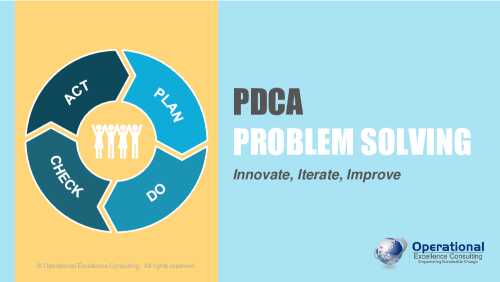
The PDCA cycle, also known as the Deming Cycle or the Shewhart cycle, is a four-step continuous improvement process that is widely used in quality management, business improvement, and project management.
The PDCA cycle is an iterative process, meaning that it is repeated continuously in order [read more]
Want to Achieve Excellence in Process Improvement?
Gain the knowledge and develop the expertise to become an expert in Process Improvement. Our frameworks are based on the thought leadership of leading consulting firms, academics, and recognized subject matter experts. Click here for full details.
Process Improvement involves analyzing and improving existing business processes in the pursuit of optimized performance. The goals are typically to continuously reduce costs, minimize errors, eliminate waste, improve productivity, and streamline activities.
As we continue to deal with COVID-19 and its economic aftermath, most organizations will prioritize Business Process Improvement initiatives. This is true for a few reasons. First, Process Improvement is one of the most common and effective ways of reducing costs. As the global economy slows down, Cost Management will jump to the forefront of most corporate agendas.
Secondly, a downturn typically unveils ineffective and broken business processes. Organizations that once seemed agile and focused during periods of growth may become sluggish and inefficient when demand drops off.
Lastly, COVID-19 has expedited Digital Transformation for most organizations. One of the quickest and most impactful forms of Digital Transformation is Robotic Process Automation (RPA). Thus, we have included numerous RPA frameworks within this Stream.
Value Stream Mapping (VSM) is a lean management technique used to analyze the flow of materials and information currently required to bring a product or service to a Customer. The goal of value stream mapping is to reduce the end-to-end lead time of a process by highlighting and eliminating [read more]
The 8D Problem Solving Process has become a standard in many industries as problem solving or improvement process, as internal Corrective Action Request (CAR) Process or as Supplier Corrective Action Request (SCAR) Process.
The 8D Problem Solving Process Training Module includes:
1. [read more]
The Gemba Walk Slide Deck is a comprehensive and professionally designed resource that equips leaders and teams with the tools and knowledge to drive meaningful improvements through effective Gemba Walks. Built around proven Lean principles, this slide deck guides you step-by-step from [read more]
Visual management is a powerful tool for conveying important information in a simple and easy-to-understand format. This practice involves displaying information in a visual format through various tools such as charts, graphs, diagrams, or photographs. By doing so, visual management reduces [read more]

 A core tenet of lean management is the elimination of
  Toyota is the originator of the lean philosophy through its renowned Toyota Production System (TPS). Its central principle of
  Amazon’s dominance is built on a relentless focus on customer value. In lean terms, this is known as
  Nike demonstrates how lean principles can create an
  In the high-stakes world of semiconductor manufacturing, precision and consistency are paramount. Intel applies lean principles to this complex environment through aggressive, data-driven