Editor's Note: Take a look at our featured best practice, Objectives and Key Results (OKR) (23-slide PowerPoint presentation). Successful organizations are using Objectives and Key Results (OKR) now. OKRs are efficient way to track company and team goals and measure their progress. It helps every organization's success by cutting out unimportant goals and focusing on what truly is important within the organization.
OKR [read more]
* * * *
Have you heard of Strategy Dynamics? Most people haven’t.
Strategy Dynamics is a framework to explain our current performance–and to develop and execute strategies for improving our future performance of our organization. This approach emphasizes building and sustaining the resources and capabilities necessary to succeed.
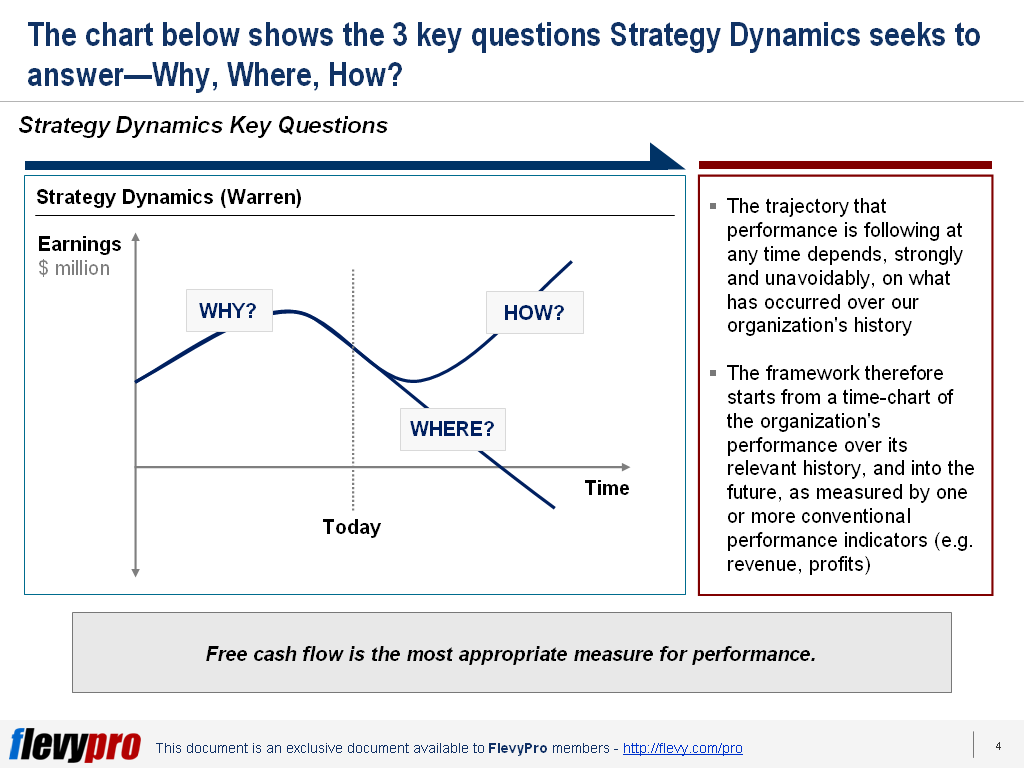
Strategy Dynamics focuses on performance over time. The overarching objective of strategic management is to develop a sustainable approach to quantitatively improve performance through time. This can apply to the enterprise as a whole, or for a key functional areas (e.g. Sales, Human Resources, Product Development, etc.).
Strategy Dynamics seeks to answer 3 key questions:
WHY is performance following its current path?
WHERE will performance go if we continue as we are doing today?
HOW can we design a robust strategy to radically improve that performance into the future?
The application of Strategy Dynamics is essentially universal. It can be used for every kind of enterprise, whether commercial, public-service, or voluntary, as well as to every corporate function within an organization. It is also applicable to not yet existing enterprises, such as new ventures or voluntary initiatives.
Strategy Dynamics also has numerous benefits:
The method works for every kind of enterprise—commercial, public-service, or voluntary—as well as to every function within an enterprise.
It is also applicable to not yet existing enterprises, such as new ventures or voluntary initiatives.
The method is strongly evidence-based and rigorous, offering a solid understanding of what causes current performance and confidence in the future performance.
Being evidence-based, it can solve differences of opinion amongst team-members. It also allows each individual, both amongst the management team and in the wider organization beyond, to see where their activity contributes to the whole, and on whom they depend.
Since it highlights exactly where management actions and decisions exert control, it provides clear and specific strategies and action plans, that can be adapted as the future unfolds.
The method provides a solid foundation for methods such as the Balanced Scorecard and Value Based Management, and is a means of integrating other established strategy frameworks and approaches, such as PEST(EL), Core Competence, and Value Chain Analysis.
Starting from the view of looking at how performance is changing over time, Strategy Dynamics works logically through 3 stages:
Stage 1: Resources
Identify the resources that performance depends on. Customers, cash, people, product catalog, and capacity are the most common examples of resources.
Stage 2: Flows
Identify the flows that cause these resources to “fill and drain.” The thinking behind this step explains why today’s performance and future performance are both unavoidably dependent on history.
Stage 3: Factors
Identify the factors that cause resources to be won and lost. The final question of causality we need to answer is what has been driving the “flow-rates” for each resource. For example, how quickly customers have been won, or how quickly staff were lost, etc. These flow-rates turn out to depend upon:
Management Decisions
External Factors
Existing Resource-levels
When the 3 steps are combined, the principles create an integrated diagram that depicts the “physics” of the system, known as the Strategic Architecture.
Interested in gaining more understanding on how to apply Strategy Dynamics? You can learn more and download an editable PowerPoint about Strategy Dynamics here on the Flevy documents marketplace.
There are clear and measurable differences that exist between organizations that use Key Performance Indicators (KPIs) to monitor and assess performance and those that use KPIs to guide and drive performance improvements. Data-driven and customer-oriented leaders use KPIs to transform their [read more]
Do You Want to Implement Business Best Practices?
You can download in-depth presentations on Performance Management and 100s of management topics from the FlevyPro Library. FlevyPro is trusted and utilized by 1000s of management consultants and corporate executives.
For even more best practices available on Flevy, have a look at our top 100 lists:
These best practices are of the same as those leveraged by top-tier management consulting firms, like McKinsey, BCG, Bain, and Accenture. Improve the growth and efficiency of your organization by utilizing these best practice frameworks, templates, and tools. Most were developed by seasoned executives and consultants with over 20+ years of experience.
Readers of This Article Are Interested in These Resources
Elevate your team's performance and strategy execution to new heights with the Performance Scorecard Framework, crafted by former strategy consultants from elite firms such as BCG and EY. This unique tool combines the strengths of the Balanced Scorecard with an exclusive proprietary [read more]
Organizations often face significant challenges in aligning their day-to-day operations with their long-term strategic goals. This issue of strategic misalignment is particularly detrimental to sectors like manufacturing, healthcare, and technology, where rapid decision-making and agility are [read more]
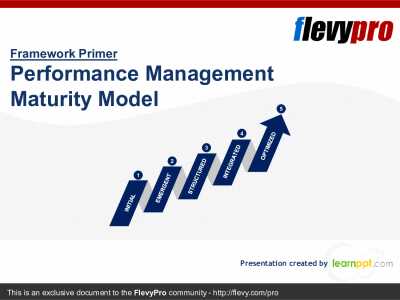
The organizational maturity notion signifies the progress of an organization in terms of developing its people, processes, technology, and capability by implementing quality practices. Organizations aiming to achieve the highest maturity levels in performance need to take care of the intricacies [read more]
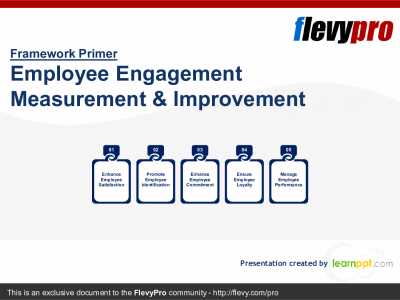
Employee Engagement has emerged as one of the significant pillars on which the Competitive Advantage, Productivity, and Growth of an organization rests. Measuring Employee Engagement is vital in shaping Employee Engagement Strategies that help propel the organization towards growth.
This [read more]