 Hospitality businesses carry a specific kind of vulnerability. One bad evening (a guest breaks a wrist on a wet pool deck, a kitchen fire makes the local news, a data breach exposes ten thousand loyalty accounts), and the recovery takes years. Not weeks. In 2026, the operating environment isn’t getting more forgiving: labor instability, tighter compliance expectations, guests who know their rights. This article maps the core risk categories and the mitigation mechanisms operators have available today.
Why Resort Properties Face Exposure Others Don’t
Hotels and resorts are unusual businesses. The public walks through them constantly, on premises the operator controls and is legally responsible for maintaining. A lobby floor. A pool deck. A parking structure at midnight. Every one of those surfaces is a liability that sits quietly — until it isn’t.
The McDonald’s coffee case (Liebeck v. McDonald’s, 1992) still gets cited in hospitality risk training. Fairly or not, it changed how service businesses approach standards of care. The lesson wasn’t about coffee temperature. It was about documentation, warning systems, and what happens when neither is adequate.
Resort markets compress this exposure further. Pool decks, spa facilities, valet operations — the amenities guests pay for — are precisely where claims concentrate. A Palm Springs personal injury attorney handling premises liability work sees this pattern consistently: properties invest in aesthetics, underinvest in documented safety protocols, and face disproportionate legal exposure when something goes wrong.
Four Categories. All of Them Matter.
Premises Liability
Slip-and-fall incidents. Pool injuries. Elevator malfunctions. These aren’t edge cases — they’re the routine content of hospitality liability dockets. The legal question is almost always the same: did the operator exercise reasonable care? Inspection records, maintenance logs, signage compliance — these determine the answer. Properties with documentation create defensible records. Properties without them hand plaintiffs’ counsel a ready-made case.
Employment Practices
High turnover, long shifts, tip pooling disputes, a manager who said something he shouldn’t have at a staff meeting. Hospitality generates employment litigation at a rate most industries don’t come close to. EPLI coverage is standard at this point — but insurance pays for the loss, it doesn’t prevent it. What actually reduces claim frequency is less glamorous: solid onboarding documentation, a complaint escalation process that staff actually use, and managers who’ve been trained on what not to say. None of that is complicated. It just requires follow-through.
Cyber and Data Risk
Think about what a reservation system actually holds. Credit card numbers. Passport scans for international bookings. Loyalty profiles going back years. Home addresses. The Marriott breach — disclosed in 2018, traced to the Starwood acquisition two years earlier — exposed data on hundreds of millions of guests. The regulatory settlement ran into nine figures. What made the case instructive wasn’t just the scale. It was how long the vulnerability sat undetected after the acquisition, and how inadequate the post-merger security review turned out to be. Tokenized payments, third-party penetration testing, multi-factor authentication on reservation systems — none of this is exotic technology in 2026. The operators who skip it tend to find out why they shouldn’t have in the worst possible circumstances.
Event-Driven and Reputational Risk
Route 91 Harvest. Las Vegas, October 2017. The deadliest mass shooting in U.S. history at the time, at an outdoor music festival adjacent to a major hotel strip. Whatever conclusions one draws about security policy, it forced hospitality operators — particularly those near entertainment venues or festival grounds — to ask uncomfortable questions about crowd management, emergency communication, and whether their existing protocols would hold up under scrutiny. A highway hotel outside Tulsa operates in a different risk universe than a resort two blocks from an amphitheater. That distinction belongs in the risk model, in the insurance stack, and in the security SOP.
Inspection Logs Won’t Save You. Systems Will.
Checklists get signed without being completed. Incident reports get filed without triggering follow-up. Training hours get logged without behavioral change. This isn’t a criticism — it’s a structural problem with compliance treated as paperwork.
Some mid-size operators now use QR-code inspection workflows where staff scan a location code and complete a structured checklist — every entry timestamped, every gap visible to management in real time. Not expensive technology. Just evidence that holds up in discovery.
Tiered incident response matters too. A fall with no injury gets a different protocol than a fall with a hospital visit. The first 72 hours after an incident determine what documentation exists when litigation arrives. Video footage, witness names, maintenance records from the prior week — these don’t get preserved automatically. Someone has to make that call, and there needs to be a written protocol specifying who.
External audits, conducted quarterly or twice a year, introduce an adversarial perspective internal teams simply can’t replicate. Familiarity is a liability. People working in a space every day stop noticing what a first-time guest notices immediately.
The Insurance Stack in Practice
Here’s the honest version of how hospitality insurance tends to work: operators buy a CGL policy, assume they’re covered, and find out at claim time how many gaps exist. The full stack for a mid-size property looks more like this:
- Commercial General Liability: Limits should reflect actual exposure. A resort with three pools and a swim-up bar carries different frequency assumptions than a boutique inn with a kettle and a parking lot.
- EPLI: Non-negotiable for operations with more than 15 employees. The question isn’t whether a claim will come — it’s when.
- Cyber Liability: Underwriters now require documented security controls before binding. The policy without the underlying controls is often unenforceable when a breach occurs. Worth re-reading that sentence.
- Liquor Liability: Dram shop laws vary by state. In several jurisdictions, serving a visibly intoxicated guest creates direct operator liability for whatever happens next, to whoever it happens to.
- Business Interruption: COVID-era litigation clarified, painfully, how many operators misread their policies. Communicable disease exclusions turned out to be very expensive language for those who assumed “all-risk” meant all risks. Reading the actual policy language before the loss is not optional.
Brokers who specialize in hospitality placements know where the gaps are. General commercial brokers frequently don’t — and the difference becomes visible when a claim is filed.
Compliance Is Not a Department
ADA Title III litigation against hotels and restaurants has been consistent for two decades. Physical accessibility gaps remain common, but increasingly, digital ones generate claims. Website accessibility under WCAG 2.1 standards is active litigation territory in 2026, and most operators haven’t addressed it with the same urgency applied to parking lot ramps.
Multi-state operators face additional complexity: compliance standards aren’t uniform across jurisdictions. California and Florida apply different premises liability frameworks. A single national compliance template doesn’t close that gap — it creates the appearance of having addressed it.
Annual compliance review by counsel with sector-specific experience is the mechanism that catches gaps before a regulatory inquiry or a lawsuit does it instead.
Documentation Is Defense
When a premises liability claim reaches litigation, the question is never just whether the injury occurred. It’s what the operator knew, when they knew it, and what was done about it. Inspection records, maintenance logs, incident reports — these are the materials from which defense is constructed.
The operators who lose winnable cases aren’t usually the ones with the most dangerous properties. They’re the ones with no records.
Do You Want to Implement Business Best Practices?
You can download in-depth presentations on Hotel Industry and 100s of management topics from the FlevyPro Library. FlevyPro is trusted and utilized by 1000s of management consultants and corporate executives.
For even more best practices available on Flevy, have a look at our top 100 lists:
These best practices are of the same as those leveraged by top-tier management consulting firms, like McKinsey, BCG, Bain, and Accenture. Improve the growth and efficiency of your organization by utilizing these best practice frameworks, templates, and tools. Most were developed by seasoned executives and consultants with over 20+ years of experience.
Readers of This Article Are Interested in These Resources
Excel workbook
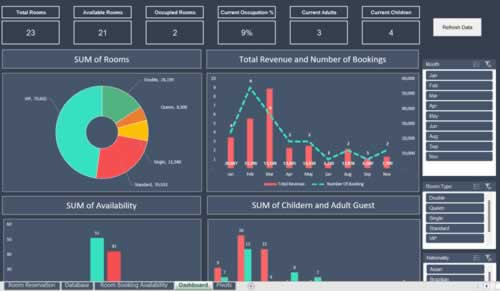
1) Sheet - Database:
In this sheet you can record all of your hotel standards and references database that will be automatically reflect in your data, calculations and drop-down lists
1. Starting the in the Database sheet, In Room Types Database list out all room types that you have in your hotel
[read more]

Excel workbook
This financial model is designed to evaluate the investment feasibility, operating performance, and return metrics of a hotel development project. This financial model provides a comprehensive 10-year projection of revenues, expenses, and cash flows, structured on a monthly basis with annual
[read more]
Excel workbook
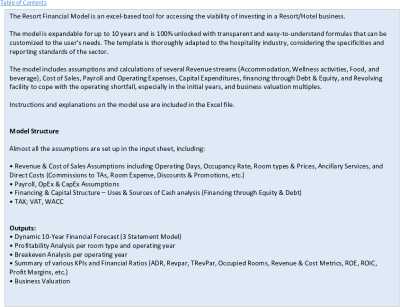
The Resort Financial Model is an excel-based tool for assessing the viability of investing in a Resort/Hotel business.
The model is expandable for up to 10 years and is 100% unlocked with transparent and easy-to-understand formulas that can be customized to the user's needs. The template is
[read more]

Excel workbook
Resort/Hotel Project Valuation- Construction and Operation Phase with NPV & IRR calculations
Hotel - Construction and Operations FM helps the user to assess the financial viability of constructing and operating a hotel by capturing all the essential inputs related to construction, operation, and
[read more]