Editor's Note: Take a look at our featured best practice, Six Building Blocks of Digital Transformation (35-slide PowerPoint presentation). Digital Transformation touches practically every function in the entire organization. This thus requires an unprecedented amount of coordination among people, process, and technologies throughout the organization, leading to a difficult Transformation program.
The Six Building Blocks of [read more]
* * * *
It’s a new year, meaning it’s time to make not just personal commitments to yourself but it’s also time to give your business what it needs. One goal you can set for your business to make it more productive and efficient is a completely touchless invoice processing system.
In order to make that happen and see benefits throughout your organization, you’ll need the right artificial intelligence and automation technology. Then, once you have those elements in place, your human team is left to make higher-level decisions, fueling a more innovative and effective business all around.
The following are some of the things to know about integrating touchless invoice processing solutions into your business this year.
What’s Meant by Touchless Invoice Processing?
Touchless invoice processing in simplest terms, means getting rid of paper invoices, but there’s more to it than that. It’s also about taking out elements of human error, so you don’t have to go through the process of figuring out why an invoice doesn’t match a contract or purchase order.
Touchless invoice processing eliminates the manual input requirements that are traditional in AP. No one in the AP department should have to do any manual input or work on an invoice.
The overarching benefit of a touchless invoice processing system is that you’re leaving room to improve other business processes, and you’re giving your employees the time they need to dedicate to other activities that are strategically more important. This allows your entire business to operate more competitively.
Any time your employees are spending time on repetitive administrative work, it can be considered time wasted.
The idea of touchless invoice processing varies from traditional means of processing in that steps tend to include scanning, verification of data, and exception management. There are several stages of manual processing that an invoice goes through before it’s paid by accounts payable.
With accounts payable automation, all invoices are digitized, routed, matched approved, and ultimately processed without any manual input and without a single piece of paper being passed around.
What Are the Benefits of Touchless Invoice Processing?
Some of the many benefits of moving to a touchless approach to invoice processing include:
You can improve your overall forecasting. When you have shorter lead times and automated processing, it allows you to more accurately project financials and cash flow.
There are fewer errors. Errors are expensive, and they take up valuable time to remedy. When you’re relying on more automation in your invoice processing strategy, then you’re reducing human errors. You’re then able to put more resources toward high-level activities instead of dedicating so much to the correcting of mistakes.
Automation, through the elimination of potential human error, allows for a more accurate analysis of pricing and cost. You can then make smarter supplier decisions with the use of this analysis.
It’s not uncommon to be able to gain cash discounts when you’re using an automated invoice processing system because you’re paying faster.
You’re saving significant amounts of money on the time it takes to process an invoice. You can then use that money for other goals. Saving money is probably going to be a top priority for most organizations in 2021, based on the challenges presented by 2020.
How Does Matching Work?
While it depends on the specific automation vendor you choose, typically, when you invest in an infrastructure for touchless invoice process, there’s a two or three-way match. Digitized invoice data is used, along with a PO and any other data.
Then, transactions are measured against criteria like Invoice Date, Vendor ID, and total.
Acceptable levels are set so that any variances can be matched up against them, and then if invoices do need further processing, they can be appropriately routed.
There’s also the provision of statistics and data regarding the process itself, so it can be refined and changed when needed.
If you haven’t yet invested in touchless invoice processing and the software required to make it happen, it should be at the top of your business priority lists for 2021. In doing so, you can save money and cut out expensive manual tasks.
Your finance team can be put to their best possible use by focusing on a true analysis of financials, rather than repetitive manual work that doesn’t create value or lead to innovation within your business.
You’re also creating visibility for every stakeholder for improved cash management, and compliance becomes simpler and more manageable. You can use the data you capture through these automated processes for important decision-making organization-wide.
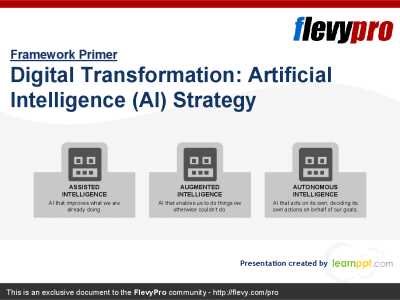
The rise of the machines is becoming an impending reality. The Artificial Intelligence (AI) revolution is here. Most businesses are aware of this and see the tremendous potential of AI.
This presentation defines AI and explains the 3 basic forms of AI:
1. Assisted Intelligence
2. [read more]
Do You Want to Implement Business Best Practices?
You can download in-depth presentations on RPA and 100s of management topics from the FlevyPro Library. FlevyPro is trusted and utilized by 1000s of management consultants and corporate executives.
For even more best practices available on Flevy, have a look at our top 100 lists:
These best practices are of the same as those leveraged by top-tier management consulting firms, like McKinsey, BCG, Bain, and Accenture. Improve the growth and efficiency of your organization by utilizing these best practice frameworks, templates, and tools. Most were developed by seasoned executives and consultants with over 20+ years of experience.
Readers of This Article Are Interested in These Resources
The Process Automation & Digitalization Assessment is a comprehensive framework designed to help organizations identify opportunities for streamlining operations, reducing manual efforts, and leveraging technology to drive efficiency and scalability. The assessment provides a structured approach to [read more]
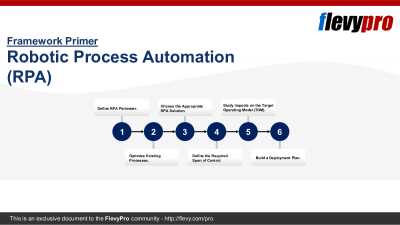
First, what is RPA?
Robotic Process Automation (RPA), also referred to as Robotic Transformation and Robotic Revolution, refers to the emerging form of process automation technology based on software robots and Artificial Intelligence (AI) workers.
In traditional automation, core activities [read more]
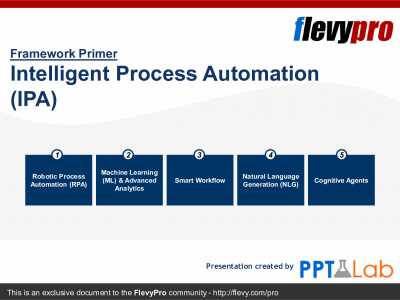
Intelligent Process Automation (IPA) is a set of emerging Digital Technologies that combine process redesign with Robotic Process Automation (RPA) and Machine Learning (ML). IPA can be viewed as a suite of Business Process Improvements and Digital Transformation tools that assists the [read more]
In the past several years, organizations across all industries have begun embracing emerging technologies to drive Digital Transformation programs. Of these technologies, among the most prevalent are Robotic Process Automation (RPA) and Artificial intelligence (AI).
Likewise, RPA and AI are [read more]
 It’s a new year, meaning it’s time to make not just personal commitments to yourself but it’s also time to give your business what it needs. One goal you can set for your business to make it more productive and efficient is a completely