Editor's Note: Take a look at our featured best practice, Agentic AI Primer (32-slide PowerPoint presentation). Agentic AI addresses a critical challenge in enterprise adoption: while most organizations achieve early success with individual models, few connect them into cohesive systems that transform business performance.
Traditional automation improves efficiency, yet it rarely redefines how decisions [read more]
* * * *
Generative AI (GenAI) is not just another shiny object in the tech stack. It is a force multiplier, but only for organizations that treat it as such. The early adopters are already seeing outsized gains. For the rest, GenAI remains stuck in “pilot agony,” where experimentation flourishes but value never materializes. What is missing is not tools or ambition. It is a coherent, grounded GenAI Strategy that cuts through the noise and focuses energy on outcomes that move the needle.
GenAI’s potential spans productivity, growth, and Cost Optimization. McKinsey projects a $2.6–4.4 trillion annual impact from GenAI across industries. FP&A, software development, Procurement, Marketing—all ripe for redesign. The average handle time in call centers is already down 14% with GenAI copilots. Marketing ROI is up. Yet for most organizations, these results remain aspirational because the Strategy Playbook Development is either nonexistent or riddled with buzzwords.
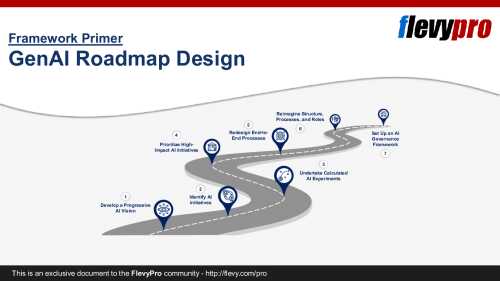
Here is the fix—a disciplined approach to GenAI rooted in 9 Strategic Initiatives. These are not vague aspirations. These are concrete levers that unlock scalable value. They help organizations exit the experimentation trap and build a foundation where GenAI becomes operational, measurable, and durable.
Let’s walk through the 9 Strategic moves that matter:
Determine GenAI Vision
Identify Use Cases
Reimagine Technology Function
Develop GenAI Capabilities Using the Right Model
Modernize Tech Stack
Build Data Architecture
Create GenAI Team
Upskill Talent
Manage Risk
Why Strategy is Hard
Most organizations rush into GenAI like it is a gold rush. Everyone is experimenting. Nobody is coordinating. This is how technical debt and fragmented tools multiply. A real GenAI Strategy enforces discipline—what to do, what not to do, and how fast to move. It aligns GenAI with enterprise Strategy, brand positioning, and operational levers. It forces executives to make hard choices on ambition versus caution, speed versus safety.
It also enforces prioritization. Not every process needs GenAI. Not every team is ready. Not every tool delivers. The smartest organizations prioritize based on ROI, feasibility, internal capability, and readiness.
Governance plays a big role too. Without clear executive ownership and cross-functional commitment, GenAI becomes a hobby, not a Business Transformation. A strong GenAI Strategy puts the right people in charge and holds them accountable.
Let’s discuss the first 3 strategic initiatives recommended in the framework, in detail.
Determine GenAI Vision
The foremost step is to decide whether GenAI is a core strategic accelerator or just a productivity enhancer. Sounds simple. But this choice shapes every downstream decision—tech stack, risk posture, investment level, Operating Model.
Leadership must define the GenAI ambition. Is the organization a Taker, Maker, or Shaper? Takers use enterprise-ready tools. Makers customize open-source models. Shapers co-develop models and capabilities with vendors. All 3 paths are valid—but only if they align with data sensitivity, compliance, and talent maturity.
The GenAI Vision must also come with guardrails: policy, governance, and communication. Employees need to understand what is allowed, where GenAI adds value, and how it impacts their roles. This clarity sets the tone. It builds trust and creates the structure needed for fast yet responsible scaling.
Identify Use Cases
Identifying the right use cases is the single most important decision in the GenAI journey. Poorly chosen pilots drain resources and erode credibility. High-value use cases, on the other hand, generate momentum and financial upside.
Start with workflows tied to revenue, cost, risk, or speed. Customer support. Procurement. Code generation. Marketing personalization. Legal contract analysis.
The best use cases are those supported by clean, accessible data and staffed with people who can drive execution. They also come with measurable outcomes: hours saved, throughput increased, margin improved.
Reimagine Technology Function
Legacy tech functions often become hurdles in the GenAI race. Traditional SDLC models do not scale. Waterfall deployments and siloed engineering break under the demands of continuous model updates, prompt iteration, and rapid experimentation.
CIOs and CTOs must shift to AI-native delivery models. That means cross-functional teams staffed with GenAI product managers, prompt engineers, model stewards, and DevSecOps professionals. It means embedding security, auditing, and governance into architecture.
Think of the technology function as a GenAI product shop. One that continuously ships, tests, and improves. One that automates the mundane so developers and analysts can focus on design, quality, and context. One that owns the GenAI platform, end to end.
Case Study
Imagine a financial services organization. Heavy compliance, tons of manual work, and legacy systems everywhere. Yet they saw the potential of GenAI to cut through inefficiencies.
They started with a vision—GenAI as a margin expansion tool, not just a productivity toy. They prioritized 3 use cases: call center automation, client onboarding, and compliance document review. All had measurable impact, high friction, and strong data pipelines.
They modernized their stack using a Taker approach—enterprise-grade APIs and managed services for speed. The GenAI team was centralized, cross-functional, and empowered. Risk management was embedded in every layer—from prompt logging to data classification to model drift detection.
Within a year, call center volume dropped by 20 percent, onboarding time halved, and compliance reviews accelerated by 40 percent. It was not a lab project or a prototype, but a real operating Transformation.
FAQs
What is the first thing a CIO should do to start a GenAI Strategy?
Define the GenAI vision. Decide how aggressively to move, what role GenAI plays in the operating model, and what risks are acceptable.
How should organizations choose between open-source and managed GenAI models?
It depends on data sensitivity, control requirements, engineering maturity, and speed to value. Highly regulated organizations may favor open source; others may start with enterprise services.
Is it necessary to create a centralized GenAI team?
Yes. Without centralized ownership, GenAI tools and models will fragment. A centralized team enforces standards, accelerates reuse, and ensures responsible deployment.
How do you identify strong GenAI use cases?
Look for high-volume workflows tied to value levers like revenue growth, Cost Reduction, and Risk Management. Validate feasibility, data availability, and potential ROI.
What is the role of talent in scaling GenAI?
Massive. Hiring alone won’t cut it. Organizations must build tiered training programs, embed GenAI into workflows, and ensure every role—from frontline to Leadership—understands how to use it.
Concluding Thoughts
The organizations that win with GenAI will not be the ones with the most experiments. They will be the ones with the most coherence. Coherence between ambition and architecture. Between tools and talent. Between risk and reward.
Many leaders still treat GenAI like a software upgrade: bolt it on, automate a few workflows, call it a day. But this is not like adding a CRM module. It is a shift in how work gets done. It rewires organization charts. It changes what gets measured. It affects culture.
The real test is whether GenAI becomes operationally embedded. That means repeatable outcomes, auditable impact, platform ownership, and Continuous Improvement. If it is still sitting in a pilot environment 6 months from now, it is not a Strategy. It is a science fair.
Ask yourself: what is your GenAI ambition? Where is the first dollar of value? Who owns the roadmap? If the answers are not crystal clear, it is time to reboot the conversation.
You can download in-depth presentations on this and hundreds of similar business frameworks from the FlevyPro Library. FlevyPro is trusted and utilized by 1000s of management consultants and corporate executives.
For even more best practices available on Flevy, have a look at our top 100 lists:
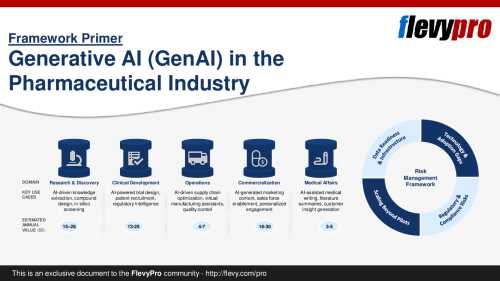
Pharmaceutical companies recognize the immense potential of Generative AI (GenAI) to accelerate drug discovery, improve clinical trials, and optimize commercial operations. Yet, capturing real value requires moving beyond hype to structured implementation strategies.
The McKinsey Global [read more]
Readers of This Article Are Interested in These Resources
Organizations worldwide are embracing GenAI for its ability to generate actionable insights, predict outcomes, personalize at scale, and process natural language with human-like fluency.
Leading organizations already deploy GenAI in AI-assisted software development, workflow automation, [read more]
GenAI use is rising globally. Many organizations set GenAI strategies and launch pilots across functions. Yet most stall at the proof-of-concept stage and never show measurable financial or operational results.
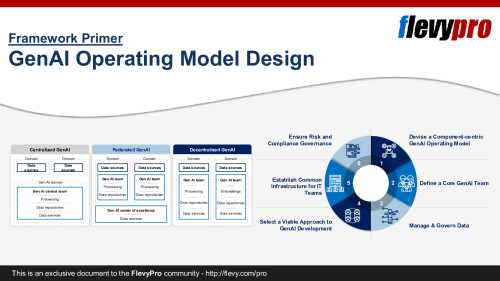
This PPT presentation outlines the missing piece: an effective GenAI Operating [read more]
Generative Artificial Intelligence (GenAI) refers to foundation models that create new content, code, analyses, and decisions based on large-scale training data. Unlike traditional automation and analytics, GenAI operates as a reasoning and production layer embedded directly into daily [read more]
Curated by McKinsey-trained Executives
The GenAI Playbook -- The Ultimate 800+ Slide Powerhouse for Building, Scaling & Monetizing Generative AI in the Enterprise
If your organization is serious about winning in the age of Generative AI, The GenAI Playbook is the definitive resource you [read more]
 Generative AI (GenAI) is not just another shiny object in the tech stack. It is a force multiplier, but only for organizations that treat it as such. The early adopters are already seeing outsized gains. For the rest, GenAI remains stuck in “pilot agony,” where experimentation flourishes but value never materializes. What is missing is not tools or ambition. It is a coherent, grounded GenAI Strategy that cuts through the noise and focuses energy on outcomes that move the needle.