Editor's Note: Take a look at our featured best practice, Developing Consulting Project Proposals (22-slide PowerPoint presentation). This document acts as high-level training guide on developing consulting project proposals. It covers the basics of consulting proposal development. Topics include the following:
Structuring our Value Proposition
Types of Proposals
RFP Response / Proposal
Non-RFP Proposals
This deck [read more]
* * * *
Artificial Intelligence (AI) adoption is accelerating at a breakneck pace. Generative AI has shifted from curiosity to boardroom mandate in less than two years. Executives now rank AI among their top strategic priorities, and in many organizations, it sits at the very top of the agenda. Yet despite this surge in interest and investment, a stubborn gap persists between pilot enthusiasm and scaled impact. AI initiatives often work in controlled tests, then stall before they reshape operations or deliver measurable revenue growth or Cost Reduction.
The AI Deployment Acceleration Levers framework addresses this execution gap. It focuses not on algorithms, but on the operating levers that convert AI ambition into organization wide results. The premise is straightforward. Technology access alone does not create value. Value emerges when leaders mobilize employees, orchestrate disciplined rollout steps, and build the right ecosystem partnerships to sustain momentum. This is less about tools and more about operating model design.
Consider the current rise of Agentic AI. Organizations are experimenting with AI agents that autonomously handle workflows in software development, procurement, and customer service. Early pilots show promise. Code is generated faster. Service tickets are triaged automatically. Procurement analytics surface supplier risks in real time. Yet many of these initiatives remain isolated experiments. Without Employee Engagement, clear rollout playbooks, and ecosystem partnerships, agentic AI becomes another shiny object. The framework provides a structured consulting template to ensure such innovations scale beyond test environments into core operations.
Recent executive surveys underscore the urgency. AI adoption has expanded rapidly across domains such as software development, customer service, and marketing. A majority of organizations now treat AI as a top three strategic priority, and satisfaction with outcomes is improving. Yet only a minority report measurable financial gains at scale. Data security remains the leading barrier. Internal capability gaps persist. Many leaders admit their pilots succeeded technically but failed to scale operationally.
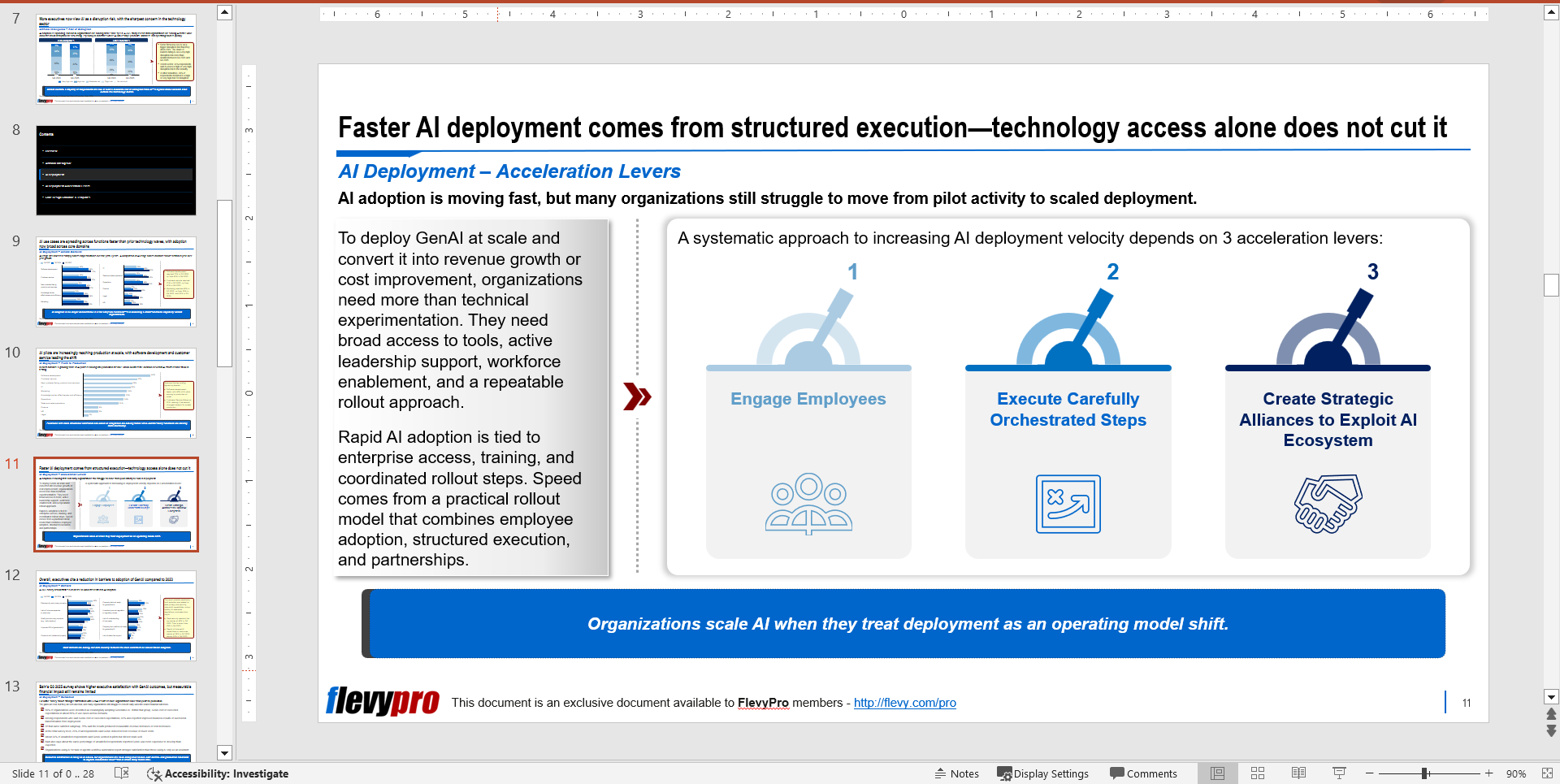
The framework organizes AI acceleration into 3 primary levers:
Engage Employees
Execute Carefully Orchestrated Steps
Create Strategic Alliances to Exploit the AI Ecosystem
Each lever addresses a distinct bottleneck in the journey from experimentation to scaled deployment.
Why This Framework Matters
Executives often underestimate the human and operational friction embedded in AI rollouts. Leadership teams approve budgets, launch pilots, and assume momentum will carry forward. It rarely does. Employees revert to familiar workflows. Governance concerns slow expansion. Costs creep upward. The framework forces discipline. It treats AI deployment as a structured change program rather than a series of disconnected experiments.
Organizations also struggle with diffusion. Early adopters experiment enthusiastically while the broader workforce watches from the sidelines. This creates pockets of excellence instead of enterprise transformation. The framework pushes leaders to design for broad adoption from day one. Engagement is not an afterthought. It is the first lever for a reason.
Security and governance concerns can quietly suffocate progress. Data privacy remains the most cited adoption barrier. Without clear usage standards, executive buy in erodes quickly. The second lever embeds governance and communication into the rollout model. Leaders define success metrics, establish codes of conduct, and align deployment with measurable targets. That rigor converts enthusiasm into accountability.
External pace compounds internal challenges. AI capabilities evolve monthly. No organization can build everything alone. The third lever recognizes that alliances are not optional. Ecosystem partnerships provide access to emerging models, integration expertise, and responsible AI safeguards. Organizations that isolate themselves fall behind the curve. Those that cultivate structured alliances move faster and reduce execution risk.
Let’s dig deeper into the first two levers of the framework.
Engage Employees
AI adoption begins at the front line. It scales fastest when it solves daily pain points. Leaders should start with high value enterprise tools tied to repetitive, labor-intensive tasks. Automating data analysis, complex spreadsheet calculations, or ticket triage delivers immediate time savings. When employees see tangible relief in their workflows, usage grows organically.
Design matters. Pilots must be embedded into core workflows, not layered awkwardly on top. High frequency pain points offer the best launchpad. Early wins should be visible and celebrated. Recognition builds momentum. Train the trainer models accelerate skill diffusion. Power users become internal champions who expand capability faster than centralized teams ever could.
Upskilling cannot be episodic. Continuous capability building signals that AI is part of the long-term Strategy, not a passing experiment. Encourage customization. Invite teams to propose new use cases. When employees shape the tools they use, adoption sticks.
Execute Carefully Orchestrated Steps
Many organizations run pilots without predefined success metrics. They celebrate anecdotal wins and then debate endlessly about scaling. Discipline eliminates ambiguity.
Leaders should define clear targets before pilots begin: Adoption rates, productivity gains, cycle time reductions, or cost impact. These metrics determine which initiatives graduate to enterprise rollout. Successful pilots are converted into structured playbooks that outline approvals, communication plans, governance guardrails, and staged deployment steps.
Communication must be consistent and explicit. Employees need clarity on deadlines, usage expectations, and security policies. Establish a central access point for AI tools to avoid fragmentation. Assign local champions who translate strategy into practical guidance. Pair rollout with training and controlled experimentation.
Case Study
A global financial services organization sought to deploy Generative AI across risk analysis and customer operations. Early pilots in fraud detection showed promising accuracy improvements. Yet scaling stalled due to compliance concerns and uneven adoption.
Leadership applied the 3 levers. They launched targeted engagement initiatives focused on automating repetitive compliance documentation tasks. Immediate time savings built grassroots support. Train the trainer programs expanded AI literacy across regional offices.
Next came disciplined rollout. Success metrics were defined. Fraud detection cycle time, error reduction rates, and cost per case were tracked rigorously. A formal playbook outlined approval workflows, model validation processes, and data security standards. AI champions were appointed in each business unit.
Strategic alliances completed the model. The organization partnered with specialized AI vendors to enhance model monitoring and integrate advanced security features. These alliances reduced technical friction and reassured regulators.
Within a year, AI solutions moved from isolated pilots to scaled deployment across multiple risk and operations functions. Measurable cost reductions emerged. Employee satisfaction improved. The difference was not the algorithm. It was execution discipline anchored in the framework.
FAQs
How can an organization ensure AI pilots do not stall at the testing phase?
Define measurable success criteria before launch. Convert successful pilots into structured rollout playbooks with clear governance and communication protocols.
Why is employee engagement prioritized as the first lever?
Adoption spreads when AI solves real daily problems. Early visible value creates pull from the workforce rather than push from leadership.
What role do ecosystem partnerships play in AI Strategy?
Partnerships provide access to evolving capabilities, integration support, and responsible AI safeguards. They shorten deployment cycles and reduce execution risk.
How should leaders address data security concerns?
Establish explicit usage standards and a formal AI code of conduct. Centralize tool access and align governance with regulatory expectations.
Is financial impact guaranteed once AI scales?
No. Financial outcomes depend on disciplined rollout, cost control, and alignment with core workflows. Scaling without structure often inflates costs.
Closing Reflections
AI acceleration is not about moving faster for its own sake. Speed without structure amplifies waste. The real differentiator lies in coherence. Engagement, execution discipline, and alliances must reinforce each other. Treating them as isolated initiatives fragments momentum.
Leaders should ask themselves a blunt question. Are we experimenting with AI, or are we redesigning how our organization works. The framework demands the latter. It reframes AI from a technology project into an operating model shift.
Organizations that internalize this mindset build a repeatable deployment engine. They create a culture where experimentation aligns with governance, and where partnerships extend internal capability. That is how AI interest becomes sustained impact.
You can download in-depth presentations on this and hundreds of similar business frameworks from the FlevyPro Library. FlevyPro is trusted and utilized by 1000s of management consultants and corporate executives.
For even more best practices available on Flevy, have a look at our top 100 lists:
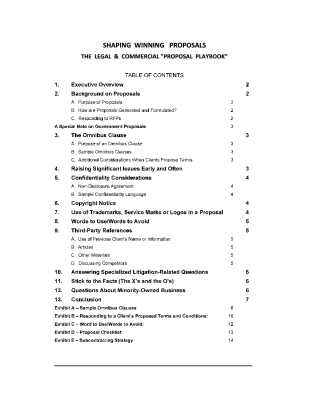
As we all know, developing effective, convincing and competitive client proposals is crucial to our firm's ability to sell our services to our clients. Since our clients will often rely upon the content of these proposals in making their decisions as to whether they should hire XYZ, these documents [read more]
Readers of This Article Are Interested in These Resources
This Sample is a consulting job arrangement letter template used by a global consulting firm.
It contains:
- Business Consulting Job Arrangement Letter
A ABC Job Arrangement Letter is to be used on all ABC engagements worldwide. This specific form of Job Arrangement Letter is to be used in [read more]
Pricing is key to profits for consultants and wider providers of professional services. Often consultants don't get this right or don't know where to start with pricing. This template offers a powerful and simple pricing model for consultants, supporting the effective pricing of custom consulting [read more]
This presentation provides a good understanding of how to win new consulting business. It discusses five key elements of winning proposals and provides a tool immediately to develop proposals by using a new approach. The five key elements are relationships, message, issue, team and interaction. [read more]
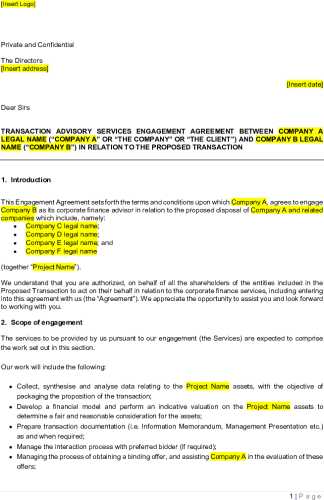
The engagement letter outlines the scope of work to be carried out and the respective responsibilities of the consultant and the client respectively under the engagement.
This template is a consulting/advisory job engagement letter template in line with the standards of a global consulting [read more]