 A full rewrite sits in the back of every engineering leader’s mind like an unpaid debt. The codebase is 15 years old. The original architects left years ago. Nobody wants to touch the payment module. And somewhere in a board deck, someone has written “technical debt” next to a red arrow.
But here’s the thing about legacy modernization:often, it is not an engineering decision. It is a bet. You are betting that a new system, built by a team that doesn’t yet understand the business rules embedded in the old one, will be ready before the market moves or the budget runs out. The Standish Group found that large IT projects run over budget by an average of 45% and deliver 56% less value than originally projected. The bigger the project, the worse those numbers get.
Learn how you can modernize your legacy software and get faster ROI with Altamira legacy modernization team.
Why Rewrites Fail to Deliver Fast Enough
Netscape rewrote its browser from scratch in 2000. It took three years, cost the company its market position, and produced a product that, by launch, was already behind. That is an extreme case, but the pattern repeats at smaller scale across enterprise software projects every quarter.
The numbers are not kind to rewrites. According to a McKinsey and Oxford University study of 5,400 large IT projects, 17% of projects went so badly they threatened the company’s existence. Cost overruns averaged 66%. Schedule overruns averaged 33%. Most of those projects were full replacements of existing systems.
What makes rewrites slow is not technical complexity alone. It is the discovery process. Legacy systems contain 20 years of business logic, edge cases, and regulatory workarounds that nobody documented because the people who built them didn’t expect to leave. When you rewrite, you spend the first 12 months reverse-engineering what you should have modernized.
Where Modernization Creates Earlier ROI
Maintenance Cost Reduction
The most immediate financial return from modernization comes from cutting the cost of keeping the lights on.
A typical enterprise running a 10-to-15-year-old Java monolith spends between 60% and 75% of its engineering budget on maintenance: patches, dependency updates, incident response, and workarounds for known architectural limitations. Gartner estimates that 80 cents of every IT dollar goes to maintaining existing systems rather than building new ones.
One financial services firm Altamira worked with reduced their mean time to resolve production incidents from 4.2 hours to 47 minutes after extracting their authentication and session management into a standalone service. They extracted, replaced, and moved on.
Faster Release Cycles
The second place modernization pays back early is in deployment frequency.
DORA research (the DevOps Research and Assessment program, which has tracked engineering performance since 2014) shows that elite-performing teams deploy 973 times more frequently than low performers and restore service 6,570 times faster. The gap is not talent. It is architecture.
Modernizing toward loosely coupled components, even within a monolith, before moving to microservices, reduces the blast radius of any change. Teams start deploying weekly instead of quarterly. That means 12 releases per year instead of four, which means 12 opportunities to respond to what the market is doing.
Which Systems Are Best Suited for Modernization
Not every legacy system is a good modernization candidate. Some genuinely need to be replaced. The question is how to tell the difference.
Systems that modernize well tend to share certain characteristics:
- Clear domain boundaries exist, even if the code doesn’t reflect them. If you can draw a diagram of what the system does and identify where one concern ends and another begins, you can extract and replace those concerns incrementally.
- The core business logic is stable. The rules haven’t changed much in five years. The system isn’t wrong; it’s just old. That logic is an asset, not a liability.
- The system has known, addressable performance bottlenecks. Slow is not the same as broken. If you can identify the three database queries that cause 80% of latency, you can fix those without touching the rest.
- There is existing test coverage, even partial. Even 30% unit test coverage gives you a safety net for changes.
How Altamira Evaluates Modernization Opportunities
Technical Audit
Before recommending a direction, Altamira runs a structured technical audit of the existing system. This is not a code review. It is a business risk assessment expressed in technical terms.
The audit covers: dependency exposure (which libraries are unsupported, and what is the CVE burden), coupling analysis (which modules are most entangled, and what does a change in one cost in testing elsewhere), performance profiling under realistic load, and deployment pipeline analysis to understand how long it takes to get a change from a developer’s machine into production.
The output is not a list of things that are wrong. It is a ranked map of where modernization effort produces the largest reduction in cost or risk per unit of engineering time.
Business Priority Mapping
After the audit, we map each technical finding to the business processes it affects.
A slow authentication service is not just a performance problem. It affects conversion rates on every page that requires a login. A fragile billing module is not just a technical risk. It is a compliance risk and a revenue recovery risk. When you connect those findings to dollar figures, the prioritization decisions become clear and defensible to non-technical stakeholders.
A Practical ROI Checklist for Decision-Makers
Before committing to either path, work through these questions:
- What percentage of engineering time currently goes to maintenance versus new development? If it’s above 60%, modernization likely pays back within 12 months.
- How many production incidents per quarter are caused by the legacy system? What is the average cost per incident in engineering hours and revenue impact?
- What is the current deployment frequency? What would it be worth, in time-to-market terms, to double or triple it?
- Can you identify the three to five modules responsible for the highest volume of bugs or change requests? Those are your first modernization targets.
- Does the system have documented business rules? If not, how confident are you that a rewrite team would discover all of them before go-live?
- What is the realistic rewrite timeline, and what is the business cost of the existing system running for that entire period?
- Is there an external deadline: regulatory, vendor, contractual that constrains the timeline? Rewrites rarely respect deadlines.
ROI Comparison: Modernization vs. Full Rewrite
| Factor |
Modernization |
Full Rewrite |
| Time to first business value |
3–6 months |
18–36 months |
| Budget risk |
Low–Medium (incremental) |
High (all-or-nothing) |
| Business continuity during transition |
High |
Low |
| Risk of lost business logic |
Low |
High |
| Typical maintenance cost reduction (Year 1) |
30–40% |
0% (parallel systems) |
| Deployment frequency improvement |
Visible within 6 months |
Post-launch only |
| Team knowledge retention |
High |
Medium–Low |
Conclusion
The choice between modernization and rewrite is not a technical question dressed up as a business one. It is a business question that requires technical input to answer well.
Full rewrites are appropriate in specific circumstances, when the existing system’s data model is fundamentally broken, when the technology stack has no viable migration path, or when the business logic itself is wrong and no longer reflects how the business actually works. Those cases exist.
But most legacy systems are just slow, expensive to change, and increasingly fragile at the edges. Those are problems modernization solves faster, at lower risk, and with returns that show up in the current fiscal year rather than the next one.
170-slide PowerPoint presentation
This presentation is a collection of PowerPoint diagrams and templates used to convey 30 different IT-related frameworks, models, standards and methodologies. The list is compiled based on recent trends in agile methodologies, cybersecurity, project management, and risk management, reflecting their
[read more]
Do You Want to Implement Business Best Practices?
You can download in-depth presentations on Information Technology and 100s of management topics from the FlevyPro Library. FlevyPro is trusted and utilized by 1000s of management consultants and corporate executives.
For even more best practices available on Flevy, have a look at our top 100 lists:
These best practices are of the same as those leveraged by top-tier management consulting firms, like McKinsey, BCG, Bain, and Accenture. Improve the growth and efficiency of your organization by utilizing these best practice frameworks, templates, and tools. Most were developed by seasoned executives and consultants with over 20+ years of experience.
Readers of This Article Are Interested in These Resources
23-slide PowerPoint presentation
All organisations have to have a framework to maintain, adapt and grow their IT applications, software and hardware alike, they have to manage vendors and they have to create scale-able platforms.Without a governance framework these efforts can not be orchestrated in a methodical way. This
[read more]
129-slide PowerPoint presentation
This document is a 129-slide PowerPoint presentation that provides an overview of IT Service Management based on the ITIL V3 Best Practice Framework, and is inclusive of the 2011 updates
The whole of the Service Lifecycle (Service Strategy, Service Design, Service Transition, Service
[read more]
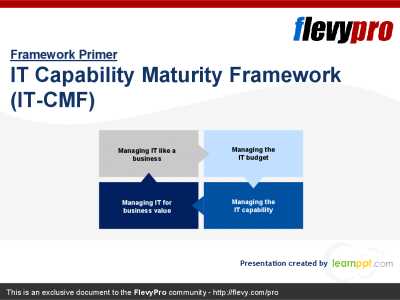
21-slide PowerPoint presentation
An integrated framework for evaluating IT from both an IT as well as a business perspective is a necessity for CIOs and other technology leadership. This presentation focuses on the IT Capability Maturity Framework (IT-CMF) developed by the Innovation Value Institute (IVI), geared towards
[read more]
Excel workbook
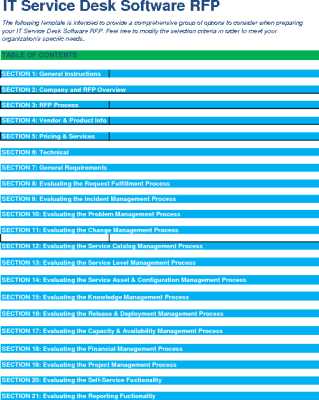
This Excel document is a template intended to provide a comprehensive group of options to consider when preparing an RFP for IT Service Desk software. It is highly customisable. Questions can be added, removed, or modified, as can entire workbooks.
The template can of course be used as an RFP
[read more]