Editor's Note: Take a look at our featured best practice, Supply Chain Resilience (23-slide PowerPoint presentation). Supply Chain "resilience" is the Supply Chain's ability to respond and recover quickly to potential disruptions. It can return to its original situation or grow by moving to a new, more desirable state in order to increase customer service, market share, and financial performance.
Resilience is [read more]
* * * *
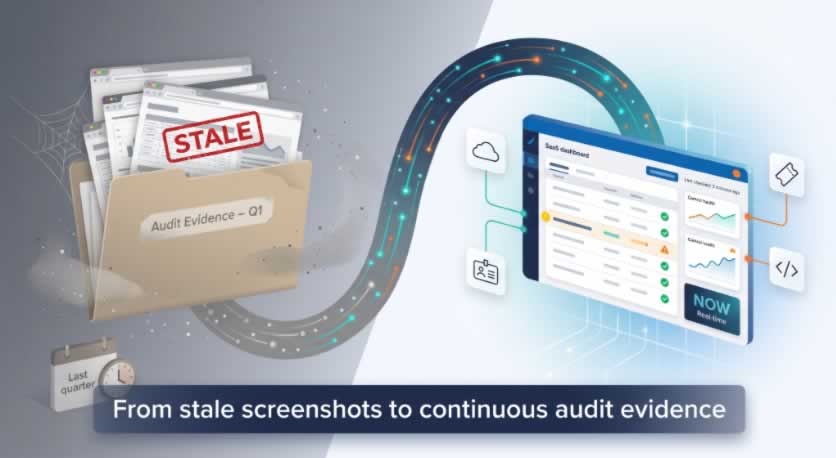
Governance, risk, and compliance software—“GRC” for short—keeps the wheels on the enterprise bus. It tracks policies, tests controls, and proves to regulators that your house is in order. Yet most teams still walk into audit season clutching screenshots from months ago. Those stale artifacts erode trust and trigger last-minute fire drills.
The market is steering in a different direction. Modern, API-driven platforms plug straight into your cloud accounts, ticket queues, and identity stores. They capture evidence as work happens, so audits become a by-product of daily operations—not a retroactive panic. Companies that automate compliance cut audit prep time by as much as 75 percent.
That shift matters because regulators now expect time-stamped proof on demand. When a control fails today, you can’t wait a quarter to discover it. You need real-time visibility and an unbroken chain of custody for every log, policy, and approval.
Choosing the right platform is tricky. Legacy suites offer breadth but require armies to run them, while newer SaaS tools bring speed and automation yet may lack deep financial controls. In this guide, we cut the noise to show you what works.
We scored each contender on five factors that move the needle—automated evidence collection, framework coverage, integrations, usability, and cost—then ranked them one through eleven.
As you read, we’ll call out where each tool shines, where it falls short, and how it fits into a live control environment. For a quick snapshot of how market front-runners compare on automation depth, integration breadth, and emerging AI features, check out this GRC software guide.
Ready to retire the dusty screenshot folder? Let’s explore the platforms that keep evidence fresh, audits painless, and your risk posture clear.
How We Ranked the Platforms
Transparency matters. You deserve to know why one tool edges out another, so we built a scoring sheet before we visited a single vendor site.
We started with the problem you raised most: stale evidence that drags audits into overtime. That challenge carries the heaviest weight. If a platform cannot auto-collect control data straight from source systems, it drops down the list, plain and simple.
From there we layered on six more factors that shape day-to-day success:
Framework coverage (20 percent). A broader regulation library means less time remapping the same control.
Integration ecosystem (15 percent). Every native connector replaces a custom script.
Ease of use (10 percent). A friendly interface and quick setup keep projects on budget.
Pricing and value (10 percent). Quote-only is fine, but price must match feature depth.
User satisfaction (10 percent). Fresh G2 and Gartner Peer Insights scores ground our view in real-world feedback.
Analyst and market presence (5 percent). Recognition from Gartner, Forrester, or broad Fortune 500 adoption signals staying power.
Each vendor received a weighted score out of 100. The math drives the ranking you will see next, not gut feel or sponsorship money. If two tools tied, we gave the edge to the one with stronger evidence automation because that delivers the fastest return when your next audit starts.
The Shortlist: Best GRC Software
Vanta: continuous evidence on autopilot
Vanta leads this list because it is built for one job: keep your evidence current without a monthly scramble.
At the core is automated evidence collection. Vanta connects directly to 400+ cloud, identity, HR, device management, and developer tools, then runs hourly automated tests to pull live configuration and activity data into a time-stamped evidence trail. Instead of handing an auditor a screenshot from “sometime last quarter,” you can share the control itself, with current status and supporting evidence.
Framework coverage is broad enough to scale beyond a single audit. Vanta supports 35+ frameworks, including SOC 2, ISO 27001, HIPAA, PCI DSS, GDPR, CMMC 2.0, and additional enterprise and public-sector standards such as NIST 800-53 and FedRAMP. Controls can be mapped once and reused across multiple frameworks, which helps when a second (or third) certification comes up mid-year.
Where Vanta pulls away from legacy GRC suites is automation depth. In addition to 1,400+ automated tests that can reduce manual evidence collection by up to 90 percent, Vanta layers on AI and workflow acceleration:
AI Agent and AI-assisted remediation to help teams move from “failed test” to “fixed” faster
Smart Policy Builder to generate and maintain policy documentation with less manual drafting
QAuto to reduce the time spent answering security questionnaires
Vendor risk management (VRM), including shadow IT discovery, to bring third-party risk into the same system of record
For customer-facing trust, Vanta also includes a Trust Center, with 6,000+ live public trust centers and an AI chatbot that helps external stakeholders self-serve common compliance questions.
Implementation and pricing: Most mid-market teams can get value in days to weeks, while larger, multi-framework enterprise rollouts often land in the 4 to 8 week range. Pricing is subscription-based and scales with headcount and framework count. Smaller companies typically start in the low five figures annually, with enterprise programs scaling up from there.
Limitations to know upfront: Vanta supports SOX-related needs, but SOX financial-reporting controls are still maturing compared to purpose-built SOX platforms. It is also not designed to replace deep, suite-style enterprise GRC programs that require extensive operational risk, ESG, or highly customized internal audit workpaper management.
Best for: Security and compliance teams that want continuous audit readiness with minimal manual evidence work, especially in organizations growing from one framework into many. Vanta is also widely adopted, with credibility signals that include 10,000+ companies, #1 on G2 for Security Compliance (2,000+ reviews), and recognition as a Leader in the IDC MarketScape 2025 for Worldwide GRC Software.
Recent product momentum is another indicator of fit for teams that need platforms to keep pace with new requirements. Vanta shipped 259 product launches in 2024, including expanded AI capabilities and support for emerging areas such as ISO 42001 (AI governance).
Optro: the auditor’s powerhouse for SOX and beyond
Optro, formerly known as AuditBoard, is built for teams who live in SOX. It started as SOXHUB, and that DNA still shows in how the product handles walkthroughs, testing, review notes, and the never-ending PBC cycle.
Where it shines is workflow discipline. Risks, controls, and tests sit in one place, with clear ownership, due dates, reminders, and sign-offs that look and feel like modernized workpapers. For internal audit leaders, that structure matters because it standardizes execution across teams and makes it easier to spot overdue testing before external auditors do.
On evidence collection, Optro is moving in the right direction, but it is not “always-on” automation. With CrossComply, you can connect common systems such as AWS, Okta, Jira, and Azure AD to streamline parts of evidence gathering. In practice, evidence freshness is typically driven by scheduled pulls plus manual uploads for many control types, rather than hourly testing across your stack.
Framework coverage is strong where many enterprises feel the most pain: SOX (with deep financial-controls and COSO-aligned workflows), plus support for programs that often sit adjacent to finance and audit such as SOC 1, SOC 2, ISO 27001, NIST CSF, PCI DSS, HIPAA, CMMC, and FedRAMP. The platform has also expanded into a broader, module-based suite, with offerings that can include OpsAudit, RiskOversight, ITRM, ESG, and CrossComply depending on your scope.
What to expect on rollout and cost: Optro can be quick to adopt for a contained program, but migrations are the reality check. If you are moving thousands of legacy controls and historical evidence into a new system, implementation commonly stretches into months. Pricing is modular and quote-based, and total cost rises as you add modules. For large enterprises running multiple modules, contracts are commonly six figures.
Where Optro fits best
Public companies or large enterprises with meaningful SOX 404 scope and a dedicated internal audit function
Teams that want auditor-friendly structure, dashboards, and accountability more than continuous technical control monitoring
Limitations to factor in
Evidence automation is more periodic than real-time, especially compared to platforms built around hourly testing
Costs can climb quickly with module expansion, and implementations can become long projects for large libraries
The experience is optimized for audit and compliance users, which can be less intuitive for engineering-heavy workflows
A final signal on market momentum: Optro was acquired by Hg and ICG in 2024 for approximately $3B, which suggests continued investment as it pushes beyond SOX into broader GRC coverage.
ServiceNow GRC: risk meets IT operations on one workflow engine
ServiceNow GRC, often packaged under Integrated Risk Management (IRM), makes the most sense when your enterprise already runs on the Now Platform. Its differentiator is not a library of pre-built controls or always-on evidence collection. It is the ability to turn risk and compliance work into the same tickets, tasks, and workflows your IT teams already use.
That tight coupling shows up immediately in day-to-day operations. Because GRC sits alongside ITSM, SecOps, and the CMDB, you can trace a control or policy obligation to specific assets and operational activity. When something breaks, remediation can live in the same workflow engine that already routes incidents and change requests.
Where buyers get surprised is evidence collection. Out of the box, ServiceNow GRC does not include pre-built automated compliance tests, and evidence gathering is primarily manual. In practice, control owners receive evidence request tasks, then upload documents, screenshots, or attestations. You can automate data pulls, but it typically requires IntegrationHub, Flow Designer, or scripted REST APIs, plus ongoing administration.
Framework content works similarly. ServiceNow GRC does not ship with pre-built frameworks out of the box. Content packs and templates are available through the ServiceNow Store, but teams should expect configuration and mapping work before they resemble a ready-to-audit program. One area where ServiceNow stands out is regulatory tracking: Regulatory Change Management, including a Thomson Reuters feed, plus Now Assist AI for summarizing regulatory changes.
Implementation and cost: ServiceNow GRC is a platform program, not a quick toggle. Expert research points to 3 to 6 months for a single module, and 12 to 18 months for a broader IRM rollout across risk, policy and compliance, audit, vendor risk, and continuity. Pricing is opaque and contract-driven, with typical annual licensing in the $50K to $500K+ range, and implementation costs often running 2 to 3 times the base license. Licensing can also be a constraint, with an all-or-nothing suite approach even when you only need one piece.
Best for
Large enterprises that already depend on ServiceNow for IT operations and want GRC to run on the same data model
Mature programs with dedicated admins who can build and maintain integrations and workflows over time
Limitations to plan around
Evidence collection is manual by default, and evidence freshness depends on how much you build
No pre-built frameworks and no automated tests out of the box, which increases time-to-value for audit readiness
High total cost of ownership when you factor in implementation lift and specialized admin needs
Recent product updates reinforce the platform direction: Model Risk Management (Dec 2025), an AI Risk and Compliance module, Continuous Authorization and Monitoring for FedRAMP, and Granular Role Security (Aug 2025). For the right enterprise, those platform investments can pay off. For teams shopping primarily for continuous evidence automation, the build-required model is the key trade-off to understand upfront.
MetricStream: heavyweight suite for regulated giants
MetricStream is a long-running enterprise GRC suite built for organizations that need one system to span many risk domains, not just one audit. It has been in the market for more than 25 years, and it shows up most often in heavily regulated environments where operational risk, cyber risk, SOX, third-party oversight, and ESG reporting all need to roll up into a single program.
The product portfolio is broad by design. MetricStream groups its capabilities into BusinessGRC, CyberGRC, and ESGRC, all delivered on the M7 Connected GRC platform. For large enterprises, that matters because it gives you a common taxonomy for risks, controls, issues, and reporting across business units, regions, and regulators.
Where MetricStream stands out is content breadth and mapping. Its Unified Control Framework maps 9,300+ IT control statements to 1,200+ regulations worldwide, which is valuable when you are juggling overlapping obligations across many jurisdictions. Instead of rebuilding the same control logic repeatedly, teams can standardize once and reuse the mapping across programs.
Evidence collection is the key trade-off. MetricStream is still largely assessment and questionnaire driven, with evidence collection and control testing that is primarily manual. Even when organizations invest in Continuous Control Monitoring (CCM) and data feeds, the evidence refresh cadence is typically weekly at best, not the hourly, integration-led model buyers expect from modern compliance automation platforms. If your main pain is stale screenshots and last-minute PBC churn, this distinction matters.
On integrations, MetricStream offers building blocks rather than ready-made, compliance-specific connectors. You get 200+ built-in GRC APIs and a low-code path through AppStudio, and many enterprises integrate it with ERPs, vulnerability scanners, and other data sources. The model is closer to data aggregation and workflow orchestration than continuous evidence automation out of the box.
MetricStream also has an AI story through AiSPIRE, with capabilities such as AI-driven risk scoring and document analysis. The practical impact is often strongest for organizing and analyzing GRC data at scale, not for accelerating evidence freshness and day-to-day control testing.
Implementation and cost: MetricStream is a program, not a quick deployment. Enterprise rollouts typically run months to over a year, with professional services commonly required to align the platform to your taxonomy, workflows, and reporting needs. Pricing is highly customized and can range from $75K to $1M+ per year, with additional cost drivers like admin seats ($200 to $2,500 per user, per app) and support surcharges that can run 20 to 35 percent of license cost.
Best for
Fortune 500 and Global 2000 organizations with mature GRC teams
Banking, insurance, energy, and healthcare environments where multi-regulator breadth and consolidated reporting outweigh speed-to-value
Limitations to plan for
Evidence collection is manual by default, and continuous monitoring tends to be less frequent than modern automation-first tools
High total cost of ownership once you include services, configuration, and ongoing administration
Slower time-to-value for teams primarily trying to get continuously audit-ready
On market signals, MetricStream is recognized as a Leader in the IDC MarketScape 2025 for Worldwide GRC Software, and it remains prominent in analyst coverage (including Chartis Research leadership across multiple GRC domains). Recent momentum includes Series 5A funding (Sept 2024) and a product and brand refresh focused on outcomes.
Archer: configure-anything control central
Archer is the “build it your way” option on this list. If your organization has a unique risk taxonomy, non-standard approval paths, or niche regulatory requirements that do not fit neatly into prebuilt templates, Archer is designed to flex around your process instead of forcing you into someone else’s model.
That configurability comes with real enterprise weight behind it. Archer has about 1,500 customers, including 50 percent of the Fortune 500, and it has continued evolving since being acquired by Cinven for approximately $2B in 2023. For regulated industries and government environments, that scale and longevity often matter as much as features.
Evidence collection and freshness: Archer does not deliver continuous compliance automation out of the box. Most programs start with assessment-style workflows and evidence requests, then mature into more automated collection only after you configure data feeds. Archer’s Feed Manager can schedule imports from ERPs, SIEMs, and other data sources, which can improve evidence freshness, but the cadence and coverage depend on how much you build and maintain. Archer’s newer SaaS line, Archer Evolv, added Continuous Controls Monitoring as a capability in November 2025, which signals a move toward more ongoing oversight.
Framework coverage: Archer is strongest when you want to design your own control universe. Framework mappings and accelerators exist, but they are typically add-ons rather than “ready on day one.” On the regulatory side, Evolv Compliance monitors 2,000+ regulatory sources in 99 jurisdictions, which is useful for teams tracking change across geographies.
Integrations and automation depth: Archer’s integration story is more limited and more commercialized than modern compliance automation platforms. Expert research notes roughly 68 pre-built integrations, and many are not Archer-built. They are typically purchased individually through Archer Exchange. Beyond that, you can integrate through REST APIs and Feed Manager, but the platform is not designed around prebuilt automated tests. In other words, Archer can automate a lot, but it does so through configuration and program investment, not out-of-the-box compliance checks.
Implementation and cost: Archer is widely known as a multi-phase rollout. Implementations can take months to multiple years, often involving consulting partners and at least one dedicated Archer subject matter expert on your team. Pricing is modular and enterprise-oriented. Expert research notes implementation fees starting at $55K per year for the basic suite, with additional costs for integrations, content packs, and accelerators.
Where Archer is a great fit
Large enterprises that need a highly customized GRC system of record across multiple lines of defense
Organizations that want to model unique workflows, fields, and relationships at scale, and have the people to maintain them
Where teams struggle
The user experience is frequently described as dated, and adoption can suffer without strong enablement
Total cost of ownership climbs as you add paid integrations and content, plus the ongoing admin burden
If your priority is rapid, automated evidence collection, Archer typically requires more build effort than automation-first platforms
On analyst presence, Archer is recognized as a Leader in the IDC MarketScape 2025 for Worldwide GRC Software, and it was also named a Leader in the Forrester Wave for Third-Party Risk Management Platforms (Q1 2026). Recent moves include acquiring Compliance.ai (Feb 2024) and Flisk (Mar 2024), launching Archer Evolv (Feb 2025), and partnering with Deloitte in October 2025, all signals that Archer is investing in modernizing the platform while keeping its core strength: configurability.
Compare the Contenders at a Glance
You have just read almost two thousand words of detail. Let’s compress the essentials into one quick scan. The table below highlights the attributes buyers ask about first: automation strength, integration count, framework breadth, ideal company size, and ballpark cost. Use it to narrow your short list before you schedule demos.
Platform
Evidence automation
Integrations
Framework coverage
Best for
Deployment
Approx. cost*
Vanta
Hourly auto-tests on 1,200+ controls
400+
35+ (security-heavy)
High-growth SaaS, mid-enterprise
SaaS
$
Optro
Scheduled pulls via CrossComply
200+
Strong SOX and core IT
Large enterprises, audit teams
SaaS
$$
ServiceNow GRC
Real-time if linked with ITSM data
300+ (Now + API)
Any (via UCF)
Existing ServiceNow shops
SaaS / on-prem
$$$
MetricStream
Rules-based CCM after configuration
250+
Very broad, multi-industry
Regulated Fortune 500
SaaS / on-prem
$$$
Archer
Data feeds; highly configurable
API-driven
Broad (DIY content)
Government and financial giants
SaaS / on-prem
$$$
*Cost legend: $ (< $50K/year), $$ ($50K–$100K), $$$ ($100K–$250K), $$$$ (> $250K). Actual pricing varies by users, modules, and contract length.
Frequently Asked Questions
What exactly is GRC software?
GRC stands for governance, risk, and compliance. A modern platform centralises policies, risks, control tests, and audit evidence, so you can monitor everything in one place instead of juggling spreadsheets and shared drives.
Do we need a tool, or can spreadsheets work?
Spreadsheets work until you track more than a few dozen controls or frameworks. Version control breaks down, evidence goes stale, and audits slow down. A purpose-built platform automates reminders, timestamps evidence, and creates an immutable trail your external auditors can trust.
How long does implementation take?
SaaS-first tools such as Vanta can be live in a few weeks because they ship with integrations and policy templates. Enterprise suites, including MetricStream, Archer often roll out in phases over several months. The larger the scope and customisation, the longer the runway.
Will these platforms replace our auditors?
No. They remove the manual task of chasing evidence and compiling reports. Auditors still provide independent assurance, but their time shifts from collecting documents to analysing results, which usually means a smoother, faster audit for everyone.
Why is pricing almost always “contact sales”?
Compliance needs vary by company size, user count, and framework mix. Most vendors quote bespoke plans to avoid overcharging small teams or underpricing large deployments. Use the cost bands in the comparison table as a guide, then negotiate based on the modules you truly need.
Conclusion
Still have questions? Spin up a trial or proof of concept with your top two vendors. Nothing beats exploring the interface with your own controls and data.
This document is an 85-slide PowerPoint presentation that provides a Risk Management Overview based on the M_o_R methodology that has been recognized worldwide as the leading Best Practice framework for successful management of Business Risk.
The document is easily customizable, content can be [read more]
Do You Want to Implement Business Best Practices?
You can download in-depth presentations on Risk Management and 100s of management topics from the FlevyPro Library. FlevyPro is trusted and utilized by 1000s of management consultants and corporate executives.
For even more best practices available on Flevy, have a look at our top 100 lists:
These best practices are of the same as those leveraged by top-tier management consulting firms, like McKinsey, BCG, Bain, and Accenture. Improve the growth and efficiency of your organization by utilizing these best practice frameworks, templates, and tools. Most were developed by seasoned executives and consultants with over 20+ years of experience.
Readers of This Article Are Interested in These Resources
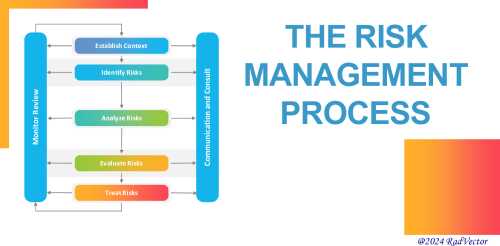
Risk management is a vital process for organizations to identify, assess, and mitigate potential risks that could impact their objectives. The seven steps to risk management provide a structured approach to effectively manage risks and safeguard organizational assets.
Step 1: Communication & [read more]
ISO 31000:2018 is an internationally recognized standard that helps organizations implement a robust Risk Management System. Risks can arise from anything that generates uncertainty related to an organization's objectives or deviates from the expected, including opportunities to be gained. In [read more]
Cybersecurity is a growing threat and should be at the forefront in any IT Risk Management Strategy. As role of
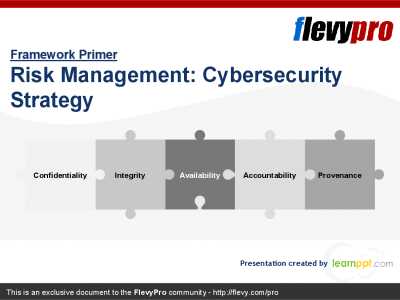
The PPT outlines the critical elements of a robust cybersecurity strategy, emphasizing the importance of integrity, availability, accountability, and provenance of information. It [read more]
Curated by McKinsey-trained Executives
Complete Risk Management Standard Operating Procedures (SOP) Business Toolkit: Comprehensive Guide to Risk Management
In today's dynamic business environment, risk management is a critical area that ensures organizations can identify, assess, [read more]