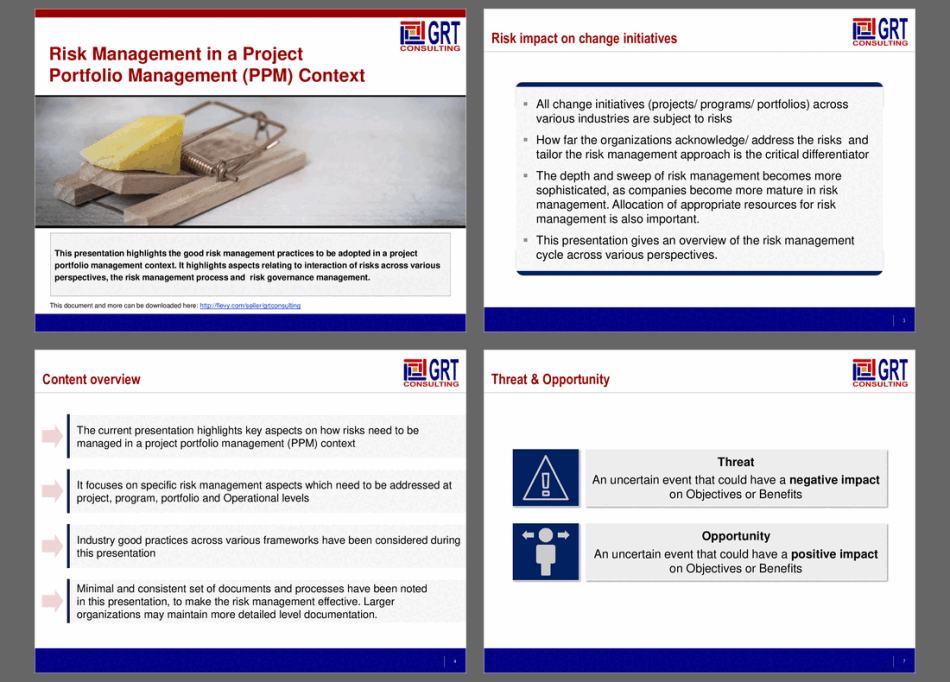

Risk Management in a Project Portfolio Management (PPM) Context   84-slide PPT PowerPoint presentation slide deck (PPTX)
$49.00

Risk Management in a Project Portfolio Management (PPM) Context (84-slide PPT PowerPoint presentation slide deck (PPTX)) Preview Image
Log in to unlock full preview.
Risk Management in a Project Portfolio Management (PPM) Context (84-slide PPT PowerPoint presentation slide deck (PPTX)) Preview Image
Arrow   Click main image to view in full screen.

Risk Management in a Project Portfolio Management (PPM) Context (PowerPoint PPTX Slide Deck)

PowerPoint (PPTX) 84 Slides

$49.00

Add to Cart


Immediate download
Fully editable PowerPoint
Free lifetime updates

BENEFITS OF THIS POWERPOINT DOCUMENT

  1. Provides an integrated flow of risk management in a project portfolio context.
  2. Highlights the complete risk management cycle across diverse perspectives, including reference to Key Risk Indicators.
  3. Gives reference to various tools and techniques, which can be used in risk management.

PROJECT MANAGEMENT PPT DESCRIPTION

Editor Summary Risk Management in a Project Portfolio Management (PPM) Context is an 84-slide PowerPoint by S Ramani (GRT Consulting) that outlines risk management practices across project, program, and portfolio levels. Read more

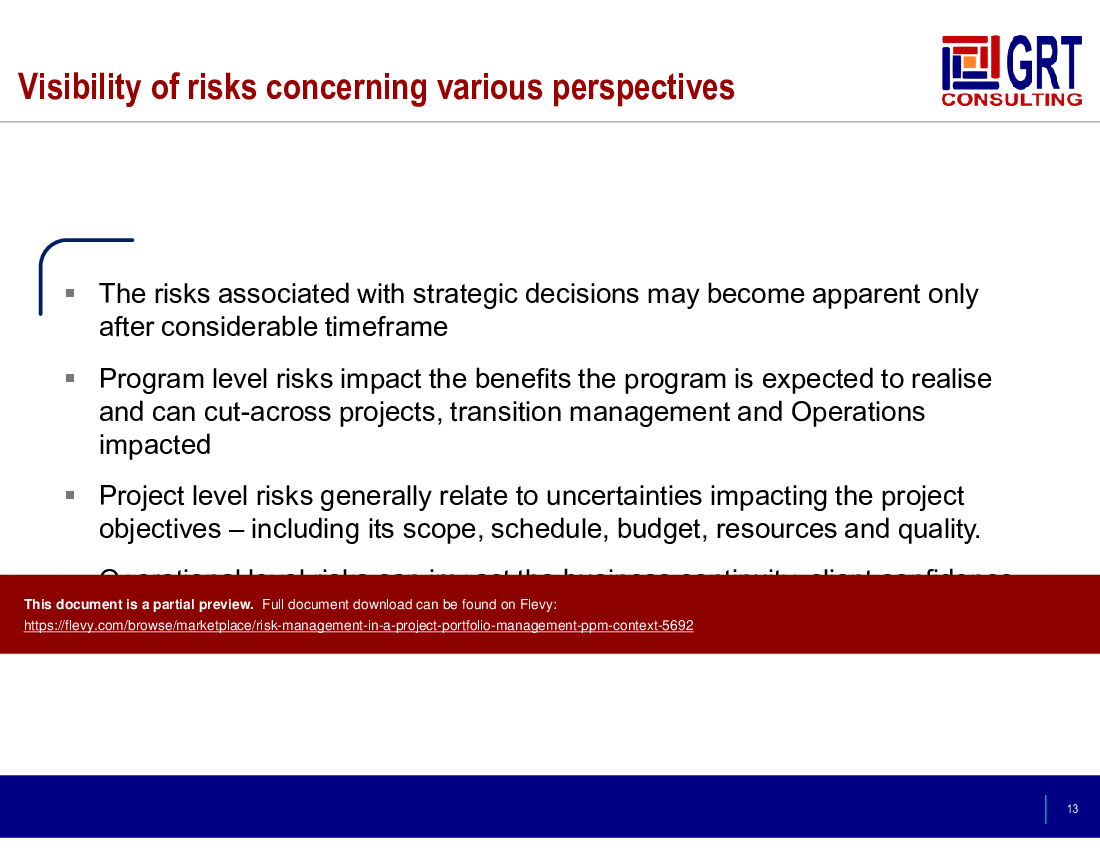
Risk management is an integral aspect of mature project portfolio management. Studies by leading consulting companies have highlighted that there is an undeniable correlation between better risk management, enhanced project portfolio management maturity and superior delivery management.

Successful companies always incorporate risk management tract in project portfolio management.

This presentation encapsulates the good practices across various perspectives in project portfolio management (covering project portfolio, program, project and business operations) from various industry standards in a seamless flow. It includes reference to the entire risk management cycle, tools and techniques which can be used, role of various key stakeholders and risk responses which can be used. Key document templates for risk management are also included for reference and customization.

Got a question about the product? Email us at support@flevy.com or ask the author directly by using the "Ask the Author a Question" form. If you cannot view the preview above this document description, go here to view the large preview instead.

MARCUS OVERVIEW

This synopsis was written by Marcus [?] based on the analysis of the full 84-slide presentation.


Executive Summary
This presentation on Risk Management in a Project Portfolio Management (PPM) context provides a comprehensive overview of effective risk management practices tailored for various organizational levels. It emphasizes the importance of recognizing and addressing risks across projects, programs, and portfolios. The document outlines the risk management process, governance, and cultural aspects necessary for fostering a robust risk management environment. By utilizing this presentation, corporate executives and consultants can enhance their understanding of risk dynamics and improve their organization's risk management strategies.

Who This Is For and When to Use
•  Project Managers overseeing individual projects within a portfolio
•  Program Managers responsible for coordinating multiple projects
•  Portfolio Managers focused on aligning projects with organizational strategy
•  Risk Management Professionals tasked with developing and implementing risk policies
•  Executives seeking to enhance governance and risk oversight

Best-fit moments to use this deck:
•  During project initiation to establish risk management frameworks
•  At program reviews to assess risk exposure and mitigation strategies
•  In portfolio governance meetings to align risk management with strategic objectives
•  For training sessions aimed at improving organizational risk culture

Learning Objectives
•  Define key concepts of risk management in a PPM context
•  Identify and assess risks at project, program, and portfolio levels
•  Develop a risk management approach tailored to organizational needs
•  Implement effective risk responses and monitor their effectiveness
•  Communicate risk status and updates to stakeholders
•  Foster a risk-aware culture within the organization

Table of Contents
•  Risk Management – The ‘Big Picture’ (page 5)
•  Risk Management Approach (page 19)
•  Management of Risk - Process (page 22)
•  Risk Management Culture of the Organization (page 52)
•  Risks Concerning Perspectives & Specialisms (page 57)
•  Appendix (page 77)

Primary Topics Covered
•  Risk Management Overview - This section provides a foundational understanding of risk management principles and their relevance in PPM.
•  Risk Identification Techniques - Various methods for identifying risks are discussed, including checklists and stakeholder analysis.
•  Risk Assessment and Prioritization - Techniques for assessing and prioritizing risks based on probability, impact, and urgency are outlined.
•  Risk Response Planning - Strategies for addressing identified risks, including mitigation, transfer, and acceptance, are detailed.
•  Risk Monitoring and Communication - Emphasis is placed on the importance of ongoing risk monitoring and effective communication with stakeholders.
•  Cultural Aspects of Risk Management - The role of organizational culture in supporting effective risk management practices is examined.

Deliverables, Templates, and Tools
•  Risk Management Policy template for organizational use
•  Initiative Risk Management Approach document template
•  Risk Register template for tracking identified risks
•  Risk Progress Report template for monitoring risk status
•  Risk Improvement Plan template for ongoing risk management enhancement
•  Key Risk Indicators (KRI) framework for measuring risk exposure

Slide Highlights
•  Overview of the risk management cycle and its importance in PPM
•  Detailed explanation of risk identification techniques and their applications
•  Probability-Impact Matrix for visualizing risk prioritization
•  Risk response strategies and their implications for project success
•  Cultural considerations for embedding risk management into organizational practices

Potential Workshop Agenda
Risk Management Fundamentals (60 minutes)
•  Introduce key concepts of risk management
•  Discuss the importance of risk management in PPM

Risk Identification Techniques (90 minutes)
•  Explore various risk identification methods
•  Engage participants in practical exercises

Risk Assessment and Response Planning (90 minutes)
•  Review risk assessment techniques
•  Develop risk response strategies in group discussions

Cultural Aspects of Risk Management (60 minutes)
•  Discuss the role of culture in effective risk management
•  Identify strategies for fostering a risk-aware environment

Customization Guidance
•  Tailor the risk management approach to align with specific organizational objectives and culture
•  Adjust risk assessment criteria based on industry-specific challenges and organizational maturity
•  Incorporate organizational terminology and frameworks into templates and documents
•  Update risk registers and reports to reflect current organizational risks and responses

Secondary Topics Covered
•  Governance structures for effective risk management
•  Integration of risk management into project and program lifecycles
•  Best practices for stakeholder engagement in risk management
•  Techniques for continuous improvement in risk management processes

Topic FAQ

What are the typical phases of risk management within a PPM context?

Risk management in PPM is typically organized around identifying risks, assessing and prioritizing them, planning and implementing responses, and monitoring and communicating outcomes. Governance and culture operate as cross-cutting elements that influence each stage, together forming 4 core stages: identification, assessment, response planning, and monitoring/communication.

How should I prioritize risks across projects and programs?

Prioritization combines likelihood, impact, and urgency to rank risks. Visual tools such as a Probability-Impact Matrix help plot risks for easy comparison and support selection of where to apply mitigation, transfer, or acceptance. The method relies on probability, impact and urgency criteria and a Probability-Impact Matrix.

What are Key Risk Indicators (KRIs) and how are they used?

Key Risk Indicators are measurable metrics that provide early warning of changes in risk exposure affecting objectives. KRIs are tracked over time to trigger escalation and corrective action when thresholds are breached, and should be integrated into regular reporting via a KRI framework.

How is a Probability-Impact Matrix used in practice for PPM?

A Probability-Impact Matrix visualizes each risk by its likelihood and consequence, enabling consistent prioritization and reporting. Project and portfolio teams map risks onto the matrix to identify high-priority items for mitigation and to summarize exposure for governance, using a Probability-Impact Matrix.

What should I look for when choosing a PPM risk management toolkit?

Seek materials that cover project, program, and portfolio levels; include governance and cultural guidance; and provide practical templates (risk register, progress reporting) and measurement tools (KRI framework). For example, Risk Management in a Project Portfolio Management (PPM) Context includes templates and governance guidance such as a risk register and KRI framework.

How much time and what format works to introduce this risk approach to teams?

A workshop rollout is common, with modular sessions focused on fundamentals, identification, assessment/response, and culture. The included potential agenda uses sessions of 60–90 minutes for each topic, allowing hands-on exercises and template familiarization in half-day to multi-day formats with 60–90 minute session lengths.

What should I include when reporting risk exposure to a portfolio governance board?

Governance reporting should show aggregated exposure aligned to strategic objectives, top risks and their status, KRIs against thresholds, recent mitigation actions, and recommended escalations. A concise Risk Progress Report or summarized Risk Register is suitable for governance review and decision-making.

What templates and tools are typically provided to support PPM risk processes?

Typical deliverables include a Risk Management Policy, Initiative Risk Management Approach, Risk Register, Risk Progress Report, Risk Improvement Plan, and a Key Risk Indicator (KRI) framework, plus visual tools like a Probability-Impact Matrix; these specific templates are included in the Risk Management in a Project Portfolio Management (PPM) Context deck.

Document FAQ
These are questions addressed within this presentation.

What is the primary goal of risk management in PPM?
The primary goal is to identify, assess, and manage risks to ensure that projects and programs achieve their objectives while minimizing negative impacts.

How can organizations improve their risk management maturity?
Organizations can enhance their risk management maturity by implementing structured processes, fostering a risk-aware culture, and regularly reviewing and updating their risk management practices.

What are Key Risk Indicators (KRIs)?
KRIs are metrics used to provide early warning signals of potential risks that may impact organizational objectives.

How do I prioritize risks effectively?
Prioritize risks based on their probability of occurrence, potential impact on objectives, and the urgency of their expected occurrence.

What role does communication play in risk management?
Effective communication ensures that stakeholders are aware of risks, understand their implications, and are informed about risk management strategies and updates.

How often should risk assessments be conducted?
Risk assessments should be conducted regularly, especially at key project milestones and when significant changes occur in the project or organizational environment.

What is the importance of a risk register?
A risk register is essential for tracking identified risks, their status, and the actions taken to mitigate them, providing a clear overview of the organization's risk landscape.

How can organizations ensure effective risk governance?
Effective risk governance can be achieved by establishing clear roles and responsibilities, implementing standardized processes, and ensuring regular oversight by leadership.

Glossary
•  Risk Management - The systematic application of principles and processes to identify, assess, and respond to risks.
•  Risk Register - A document that records identified risks, their status, and actions taken to manage them.
•  Key Risk Indicators (KRI) - Metrics used to measure risk exposure and provide early warning signals.
•  Expected Monetary Value (EMV) - A calculation used to assess the potential financial impact of risks.
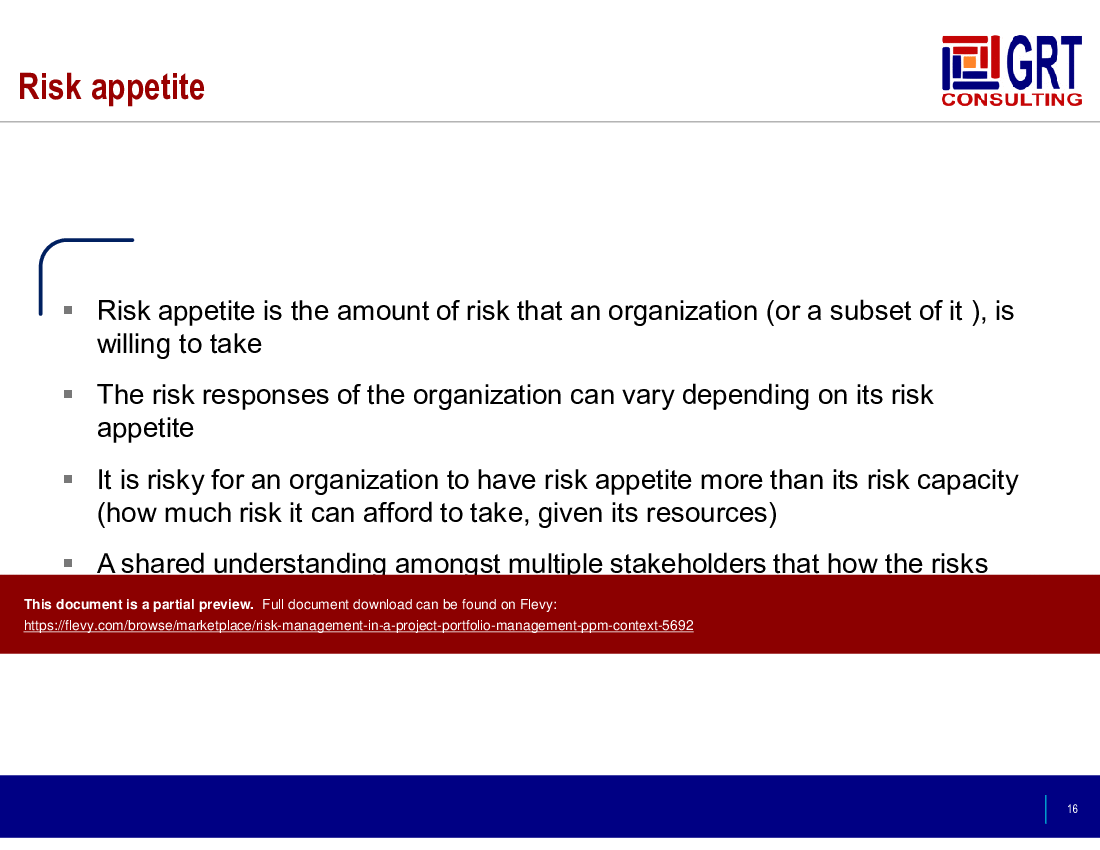
•  Risk Appetite - The amount of risk an organization is willing to accept in pursuit of its objectives.
•  Risk Tolerance - The specific level of risk that an organization can tolerate for individual risks.
•  Risk Response - Strategies implemented to address identified risks, including avoidance, mitigation, transfer, and acceptance.
•  Stakeholder - Individuals or groups with an interest in the outcome of a project or program.
•  Governance - The framework of rules and practices that guide and control an organization.
•  Cultural Aspects - The organizational values and behaviors that influence risk management practices.
•  Qualitative Risk Management - A method of assessing risks based on subjective judgment rather than quantitative data.
•  Quantitative Risk Management - A method of assessing risks using numerical data and statistical analysis.
•  Risk Assessment - The process of identifying and evaluating risks to determine their potential impact.
•  Risk Communication - The process of sharing information about risks and risk management strategies with stakeholders.
•  Risk Improvement Plan - A document outlining actions to enhance risk management practices within an organization.
•  Business Continuity Management (BCM) - A holistic process that ensures the continuity of critical business functions during and after a disruption.
•  Crisis Management - The process of managing an organization’s response to a significant threat to its operations or reputation.
•  Environmental Risk Management - The practice of identifying and mitigating risks related to environmental factors affecting an organization.
•  Reputational Risk - The potential for negative publicity or public perception to impact an organization’s reputation.
•  Contract Risk Management - The process of managing risks associated with contractual agreements and supplier relationships.

Source: Best Practices in Project Management, Risk Management PowerPoint Slides: Risk Management in a Project Portfolio Management (PPM) Context PowerPoint (PPTX) Presentation Slide Deck, S Ramani (GRT Consulting)


$49.00

Add to Cart
  

ABOUT THE AUTHOR

Additional documents from author: 3

S. RAMANI
Founder and Managing Director , GRT Consulting LLP,
Project Portfolio Management Advisor/ Facilitator

Ramani has over 30 years of experience in Project Portfolio Management (PPM) Delivery Management, Consulting and Facilitation. His experience spans multiple domains and organizations, including working in PwC Consulting.

His specialisms include ... [read more]

Ask the Author a Question

You must be logged in to contact the author.

Click here to log in Click here register

Did you know?
The average daily rate of a McKinsey consultant is $6,625 (not including expenses). The average price of a Flevy document is $65.


Trusted by over 10,000+ Client Organizations
Since 2012, we have provided business templates to over 10,000 businesses and organizations of all sizes, from startups and small businesses to the Fortune 100, in over 130 countries.
AT&T GE Cisco Intel IBM Coke Dell Toyota HP Nike Samsung Microsoft Astrazeneca JP Morgan KPMG Walgreens Walmart 3M Kaiser Oracle SAP Google E&Y Volvo Bosch Merck Fedex Shell Amgen Eli Lilly Roche AIG Abbott Amazon PwC T-Mobile Broadcom Bayer Pearson Titleist ConEd Pfizer NTT Data Schwab


Read Customer Testimonials

 
"FlevyPro provides business frameworks from many of the global giants in management consulting that allow you to provide best in class solutions for your clients."

– David Harris, Managing Director at Futures Strategy
 
"I have found Flevy to be an amazing resource and library of useful presentations for lean sigma, change management and so many other topics. This has reduced the time I need to spend on preparing for my performance consultation. The library is easily accessible and updates are regularly provided. A wealth of great information."

– Cynthia Howard RN, PhD, Executive Coach at Ei Leadership
 
"As an Independent Management Consultant, I find Flevy to add great value as a source of best practices, templates and information on new trends. Flevy has matured and the quality and quantity of the library is excellent. Lastly the price charged is reasonable, creating a win-win value for "

– Jim Schoen, Principal at FRC Group
 
"Flevy is our 'go to' resource for management material, at an affordable cost. The Flevy library is comprehensive and the content deep, and typically provides a great foundation for us to further develop and tailor our own service offer."

– Chris McCann, Founder at Resilient.World
 
"As a young consulting firm, requests for input from clients vary and it's sometimes impossible to provide expert solutions across a broad spectrum of requirements. That was before I discovered Flevy.com.

Through subscription to this invaluable site of a plethora of topics that are key and crucial to consulting, I "

– Nishi Singh, Strategist and MD at NSP Consultants
 
"Last Sunday morning, I was diligently working on an important presentation for a client and found myself in need of additional content and suitable templates for various types of graphics. Flevy.com proved to be a treasure trove for both content and design at a reasonable price, considering the time I "

– M. E., Chief Commercial Officer, International Logistics Service Provider
 
"I have used FlevyPro for several business applications. It is a great complement to working with expensive consultants. The quality and effectiveness of the tools are of the highest standards."

– Moritz Bernhoerster, Global Sourcing Director at Fortune 500
 
"[Flevy] produces some great work that has been/continues to be of immense help not only to myself, but as I seek to provide professional services to my clients, it gives me a large "tool box" of resources that are critical to provide them with the quality of service and outcomes they are expecting."

– Royston Knowles, Executive with 50+ Years of Board Level Experience


Customers Also Bought These Documents


Customers Also Like These Documents

Explore Templates on Related Management Topics


Your Recently Viewed Documents
Receive our FREE presentation on Operational Excellence

This 50-slide presentation provides a high-level introduction to the 4 Building Blocks of Operational Excellence. Achieving OpEx requires the implementation of a Business Execution System that integrates these 4 building blocks.









