
Risk Management Professionals aim to recognize, evaluate, and document the risks associated with a company's business operations. They also oversee the efficacy of risk management processes and implement necessary adjustments. Attaining the PMI Risk Management Professional (PMI‑RMP)® certification not only underscores the capacity to identify and evaluate project risks, address threats, and seize opportunities but also safeguards the organization's needs. Achieving distinction as a PMI‑RMP sets Risk Management Professionals apart, bringing credit to both the individual and the organization.
Exams from the Project Management Institute are challenging. Whether you're instructing a course or self-studying, a comprehensive study guide is essential to optimize study time and enhance the likelihood of passing the exam. Test takers require a guide suggesting the best study materials, offering exercises for improved learning, and providing sample exam questions.
While most study guides merely outline exam content, this presentation interprets the PMI examination content outline for April 2022 into actionable steps and knowledge. This presentation not only identifies essential readings in PMI publications, accessible through PMI membership with an exam discount but also integrates all books from the PMI‑RMP examination reference list. This inclusive approach saves time and money, presenting ideas coherently to enhance understanding significantly and increase the likelihood of passing the PMI‑RMP certification exam with confidence.
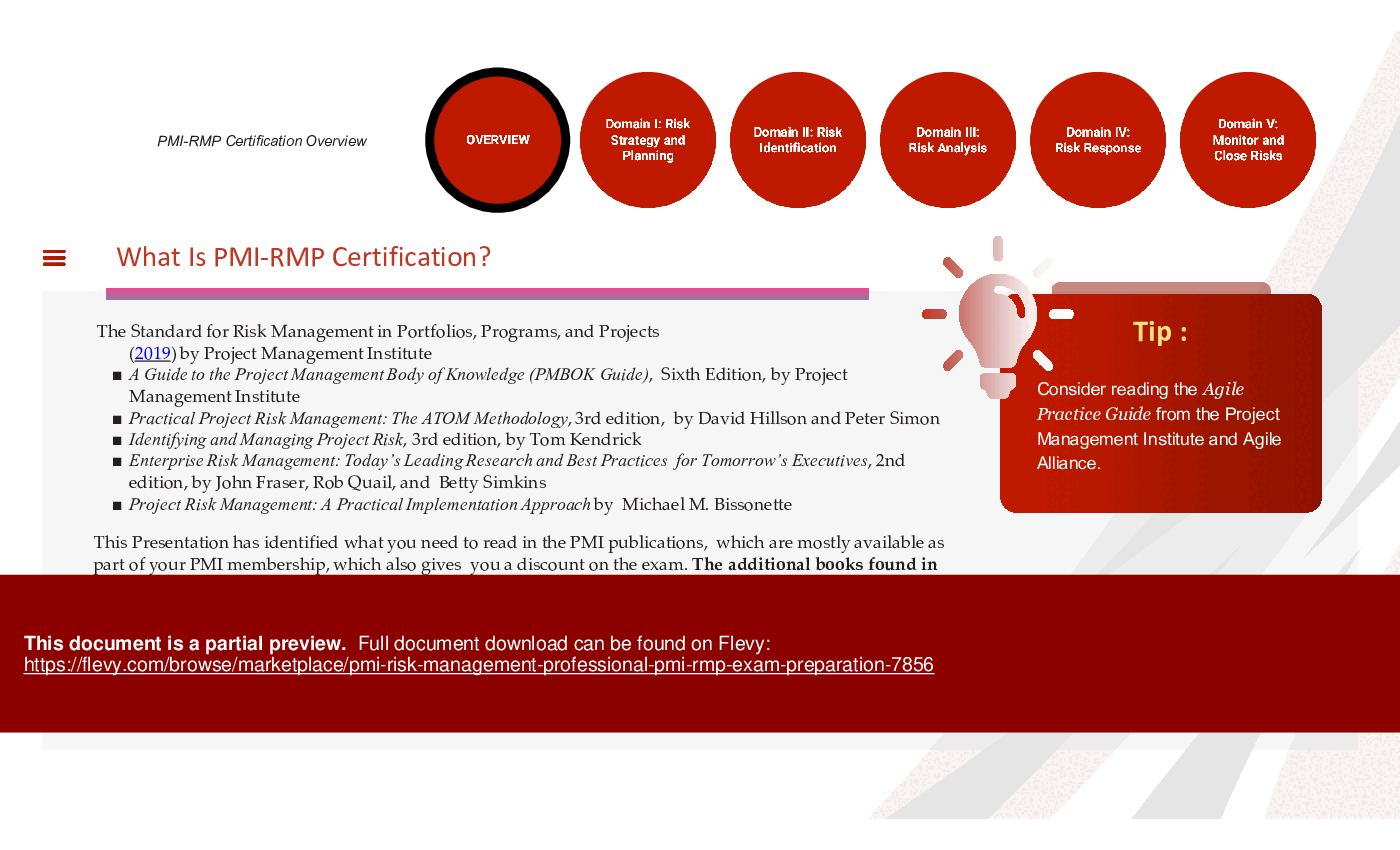
This 211-slide Presentation has identified what you need to read in the PMI publications, which are mostly available as part of your PMI membership, which also gives you a discount on the exam. The additional books found in the PMI‑RMP examination reference list are all included in this work, which should save you a significant amount of time/money, and at the same time present the ideas and concepts in a cohesive manner, which will increase your understanding significantly and the likelihood of passing the PMI‑RMP certification exam with flying colors.
This guide breaks down complex risk management concepts into manageable tasks and exercises to reinforce learning. It also includes sample exam questions to help gauge your readiness and identify areas needing improvement.
Got a question about the product? Email us at support@flevy.com or ask the author directly by using the "Ask the Author a Question" form. If you cannot view the preview above this document description, go here to view the large preview instead.
Executive Summary
The PMI Risk Management Professional (PMI-RMP) Exam Preparation presentation is meticulously crafted to equip candidates with the essential knowledge and skills required for the PMI-RMP certification. This comprehensive slide deck, developed by seasoned professionals with extensive consulting backgrounds, aligns with the PMI-RMP Exam Content Outline and Specifications updated in March 2022. It covers critical areas such as risk strategy, identification, analysis, response, and monitoring, ensuring that learners can effectively navigate the complexities of risk management in project environments. By utilizing this resource, candidates can enhance their understanding, engage in practical exercises, and maximize their chances of passing the PMI-RMP exam.
Who This Is For and When to Use
• Project Managers seeking to enhance their risk management skills.
• Risk Management Professionals aiming for PMI-RMP certification.
• Business Analysts involved in project risk assessments.
• Consultants and advisors focusing on risk management strategies.
• Teams implementing risk management frameworks in their projects.
Best-fit moments to use this deck:
• During PMI-RMP exam preparation to solidify understanding of key concepts.
• As a training tool for teams focusing on risk management practices.
• For workshops aimed at improving organizational risk management capabilities.
Learning Objectives
• Define the PMI-RMP certification requirements and exam structure.
• Build a comprehensive risk management plan based on PMI standards.
• Establish effective risk identification and analysis techniques.
• Create and implement risk response strategies tailored to project needs.
• Monitor and evaluate project risks continuously throughout the project lifecycle.
• Engage stakeholders effectively in the risk management process.
Table of Contents
• PMI-RMP Certification Overview (page 9)
• Study Tips (page 28)
• Domain I: Risk Strategy and Planning (page 49)
• Domain II: Risk Identification (page 82)
• Domain III: Risk Analysis (page 109)
• Domain IV: Risk Response (page 135)
• Domain V: Monitor and Close Risks (page 158)
• Glossary of Terms and Acronyms (page 185)
• Templates (page 191)
• References (page 209)
Primary Topics Covered
• Risk Strategy and Planning - This domain focuses on establishing a robust risk management strategy, including risk thresholds and stakeholder engagement.
• Risk Identification - Techniques for identifying risks through exercises, assumption analysis, and developing a risk register.
• Risk Analysis - Qualitative and quantitative analysis methods to prioritize risks based on their probability and impact.
• Risk Response - Planning and implementing strategies to mitigate risks, including contingency and fallback plans.
• Monitor and Close Risks - Ongoing evaluation of risks, including monitoring residual and secondary risks, and updating project documentation.
Deliverables, Templates, and Tools
• Risk management plan template outlining roles, responsibilities, and strategies.
• Risk register template for documenting identified risks and their attributes.
• Risk assessment tools such as probability and impact matrices.
• Contingency and fallback plan templates for risk response strategies.
• Stakeholder engagement plan template for effective communication.
Slide Highlights
• Overview of the PMI-RMP certification process and its significance in project management.
• Detailed breakdown of the 5 domains of risk management as per PMI standards.
• Practical exercises and case studies to reinforce learning and application of concepts.
• Visual aids such as flowcharts and matrices to simplify complex risk management processes.
• Sample exam questions to prepare candidates for the PMI-RMP certification exam format.
Potential Workshop Agenda
Risk Management Fundamentals Workshop (90 minutes)
• Introduction to PMI-RMP certification and its importance.
• Overview of risk management domains and tasks.
• Group exercise: Developing a risk management plan.
Risk Identification and Analysis Session (60 minutes)
• Conducting risk identification exercises.
• Analyzing risks using qualitative and quantitative methods.
• Group discussion: Sharing insights and experiences.
Risk Response Strategies Workshop (90 minutes)
• Planning effective risk responses.
• Implementing contingency plans and monitoring outcomes.
• Role-playing scenarios to practice stakeholder engagement.
Customization Guidance
• Tailor the risk management plan template to fit specific project contexts and stakeholder needs.
• Adjust the risk register format to include project-specific risk categories and thresholds.
• Incorporate organizational language and terminology into training materials for consistency.
Secondary Topics Covered
• Best practices for stakeholder engagement in risk management.
• Techniques for effective communication of risk management strategies.
• Tools for continuous risk monitoring and evaluation.
• Case studies showcasing successful risk management implementations.
FAQ
What is the PMI-RMP certification?
The PMI-RMP certification recognizes professionals who demonstrate expertise in project risk management, focusing on identifying, analyzing, and responding to project risks.
How can I prepare for the PMI-RMP exam?
Utilize this presentation as a study guide, engage in practical exercises, and review relevant PMI publications and resources.
What topics are covered in the PMI-RMP exam?
The exam covers 5 domains: Risk Strategy and Planning, Risk Identification, Risk Analysis, Risk Response, and Monitor and Close Risks.
How long is the PMI-RMP exam?
The exam consists of 115 questions, with a total duration of 2 hours and 30 minutes.
What resources should I use for exam preparation?
Refer to the PMBOK Guide, PMI Practice Standards, and this presentation for comprehensive coverage of the exam content.
How often do I need to renew my PMI-RMP certification?
The PMI-RMP certification must be renewed every 3 years by earning professional development units (PDUs).
Can I take the PMI-RMP exam online?
Yes, the PMI-RMP exam can be scheduled for online proctored testing or at designated Pearson Vue test centers.
What is the passing score for the PMI-RMP exam?
The passing score is not publicly disclosed,, but it is estimated to be between 63% and 67%.
Glossary
• Assumption - A factor that is considered to be true for the purposes of planning.
• Risk Register - A document used to record identified risks, their analysis, and response strategies.
• Contingency Plan - A predefined plan to address risks if they occur.
• Stakeholder - An individual or group that has an interest in the outcome of a project.
• Residual Risk - The remaining risk after risk response strategies have been implemented.
• Secondary Risk - A new risk that arises as a direct result of implementing a risk response.
• Probability and Impact Matrix - A tool used to prioritize risks based on their likelihood of occurrence and potential impact.
• SWOT Analysis - A strategic planning tool used to identify strengths, weaknesses, opportunities, and threats related to a project.
• Risk Appetite - The amount of risk that an organization is willing to accept in pursuit of its objectives.
• Risk Mitigation - The process of reducing the impact or likelihood of a risk.
• Risk Transference - Shifting the impact of a risk to a third party.
• Risk Avoidance - Changing the project plan to eliminate the risk or protect the project objectives.
Source: Best Practices in Risk Management PowerPoint Slides: PMI Risk Management Professional (PMI-RMP) Exam Preparation PowerPoint (PPTX) Presentation Slide Deck, RadVector Consulting
|
Receive our FREE presentation on Operational Excellence
This 50-slide presentation provides a high-level introduction to the 4 Building Blocks of Operational Excellence. Achieving OpEx requires the implementation of a Business Execution System that integrates these 4 building blocks. |










