 Many businesses discover just how complicated legal work becomes the moment they expand into more than one state. What felt manageable in a single jurisdiction suddenly turns into a maze of conflicting rules, unclear workflows, and mounting administrative pressure. Teams often feel overwhelmed long before they realize their processes no longer scale.
A strong legal operations framework gives organizations a way to regain control. In this article, you’ll learn how companies build scalable systems that support multi-state operations through standardized workflows, centralized intake, and adaptable state-specific procedures.
Creating a Standardized Core
A scalable legal operations framework begins with a repeatable foundation. Teams perform better when expectations are clear, and tasks follow predictable pathways across departments. You can think of it as building the rails before running the train.
Organizations often start by identifying which recurring tasks can be streamlined across all states. Those tasks then become the backbone of the legal team’s core workflows.
Here are the elements that make a strong foundation:
- Centralized intake
- Clear SOPs
- Routing rules that eliminate guesswork
These components help ensure that requests land where they should and that teams are not improvising legal processes every week.
Governance and Multi-State Alignment
Once core workflows are in place, governance defines how decisions move across the organization. This includes ownership structures, escalation paths, and rules for handling jurisdiction-specific variation.
Multi-state operations often introduce subtle but important legal differences. Subpoena handling, filing requirements, and service rules can vary by jurisdiction, requiring teams to rely on specialized service providers and build structured exceptions into their workflows rather than relying on ad hoc decisions.
For example, when dealing with Pennsylvania-specific subpoena requirements, some teams rely on Serve Index PA subpoena help to ensure accurate handling of out-of-state subpoena processes within a broader multi-jurisdictional system.
Establishing clear governance ensures these variations are managed without disrupting the overall framework. Instead of creating separate processes for each state, organizations embed exceptions into a controlled, scalable structure.
Technology’s Role in Scalable Legal Operations
Technology plays a major part in making legal operations scalable across states. Many teams rely on workflow tools to simplify intake, track deadlines, and organize documents. Tools such as legal service delivery systems, contract lifecycle management platforms, and document repositories help standardize processes and reduce operational friction.
Automation also reduces time spent on manual tasks. When software handles routing or document creation, teams can shift their focus to decisions that require legal judgment. As organizations grow into new states, technology becomes a vital support system that adjusts without slowing teams down.
Building Flexible State-Specific Execution
Even well-organized teams face challenges when state rules diverge. A framework that works nationwide needs flexible points built in so local variations can fit neatly into standard workflows.
You can support local execution by identifying where differences matter and creating add-ons to the core workflow. That approach keeps the system streamlined while honoring local requirements.
Teams benefit from mapping these details clearly. Here are some areas that usually require state-level adjustments:
- Filing formats
- Document turnaround rules
- Special compliance triggers
Once these rules are documented and integrated, the legal team can respond quickly without confusion.
Training Teams for Multi-State Compliance
Growth across multiple states calls for strong training programs. Without training, teams may follow outdated habits or misunderstand local requirements. Regular refreshers help reinforce expectations and give employees confidence when they handle state-specific tasks.
Cross-functional training also supports unified communication. When legal, HR, compliance, and operations share the same understanding, work moves more smoothly. This approach ensures that when new states are added, the entire organization adapts quickly and stays aligned with the company’s legal operations framework.
Tracking Performance across States
A legal operations system is only scalable if you can measure its success. Tracking performance helps leadership understand whether the framework works across states or if certain regions need added support. It also gives teams the data needed to refine workflows over time.
Most businesses track cycle times, bottlenecks, and intake volume. These metrics reveal how well standardized processes perform and highlight where improvements would make the biggest impact. When teams review these numbers regularly, the framework stays aligned with organizational growth.
Strengthening Your Multi-State Legal Operations Framework
A strong multi-state legal operations framework helps your team stay organized, compliant, and adaptable as your business grows. Clear workflows, consistent governance, and flexible state-level processes allow you to manage expanding responsibilities without losing efficiency. Each part of the framework supports smoother operations across every jurisdiction.
If you’re reworking your strategy or preparing for expansion, reviewing your current structure is a great starting point. You can also explore topics on our blog to find more insights and guidance that support long-term legal operations success.
Do You Want to Implement Business Best Practices?
You can download in-depth presentations on Corporate Strategy and 100s of management topics from the FlevyPro Library. FlevyPro is trusted and utilized by 1000s of management consultants and corporate executives.
For even more best practices available on Flevy, have a look at our top 100 lists:
These best practices are of the same as those leveraged by top-tier management consulting firms, like McKinsey, BCG, Bain, and Accenture. Improve the growth and efficiency of your organization by utilizing these best practice frameworks, templates, and tools. Most were developed by seasoned executives and consultants with over 20+ years of experience.
Readers of This Article Are Interested in These Resources
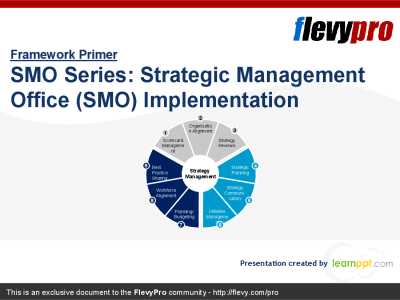
24-slide PowerPoint presentation
The Strategy Management Office (SMO), also referred sometimes as the Office of Strategy Management (OSM), is the team responsible for managing the Corporate Strategy of the organization.
The ultimate role to execute Strategy lies with the line managers and employees, but without a core command
[read more]
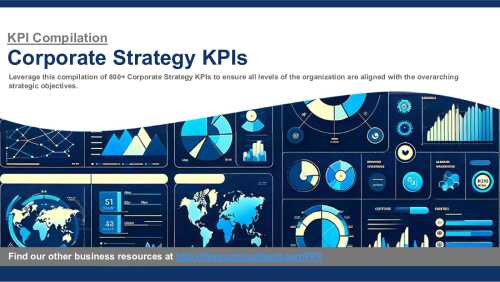
186-slide PowerPoint presentation
This presentation is a comprehensive collection of Key Performance Indicators (KPI) related to Corporate Strategy. A KPI is a quantifiable measure used to evaluate the success of an organization, employee, or process in meeting objectives for performance.
KPIs are typically implemented at
[read more]
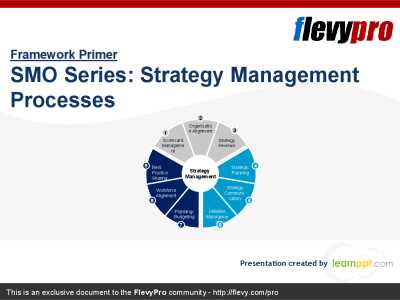
24-slide PowerPoint presentation
The Strategy Management Office (SMO), also referred sometimes as the Office of Strategy Management (OSM), is the team responsible for managing the Corporate Strategy of the organization.
The ultimate role to execute Strategy lies with the line managers and employees, but without a core command
[read more]
26-slide PowerPoint presentation
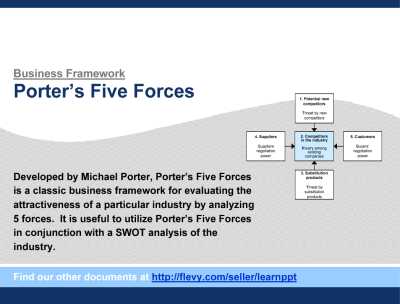
Developed by Michael Porter, Porter's Five Forces is a classic business framework for evaluating the attractiveness of a particular industry by analyzing 5 forces. It is useful to utilize Porter's Five Forces in conjunction with a SWOT analysis of the industry.
This presentation provides a
[read more]