 Turn on the news, and you’ll see it sooner or later – the weather is breaking records all over the place. And along with records, it’s also breaking budgets.
For executives, the weather has been more of a background noise than anything else, but today, the environment is too unpredictable to keep treating it like that. The weather is disrupting operations and tangling up supply chains, which is throwing revenue forecasts off course.
You can no longer react to the storm after it hits.
In order to stay resilient, modern risk models need to include the weather as one of the factors.
Why Weather Data Now Belongs in Your Risk Model
If you had pulled out a standard Enterprise Risk Management framework 20 years ago, you’d find weather under ‘external factors.’
It was on the same shelf as geopolitical events and currency fluctuations; something you could maybe see coming, but you had no way of controlling it. Besides, it’s just the weather; what are you going to do about it anyway?
Now, that mindset is incredibly outdated, and the pattern at which the weather is becoming more intense has measurable business consequences.
The weather itself is still hard to predict.
In fact, that part is getting harder, but our ability to quantify its impact is getting easier. Environmental variability has become a data set we can actually model. Say you manage facilities or assets.
You already know that changes in temperature or heavy precipitation do a lot more than just cause dramatic floods; they also slow things down. They impact the longevity of your equipment, the schedule for maintenance cycles, and even how productive your employees are on a given day. So essentially, you’re left with reacting to breakdowns instead of predicting them.
That is, unless you pull historical and forecast weather inputs into your planning, which you can do with Visual Crossing’s weather API, or any other high-performing and highly-accurate weather data provider.
You also need to look at the supply chain.
This is where the weather exposes the weakest links because there are significant exposure points here. You have the major port on the coast, a trucking route that buckles in extreme heat, or a supplier whose location is in a region that’s known for hurricanes. Unless all these pieces work together, the puzzle collapses. The best way to protect yourself would be to run simulations that include the weather and ask questions based on actual climate data. This way, you can build a supply chain that can adjust (up to a point).
Of course, this story wouldn’t be complete without mentioning some numbers. Weather moves commodity prices, and it changes what your customers want to buy. It also drives up insurance claims, and it even has an impact on what people can pay you.
This connection is more direct for some industries than others, but in any case, weather data should be a part of financial planning. Once it is, you no longer have to cross your fingers and hope things will turn out well; you can make actual, informed decisions according to what’s coming.
How to Embed Weather Data into Strategic Risk Models
Once you have all this weather data, you need to do something with it so you can use it to make decisions.
Here’s how.
Start with Exposure Mapping
The first thing to do is to ask yourself a simple question: what breaks or loses money when the weather turns? You also want to look at geographic concentration because if you have all your most important facilities in one region, a single storm could take out everything.
Once you’ve identified those spots, run sensitivity analysis so you can see how different weather variables move your numbers.
Move to Scenario Testing
Now that you know what’s most exposed, start asking ‘what ifs.’
Basically, you take the forecasts that tell you how likely different outcomes are and you run them through simulation models. Once you stress test against these scenarios, you can start putting actual dollar ranges around the risk. You’ll know what a bad month will look like and what a catastrophic year would look like.
Adjust Strategy, Not Just Tactics
This is the step at which most companies stop.
They figure out the risk and then wait for it to happen. But the point of this whole thing is to change how you work. Perhaps you need to rethink your supplier network and redesign it, or you realize that you’re relying on one region for everything.
If you know the risks, why not make your business more resilient right now?
Make Monitoring Ongoing
The weather never stops, so your models can’t either.
It’s imperative that you set up rolling updates that pull in current data and compare what happened against what you predicted. Every time reality doesn’t match your model, it is an opportunity to learn because you have the chance to refine your assumptions and recalibrate.
Conclusion
You can’t control the weather, and this isn’t your attempt at doing so.
But just because you can’t control it doesn’t mean you shouldn’t try your hardest to see major events coming because they impact your business in one way or another. Unless you do this, you’ll be caught off guard again and again, every single time, until the situation finally forces you to work in the weather as one of the factors in your risk model.
Because it will.
Do You Want to Implement Business Best Practices?
You can download in-depth presentations on Risk Management and 100s of management topics from the FlevyPro Library. FlevyPro is trusted and utilized by 1000s of management consultants and corporate executives.
For even more best practices available on Flevy, have a look at our top 100 lists:
These best practices are of the same as those leveraged by top-tier management consulting firms, like McKinsey, BCG, Bain, and Accenture. Improve the growth and efficiency of your organization by utilizing these best practice frameworks, templates, and tools. Most were developed by seasoned executives and consultants with over 20+ years of experience.
Readers of This Article Are Interested in These Resources
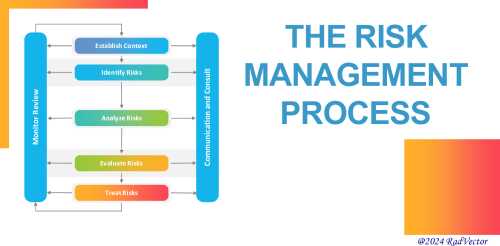
65-slide PowerPoint presentation
Risk management is a vital process for organizations to identify, assess, and mitigate potential risks that could impact their objectives. The seven steps to risk management provide a structured approach to effectively manage risks and safeguard organizational assets.
Step 1: Communication &
[read more]
61-slide PowerPoint presentation
ISO 31000:2018 is an internationally recognized standard that helps organizations implement a robust Risk Management System. Risks can arise from anything that generates uncertainty related to an organization's objectives or deviates from the expected, including opportunities to be gained. In
[read more]
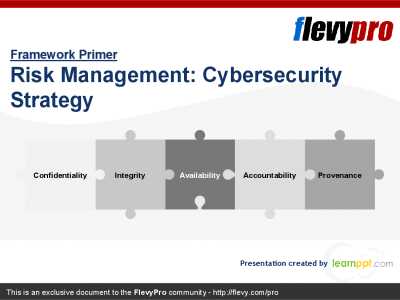
23-slide PowerPoint presentation
Cybersecurity is a growing threat and should be at the forefront in any IT Risk Management Strategy. As role of
The PPT outlines the critical elements of a robust cybersecurity strategy, emphasizing the importance of integrity, availability, accountability, and provenance of information. It
[read more]
1587-slide PowerPoint presentation
Curated by McKinsey-trained Executives
Complete Risk Management Standard Operating Procedures (SOP) Business Toolkit: Comprehensive Guide to Risk Management
In today's dynamic business environment, risk management is a critical area that ensures organizations can identify, assess,
[read more]