Editor's Note: Take a look at our featured best practice, Business Transformation Framework for New CEOs (22-slide PowerPoint presentation). Transformation is about making fundamental changes in how business is conducted in order to help cope with a shift in market environment and achieve a sustainable, quantum improvement in performance. Specifically, this fundamental change can be in the company's corporate strategy, business model, [read more]
* * * *
 Corporate leadership training is a billion-dollar industry. Companies spend thousands per executive on workshops, seminars, and coaching sessions. The irony is striking. Most of those lessons already exist inside a 20-year-old video game.
World of Warcraft is not just entertainment. It is a real-time management simulator. All serious players have to deal with resource limitations, team politics, and stakes. They do it hours and hours and hours. All that happens under pressure. Most leadership retreats do not provide that much practice.
This is not a mere argument. The similarities between managing a successful guild and a company are concrete and quantifiable. CEOs who consider gaming a waste of time are missing out on a valuable development tool.
Resource Management: Every Gold Piece Counts
WoW operates on a player economy. Gold is used to repair, purchase consumables, crafting materials, and raid preparations. One can never have enough of it. The priorities are always competing over the same limited pool.
Sound familiar? It should. The same tension is present in every CFO meeting. Marketing wants a budget. Engineering needs headcount. The work requires new equipment. The resource is limited. The requirements are not.
In WoW, ineffective resource allocation is a killer of progression. A guild that burns gold on the incorrect consumables stalls at the same boss weeks. A well-spending guild clears content more quickly and keeps players longer.
This is something that experienced players know. Most of them prefer to purchase WoW gold on reliable sites to avoid the tedious farming and use the time to plan and act. That choice reflects a fundamental business concept — outsource low-value activities, defend high-value focus. It is about prioritization.
This lesson is taught in the game by consequences. Poor expenditure choices have short-term and obvious outcomes. There is no delay in the quarterly report or abstract metric. The raid just fails. That feedback loop is more visceral and quicker than anything a spreadsheet can offer.
Team Building and Role Distribution
A raid group in WoW requires 10 to 30 players. All of them serve a particular purpose. Tanks take up the damage and contain enemies. Healers maintain the group alive. DPS players are effective at eliminating threats.
The point is that you cannot stock a raid with damage dealers alone. Ten genius assailants without a tank are killed within seconds. Balance of roles is more important than personal genius. The same lesson applies to team composition in business.
This is a mistake that organizations commit all the time. They recruit on a single profile. Teams are piled with like-minded thinkers, backgrounds, and strengths. The outcome is impressive on paper. It fails when pressurized. WoW penalizes imbalance on the spot. Business is a slow punisher. That is why the game is a more effective teacher. The feedback is immediate.
Good guild leaders also understand that an average player can easily outperform an unreliable star. A healer who appears every time is better than a brilliant healer who goes offline during a raid. Reliability is a competitive edge. It is underestimated in most hiring processes.
Crisis Management: When the Raid Wipes
The wipe is familiar to every serious WoW player. The raid falls apart. Everyone dies. The attempt fails. The next thing that occurs is what makes the leader. Weak guild masters criticize individual players. They accuse, build up tension, and lose trust. Powerful ones do otherwise. They demand a suspension. They inquire what failed in a systematic manner. They change the strategy prior to the subsequent pull.
Stop, diagnose, adapt, retry is textbook crisis management. It is also rare in corporate environments. The majority of organizations react to failure through blame games and defense. The reputation-protecting instinct prevails over the learning instinct. WoW eliminates that instinct. There is no reputation to protect mid-raid. There is only the next attempt. High-level players of the game build a habit of quick, structured reflection. They become accustomed to failure because of data. That mental model is worth more than most crisis communication workshops. It gets built through repetition.
Talent Retention: Keeping Your Best Players
It takes months to build a strong guild. Finding talented players, assimilating them into the team culture, and building trust make the process slow and painstaking. The loss of a major member is a big step backwards. Guild masters are concerned with retention at all times. Players move to superior guilds, time issues, or just because they feel under-appreciated. The causes are almost identical to corporate attrition.
The solutions do as well. Players remain when they feel appreciated. They remain when their position is not in doubt. They remain where the leadership is honest and consistent. They go when they believe they are dispensable figures.
Good guild leaders conduct one-on-one check-ins with key members. They deal with internal disputes before they get out of control. They open doors to development and assist players in becoming better at their game. HR professionals would be aware of each of those practices. Context is the difference. The stakes are immediate in WoW. The disintegration of a guild is a reality that is painful to watch. That emotional fact cuts retention instincts quicker than HR theory could ever cut them. Guild leaders who are in charge of their guilds acquire real people-management skills.
The Boardroom Needs More Guild Masters
Corporate learning requires improved tools. The existing model yields little. Executives get to learn things. However, they rarely apply them when under pressure. WoW has something different. It is an active place where management skills are put to the test all the time. Resource allocation, role clarity, crisis response, and talent retention are not discussed. They are practiced.
The concept of gamification in leadership development is receiving academic attention. Scholars of complex multiplayer games have observed quantifiable strategic thinking and coordination of teams among ordinary players.
Simulations are already utilized in the business world to train pilots, practice surgery, and military strategy. The same approach is long overdue in leadership development.
World of Warcraft is not an ideal corporate training tool. It was not designed to be one. However, the skills it develops are tangible. Any CEO who is ready to raid in earnest over three months will emerge a better leader. The lessons do not feel like lessons. That is precisely the reason why they stick.
Do You Want to Implement Business Best Practices?
You can download in-depth presentations on CEO and 100s of management topics from the FlevyPro Library. FlevyPro is trusted and utilized by 1000s of management consultants and corporate executives.
For even more best practices available on Flevy, have a look at our top 100 lists:
These best practices are of the same as those leveraged by top-tier management consulting firms, like McKinsey, BCG, Bain, and Accenture. Improve the growth and efficiency of your organization by utilizing these best practice frameworks, templates, and tools. Most were developed by seasoned executives and consultants with over 20+ years of experience.
Readers of This Article Are Interested in These Resources
49-slide PowerPoint presentation
In "The Business Transformation Playbook," a former Fortune 50 executive shares his invaluable insights and expertise in orchestrating successful organizational transformations. With a career spanning decades and a track record of turning struggling businesses into industry leaders, this playbook
[read more]
76-page Word document
Curated by McKinsey-trained Executives
🚀 THE CEO AGENDA - The Ultimate C-Suite Business Toolkit
The Ultimate Strategic Playbook for High-Performance Leaders Who Refuse to Settle
🔥 Dominate your market. Outperform your competitors. Lead with absolute clarity.
If you're a
[read more]
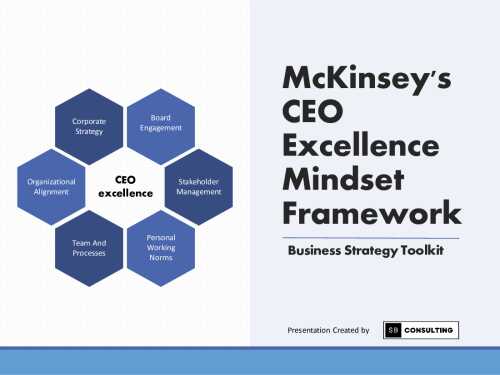
251-slide PowerPoint presentation
Curated by McKinsey-trained Executives
The McKinsey CEO Excellence Framework: Unleashing the Power of Strategy and Leadership
In the ever-evolving landscape of modern business, the role of a CEO is more critical than ever before. CEOs are not just leaders; they are visionaries, strategists,
[read more]
38-slide PowerPoint presentation
Is your company being led by a group or a team? There is a big difference in top and bottom line performance between the two.
More often than not, the teaming ability at the top of the organization is the determinant of success or failure as opposed to the technology, product, or idea on which
[read more]