Editor's Note: Take a look at our featured best practice, Gartner TIME Framework (34-slide PowerPoint presentation). Application Portfolio Management (APM) is the disciplined inventory and assessment of every application, platform, capability, and service that supports organizational Strategy. APM establishes a single source of truth, assigns ownership, and ties each asset to cost, risk, and business [read more]
* * * *
For decades, corporate strategy frameworks have treated network infrastructure as operational overhead — a necessary cost controlled by IT departments. That mindset has become a critical liability. Modern enterprises face an unavoidable reality: the network is no longer invisible plumbing. It has become a strategic differentiator directly influencing revenue, customer experience, resilience, and speed to market.
Organizations that view network infrastructure as a strategic asset — not a cost center — are gaining measurable advantage across their value chains.
Global data transfers contribute an estimated $2.8 trillion to GDP, projected to reach $11 trillion by 2025. Yet most companies lack visibility into how data flows, where bottlenecks emerge, or how network choices cascade into business outcomes. Bridging this gap is now a strategic imperative.
The Strategic Shift: From Invisible to Essential
Enterprise Architecture (EA) traditionally aligns IT with business goals, but networking has remained in the background — a function expected to “just work.”
That approach fails for three concrete reasons.
1. Data Gravity Has Changed the Competitive Battlefield
Organizations now span hybrid, multi-cloud, and edge environments. The path data takes — latency, cost, compliance, and security posture — determines whether an organization can scale, innovate, or deploy AI effectively.
Global data creation grows 35 % annually, while network capacity expands only 24 %. The gap throttles AI initiatives and slows decision cycles. Up to two-thirds of enterprises say they are not ready to operationalize AI — citing data movement as the top blocker.
2. Cyber Resilience Is Now a Strategic Asset
Security is no longer just about prevention. Leading firms design cyber-resilient networks — capable of anticipating threats, sustaining operations, and adapting post-incident.
Enterprises integrating resilience into network design maintain operations during breaches, preserve trust, and often emerge stronger than competitors.
Strategic players reduce cross-border latency from hundreds of milliseconds to sub-50 ms, ensure compliance, and enter new markets without physical expansion.
The Value Chain Perspective: Where Networks Create Business Impact
In modern value-chain thinking — from Wardley Mapping to the Elements of Value framework — the network acts as an enabling layer touching every stage of business capability, cost, and resilience.
Capability Level: The Execution Engine
Network infrastructure enables real-time decisions, AI operations, and global scalability.
From algorithmic trading to predictive logistics, execution depends on how predictably and securely data moves. Misaligned network design turns strategic goals into stalled projects.
Cost and Resilience Level: Operational Leverage
Optimized routing, caching, and edge computing can cut bandwidth use by up to 78 %. Poor network design adds hidden costs — duplicated transfers, idle AI hardware, unplanned outages.
Resilient design (redundant paths, multi-region failover) prevents revenue loss and strengthens continuity.
Competitive Velocity Level: Data-Driven Agility
Transparent data flows reveal bottlenecks and unlock faster market decisions.
Companies with real-time network intelligence pivot faster, optimize supply chains, and capture fleeting opportunities competitors miss.
Architectural Integration: Making Networks Strategic
Most EA frameworks include four layers — Business, Data, Application, and Technology Architecture. But the network has long been buried inside the technology layer. A modern, strategic framework threads network intelligence across all layers.
Business Architecture & Network Design
Business models define network requirements. A global SaaS platform needs multi-region deployment, sub-100 ms latency, and data-residency compliance. A manufacturer running predictive maintenance needs millisecond sensor connectivity. Network design is business design.
Data Architecture & Flow Optimization
Traditional data architecture focuses on storage and governance. Strategic design adds data-flow intelligence — where processing happens (edge vs. cloud), how routes are encrypted, and which transfers prioritize latency versus cost.
Application Architecture & Network Dependencies
Modern apps span microservices, APIs, clouds, and devices. Inter-service latency and reliability depend on network pathways. Integrated architecture treats connectivity as a first-class dependency, not an afterthought.
Technology Architecture & Network as Infrastructure
The network now includes security controls, compliance layers, and failover mechanisms. Strategic enterprises align network roadmaps with AI, cloud, and cybersecurity strategies, embedding data-flow governance across technology decisions.
Competitive Advantage through Network Intelligence
Organizations that elevate networking to strategic status achieve measurable differentiation.
Performance & Scale: Optimized networks cut latency up to 43 %, deliver sub-50 ms response globally, and enhance digital experience — boosting conversions in e-commerce and SaaS.
Cost Optimization: Intelligent caching and content-delivery routing reduce redundant transfers and server load, often saving millions annually without new hardware.
Regulatory Navigation: Region-specific routing and proxy infrastructure allow global operations within local data laws — supporting research, monitoring, and pricing validation efficiently.
Operational Resilience: Redundant routes, multi-path routing, and automated failover keep businesses running during outages — preserving revenue and trust.
AI & Innovation Velocity: Strategic data-flow design shortens time-to-insight and accelerates monetization of AI investments — turning infrastructure into an innovation accelerator.
Strategic Decision Framework
Executives embedding network architecture into corporate strategy should address:
Capability Alignment: Which core functions depend on latency, bandwidth, or uptime?
Competitive Differentiation: What network strengths are hard to replicate?
Cost-Value Trade-offs: Where do network investments drive the highest ROI?
Resilience Posture: What downtime tolerance fits the business model?
Regulatory Design: How can architecture ensure compliance while optimizing performance?
Implementation Essentials
Turning network infrastructure into a strategic capability requires governance, collaboration, and transparency.
Governance Integration: Network strategy must align with corporate planning — not follow it reactively.
Cross-Functional Collaboration: Executives, enterprise architects, and network engineers should collaborate from vision to execution.
Measurement & Visibility: Real-time metrics (latency, uptime, cost per transaction, time-to-insight) connect technical health to business KPIs.
Vendor & Partner Strategy: Cloud and network partners become strategic allies, not commodity vendors.
Contracts must embed compliance, resilience testing, and business alignment.
Conclusion
The invisibility of network infrastructure within corporate strategy is a closing window of opportunity.
As AI adoption, global expansion, and regulatory complexity accelerate, network design increasingly defines strategic success.
Companies that integrate network infrastructure into enterprise architecture — treating it as a strategic asset rather than operational plumbing — achieve superior cost efficiency, performance, resilience, and innovation speed.
The key question is no longer whether to invest in the network, but how intentionally those investments are made.
Forward-thinking organizations are embedding network architecture into their strategy — using network intelligence as a competitive differentiator.
Key Takeaways
Network infrastructure is evolving from invisible cost to strategic advantage
Data-flow optimization ($2.8T → $11T GDP impact) is the next competitive frontier
AI readiness depends on bridging the 35 % vs 24 % data-to-capacity gap
Strategic networks enable cyber-resilience, compliance, and global scalability
Integrating networking into EA frameworks unlocks measurable business value
Firms that treat connectivity as strategy — not cost — lead in performance, cost, and resilience
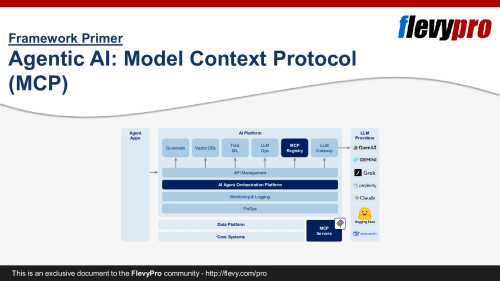
As AI agents spread across organizations, they need access to the tools where work and data already live. Connecting agents to databases, project management platforms, ERP suites, CRM systems, and similar applications remains a major integration hurdle.
This slide deck provides a detailed [read more]
Do You Want to Implement Business Best Practices?
You can download in-depth presentations on Enterprise Architecture and 100s of management topics from the FlevyPro Library. FlevyPro is trusted and utilized by 1000s of management consultants and corporate executives.
For even more best practices available on Flevy, have a look at our top 100 lists:
These best practices are of the same as those leveraged by top-tier management consulting firms, like McKinsey, BCG, Bain, and Accenture. Improve the growth and efficiency of your organization by utilizing these best practice frameworks, templates, and tools. Most were developed by seasoned executives and consultants with over 20+ years of experience.
Readers of This Article Are Interested in These Resources
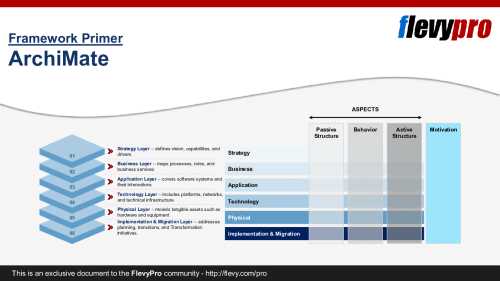
Enterprise Architecture (EA) provides a holistic view of the enterprise strategic, operational, and technical domains. EA provides a clear and comprehensive view of the current state of the enterprise, as well as the desired future state. However, EA initiatives often stall--bogged down by [read more]
Unlocking the Power of Enterprise Architecture: Your Complete Business Toolkit
In today's fast-paced and ever-evolving business landscape, organizations are constantly seeking ways to optimize their operations, enhance their competitive edge, and adapt to the challenges of the digital age. Enter [read more]
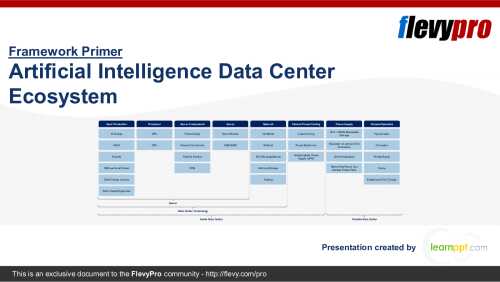
This surge in AI usage stems from its ability to process vast amounts of data and derive insights that can significantly improve efficiency, innovation, and competitiveness.
Critical data center infrastructure plays a foundational role in the deployment and scaling of AI applications. The [read more]
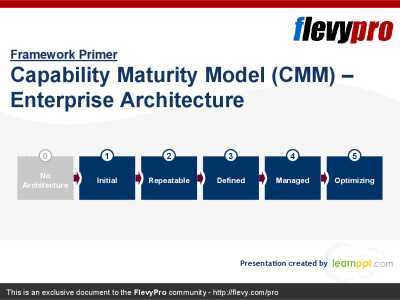
The Capability Maturity Model (CMM) is an organizational model that describes 5 evolutionary stages (or levels), in which the business processes in an organization are managed. The term "maturity" relates to the degree of formality and optimization of processes, from ad hoc practices, to formally [read more]
 For decades, corporate strategy frameworks have treated network infrastructure as operational overhead — a necessary cost controlled by IT departments. That mindset has become a critical liability. Modern enterprises face an unavoidable reality: the network is no longer invisible plumbing. It has become a strategic differentiator directly influencing revenue, customer experience, resilience, and speed to market.
 Architectural Integration: Making Networks Strategic