Editor's Note: Take a look at our featured best practice, Complete Guide to Business Strategy Design (51-slide PowerPoint presentation). Summary: This document provides a framework to design your business strategy.
A key question that every business needs to able to answer is "What is our strategy?"
'Strategy' is part of everyday business language and is often used in the wrong context (e.g. 'Operational [read more]
* * * *
Strategy leaders operate in an awkward moment. AI activity is everywhere. Research teams use it to scan markets. Analysts lean on it for modeling. Planning teams use it to accelerate cycles. Yet many Chief Strategy Officers still report the same unease. The output looks impressive. The decisions do not feel meaningfully better.
The frustration rarely sits with technology. It sits with impact.
Strategy does not fail because leaders lack information. Strategy fails because organizations misdiagnose the problem, narrow options too quickly, commit without alignment, or fail to adapt once execution starts to bend reality. AI only helps when it strengthens those moments. Everything else is noise.
The shift required is conceptual rather than technical. AI should not be framed as a tool that speeds up work. Speed rarely fixes Strategy. AI should be framed as a set of roles that directly reinforce how Strategy gets shaped, tested, committed, and mobilized.
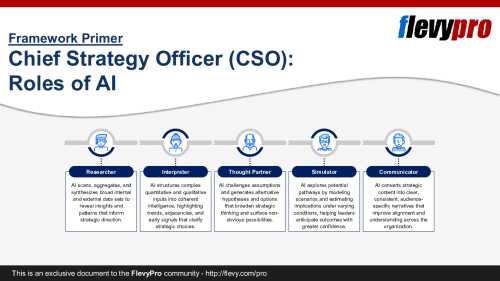
This framework positions AI as 5 distinct roles that map cleanly to the real work of a CSO. Each role strengthens a different cognitive task. Together they form a practical template for embedding AI into Strategy without turning it into a science project.
The Strategic Value of Thinking in Roles
Executives instinctively understand roles. Organizations scale through role clarity. Strategy benefits from the same discipline.
Treating AI as a monolithic capability creates confusion. Teams argue about use cases. Leaders debate risks in the abstract. Adoption stalls because no one knows where AI actually belongs in decision making.
A role based framework changes the conversation. Each role answers a simple question. What part of Strategy does AI strengthen here. When framed that way, value becomes concrete.
The Roles of AI framework defines 5 complementary roles:
Researcher
Interpreter
Thought Partner
Simulator
Communicator
Each role plugs into a recurring friction point in Strategy work. None replaces leadership judgment. All elevate it.
Why This Framework Resonates With Real CSO Work
Strategy leaders juggle ambiguity, pressure, and politics. Frameworks only survive if they reduce friction rather than add ceremony.
This one works because it mirrors how Strategy actually unfolds.
Early phases suffer from narrow inputs and late signals. AI as a Researcher widens the aperture and accelerates discovery.
Mid cycle debates stall when leaders interpret the same data differently. AI as an Interpreter creates shared meaning and reduces circular argument.
Option generation collapses under time pressure. AI as a Thought Partner expands the solution space without slowing momentum.
Commitment suffers when uncertainty feels unquantified. AI as a Simulator previews consequences and sharpens conviction.
Execution falters when Strategy is misunderstood. AI as a Communicator ensures intent travels cleanly across the organization.
Each role addresses a known failure mode. Together they form a system rather than a set of isolated tools.
Strategy in a World That Refuses to Sit Still
Modern Strategy operates under constant motion. Market structures shift mid plan. Regulations evolve without warning. New entrants surface from unexpected adjacencies. Static Strategy cycles crack under this pressure.
AI as a Researcher keeps the organization connected to weak signals as they emerge rather than after they harden.
AI as an Interpreter prevents fragmentation as new data floods in. Leaders stay aligned on what matters even as conditions change.
AI as a Thought Partner keeps creativity alive under pressure. Options expand without devolving into chaos.
AI as a Simulator allows Strategy to flex without panic. Scenarios evolve as reality updates.
AI as a Communicator keeps execution tethered to intent. Strategy stays alive rather than frozen in a deck.
The framework does not promise certainty. It delivers readiness.
Applying the Framework in a Real Strategy Cycle
Consider a CSO navigating a multi market expansion under regulatory uncertainty and shifting demand.
AI as a Researcher scans regulatory developments, customer sentiment, competitor moves, and internal capacity signals simultaneously.
AI as an Interpreter connects those inputs into a clear framing of risk drivers and opportunity zones.
AI as a Thought Partner proposes alternative entry paths including partnerships, phased rollouts, or adjacency plays.
AI as a Simulator models financial and operational outcomes across regulatory timelines and demand scenarios.
AI as a Communicator translates the decision into board ready logic and execution ready guidance.
The leadership team still owns the call. The quality of the call improves because each role strengthens a different moment.
Why This Framework Changes Strategy Team Dynamics
Strategy teams often get trapped producing artifacts rather than influencing decisions.
This framework shifts the role of the team from analysis factory to judgment engine. Fewer slides for their own sake. More orchestration of insight, meaning, options, and commitment.
Skill mix evolves. Curiosity matters more than modeling tricks. Synthesis beats volume. Judgment becomes the differentiator.
The framework also clarifies ownership. Each role has a purpose. Gaps become visible. Redundancies disappear.
Frequently Asked Questions
Does this framework replace traditional Strategy processes?
No. It strengthens them. Existing Strategy cycles remain intact. The framework improves how work flows through them.
Is advanced AI infrastructure required?
No. Framing and usage discipline drive most value. Sophisticated models help but leadership intent matters more.
How should a CSO sequence the roles?
Sequence depends on context. Early ambiguity favors Researcher and Interpreter. High stakes decisions demand Simulator and Communicator strength. Mature teams operate all 5 continuously.
What risks should leaders manage?
Over automation and under accountability. AI informs decisions. Leaders own outcomes.
How does this affect governance?
It improves it. Decisions become better documented. Assumptions stay visible. Adjustments happen earlier.
Reflections From the Strategy Seat
AI will not rescue weak Strategy. It will expose it faster.
The real shift sits in how leaders think together. Shared evidence. Shared meaning. Broader options. Clearer commitments. Cleaner execution.
Organizations that win with this framework will not be the ones with the flashiest tools. They will be the ones that integrate AI roles into how leadership teams operate day to day.
You can download in-depth presentations on this and hundreds of similar business frameworks from the FlevyPro Library. FlevyPro is trusted and utilized by 1000s of management consultants and corporate executives.
For even more best practices available on Flevy, have a look at our top 100 lists:
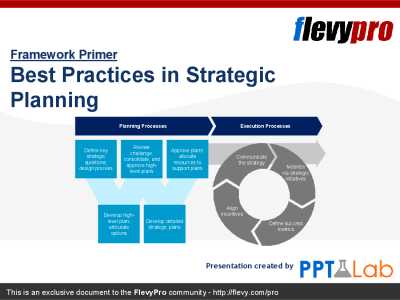
Strategic Planning is an essential tool for organizations aiming to thrive in today's dynamic business environment. It's not just about setting goals--it's also about crafting a roadmap for sustainable success. For executives, understanding and effectively implementing Strategic Planning is crucial [read more]
Readers of This Article Are Interested in These Resources
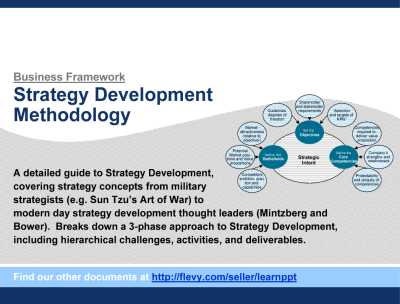
This PowerPoint presentation is a detailed guide to Strategy Development, covering strategy concepts from military strategists (e.g. Sun Tzu's Art of War) to modern day Strategy Development thought leaders (Mintzberg and Bower).
This Strategy Development methodology PPT presentation is divided [read more]
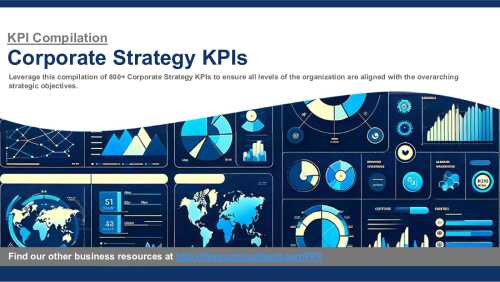
This presentation is a comprehensive collection of Key Performance Indicators (KPI) related to Corporate Strategy. A KPI is a quantifiable measure used to evaluate the success of an organization, employee, or process in meeting objectives for performance.
KPIs are typically implemented at [read more]
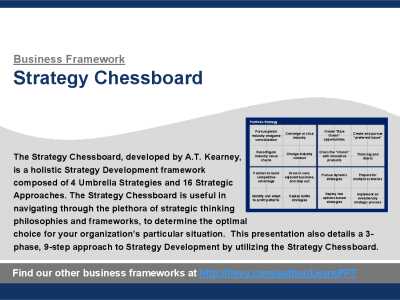
The Strategy Chessboard is a holistic Strategy Development framework developed by A.T. Kearney. It first presents a 2X2 of 4 Umbrella Strategies:
1. Position and Conquer (e.g. Porter's Five Forces, Profit Patterns, Art of War)
2. Redefine the Industry (e.g. Consolidation Curve, Value Chain [read more]
AI is showing up across Strategy teams today, in research tasks, in analysis, and increasingly in day-to-day planning. But even with all this activity, many leaders still feel the impact is uneven. Tools are helpful, but they rarely change how Strategy gets shaped or how decisions ultimately get [read more]
 Strategy leaders operate in an awkward moment. AI activity is everywhere. Research teams use it to scan markets. Analysts lean on it for modeling. Planning teams use it to accelerate cycles. Yet many