Editor's Note: Take a look at our featured best practice, Agentic AI Playbook (562-slide PowerPoint presentation). Curated by McKinsey-trained Executives
Unlock the Future of Business with the Ultimate Agentic AI Playbook: The Only Resource You'll Ever Need to Dominate the AI Revolution
In today's fast-paced, tech-driven world, the companies that stay ahead of the curve are the ones that fully [read more]
* * * *
Most organizations claim they have an Agentic AI strategy. Few can explain it without pulling up a deck. Fewer still can point to sustained operational or financial impact that clearly traces back to it.
What usually exists is a collection of pilots, some analytics wins, a preferred vendor list, and a hope that scale will somehow emerge. Activity looks impressive. Outcomes stay uneven. Leadership confidence erodes quietly.
Agentic AI Strategy exists because intelligence does not scale on enthusiasm alone. Pilots do not coordinate themselves. Tools do not evolve into systems without design. Momentum fades when there is no unifying logic connecting ambition, investment, governance, and leadership behavior into one coherent operating model.
This framework reframes AI strategy as enterprise design. It treats intelligence as infrastructure rather than experimentation. The objective is not smarter models. The objective is an organization that learns faster, adapts continuously, and executes with discipline over time.
The Structural Flaw in Most AI Strategies
Traditional AI strategies tend to answer the wrong question. They ask where AI can be applied instead of how intelligence should flow.
As a result, organizations optimize locally. One function improves forecasting. Another automates customer service. A third deploys copilots. Each initiative delivers value. None compound.
Fragmentation becomes the default. Data standards diverge. Governance lags. Talent concentrates in pockets. Executives struggle to see the whole.
Agentic AI Strategy addresses this structural flaw directly. It focuses on building the conditions that allow AI systems to work together, support employees consistently, and improve decisions over time rather than in bursts .
The shift is subtle and consequential. AI stops being something the organization does and becomes something the organization runs on.
The Core Idea Behind Agentic AI Strategy
At its core, the framework asserts one principle. Intelligence must be designed like infrastructure if it is expected to scale.
Infrastructure is shared. It is governed. It is boring when it works. It is catastrophic when it fails.
Most AI efforts never cross that threshold. They remain exciting, fragile, and isolated.
Agentic AI Strategy introduces a 5-phase blueprint that helps organizations move deliberately from experimentation to endurance. Each phase builds structural capability rather than tactical momentum. Each phase reduces dependency on hero teams and increases institutional reliability.
This is why the framework resonates with executives who have lived through multiple transformation cycles. It acknowledges that scaling intelligence is as much an organizational challenge as a technical one.
The 5 Phases of Agentic AI Strategy
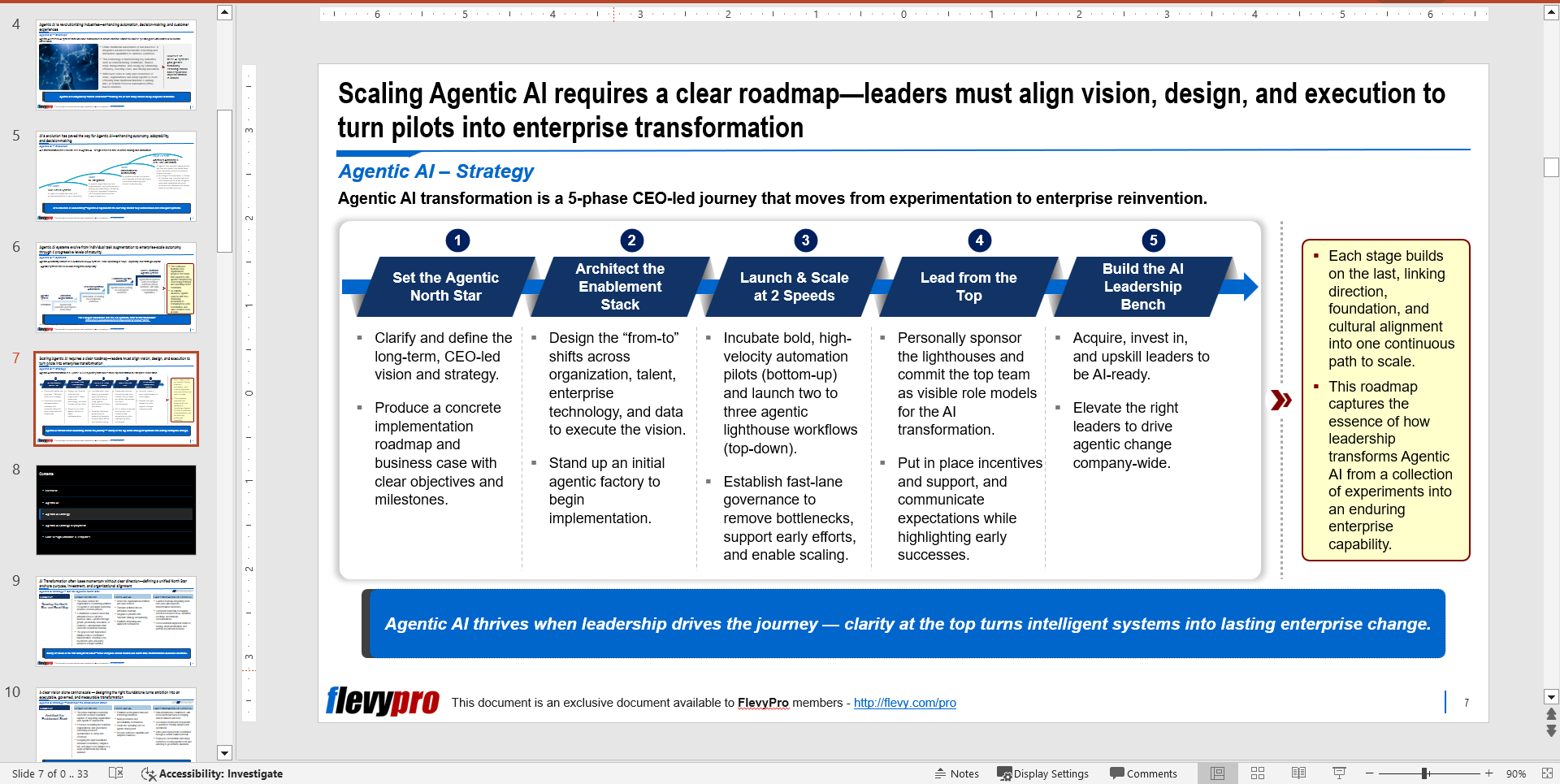
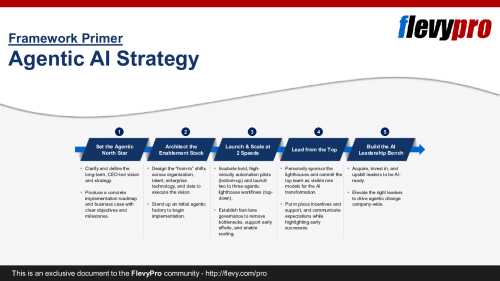
As defined in the framework, Agentic AI Strategy unfolds across 5 reinforcing phases :
Set the Agentic North Star
Architect the Enablement Stack
Launch and Scale at 2 Speeds
Lead from the Top
Build the AI Leadership Bench
These phases are not linear gates. They form a system. Weakness in any one phase eventually undermines the rest.
Organizations that treat them as a checklist stall. Organizations that treat them as an operating logic scale.
What the Slides Are Really Saying
Beneath the structure, the message is blunt. AI transformation loses momentum without clarity, foundations, and visible leadership commitment.
Vision without architecture creates confusion. Architecture without leadership creates resistance. Leadership without capability creates dependency.
The framework also introduces a crucial time horizon. Years 1 to 2 focus on activation and proof. Years 3 to 4 embed Agentic AI into the operating model itself. Confusing these horizons leads to unrealistic expectations and premature disappointment.
This temporal discipline is one of the framework’s most practical contributions. It gives leaders permission to focus on momentum early and mastery later without constantly moving the goalposts.
Why This Framework Is Useful
Agentic AI Strategy forces executives to confront tradeoffs early rather than explaining them later.
The first benefit is coherence. Every pilot, investment, and policy must advance a single narrative. When initiatives compete for funding or attention, the framework provides a disciplined way to prioritize without slowing progress.
The second benefit is governance by design. Responsible AI, data standards, and accountability mechanisms are embedded from the start. This reduces downstream risk and increases executive confidence to scale beyond safe pilots.
The third benefit is credibility. Transformation gains legitimacy when leaders can articulate not just what is happening, but why it fits into a broader strategy and where it is headed.
Consulting teams use this framework as a strategy template. Operators use it as an execution guide. Boards use it to distinguish between activity and institutional change.
Phase 1: Set the Agentic North Star
Let’s take a closer look at the first element of the strategy.
Setting the Agentic North Star defines the organization’s ambition for Agentic AI and aligns leadership around a shared purpose .
This phase answers a deceptively simple question. What role should AI play in how this organization creates value.
Most leadership teams default to broad aspirations. Growth. Productivity. Innovation. Resilience. Saying yes to everything is indistinguishable from having no strategy at all.
The North Star forces focus. It defines the value horizon and clarifies where Agentic AI will lead versus support. It translates ambition into an actionable roadmap that connects short term wins to long term transformation milestones.
Alignment is the real work. Messaging must be consistent across board discussions, capital allocation, talent decisions, and performance reviews. When funding, incentives, and communication reinforce the same story, resistance fades.
Without a North Star, organizations accumulate initiatives without momentum. With it, every effort knows where it fits.
Phase 2: Architect the Enablement Stack
Vision alone never scales.
Architecting the Enablement Stack translates leadership intent into foundations capable of supporting organization-wide Agentic AI deployment .
This phase focuses on building shared data, technology, governance, and operating cores. The goal is not technical elegance. The goal is consistency and trust.
Integrated data backbones replace bespoke pipelines. Governance mechanisms clarify accountability before autonomy expands. A central enablement hub coordinates pilots so learning compounds instead of fragmenting.
Workforce readiness matters just as much. Employees need clarity on guardrails, confidence in tools, and visible leadership support. Adoption accelerates when people understand both the freedom and the boundaries.
Organizations that skip this phase pay for it later, usually after a public failure forces a reactive fix.
Phase 3: Launch and Scale at 2 Speeds
This phase introduces a discipline many organizations struggle to maintain.
Launching and scaling at 2 speeds balances rapid experimentation with controlled scaling .
Teams innovate quickly at the front line. Governance operates deliberately at the center. Successful pilots move into production through clear review and integration pathways.
Speed without control burns out teams and erodes trust. Control without speed kills momentum. The 2-speed model preserves both.
The visible signal of success is not the number of pilots. It is the steady conversion of pilots into core workflows.
Case Study
A diversified services organization illustrates the difference.
Early analytics pilots delivered strong ROI within functions. Leaders declared success. Scaling stalled.
The organization reset around an Agentic AI Strategy. A clear North Star prioritized decision velocity and operational intelligence. A shared enablement stack replaced duplicated tooling. Governance shifted from reactive approval to proactive design.
Within 18 months, pilots transitioned into production workflows across multiple functions. Confidence rose. Scrutiny dropped. AI became boring in the best possible way.
The breakthrough was not technology. It was strategy.
FAQs
Is this strategy only for large organizations?
Scale increases complexity, but fragmentation appears everywhere.
How long before results appear?
Early wins emerge in year 1. Structural impact compounds over time.
Does this replace digital strategy?
No. It integrates and prioritizes existing efforts.
Who owns the strategy?
CEO sponsorship with a dedicated execution leader is essential.
What fails most often?
Stopping after pilots and declaring victory.
Closing Reflections
Agentic AI Strategy surfaces an uncomfortable truth. Intelligence does not scale accidentally. It scales when organizations design for it deliberately.
This framework is less about technology and more about discipline. Discipline in vision. Discipline in architecture. Discipline in leadership behavior.
Organizations that adopt it stop chasing isolated wins. They start building systems that learn.
AI will keep advancing. The real question is whether organizations evolve structurally or continue leaking value through fragmentation.
You can download in-depth presentations on this and hundreds of similar business frameworks from the FlevyPro Library. FlevyPro is trusted and utilized by 1000s of management consultants and corporate executives.
For even more best practices available on Flevy, have a look at our top 100 lists:
Agentic AI represents a shift toward autonomous, intelligent systems that can make decisions and take actions with minimal human intervention. Evolving from traditional machine learning, this technology enhances operations by automating complex workflows, optimizing decision-making, and enabling [read more]
Readers of This Article Are Interested in These Resources
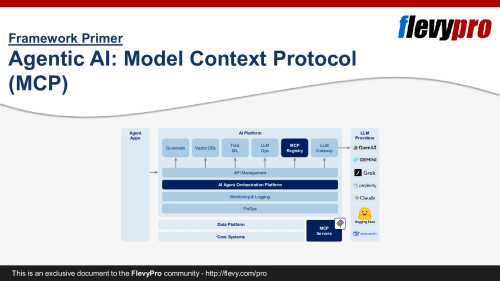
As AI agents spread across organizations, they need access to the tools where work and data already live. Connecting agents to databases, project management platforms, ERP suites, CRM systems, and similar applications remains a major integration hurdle.
This slide deck provides a detailed [read more]
Agentic AI addresses a critical challenge in enterprise adoption: while most organizations achieve early success with individual models, few connect them into cohesive systems that transform business performance.
Traditional automation improves efficiency, yet it rarely redefines how decisions [read more]
Curated by McKinsey-trained Executives
100+ Agentic Organization SOPs Library
Complete AI-First Operating System -- Delivered in a Scalable Excel Template
Build, govern, and scale a fully Agentic Organization with confidence.
This 100+ Agentic Organization SOPs Library is a [read more]
Most organizations have realized wins by developing AI and analytics capabilities. The challenge is scaling those wins so they are seen in operations, customer experience and financial results, however, tools alone rarely deliver that outcome.
An Agentic AI Strategy focuses on building the [read more]
 Most organizations claim they have an