Editor's Note: Take a look at our featured best practice, Agentic AI Playbook (562-slide PowerPoint presentation). Curated by McKinsey-trained Executives
Unlock the Future of Business with the Ultimate Agentic AI Playbook: The Only Resource You'll Ever Need to Dominate the AI Revolution
In today's fast-paced, tech-driven world, the companies that stay ahead of the curve are the ones that fully [read more]
* * * *
Organizations love tools. Dashboards. Bots. Co-pilots. Plug ins everywhere. Many executives feel good when teams adopt generative AI for writing decks, summarizing meetings, or speeding up code reviews. Activity spikes. Demos look slick. Impact stays stubbornly local.
That gap sits at the center of the Agentic AI primer. The framework reframes AI not as a collection of point solutions but as an operating system for work itself. The shift matters because productivity gains at the edges never compound into enterprise performance. Strategy suffers when intelligence remains fragmented.
Agentic AI introduces a different mental model. Autonomous, goal driven agents collaborate with humans and with other agents. They plan, reason, execute, and learn. Work no longer flows through static processes owned by functions. Work flows through intelligent systems that adapt in real time.
This framework describes how organizations evolve from isolated AI usage into agent first enterprises. The progression is deliberate. Each stage expands scope, autonomy, and strategic relevance. Skipping stages rarely works. Over engineering too early creates chaos. Under investing stalls momentum.
The prize is not efficiency theater. The prize is an organization that learns faster than its environment.
Why This Framework Exists Now
Three forces collide. Compute costs drop fast. Models reason better. Capital floods the ecosystem. None of that guarantees results inside an organization. Without a coherent template for scale, AI adoption plateaus.
Agentic AI addresses the structural problem. Traditional automation improves throughput but preserves old decision logic. Generative AI improves individual productivity but rarely changes how value moves. Agentic systems rewire coordination itself.
A modern example plays out in customer operations. Many organizations deploy chatbots to deflect calls. Savings show up early. Frustration rises. Customers escalate. Costs creep back. An agentic approach looks different. Agents coordinate across service, billing, logistics, and finance. Issues resolve end to end. Root causes surface. Policies adjust. The system learns. Cost drops stay dropped.
That difference explains the urgency behind the framework.
The Agentic AI Maturity Continuum
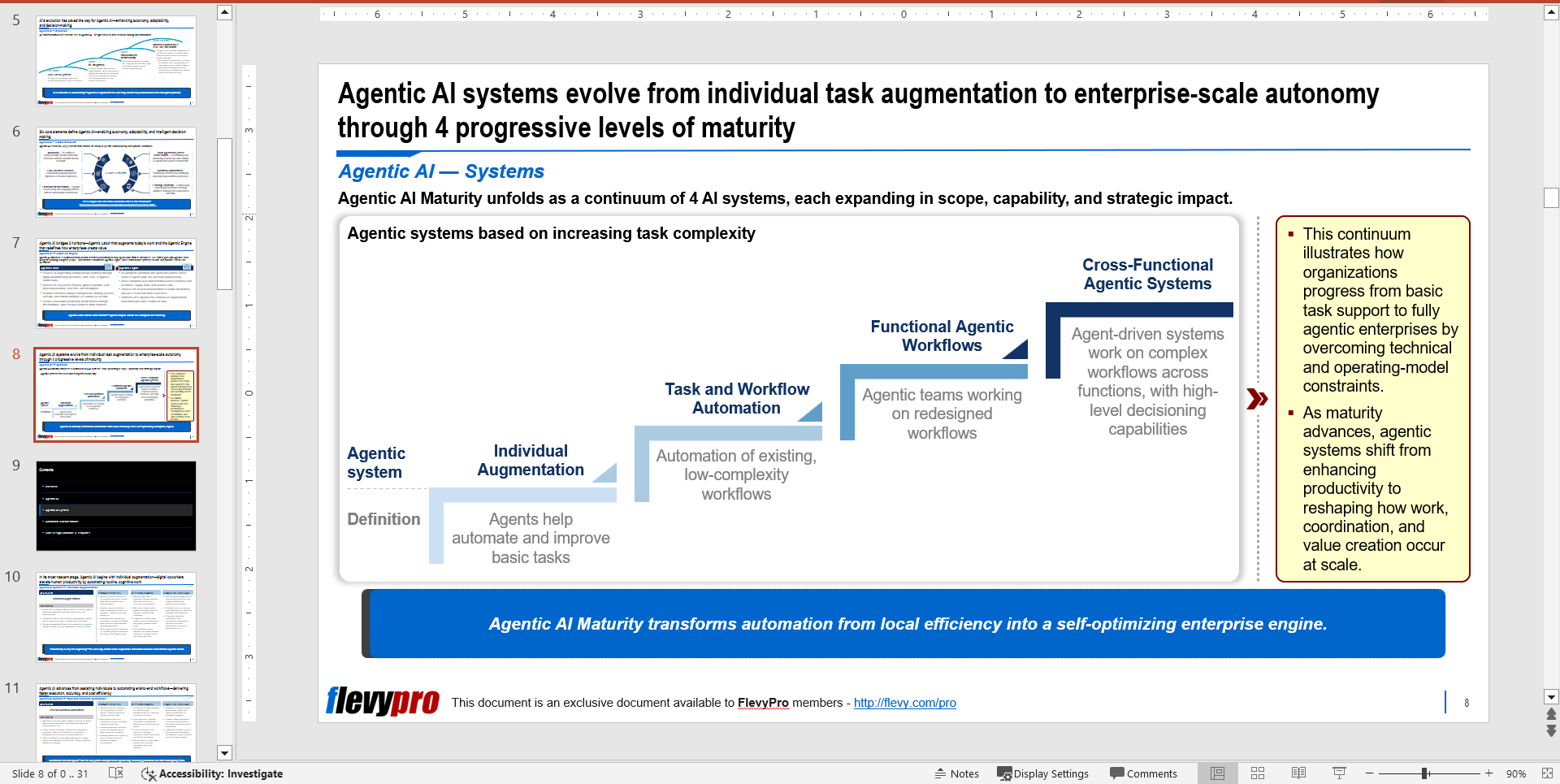
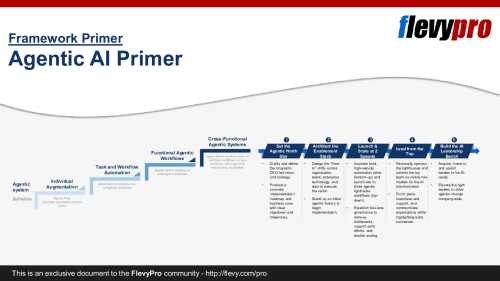
As defined in this framework, Agentic AI maturity unfolds across 4 systems, each building on the last :
Individual Augmentation
Task and Workflow Automation
Functional Agentic Workflows
Cross Functional Agentic Systems
Each system expands intelligence horizontally and vertically. Horizontal expansion connects tasks into workflows. Vertical expansion shifts decision making from humans to agents to systems.
The continuum matters because organizations stall when they treat maturity levels as optional features rather than structural phases.
What the Slides Are Really Saying
The underlying message is blunt. Early wins do not equal transformation. Individual augmentation delivers speed. Automation delivers cost reduction. Neither changes how an organization thinks.
The framework highlights two horizons. Agentic Labor augments today’s work. Agentic Engine redefines how value is created. Most organizations hover in the first horizon far longer than leaders expect. The second horizon requires operating model change, not just better models.
Another thread runs through the material. Scale depends less on algorithms and more on governance, orchestration, and leadership behavior. Agents fail silently when accountability stays fuzzy. They thrive when outcomes replace activities as the unit of management.
Why This Framework Is Useful
Executives struggle with AI because strategy conversations collapse into technology debates. Which model. Which vendor. Which stack. The framework recenters the discussion on system design and value flow.
The first benefit lies in sequencing. Leaders gain a clear roadmap that aligns ambition with readiness. This prevents two classic failures. One involves boiling the ocean with cross functional agents before data and workflows are stable. The other involves endless pilots that never escape functional silos.
The second benefit shows up in governance. Agentic systems blur traditional lines of control. The framework forces early decisions about decision rights, escalation logic, and human oversight. Governance becomes an enabler instead of a brake.
The third benefit is cultural. Teams understand where they are headed and why today’s discomfort matters. Adoption improves when people see augmentation as a stepping stone rather than a dead end.
Consulting teams use this framework as a diagnostic template. Operators use it as a build guide. Boards use it to separate signal from noise.
Individual Augmentation: Where Momentum Starts
Individual Augmentation marks the entry point. Agents assist employees with cognitive tasks. Summaries, drafts, research, code generation. Productivity lifts land fast. Roughly 20 to 30 percent improvements are common.
The real value sits beneath the surface. Cognitive load drops. Decision quality improves through standardized outputs. Professionals spend more time on judgment and less on mechanical work.
Constraints appear just as fast. Adoption decays without reinforcement. Early enthusiasts race ahead. Others disengage. Security friction slows integration. The organization celebrates pockets of excellence while enterprise impact stays muted.
Scaling this stage requires intent. Agents must live inside core workflows. Usage ties to performance outcomes. Leaders model behavior visibly. Training shifts from one time sessions to continuous coaching.
This stage builds fluency. It does not deliver transformation. Treating it as an end state is a strategic error.
Task and Workflow Automation: Speed With Limits
The next system moves from helping people to running processes. Agents automate approvals, scheduling, reporting, data entry. Cycle times drop. Error rates fall. Costs shrink.
Value creation becomes measurable. Dashboards light up. Finance smiles.
The critical shift involves redesign. Automating broken workflows locks in inefficiency. Agentic logic demands rethinking sequence, ownership, and feedback loops.
Organizations that succeed treat this stage as a bridge. Automation creates capacity. Capacity funds redesign. Redesign sets the stage for agent collaboration.
Case Study
A global logistics organization illustrates the arc. Stage one involved individual agents for planners. Forecast reviews sped up. Errors dropped. Adoption plateaued.
Stage two automated booking and documentation workflows. Throughput improved. Customer complaints declined modestly.
The breakthrough came at stage three. The organization redesigned planning as a functional agentic workflow. Demand sensing agents, capacity agents, pricing agents coordinated continuously. Humans supervised exceptions. Cycle times fell by half. Margin leakage shrank. Customers noticed.
Cross functional expansion now connects sales, operations, and finance. Decisions propagate instantly. The organization manages intelligence, not tasks.
FAQs
What differentiates Agentic AI from traditional automation?
Traditional automation follows predefined rules. Agentic systems pursue goals, adapt plans, and learn from outcomes.
Can organizations skip directly to cross functional agentic systems?
Rarely. Data readiness, governance, and trust usually lag ambition.
Where should the CEO engage personally?
Vision setting, lighthouse sponsorship, and incentive alignment. Delegation fails here.
How does this framework reduce AI risk?
Clear maturity stages force governance, oversight, and accountability decisions early.
What breaks most implementations?
Treating technology as the hard part and change as an afterthought.
Closing Reflections
Agentic AI exposes an uncomfortable truth. Most organizations are optimized for control, not learning. Agents amplify that tension. Systems that reward compliance suffocate autonomy. Systems that reward outcomes unleash it.
The framework provides more than structure. It provides permission to rethink how work coordinates. Leaders who embrace it stop asking how AI fits existing processes. They ask which processes deserve to survive.
Intelligence at scale changes power dynamics. Decisions move closer to data. Hierarchies flatten. Roles evolve. Resistance is rational. Ignoring the shift is reckless.
Agentic AI will not replace leadership. It will expose it.
You can download in-depth presentations on this and hundreds of similar business frameworks from the FlevyPro Library. FlevyPro is trusted and utilized by 1000s of management consultants and corporate executives.
For even more best practices available on Flevy, have a look at our top 100 lists:
Agentic AI represents a shift toward autonomous, intelligent systems that can make decisions and take actions with minimal human intervention. Evolving from traditional machine learning, this technology enhances operations by automating complex workflows, optimizing decision-making, and enabling [read more]
Readers of This Article Are Interested in These Resources
As AI agents spread across organizations, they need access to the tools where work and data already live. Connecting agents to databases, project management platforms, ERP suites, CRM systems, and similar applications remains a major integration hurdle.
This slide deck provides a detailed [read more]
Agentic AI addresses a critical challenge in enterprise adoption: while most organizations achieve early success with individual models, few connect them into cohesive systems that transform business performance.
Traditional automation improves efficiency, yet it rarely redefines how decisions [read more]
Curated by McKinsey-trained Executives
100+ Agentic Organization SOPs Library
Complete AI-First Operating System -- Delivered in a Scalable Excel Template
Build, govern, and scale a fully Agentic Organization with confidence.
This 100+ Agentic Organization SOPs Library is a [read more]
Most organizations have realized wins by developing AI and analytics capabilities. The challenge is scaling those wins so they are seen in operations, customer experience and financial results, however, tools alone rarely deliver that outcome.
An Agentic AI Strategy focuses on building the [read more]
 Organizations love tools. Dashboards. Bots. Co-pilots. Plug ins everywhere. Many executives feel good when teams adopt generative AI for writing decks, summarizing meetings, or speeding up code reviews. Activity spikes. Demos look slick. Impact stays stubbornly local.