 Payment systems are rarely built from scratch. Most modern platforms depend on third-party gateways, layered APIs, and internal billing logic integrated over time. While transactions process, users are charged, and reports appear accurate, this surface stability can be misleading.
However, small inconsistencies can accumulate beneath the surface.
A delayed webhook, duplicated request, or rounding mismatch may not cause immediate failure. Instead, these issues can lead to lost revenue, incorrect balances, or unnoticed failed refunds.
A specialized code audit is essential in these situations.
Many teams turn to a code audit company when they begin to suspect that their payment flow is “mostly working” — but not entirely reliable. And in financial systems, “mostly” is not good enough.
Why Payment Integrations Are Especially Vulnerable
Unlike other features, payment logic sits at the intersection of multiple systems:
- Frontend checkout flows
- Backend services
- External payment providers
- Webhooks and asynchronous events
- Internal accounting or reporting tools
Each layer introduces its own risks.
For example:
- A payment succeeds, but the webhook fails to update the database
- A retry mechanism triggers duplicate charges
- Currency conversions introduce rounding errors
- Refund logic behaves differently across providers
These issues don’t always trigger alerts. Often, they surface weeks later — during reconciliation.
A code audit helps identify these weak points before they affect real money.
What a Code Audit Focuses on in Payment Flows
Auditing payment integrations is not just about security. It’s about correctness, consistency, and resilience.
1. Transaction Lifecycle Integrity
Every payment follows a lifecycle:
- Initiation
- Authorization
- Capture
- Settlement
- Refund (if needed)
An audit verifies that each stage is:
- Properly handled
- Logged and traceable
- Consistent across all flows
Even a small gap in this lifecycle can lead to financial discrepancies.
2. Idempotency and Duplicate Prevention
One of the most common issues in payment systems is duplicate execution.
This often happens when:
- Network timeouts trigger retries
- Users refresh the page during checkout
- Webhooks are delivered multiple times
A proper code audit checks:
- Whether idempotency keys are implemented correctly
- If duplicate transactions are safely ignored
- How the system behaves under repeated requests
3. Webhook Reliability
Webhooks are inherently unreliable:
- They may arrive late
- They may arrive multiple times
- They may not arrive at all
Auditors look for:
- Retry mechanisms
- Signature validation
- Fallback strategies
Systems that depend entirely on webhooks without safeguards are fragile by design.
4. Currency and Rounding Logic
Handling money requires precision.
Common pitfalls include:
- Floating-point errors
- Inconsistent rounding rules
- Mismatched currency formats
A code audit ensures:
- All calculations use appropriate data types
- Currency conversions are consistent
- Totals match across systems
5. Error Handling and Recovery
Not all payment failures are final.
Some require:
- Retrying
- User intervention
- Manual review
An audit evaluates:
- Whether failures are properly categorized
- If the retry logic is safe and controlled
- How the system recovers from partial success scenarios
Hidden Issues That Often Go Undetected
Payment systems can appear stable while hiding serious problems.
Silent Revenue Loss
Transactions fail internally but are not retried or flagged.
Double Charges
Duplicate requests result in multiple successful payments.
Inconsistent Refund States
Refund is processed externally but not reflected internally.
Reconciliation Gaps
Reports don’t match actual transaction records due to missing updates.
A thorough code audit connects these issues across services — something that logs alone rarely reveal.
When to Perform a Code Audit for Payment Systems
Timing is critical.
Recommended moments include:
- Before scaling transaction volume
- After integrating a new payment provider
- When discrepancies appear in financial reports
- Before compliance or financial audits
Waiting until users report issues often means the problem has already grown.
Practical Audit Checklist for Payment Integrations
A focused checklist helps ensure nothing is overlooked.
Transaction Handling
- Are all payment states tracked correctly?
- Is every transaction traceable end-to-end?
Security
- Are API keys and secrets securely stored?
- Are webhook signatures validated?
Consistency
- Do internal records match external provider data?
- Are retries handled without duplication?
Performance
- Can the system handle spikes in payment volume?
- Are timeouts managed properly?
Observability
- Are failed transactions clearly logged?
- Are alerts triggered for anomalies?
Tools vs. Manual Review
Automated tools can:
- Detect vulnerabilities
- Check for insecure configurations
- Validate dependency risks
But they cannot fully understand:
- Business logic
- Payment flows across services
- Edge cases in transaction handling
Human review is essential in any serious code audit, especially in financial systems where logic matters more than syntax.
How a Code Audit Improves Financial Reliability
After a proper audit, teams often notice:
- Fewer payment-related support issues
- More accurate financial reporting
- Reduced risk of duplicate or failed transactions
- Faster debugging when issues occur
In short, the system becomes predictable — which is exactly what financial operations require.
External Perspective in Payment Audits
Internal teams often know their system too well. That familiarity can make certain issues invisible.
This is why some organizations involve external experts. For example, DevCom has supported teams in reviewing complex payment integrations, especially where multiple gateways and custom billing logic are involved.
An external perspective can highlight:
- Hidden assumptions
- Overlooked edge cases
- Architectural weaknesses
Still, the goal is not outsourcing responsibility — but strengthening it.
Common Mistakes in Payment Code Audits
Even experienced teams can miss key aspects.
Typical mistakes include:
- Focusing only on successful transactions
- Ignoring webhook failure scenarios
- Overlooking retry logic
- Not testing real-world edge cases
- Treating audits as one-time checks
Payment systems evolve constantly — audits should too.
Conclusion: Financial Accuracy Requires Invisible Discipline
Payment integrations are deceptively complex. When they work, they feel simple. When they fail, the consequences are immediate and costly.
A well-executed code audit ensures every transaction is handled correctly, not only in ideal conditions but also in real-world scenarios where delays, retries, and failures occur.
By reviewing the entire payment lifecycle, identifying hidden inconsistencies, and strengthening system resilience, teams can shift from reactive fixes to proactive reliability.
In financial systems, trust is built quietly, one correct transaction at a time.
Do You Want to Implement Business Best Practices?
You can download in-depth presentations on Audit Management and 100s of management topics from the FlevyPro Library. FlevyPro is trusted and utilized by 1000s of management consultants and corporate executives.
For even more best practices available on Flevy, have a look at our top 100 lists:
These best practices are of the same as those leveraged by top-tier management consulting firms, like McKinsey, BCG, Bain, and Accenture. Improve the growth and efficiency of your organization by utilizing these best practice frameworks, templates, and tools. Most were developed by seasoned executives and consultants with over 20+ years of experience.
Readers of This Article Are Interested in These Resources
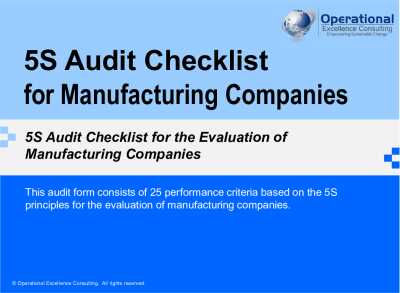
Excel workbook
5S AUDIT CHECKLIST & PERFORMANCE TOOLKIT (FOR MANUFACTURING)
Score, visualize, and track your workplace 5S performance -- without building the spreadsheet yourself.
The 5S Audit Checklist Toolkit is a comprehensive resource designed to help manufacturing teams evaluate and improve
[read more]
129-slide PowerPoint presentation
The ISO 19011:2018 standard offers guidance on auditing management systems, covering principles of auditing, managing an audit program, conducting management system audits, and evaluating the competence of individuals involved in the audit process. This standard is applicable to all organizations
[read more]
60-slide PowerPoint presentation
The Financial Statement Auditing -- Practitioner's Guide (2026 Edition) by Patrick Gitau is a practice-oriented reference designed to help auditors, finance professionals, board members, and regulators understand and implement world-class financial statement audits aligned with global
[read more]
Excel workbook
Functional and Physical Configuration Audit Checklist
A Functional Configuration Audit (FCA) is a CM audit that verifies that the functions of the as-built product match the baselined functional requirements and that the operational and support documentation is complete and satisfactory.