Editor's Note: Take a look at our featured best practice, Effective Communication with Virtual Teams (23-slide PowerPoint presentation). The number of people working remotely has been increasing progressively across the globe. An employee benefits report narrates that around 60% companies in the US offer telecommuting opportunities. According to Upwork, freelancers and contractors have increased by 81% from 2014 to 2017. [read more]
* * * *
Ah, compensation fairness at scale. One of the most challenging issues in contemporary workforce design, and global, remote-first companies frequently think they have a solution for it.
The reasoning seems sophisticated enough – establish location-based pay bands, compare them to data from the local market, and make sure every hire receives a competitive salary within their region. The recruiting process usually organized, just, and defendable.
Nevertheless, there is a fundamental flaw in this assumption. In reality, compensation fairness operates like a system that is constantly modified by outside influences, but it is frequently viewed as a one-time design choice.
Subtle but significant changes build up over time. Exchange rates fluctuate. There are regional variations in inflation. Macro conditions change. With little modification, salaries are still fixed in terms of local currency.
Currency volatility introduces a form of invisible inequality in remote teams, often emerging slowly enough that organizations only recognize it after it has already influenced outcomes.
How Multi-Currency Payroll Drift Actually Happens
The mechanics behind this issue are straightforward, yet rarely observed through a unified organizational lens. Fragmentation across HR, finance, and operations often obscures the full picture.
1. Salaries Are Set in Local Currency
Most global companies pay employees in their local currency. A developer in Poland is paid in PLN, a designer in Brazil in BRL, and an engineer in Germany in EUR. Each salary is typically anchored to local market benchmarks at the time of hiring.
At this stage, internal fairness appears resolved. The system is clear, structured, and easy to administer.
2. Exchange Rates Begin to Move
Currencies fluctuate continuously due to inflation differentials, interest rate changes, geopolitical risk, trade balances, and broader macroeconomic cycles.
These shifts tend to unfold gradually. The slow pace of change makes them easy to overlook, particularly in organizations focused on quarterly or annual cycles.
3. Real Compensation Diverges without Any Salary Change
Nominal salaries remain unchanged in local currency terms. Their relative value across the global organization begins to shift.
Two employees performing identical roles, delivering equivalent output, and operating at the same organizational level may experience different real compensation trajectories simply due to currency denomination differences.
No internal compensation decision causes this divergence. No policy update triggers it. The effect emerges externally and compounds internally over time.
Where the Hidden Inequality Actually Shows Up
This drift rarely appears directly in systems or dashboards. Instead, it becomes visible through behavioral patterns and organizational signals.
In globally connected remote environments, employees compare compensation across regions more frequently than organizations anticipate. These comparisons often evolve from curiosity into structured benchmarking.
Even when local market alignment remains accurate, perceived fairness weakens when global visibility increases without contextual explanation.
Recent updates in reputable global payroll services close this gap by introducing transparent, role-based compensation frameworks that clearly explain how geography, cost of living, and market demand influence pay decisions.
By pairing visibility with context, organizations can preserve trust while operating across borders, ensuring that increased transparency strengthens – not undermines – perceptions of fairness.
Retention Pressure in Volatile Economies
Employees in countries experiencing currency depreciation often experience gradual reductions in purchasing power relative to peers in stronger currencies. The effect tends to build slowly, influencing long-term retention decisions without immediate signals.
Attrition patterns begin to cluster in specific geographies, often without an obvious performance or hiring explanation.
Budget Asymmetry for Employers
Currency fluctuations influence consolidated payroll costs when viewed in a reporting currency. These financial impacts are frequently analyzed separately from employee experience.
A favorable FX movement may reduce reported costs while simultaneously contributing to internal dissatisfaction elsewhere in the organization.
Cultural Friction in “One Team” Narratives
Many organizations emphasize a unified global workforce. Compensation divergence created by currency shifts introduces tension between that narrative and employee experience.
Currency-driven compensation drift often persists unnoticed due to structural separation between functions and measurement systems.
Key contributing factors include:
Fragmented ownership of compensation data across HR, finance, and payroll providers
Compensation cycles that operate on annual or semi-annual schedules, while currency markets move continuously
Local optimization practices that prioritize regional competitiveness over global consistency
Early-stage organizational simplicity that masks cross-border differences
Lack of standardized metrics for tracking global pay equity over time
Limited integration between financial risk monitoring and compensation design
Each function observes a portion of the system. The combined effect remains largely untracked.
The Tipping Point: When Leadership Finally Notices
Currency-driven compensation drift rarely appears as a single, isolated issue. It surfaces through secondary indicators that initially seem unrelated.
Common signals include:
Concentrated attrition within specific countries or regions
Increased frequency of compensation-related concerns during performance cycles
Difficulty hiring in regions where offers remain competitive on paper but lose perceived value in practice
Internal benchmarking exercises revealing widening gaps between similarly leveled employees
Growing demand from managers for clarification on global compensation fairness
Informal employee comparisons surfacing inconsistencies across geographies
By the time these patterns become visible, the underlying divergence has typically been developing over multiple cycles.
The accumulation effect often surprises leadership teams because no single decision appears responsible.
Strategic Responses to Currency-Driven Pay Inequality
There is no universally optimal approach. Organizations typically navigate trade-offs between equity, predictability, cost control, and operational complexity.
1. FX-Aware Compensation Adjustments
Some organizations introduce recalibration rules triggered when currency movements exceed defined thresholds.
This approach helps reduce long-term drift while introducing additional governance requirements and communication considerations.
This structure improves global comparability while introducing variability into local expectations when adjustments occur.
3. FX Bands and Guardrails
Instead of reacting to every market movement, organizations define acceptable variance ranges within which compensation differences can persist without adjustment.
This approach introduces controlled flexibility while limiting extreme divergence.
4. Transparency-First Compensation Communication
Clear communication around compensation philosophy reduces ambiguity. When employees understand how currency affects pay structures, perceived fairness tends to improve even when structural differences remain.
Transparency does not eliminate disparity, but it reduces interpretive uncertainty.
Common Design Patterns in Mature Global Compensation Models
Organizations that actively address this challenge tend to incorporate combinations of the following elements:
A defined global compensation philosophy outlining local versus global equity priorities
A base currency framework for internal benchmarking and modeling
Scheduled FX adjustment mechanisms tied to macroeconomic thresholds
Formal communication guidelines explaining currency-related compensation impacts
Scenario modeling for currency volatility across key operating regions
Periodic audits of pay equity across comparable roles and levels
These mechanisms function best when treated as a system rather than isolated policies.
Implications for Global Workforce Design
Currency volatility highlights structural realities within distributed organizations. Compensation systems operate within a macroeconomic environment that changes continuously and unevenly across regions.
As global teams expand, compensation design increasingly intersects with financial system design, requiring consideration of:
ongoing exchange rate variability
divergence in regional purchasing power
long-term equity perception across distributed teams
retention sensitivity linked to local economic conditions
compounding effects of time on static salary structures
interactions between financial reporting and human capital strategy
Failure to account for these dynamics does not remove their influence. It allows their effects to accumulate quietly until they shape organizational outcomes in ways that appear sudden but are structurally gradual.
Conclusion: Fairness as a Continuous Calibration Problem
Remote-first organizations often approach compensation fairness as a goal achieved through initial design and benchmarking.
In reality, external economic forces that change over time are regularly addressed by worldwide compensation systems.
The incremental changes brought about by currency volatility have an impact on organizational cohesion, retention trends, and perceived equity throughout the course of compensation cycles.
Workforce dynamics are shaped by these changes over time in ways that are rarely attributable to a single choice or instance.
Clear communication, systematic monitoring, and continuous calibration are all beneficial to global compensation design. Without these components, minor external shifts add up to major internal variations that are hard to identify until they become strategically important.
To quote, Richard Branson, a British business and philanthropist, "One day, offices will be a thing of the past."
While organizations still need to travel to reach their physical offices, the rapid changes in the world is requiring businesses to form Virtual Teams. A Virtual Team refers to a [read more]
Do You Want to Implement Business Best Practices?
You can download in-depth presentations on Remote Work and 100s of management topics from the FlevyPro Library. FlevyPro is trusted and utilized by 1000s of management consultants and corporate executives.
For even more best practices available on Flevy, have a look at our top 100 lists:
These best practices are of the same as those leveraged by top-tier management consulting firms, like McKinsey, BCG, Bain, and Accenture. Improve the growth and efficiency of your organization by utilizing these best practice frameworks, templates, and tools. Most were developed by seasoned executives and consultants with over 20+ years of experience.
Readers of This Article Are Interested in These Resources
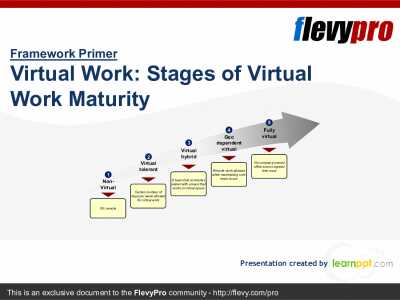
Virtual Work has become the trend of the future. In fact, 37% of the offices globally are working on hybrid-remote arrangements while 26% are 100% remote with people working in their own time. There is also about 25% of the companies that allow or tolerate virtual work with 12% that is 100% [read more]
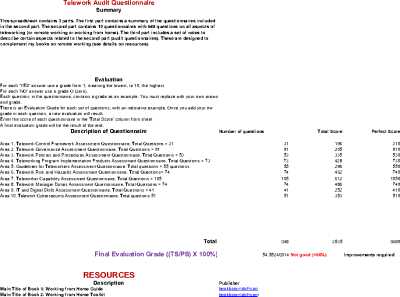
The purpose of this tool (spreadsheet) is to review, audit, assess and improve all teleworking aspects of companies, organizations and remote workers.
This spreadsheet contains 3 parts. The first part contains a summary of the questionnaires included in the second part. The second part [read more]
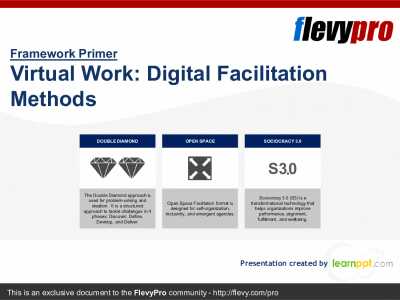
The global COVID-19 pandemic has forced organizations to rapidly adopt virtual work environments, making it the new norm. Digital Collaboration Platforms have been pivotal in the current scenario and have forever changed future work environment. Digital Collaboration Platforms is the new wave in [read more]
The global COVID-19 pandemic has forced organizations to rapidly adopt virtual work environments, making it the new norm. Digital Collaboration Platforms have been pivotal in the current scenario and have forever changed future work environment.
Digital Facilitation has its own set of [read more]
 Ah, compensation fairness at scale. One of the most challenging issues in contemporary workforce design, and global, remote-first companies frequently think they have a solution for it.