Editor's Note: Take a look at our featured best practice, Business Process Outsourcing (BPO) Sales Deck (20-slide PowerPoint presentation). This document includes a set of slides on Business Process Outsourcing (BPO), often called BPO or just Outsourcing. BPO is typically the primary revenue stream for full service consulting firms (e.g. Accenture, Deloitte, IBM). These slides were originally developed to be included in sales decks [read more]
* * * *
Most organizations put enormous effort into designing how they work. They map out workflows, restructure teams, invest in digital transformation, and spend months refining their operating model. And then reality sets in.
Because here’s something that doesn’t get said enough: a well-designed operating model and a well-executed one are two very different things. Designing the model is the easier part. Actually running it is where most organizations start to struggle. That’s exactly where outsourced business processes come in, not as a shortcut, but as a structural solution to a genuine execution problem.
What an Operating Model Is Actually Trying to Do
Think of your operating model as the bridge between your strategy and your day-to-day reality. It answers the question: how does work actually get done around here?
Done well, it aligns your people, processes, and systems toward a common purpose. It defines how work flows across the organization, where accountability sits, and how you maintain performance as things grow. It’s not glamorous work, but it’s foundational. Without it, even the smartest strategy stays stuck on a slide deck.
Where Things Start to Break Down
Most operating models don’t fail because of bad design. They fail because of execution.
As your organization grows, complexity grows with it. What worked with a team of twenty becomes a bottleneck with a team of two hundred. Processes that were once manageable start requiring more hands, more oversight, more coordination. Internal teams—already stretched across competing priorities—start handling volume spikes reactively rather than systematically.
This is where inconsistency creeps in. Exceptions get handled differently depending on who’s working that day. Service levels drift. Errors in areas like accounts payable/receivable, payroll processing, or data entry start accumulating quietly until they become visible problems. And through all of this, your people are spending more energy maintaining operations than improving them.
Why Execution Is the Real Measure of Operational Success
There’s a meaningful difference between designing a process and delivering it reliably.
Execution capability is what determines whether your operating model performs. You can have perfectly documented workflows, but if the people responsible for running them are under-resourced or constantly context-switching, performance suffers.
This is especially true for high-volume, repeatable functions: customer support, claims management, financial services processing, recruitment process outsourcing, and similar workflows that require consistency at scale.
Volume and variability are the real tests. Most internal teams are optimized for average demand. They’re not built to absorb sudden peaks without impact to quality or turnaround time.
Where Business Process Outsourcing Fits In
Business Process Outsourcing isn’t about handing over strategy or decision-making. It’s about strengthening the execution layer of your operating model with dedicated, structured delivery.
A BPO partner brings specialized expertise and dedicated resources to the repeatable workflows that are critical to your operation but don’t require internal ownership. That might be your contact center operations, healthcare claims processing, supply chain management functions, or back-office processing tasks.
The key is that these processes get the focused attention they need, with proper governance structures, service level agreements, and performance baselines built in from the start.
What this does for your operating model is significant. It separates the functions that require internal leadership and judgment from those that require reliable, repeatable execution. Both matter; they just don’t need to live in the same team.
Scalability without the Growing Pains
One of the most practical benefits of BPO is what it does for scalability. When demand increases, you don’t have to build internal headcount from scratch. Your BPO partner absorbs the volume. When demand eases, you’re not carrying fixed costs that no longer make sense.
This kind of workforce optimization gives your organization genuine flexibility. Variable costs replace fixed ones in areas where predictability is difficult, and you retain the ability to scale up or down without the operational disruption that usually comes with it.
Reducing Risk through Structured Delivery
Inconsistency is a form of operational risk, and it’s one that often goes unmeasured until it causes a visible problem. Structured BPO delivery reduces that risk through process standardization, automation tools, and clear accountability at every stage.
For organizations in regulated industries, this matters especially. Consistent execution supports compliance requirements, audit trails, and the kind of documentation that protects the business. It also maintains continuity during disruptions that would otherwise destabilize internal teams.
Making It Work
The organizations that get the most from BPO are the ones that treat it as integration, not abdication. Internal teams retain ownership of strategy and critical decision-making. The BPO partner handles defined execution responsibilities with clear KPIs, transparent reporting, and aligned communication.
This model works because the boundaries are clear. Everyone knows what they own, how performance is measured, and how the handoffs work. That clarity is what keeps the broader operating model coherent.
From Design to Delivery
Designing an operating model is a starting point. The organizations that sustain performance over time are the ones that close the gap between how they intended to work and how they work.
Business Process Outsourcing is one of the more practical tools available for doing exactly that. It doesn’t replace your strategy or your systems. It ensures that the processes supporting them are executed with the consistency, capacity, and control your operating model was designed to deliver.
Frequently Asked Questions
Q1: What is an operating model in business?
An operating model is the framework that defines how an organization delivers on its strategy. It covers how people, processes, and systems are structured, how work flows across teams, and how performance and accountability are managed day to day. It’s the practical infrastructure that sits between strategy and execution.
Q2: Why do operating models fail to deliver expected results?
Most operating models fail not because of flawed design, but because of execution gaps. As organizations grow, internal teams face increasing complexity, limited capacity, and inconsistent handling of high-volume processes. The model may be well-designed on paper, but without reliable execution capability, performance degrades over time.
Q3: How do outsourced business processes support operational performance?
Outsourced business processes provide dedicated resources and structured delivery for repeatable, high-volume functions. This ensures consistency, reduces error rates, and maintains service levels—even as demand fluctuates. It removes execution pressure from internal teams so they can focus on higher-value work.
Q4: When should organizations consider outsourcing business processes?
The right time to consider BPO is typically when internal teams are struggling to maintain quality under volume, when operational complexity is increasing faster than internal capacity, or when the organization is scaling into new markets or services. It’s also worth evaluating when fixed costs in operational functions are limiting financial flexibility.
Q5: How does outsourcing improve scalability within an operating model?
BPO allows organizations to scale operations without proportionally increasing internal headcount. Because BPO partners are structured to handle variable volumes, organizations can respond to demand fluctuations quickly — absorbing peaks and reducing capacity during quieter periods — without the disruption or cost that typically accompanies internal scaling.
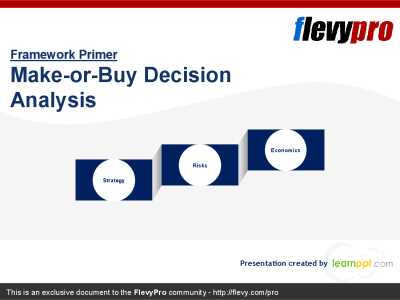
As organizations are being put under increasing pressure to cut expenses and improve return on assets, the dilemma of whether to keep key functions in-house or outsource them has taken center stage.
Manufacturing units are being identified with Make-or-Buy Decisions as third-party suppliers in [read more]
Do You Want to Implement Business Best Practices?
You can download in-depth presentations on Business Process Outsourcing and 100s of management topics from the FlevyPro Library. FlevyPro is trusted and utilized by 1000s of management consultants and corporate executives.
For even more best practices available on Flevy, have a look at our top 100 lists:
These best practices are of the same as those leveraged by top-tier management consulting firms, like McKinsey, BCG, Bain, and Accenture. Improve the growth and efficiency of your organization by utilizing these best practice frameworks, templates, and tools. Most were developed by seasoned executives and consultants with over 20+ years of experience.
Readers of This Article Are Interested in These Resources
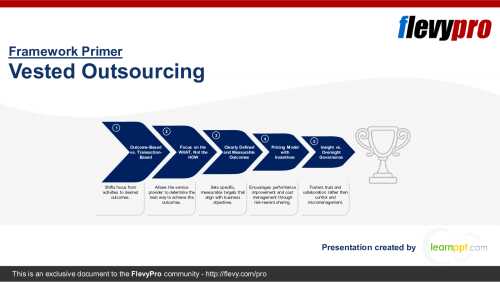
In today's complex global economy, where organizations are constantly seeking innovative ways to optimize efficiency and align with strategic goals, traditional outsourcing models often fall short in creating sustainable partnerships that drive mutual success. This challenge has led organizations [read more]
A Kanban Board is a Lean & Agile Project Management tool used to implement Kanban to manage work at a personal or organizational level.
Kanban Boards visually depict work at various stages of a process using cards to represent work items and columns to represent each stage of the process. Cards [read more]
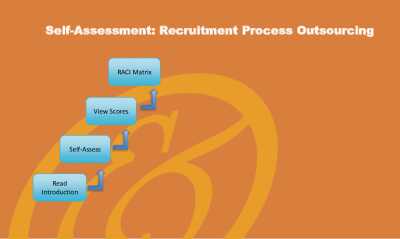
The Recruitment Process Outsourcing (RPO) Implementation Toolkit includes a set of best-practice templates, step-by-step workplans, and maturity diagnostics for any RPO related project. Please note the above partial preview is ONLY of the Self Assessment Excel Dashboard, referenced in steps 1 [read more]
The IT Outsourcing Strategy Implementation Toolkit includes a set of best practice templates, step-by-step workplans, and maturity diagnostics for any IT Outsourcing related project. Please note the above partial preview is ONLY of the Self Assessment Excel Dashboard, referenced in steps 1 and 2 [read more]