Editor's Note: Take a look at our featured best practice, Workplace Productivity Primer (26-slide PowerPoint presentation). A company can have a team of skilled, talented, and educated professionals where each team member has relevant training and experience, a good attitude, and a solid work ethic. Members of the team get along well with each other. When you put all these together, you get to achieve results. The team [read more]
* * * *
Every year, we speak with dozens of HR directors who all describe the same pain point: great technical talent stalls out because of weak communication. A sales engineer may lose a deal due to a client’s shift to small talk, a nurse may misinterpret a medication note, or a manager may struggle to communicate effectively in English with headquarters. The good news is that the latest wave of AI-powered language platforms is finally closing that gap – not with one-size-fits-all e-learning, but with systems that coach in real time, adapt to each role, and show clear business impact.
Below you’ll find seven tools I trust when a company asks, “Which AI solution will actually move the needle on workplace performance?” We’ll explain why each one stands out, where it fits in a corporate learning strategy, and what to watch for when rolling it out.
Why AI-Driven Language Training Matters Now
A 2024 LinkedIn Workplace Learning Report found that communication ranked as one of the most important skills companies plan to develop over the next two years. At the same time, budgets are tight and hybrid teams need flexible, self-directed programs. AI closes the gap by:
Scanning vast language data sets to personalize feedback
Simulating realistic role-plays so staff can practice safely
Flagging skill gaps for managers in dashboards they already use
In short, AI moves language learning from a side project to an operational lever that boosts productivity, customer satisfaction, and retention.
How We Chose the Platforms
To make this short list, a product had to meet four criteria:
Evidence of AI doing more than buzzword tagging (e.g., real-time error correction, adaptive paths, skill mapping)
Enterprise-ready admin and data-privacy controls
Clear alignment between language growth and on-the-job performance
Active development and customer momentum as of 2026
Pricing notes reflect publicly available information or typical contract ranges, but always confirm with vendors.
The 7 Best AI-Powered Language Learning Platforms for Workplace Performance
Before we dive in, remember that no single tool fits every culture. Think of this as a menu: pick the platform whose strengths match your highest-value use case – then integrate it with your LMS, HCM, or talent marketplace for maximum lift.
1. Promova – Conversational Confidence from Day One
If your employees need AI to learn English fast enough to talk with clients next quarter, Promova is the first platform I demo. The system greets learners with a brief placement quiz, then unlocks bite-sized lessons that hit listening, grammar, and pronunciation in under ten minutes each. What really moves the needle, though, is its AI role-play chat. An engineer can simulate a stand-up meeting, a sales rep can rehearse a product pitch, and a team lead can practice giving feedback – all with instant correction on stress, word choice, and sentence structure.
Why It Works
Promova’s engine doesn’t just flag errors; it asks follow-up questions and nudges the learner to try again until the response fits the context. That loop lowers anxiety, a major blocker to speaking up in real life.
Practical extras:
Cross-platform: staff can switch from mobile on the train to web at their desk
Progress analytics for L&D to spot who’s ready for advanced tasks
Everyday and business modules so learners transfer skills directly to work
Pricing
The freemium entry point keeps procurement simple; premium tiers run roughly the cost of a specialty coffee per week, often with enterprise bundles.
Watch-out
Promova excels at communication drills, but if you also need deep compliance or technical-English glossaries, you may pair it with a broader LMS.
2. 360Learning – Turning Subject-Matter Experts Into Language Coaches
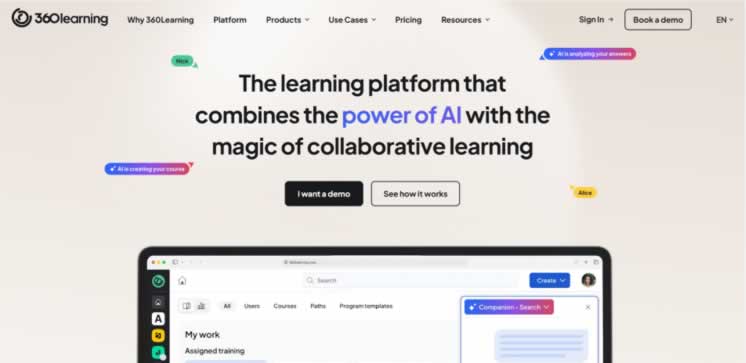
Many multinationals tell me, “Our engineers in Paris know the product vocabulary, but our off-shore teams don’t.” 360Learning solves that by blending generative AI with collaborative authoring. An in-house SME can record a quick Loom-style video, and the platform’s AI auto-tags concepts, drafts quiz questions, and suggests practice dialogues. Suddenly your niche terminology lives in contextual micro-courses everyone can finish over lunch.
Why It Works
The magic lies in peer-to-peer forums. Ask a question in Spanish, and a colleague’s answer gets machine-translated, with confidence scores so you still trust the nuance. That social layer keeps learning sticky long after initial rollout.
Practical extras:
AI certification workspace so L&D teams master the tools themselves
Automated content suggestions based on trending skill gaps
SCORM-export for LMS integration
Pricing
Starts around $8 per registered user/month; volume deals drive it lower.
Watch-out
360Learning shines where you have internal expertise to seed the content. For beginners who need foundational English, pair it with a course-centric app like Promova.
3. Docebo – Enterprise-Grade Personalization at Scale
Docebo has long been an LMS heavyweight; its recent AI upgrades make it a serious language-upskilling engine too. Deep Search combs through every PDF, video, and slide your company owns, auto-tagging content and mapping it to skills. When an employee types “negotiation in Mandarin,” the system pinpoints exactly the clip or micro-module that fixes that gap.
Why It Works
Learners see Google-like relevance, while admins stop wasting hours manually categorizing content. Docebo even suggests which materials to retire based on engagement, keeping libraries fresh.
Practical extras:
Skill-tagging aligned with your competency framework
Social invite-to-watch feature for informal peer learning
Robust APIs to push data to HCM analytics
Pricing
Fully custom – expect mid-five-figure annual contracts for 1,000 active users.
Watch-out
Docebo’s power shows when you feed it lots of content; if you’re starting from scratch, budget time and resources for curation.
4. TalentLMS + TalentCraft – AI Content in Minutes, Not Weeks
Need to launch a customer-support English course next month? TalentLMS’s new TalentCraft module does the heavy lifting. Pop in a prompt like “handling irate callers,” and it spits out an interactive lesson complete with scenario videos, branch-logic quizzes, and localized subtitles. Built-in grammar correction and tone adjustment ensure polite, brand-safe language every time.
Why It Works
The system removes the blank-page syndrome that delays internal course creation. Non-instructional designers can still fine-tune the output, so quality stays high without bottlenecks.
Practical extras:
Instant translation into 30+ languages – handy for global rollouts
AI skills mapping that aligns modules with career paths and appraisal criteria
Clean, mobile-first UX learners actually enjoy
Pricing
TalentCraft is an add-on; combined cost still lands below many legacy authoring suites.
Watch-out
The auto-generated voice-overs sound much better than they did two years ago, yet may feel synthetic in customer-facing simulations. Record a human track for high-stakes content.
When a Fortune 500 company needs a frictionless, on-brand learning hub, Adobe is usually in the RFP. Under the hood, an AI layer crunches behavioral data – course history, role, skill gaps – to push hyper-relevant language micro-courses onto the learner’s home screen. Widgets track daily streaks, trending topics, and progress toward certification, keeping engagement high without L&D hand-holding.
Why It Works
Adobe’s strength is automation. Discussion boards auto-moderate, nudging threads back on topic and weeding out low-value posts. That alone can save moderators hours a week in large cohorts.
Practical extras:
Deep integration with Adobe Experience Manager for consistent branding
Offline mobile mode – great for field teams with spotty connectivity
Built-in badging and leaderboards to foster friendly competition
Pricing
Enterprise list price leans premium; bundles with other Adobe Cloud apps often soften the blow.
Watch-out
Customization depth can overwhelm smaller L&D teams. Assign a dedicated admin or lean on an implementation partner.
6. Memrise – Fast Vocabulary Boost With an Impressive AI Coach
Front-line staff often tell me, “I just need more words.” Memrise is deceptively simple: spaced-repetition flashcards fed by real native-speaker videos, wrapped in an AI coach that lets learners practice until the phrase sticks. The coach listens via mobile mic, corrects pronunciation, and even tweaks casual wording: “Je trouve ça rigolo” becomes “Je trouve ça rigolo,” cedilla and all.
Why It Works
Real voices and facial expressions train the ear far better than synthetic TTS. The AI adds conversational flow: mention that your mother is stressed, and it responds empathetically, keeping practice human.
Practical extras:
Unlimited chats on paid plans; quick wins during commute downtime
Smart review sessions focus on words about to be forgotten
Lightweight analytics so managers can track minutes practiced and words mastered
Pricing
Freemium with upgrade options (monthly, annual, lifetime). The cost undercuts most competitors, making it easy to license widely.
Watch-out
Conversations remain short, and technical jargon can be sparse. For deep functional language, supplement with topic-specific content.
7. Cornerstone – Linking Language Skills to Strategic Workforce Plans
If your board is pressing for a skills-based organization, Cornerstone’s Skills Graph is a game changer. The AI ingests job architectures, performance data, and a library of 50,000+ skills to suggest learning tied directly to role requirements. Say a shift supervisor aims for an area manager role: the system flags advanced English report writing as a gap and proposes a targeted micro-course.
Why It Works
By embedding language into career pathways, you sidestep the classic “nice to have” stigma. Employees see English proficiency as the key to promotion, so completion rates jump.
Practical extras:
Massive off-the-shelf course catalog across leadership, safety, tech
Powerful analytics to correlate language progress with KPI shifts – perfect for ROI decks
Custom content ingestion so you can weave brand tone into exercises
Pricing
Fully bespoke. Enterprise clients mix and match modules; language-learning costs fold into broader talent-suite deals.
Watch-out
Implementation touches many HR processes. Success depends on cross-functional buy-in from ops, talent, and IT.
Making the Business Case
When pitching any of these platforms to finance or the C-suite, don’t lead with “hours of content.” Link language improvement to one or more of the following metrics:
Customer NPS and first-contact resolution (support teams)
Cycle time for global project hand-offs (engineering, supply chain)
Research in project management shows that effective communication practices are positively associated with better project outcomes, including timeliness and success. For construction and complex projects, structured communication positively affects project success, reducing delays and cost overruns. Pair that stat with a pilot program – say, 50 learners on Promova for three months, and you’ll have solid numbers to justify a full rollout.
Final Thoughts
AI will not replace human trainers, but it is already replacing wasted downtime and generic e-learning with precise, data-driven practice. Choose the platform that best fits your immediate talent gap, integrate it into daily workflows, and track real business outcomes. Do that, and language learning stops being an HR perk – it becomes a strategic engine for global performance.
People productivity is one of the most important focus area for senior leaderships across the organization. This presentation outlines one of the most innovative and up-to-date approach to tackle people productivity with a very objective lens on organization performance improvement. The document [read more]
Do You Want to Implement Business Best Practices?
You can download in-depth presentations on Workplace Productivity and 100s of management topics from the FlevyPro Library. FlevyPro is trusted and utilized by 1000s of management consultants and corporate executives.
For even more best practices available on Flevy, have a look at our top 100 lists:
These best practices are of the same as those leveraged by top-tier management consulting firms, like McKinsey, BCG, Bain, and Accenture. Improve the growth and efficiency of your organization by utilizing these best practice frameworks, templates, and tools. Most were developed by seasoned executives and consultants with over 20+ years of experience.
Readers of This Article Are Interested in These Resources
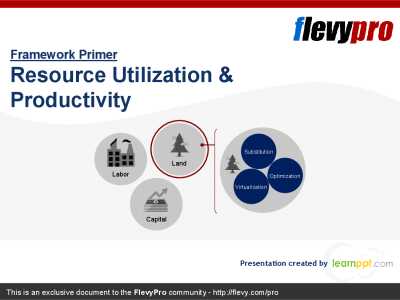
Resource Revolution represents the biggest business opportunity in the century. However, to be successful, this calls for application of new approaches by management.
Organizations that stick to the old "2% solution" are going to be obsolete quickly. The "2% solution" is an old adage where [read more]
The Ultimate 101 Productivity Hacks Business Toolkit: Unleash Your Potential
In today's fast-paced business world, productivity is the key to success. Whether you're a seasoned entrepreneur or just starting your journey, you understand that time is money. To help you unlock your full potential [read more]
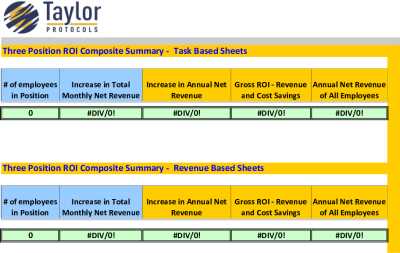
Every year companies waste millions of dollars on poor hiring decisions and employee turnover. This 3-position Human Productivity Calculator & Capacity Model was created as one of the main tools used in the throes of a thousand turnaround management and business optimization projects. It gives a [read more]
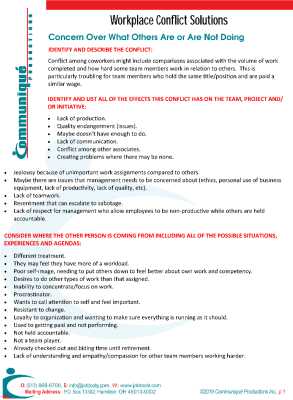
Conflict among coworkers might include comparisons associated with the volume of work completed and how hard some team members work in relation to others. This is particularly troubling for team members who hold the same title/position and are paid a similar wage.
With this tool you get the [read more]
 A 2024 LinkedIn Workplace Learning Report found that