Editor's Note: Take a look at our featured best practice, Sustainability (137-slide PowerPoint presentation). Sustainability has become an increasingly critical topic as the world recognizes the need to protect our planet and its resources for future generations. Sustainability means meeting our current needs without compromising the ability of future generations to meet theirs. It involves long-term [read more]
* * * *
Executives tend to underestimate assets they cannot see on a balance sheet. The Ocean Economy sits squarely in that blind spot. It operates as a vast, underleveraged system that quietly underpins Global Trade, Food Security, Energy Systems, and Digital Infrastructure. Leadership teams that still view the ocean through a narrow lens of conservation are missing a multi trillion-dollar growth engine that is already shaping Strategy Development across industries.
The Ocean Economy framework organizes this complexity into three categories that matter for capital allocation and Strategic Planning. Total Ocean Economy captures the full breadth of marine linked activity. Low Carbon Ocean Economy focuses on decarbonization and transition pathways. Regenerative Ocean Economy embeds restoration into value creation. This is not academic taxonomy. It is a decision-making template.
Consider the rapid expansion of offshore wind as part of the Energy Transition. Organizations that treated it as a niche sustainability play are now scrambling to catch up. Governments are redesigning energy systems around offshore capacity. Ports are evolving into energy hubs. Supply chains are shifting toward electrification. The Ocean Economy framework would have signaled this shift years ago by highlighting Low Carbon Ocean sectors as high growth, policy backed investment areas.
Summary of the framework reveals a system that is already massive yet undercapitalized. It exceeds $3 trillion in annual value. It carries over 80 percent of global trade. It supports billions of people through food systems and communications infrastructure. Growth rates outpace the broader economy. Risks are rising due to climate pressure and biodiversity loss. Opportunities span eight core sectors and a new wave of emerging industries.
Key components of the framework include:
Total Ocean Economy
Low Carbon Ocean Economy
Regenerative Ocean Economy
This framework is useful because it reframes how organizations think about infrastructure. Traditional Strategy Development isolates sectors such as logistics, energy, or food production. The Ocean Economy forces integration. Shipping is no longer just logistics. It becomes part of decarbonization strategy. Aquaculture shifts from agriculture into a hybrid system of food production and ecosystem management.
Executives also gain a sharper lens on capital allocation. Underinvestment signals opportunity, not risk avoidance. Markets that are essential yet overlooked tend to deliver outsized returns when capital flows in. The Ocean Economy fits this pattern. Organizations that build early exposure create optionality across multiple growth vectors.
Risk Management becomes more precise within this structure. Climate exposure is not abstract. It directly impacts ports, supply chains, and coastal assets. Leaders can map vulnerabilities across the three categories and embed resilience into operations. This moves Risk Management from reactive compliance to proactive value protection.
The framework also aligns naturally with Digital Transformation and Innovation agendas. Ocean based industries are undergoing rapid digitalization. Logistics platforms, smart ports, and ocean data systems are attracting significant investment. Organizations that integrate digital capabilities into ocean strategies will outperform those that treat them separately.
Let us examine the first two components more closely.
Total Ocean Economy represents the foundation. It includes maritime transport, seafood production, offshore energy, tourism, and digital infrastructure. This category is where scale lives. Ports act as economic multipliers, creating industrial clusters that extend far beyond shipping. Leadership teams should view ports not as cost centers but as strategic nodes within global value chains. Investment in port ecosystems often unlocks disproportionate returns.
Low Carbon Ocean Economy represents the transition layer. It includes offshore renewables, decarbonized shipping, and marine carbon removal. These sectors are policy driven, capital intensive, and positioned for long term growth. Executives must recognize that decarbonization is not optional. It is a structural shift in how industries operate. Early movers gain influence over standards, supply chains, and partnerships.
Case study analysis highlights offshore wind developers such as Orsted. The organization repositioned itself from a fossil fuel player to a renewable energy leader. It leveraged ocean infrastructure to scale rapidly. It integrated biodiversity initiatives into project design, reducing regulatory friction. It aligned Strategy Development with long term policy trends. The result was sustained growth and market leadership in a rapidly expanding sector.
FAQs
What makes the Ocean Economy strategically relevant today? It intersects with critical global systems such as trade, energy, and food. Its scale and growth trajectory make it central to long term economic resilience.
How should organizations approach investment in ocean sectors?
Start with exposure mapping. Identify dependencies on ocean systems. Allocate capital toward high growth segments such as offshore energy and digital infrastructure.
What are the primary risks?
Climate impacts, biodiversity loss, and underinvestment in infrastructure. These risks directly affect operational continuity and asset value.
How does this framework support Strategic Planning?
It provides a structured way to assess opportunities, risks, and investment priorities across interconnected sectors.
Why is underinvestment an opportunity?
Markets that are essential yet capital constrained often deliver higher returns when investment increases.
Closing Remarks
Executives often chase visibility. The Ocean Economy rewards those who focus on structural importance instead. It is not a trend. It is a system that quietly powers global growth. Organizations that embed it into Strategy Development will find themselves operating ahead of the curve rather than reacting to it.
Capital will inevitably flow into these sectors. The question is timing and positioning. Leaders who act early shape the rules of the game. Those who wait inherit them.
The Ocean Economy is not a side bet. It is becoming core infrastructure for the next phase of global economic expansion.
You can download in-depth presentations on this and hundreds of similar business frameworks from the FlevyPro Library. FlevyPro is trusted and utilized by 1000s of management consultants and corporate executives.
For even more best practices available on Flevy, have a look at our top 100 lists:
ISO 14001:2015 is the internationally recognized standard for Environmental Management Systems (EMS), providing organizations with a structured and systematic approach to managing environmental responsibilities. Applicable to organizations of all sizes and sectors, it supports effective [read more]
Readers of This Article Are Interested in These Resources
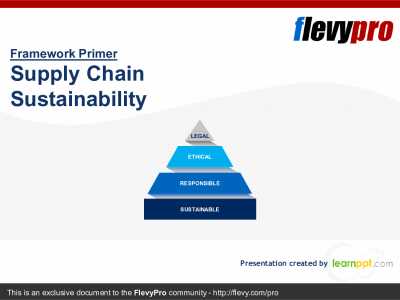
In the modern age, organizations are striving to form a sustainable Supply Chain system to cope with the challenges that are arising. Such issues include emission of hazardous substances, excessive resource consumption, Supply Chain risks, and complex procedures.
Organizations around the globe [read more]
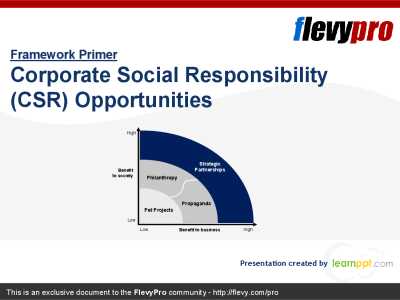
Corporate Social Responsibility (CSR) is an organization's commitment to produce an overall positive impact on society. CSR encompasses sustainability, social and economic impact, and business ethics. It makes a company socially accountable of its operations, stakeholders, and to the [read more]
This presentation compiles top 20 corporate sustainability frameworks and standards (based on the level of global influence and applicability), offering valuable insights for business leaders, C-suite executives, and experts. Please note, the slides are meant to complement your presentations [read more]
Today's executives are dealing with a complex and unprecedented brew of social, environmental, market, and technological trends which requires sophisticated Sustainability-Based Management.
A large group of executives have their own reluctance of various levels toward Sustainability due to the [read more]
 Executives tend to underestimate assets they cannot see on a balance sheet. The Ocean Economy sits squarely in that blind spot. It operates as a vast, underleveraged system that quietly underpins Global Trade, Food Security, Energy Systems, and Digital Infrastructure. Leadership teams that still view the ocean through a narrow lens of conservation are missing a multi trillion-dollar growth engine that is already shaping Strategy Development across industries.