 In today’s rapidly evolving business landscape, digital transformation is more than a buzzword; it’s a necessity. Organizations across industries are investing heavily in technology to enhance efficiency, agility, and customer experience. However, these investments often come with two critical challenges: managing capital expenditure (CapEx) effectively and ensuring robust security frameworks. Striking the right balance between these priorities is essential for sustainable growth and risk mitigation in digital initiatives.
Digital transformation involves not just adopting new technologies, but fundamentally rethinking how organizations operate and deliver value to customers. This requires substantial investment in modern infrastructure, software platforms, and skilled personnel. Yet, with rising cyber threats and budget constraints, enterprises must carefully navigate the trade-offs between spending on innovation and securing their digital assets.
This article explores a strategic framework for organizations looking to optimize their digital transformation journey by balancing CapEx and security, ensuring that investments drive value without compromising safety. We will delve into leadership roles, investment prioritization, security integration, and the benefits of managed IT services as key components of this framework.
Understanding the Digital Transformation Imperative
Digital transformation involves integrating digital technology into all areas of a business, fundamentally changing how companies operate and deliver value. With 70% of companies either in the process of digital transformation or planning to initiate it soon, the pressure to stay competitive is intense.
The drivers behind this trend include customer expectations for seamless digital experiences, the need for operational agility, and the emergence of new business models enabled by technology. However, transformation is not without its costs. Capital expenditure on new infrastructure, software, and platforms can strain budgets, especially when companies fail to align spending with strategic objectives.
Moreover, the expanded digital footprint introduces new cybersecurity vulnerabilities, which, if not managed properly, can lead to costly breaches. According to IBM’s Cost of a Data Breach Report, the average cost of a data breach in 2023 was $4.45 million, highlighting the financial risks associated with inadequate security.
Effectively managing these dual challenges requires a holistic approach that integrates financial prudence with proactive security measures.
The Dual Challenge: Capital Expenditure and Security
Investing in digital technologies often involves substantial upfront costs. These costs may include purchasing hardware, licensing software, upgrading networks, and training personnel. While these investments are necessary, organizations must avoid overcommitting resources to technologies that don’t yield measurable returns.
Capital expenditure decisions are often complex and require a clear understanding of the expected benefits, total cost of ownership, and potential risks. Without rigorous evaluation, companies risk sunk costs in obsolete or underutilized technology.
Simultaneously, security must be embedded in every aspect of the digital transformation strategy. A recent study found that cybercrime damages are expected to cost the world $10.5 trillion annually by 2025, emphasizing the risks associated with inadequate security measures.
Security incidents can disrupt business operations, erode customer trust, and lead to regulatory penalties. Therefore, organizations need to adopt a risk-aware mindset that balances the need for innovation with the imperative to protect critical assets.
Building a Framework for Balance
1. Strategic Planning with Leadership Insight
Effective digital transformation begins with clear strategic planning led by executives who understand both financial and security implications. Leaders like Ryan Rosett, CEO of Credibly, play a crucial role in guiding organizations through complex digital investments, ensuring that each expenditure aligns with broader business goals while considering security risks.
Leadership involvement ensures that digital initiatives support the company’s vision and that resource allocation reflects strategic priorities. Moreover, executives can foster a culture of security awareness and accountability, which is essential for embedding security practices throughout the organization.
2. Prioritize Investments Based on Business Value and Risk
Organizations should evaluate potential technology investments through a dual lens: the expected return on investment (ROI) and the associated cybersecurity risk. This approach enables prioritization of projects that offer the greatest value while maintaining acceptable risk thresholds.
For instance, investments in cloud computing platforms might offer scalability and cost savings but also introduce new security considerations such as data privacy and compliance. By conducting thorough risk assessments alongside financial analysis, companies can make informed decisions that optimize both cost and security outcomes.
3. Integrate Security Early in the Transformation Process
Security must be a foundational component rather than an afterthought. Partnering with specialized providers, such as Compeint’s IT services, can help businesses implement managed IT services that embed security best practices throughout the digital infrastructure.
Early integration of security reduces the likelihood of vulnerabilities and costly retrofits. This includes adopting secure development lifecycle practices, continuous monitoring, and incident response capabilities. Embedding security from the outset also facilitates compliance with regulatory requirements, which are becoming increasingly stringent across industries.
Leveraging Managed IT Services for Security and Cost Control
Managed IT services provide companies with scalable, secure technology solutions without the burden of large capital expenditures. By outsourcing infrastructure management, organizations convert CapEx to operational expenditure (OpEx), enabling more flexible budgeting aligned with business needs.
These services also bring expertise in cybersecurity, ensuring continuous monitoring and rapid response to threats. A study revealed that companies using managed security services reduce incident response time by 60%, significantly lowering the potential damage from cyberattacks.
Furthermore, managed IT providers can offer access to advanced technologies such as artificial intelligence-based threat detection and automated patch management, which may be cost-prohibitive for organizations to develop internally. This approach not only enhances security posture but also allows internal teams to focus on strategic initiatives.
Financial Governance and Continuous Monitoring
Balancing CapEx and security requires ongoing financial governance. Establishing clear budgeting processes and performance metrics helps track technology spending and security outcomes. Regular audits and risk assessments ensure that the digital environment remains resilient against evolving threats.
Additionally, leveraging data analytics can provide insights into technology utilization and risk exposure. This continuous feedback loop enables proactive adjustments to strategy, optimizing both cost efficiency and security posture.
For example, real-time dashboards can alert leadership to unusual spending patterns or emerging vulnerabilities, allowing for timely interventions. This dynamic approach contrasts with traditional static budgeting and risk management, which may fail to keep pace with the rapid changes inherent in digital transformation.
Case Study: Successful Balance in Action
A mid-sized financial services firm recently embarked on a digital transformation initiative focusing on cloud migration and automation. By involving leadership early, partnering with managed IT providers, and implementing strict security protocols, the firm reduced capital expenditure by 25% while decreasing security incidents by 40% within the first year.
This success underscores the value of a structured approach that integrates financial planning with security considerations. The firm’s leadership ensured that investments aligned with business goals and risk management policies. Meanwhile, managed IT services provided the expertise and tools necessary to maintain a secure digital environment.
The case also highlights how converting CapEx to OpEx through managed services can improve financial flexibility, enabling the company to scale technology usage according to demand without high upfront costs.
Conclusion
Digital transformation is a complex but necessary journey. Organizations that develop a strategic framework balancing capital expenditure and security are better positioned to realize the benefits of new technologies while protecting themselves from emerging risks.
By aligning leadership vision, prioritizing investments based on value and risk, embedding security early, and leveraging managed IT services, businesses can create a resilient digital infrastructure that supports long-term growth.
Embracing this balanced approach enables companies not only to survive but thrive in the digital age, turning transformation challenges into competitive advantages. Effective management of CapEx and security is not a trade-off but a strategic enabler for innovation, resilience, and sustained success.
Want to Achieve Excellence in Digital Transformation?
Gain the knowledge and develop the expertise to become an expert in Digital Transformation. Our frameworks are based on the thought leadership of leading consulting firms, academics, and recognized subject matter experts. Click here for full details.
Digital Transformation is being embraced by organizations of all sizes across most industries. In the Digital Age today, technology creates new opportunities and fundamentally transforms businesses in all aspects—operations, business models, strategies. It not only enables the business, but also drives its growth and can be a source of Competitive Advantage.
For many industries, COVID-19 has accelerated the timeline for Digital Transformation Programs by multiple years. Digital Transformation has become a necessity. Now, to survive in the Low Touch Economy—characterized by social distancing and a minimization of in-person activities—organizations must go digital. This includes offering digital solutions for both employees (e.g. Remote Work, Virtual Teams, Enterprise Cloud, etc.) and customers (e.g. E-commerce, Social Media, Mobile Apps, etc.).
Learn about our Digital Transformation Best Practice Frameworks here.
Readers of This Article Are Interested in These Resources
206-slide PowerPoint presentation
This is again a "new improved" A Comprehensive Guide to Digital Transformation. What was one 173 slides has now increased to 206 because I have added a number of latest slides to the deck about Why People are the Critical Factor. The Value of Change Management. The deck is not intended to provide
[read more]
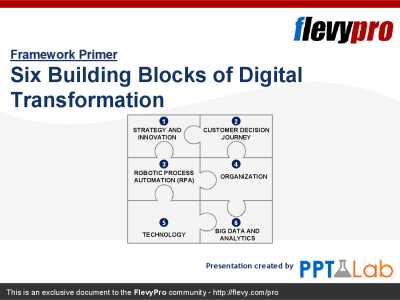
35-slide PowerPoint presentation
Digital Transformation touches practically every function in the entire organization. This thus requires an unprecedented amount of coordination among people, process, and technologies throughout the organization, leading to a difficult Transformation program.
The Six Building Blocks of
[read more]
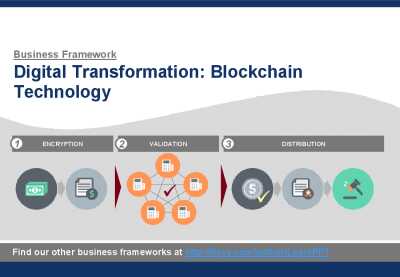
87-slide PowerPoint presentation
Blockchain Technology is an emerging database technology that has gained widespread appeal across many industries, mostly driven by the rise of cryptocurrencies--most notably Bitcoin. It provides numerous process benefits, including efficiency, security, transparency/openness, low cost, data
[read more]
21-slide PowerPoint presentation
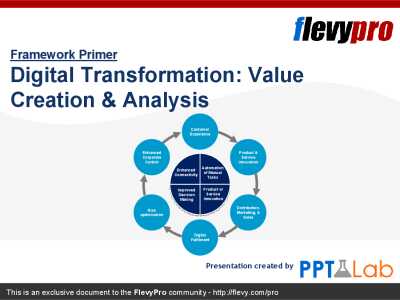
Most organizations recognize the significant potential in creating value through Digital Transformation. However, they may struggle with the question of exactly how much value they can create and where within the organization the value will come from. This presentation deals with the various
[read more]