Editor's Note: Take a look at our featured best practice, Hofstede's 6 Dimensions of National Cultures (35-slide PowerPoint presentation). Cultural differences can act as a barrier to communication. This could affect our organization's ability to build connections and motivate people. While we may be excited with the opportunities that global connectedness has brought forth, yet we are cautious of making cross-cultural faux [read more]
* * * *
Global organizations rarely fail because of bad Strategy. They fail because people interpret the same situation in radically different ways and never realize it. The Meyer Culture Map framework turns this problem into something tangible. It gives leaders a structured way to decode how culture shapes behavior across borders, replacing guesswork with a repeatable consulting tool that can actually be applied in day-to-day operations.
Erin Meyer introduced this framework as a response to a persistent leadership blind spot. Executives assume alignment because everyone speaks the same corporate language. In reality, meaning gets distorted through cultural filters. A direct email feels efficient in one market and rude in another. Silence signals agreement in one culture and discomfort in another. The framework creates a shared template for diagnosing these gaps before they escalate into execution risk.
Look at global remote work as a modern test case. Distributed teams stretch across the United States, India, Germany, and Japan. On paper, collaboration tools solve everything. In practice, friction increases. American managers push for quick decisions while German teams expect structured consensus. Japanese colleagues avoid open disagreement in virtual meetings, which gets misread as alignment. Indian teams prioritize relationship building before committing to timelines, frustrating leaders who want immediate outputs. The Culture Map helps leaders anticipate these patterns and adjust their approach instead of forcing a one-size-fits-all operating model.
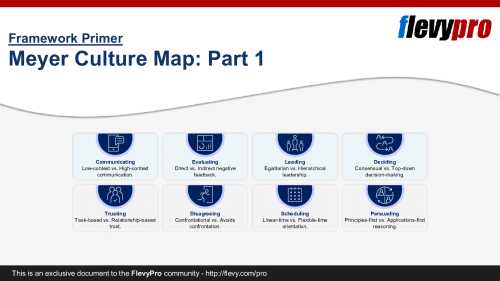
A quick scan of the Meyer Culture Map framework reveals its scope. It breaks culture into 8 measurable dimensions, each mapped on a spectrum between 2 extremes. This structure creates clarity without oversimplifying reality:
Communicating: Low context vs High context
Evaluating: Direct vs Indirect feedback
Leading: Egalitarian vs Hierarchical
Deciding: Consensual vs Top down
Trusting: Task based vs Relationship based
Disagreeing: Confrontational vs Avoids confrontation
Scheduling: Linear time vs Flexible time
Persuading: Principles first vs Applications first
These dimensions act like coordinates. Leaders can plot cultures relative to each other and identify where friction is likely to emerge. It becomes less about stereotyping and more about pattern recognition.
Why does this framework matter so much in practice? Because cultural misalignment is rarely visible in dashboards. Revenue dips, project delays, and talent attrition often trace back to human dynamics that were never diagnosed. The Meyer Culture Map forces organizations to confront this reality head on.
Leaders gain a common language to discuss behavior without making it personal. Instead of saying “this team is difficult,” they can say “we have a gap in Decision making expectations.” That shift alone changes the tone of leadership conversations. It reduces blame and increases problem solving.
The Culture Map framework also sharpens execution. Teams stop debating intent and start aligning on process. Should decisions be made in meetings or after offline alignment. Should feedback be explicit or nuanced. Should trust be built through quick wins or long dinners. These questions sound basic, but they determine how fast an organization moves.
Another benefit sits in leadership adaptability. Most executives default to their native cultural style and expect others to adjust. That works in domestic settings. It breaks down globally. The Culture Map pushes leaders to flex their approach intentionally. That flexibility becomes a core leadership capability, not a soft skill buried in HR training.
Risk reduction becomes tangible. Misreading cultural signals leads to failed negotiations, broken partnerships, and internal conflict. A structured framework reduces these risks by making the implicit explicit. Leaders can design interactions instead of reacting to surprises.
Let’s zoom into the initial 2 dimensions of the Culture Map, for now.
Communicating
This dimension sits at the center of everything. Low context cultures rely on explicit, detailed messaging. Clarity is king. People say exactly what they mean and expect others to do the same. High context cultures operate differently. Meaning lives between the lines. Tone, silence, and shared understanding carry as much weight as words.
Problems arise when these styles collide. A low-context manager sends a blunt email expecting efficiency. A high-context recipient perceives it as aggressive. On the flip side, indirect communication can frustrate low context teams who interpret it as evasive. Leaders need to bridge this gap deliberately. That means over communicating clarity in mixed environments while staying sensitive to tone and nuance. It also means asking more questions instead of assuming alignment.
Evaluating
Evaluating builds directly on communication but raises the stakes. This dimension defines how feedback is delivered. Direct cultures value bluntness. Feedback is clear, sometimes uncomfortably so. Indirect cultures soften criticism to preserve relationships. Messages get wrapped in positive language or delivered privately.
Here is where things get messy. A Dutch manager believes they are being transparent. A Japanese colleague hears public criticism and loses face. An American executive thinks they gave clear feedback. Their Asian counterpart walks away unsure what needs to change. Misalignment here damages trust quickly.
Smart leaders calibrate feedback intensity. They separate the message from the emotional delivery. They observe how teams react and adjust accordingly. Feedback becomes a designed interaction rather than a spontaneous reaction.
Case Study
Consider a case involving a global technology organization expanding into Asia while maintaining headquarters in the United States. Leadership struggled with slow decision cycles and unclear accountability. American executives pushed for rapid execution. Local teams hesitated, seeking alignment and relationship validation before committing.
Applying the Culture Map revealed multiple gaps. Decision making expectations were misaligned. The US team leaned top down with quick calls. The Asian teams expected consensus and informal alignment before formal decisions. Trust building also diverged. Headquarters focused on key performance metrics (KPIs). Local teams prioritized relationship depth.
Leadership redesigned its operating model. Decision frameworks were clarified, specifying when consensus was required and when leaders could act independently. Relationship building was formalized through regular in person engagements and informal touchpoints. Communication guidelines were introduced, encouraging explicit summaries while respecting indirect cues.
The impact showed up within months. Decision speed improved without sacrificing alignment. Employee Engagement increased across regions. Conflict reduced, not because people changed, but because expectations became visible and manageable.
FAQs
What is the primary purpose of the Culture Map framework?
It provides a structured way to identify and manage cultural differences that impact communication, leadership, and execution in global organizations.
How can leaders apply this framework in daily operations?
Leaders can map team cultures across the eight dimensions and adjust communication, decision making, and feedback approaches to align with cultural expectations.
Does the framework promote stereotyping?
No. It highlights relative tendencies, not fixed rules. The goal is awareness and adaptability, not rigid categorization.
Which dimension tends to create the most friction?
Communication and feedback often create the earliest and most visible friction, especially in multicultural teams.
Can this framework improve remote team performance?
Yes. It helps leaders design clearer interaction models, reducing misunderstandings that are amplified in virtual environments.
Closing Thoughts
Cultural intelligence is not a soft layer on top of Strategy. It is embedded in how Strategy gets executed. Leaders who ignore this reality end up solving the wrong problems. They try to redesign and improve processes when the real issue sits in human interpretation.
The Meyer Culture Map works because it turns ambiguity into structure. It gives organizations a repeatable template to diagnose and address issues that usually remain hidden. That alone changes the quality of leadership conversations.
Executives should ask themselves a blunt question. Where are we losing momentum because of invisible cultural friction. The answer appears in how people communicate, decide, and trust each other. That is where this framework earns its place in any serious consulting toolkit.
Interested in learning more about the other dimensions of the Culture Map? You can download editable PPTs on the Meyer Culture Map on the Flevy documents marketplace here:
You can download in-depth presentations on this and hundreds of similar business frameworks from the FlevyPro Library. FlevyPro is trusted and utilized by 1000s of management consultants and corporate executives.
For even more best practices available on Flevy, have a look at our top 100 lists:
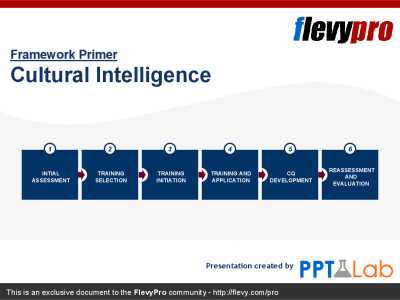
Cultural Intelligence (CQ) is a model that ability to cope with national, corporate, and vocational cultures. It was developed by Christopher Earley and Elaine Mosakowski, based on a study of 2,000 managers across 60 countries. CQ is the ability to understand unfamiliar contexts, and then to [read more]
Readers of This Article Are Interested in These Resources
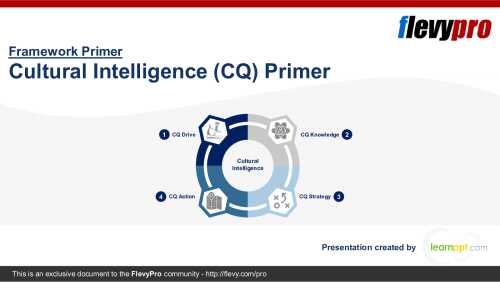
Today's business environment demands more than just market knowledge and technical expertise. It calls for Cultural Intelligence (CQ)--the ability to cross boundaries and thrive in multiple cultures.
In this PowerPoint presentation, we will explore the essence of CQ, focusing on its 4 core [read more]
In today's modern era driven by Technology and Innovation, organizations can only survive if they are swift and agile; and have the capability of learning and adjusting rapidly.
Organizations have become cognizant of this and have introduced Agile methodologies in their Operations to allow them [read more]
As organizations operate across increasingly complex international environments, cultural friction remains a persistent leadership challenge to navigate. Cultural differences weaken collaboration, disrupt trust, and create hidden operational drag.
This PPT presentation discusses the Meyer [read more]
Societal Culture shapes how organizations and societies define problems, make decisions, and pursue goals. It evolves over time through internal innovation and external influences. Differences in culture across geographies often lead to miscommunications, misalignment, and conflict.
This PPT [read more]