Editor's Note: Take a look at our featured best practice, Digital Insurance Maturity Model (25-slide PowerPoint presentation). This deck provides an outline for
1. The strategic necessity facing Insurers in embracing digital
2. The major technology and architectural components needed to be in place to be truly digital
3. Exploration of stages of excellence for insurers against each of these seven components, [read more]
* * * *
Most executives can point to at least one AI pilot that looked impressive in a demo. Few can point to a portfolio that moved the needle on Revenue Growth, Cost Efficiency, Risk Management, or Customer Experience at enterprise scale.
That mismatch is not a mystery. It is a predictable outcome of uneven maturity.
The AI Maturity Model is a practical framework that separates activity from impact. It forces an organization to answer a blunt question: “Are we doing AI, or are we running the organization differently because AI exists?”
The model lays out 4 stages that describe how AI becomes real enterprise value: AI Stagnation, AI Emergence, AI Scale, AI Leadership. Each stage is less about technical sophistication and more about Management System strength, Operating Model discipline, and Leadership Commitment.
Board members and CEOs should treat maturity as a Strategic Planning tool. Teams love to talk about “use cases.” Leaders should talk about “repeatable value creation.” That shift in language matters because it drives funding decisions, governance, and accountability.
The Four Stages That Separate Pilots from Performance
AI Stagnation
AI Emergence
AI Scale
AI Leadership
AI Stagnation shows up as fragmented experimentation and a lack of executive mandate. Teams run proofs of concept that never touch core workflows. Data access is inconsistent. Talent is scarce. Change Management is minimal. Leaders often assume the issue is “we need better models.” The issue is “we have no system to convert models into outcomes.”
AI Emergence is the most common reality. The organization runs structured pilots and starts capability building. Sandboxes exist. Data protocols begin to form. Departments act locally. Enterprise integration remains hard. Leaders sense momentum but feel stuck. Funding gets spread thin across a “sea of use cases.” The portfolio lacks a prioritization spine.
AI Scale is where value starts to become measurable and repeatable. AI moves from bespoke work to industrialized delivery. MLOps discipline appears. Central platforms support multiple functions. AI becomes embedded in decision loops. Leaders start to see cycle time reduction, higher conversion, better forecast accuracy, lower fraud, and higher throughput because workflows changed, not because a model scored well in isolation.
AI Leadership means AI drives Strategy Development and Business Transformation, not just productivity. Leaders reimagine products, redesign operating models, and create AI native offerings. Workforce AI literacy becomes expected. Responsible AI is built into governance. The organization invests consistently and allocates resources based on value, not novelty.
Why This Framework Works in the Real World
The framework is useful because it gives executives a diagnostic that is hard to game. Leaders can demand evidence tied to each stage. Leaders can also spot “stage confusion,” where a team claims to be scaling but cannot show enterprise adoption, integration, governance, and value tracking.
The framework is useful because it clarifies what to fix first. Organizations often chase advanced algorithms while the foundation is missing. A maturity lens flips the sequence. Data readiness, Operating Model, Performance Management, and Workforce Enablement become prerequisites for value.
The framework is useful because it makes investment conversations rational. Budget debates often become emotional because AI feels existential. Maturity provides a template for capital allocation. Leaders can fund the steps required to move stages, then hold teams accountable for stage progression, not activity volume.
The framework is useful because it reduces risk. AI introduces regulatory exposure, bias concerns, privacy issues, and model drift. Mature organizations build guardrails as part of scaling. Immature organizations bolt them on after an incident. Boards prefer the first option.
AI Stagnation
Executive behavior defines this stage. Leaders tolerate pilots but do not issue a multi year mandate. Ownership sits in IT or an innovation lab with limited authority. Business unit heads treat AI as optional. The workforce views AI as “someone else’s tool.” The operating cadence lacks Portfolio Governance, benefits tracking, and adoption metrics.
The fastest lever out of Stagnation is not hiring a few data scientists. The lever is Executive Commitment with a clear ambition tied to enterprise outcomes. Leaders should choose three enterprise level objectives, then tie AI investment to those objectives. Examples include working capital reduction, service cost reduction, churn reduction, quote to cash acceleration, or fraud loss reduction. The list must be short. Leadership teams that cannot say “no” to low value work stay stagnant.
AI Emergence
Emergence looks healthy on PowerPoint. Pilots exist. Vendor demos happen weekly. The pipeline is full. The problem is scale mechanics. Integration with legacy systems slows deployment. Data quality issues undermine trust. Teams lack MLOps and product management discipline. Business process owners do not redesign workflows, so AI outputs sit on the side as a recommendation nobody follows.
A critical move in Emergence is the Lighthouse Program approach. Leaders should pick one to three initiatives that are high impact and feasible within current constraints. The purpose is not technology learning. The purpose is enterprise learning. A lighthouse must include adoption, training, workflow redesign, controls, and a measurable value baseline. Leaders should require a benefits case with leading indicators. Model accuracy is not a benefit. Reduced handling time is a benefit. Increased win rate is a benefit. Lower chargebacks is a benefit.
Generative AI in the Knowledge Workflow
Generative AI is the perfect maturity stress test. Many organizations can deploy a chat tool. Few can integrate it into contract review, customer support, sales enablement, engineering, and compliance in a way that improves throughput and reduces risk. Stagnation shows up as ungoverned usage and sporadic experiments.
Emergence shows up as pilots in HR or marketing that never reach the front line. Scale shows up as role based copilots integrated into systems of record, with audit trails, prompt governance, and clear productivity baselines. Leadership shows up as redesigned processes where knowledge work is re segmented, with humans doing judgment and exceptions while AI handles first draft creation, retrieval, and routine decisions.
A Simple Executive Checklist
Ask three questions in the next operating review.
“Which maturity stage describes us, and what evidence proves it?”
“What are the two constraints blocking stage progression?”
“What will we stop doing this quarter so capital concentrates on the few bets that matter?”
Answers that sound like “we need to explore more use cases” are a warning sign. Answers that show portfolio discipline, adoption metrics, and workflow change are the signal of real maturity.
You can download in-depth presentations on this and hundreds of similar business frameworks from the FlevyPro Library. FlevyPro is trusted and utilized by 1000s of management consultants and corporate executives.
For even more best practices available on Flevy, have a look at our top 100 lists:
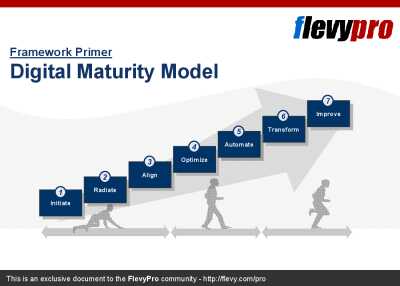
Driven by 8 core emerging technologies, the role of technology in an organization is shifting from being a business enabler to a business driver. As companies transform "digitally," they go through a process where their technological capabilities mature and evolve over time.
This is captured [read more]
Readers of This Article Are Interested in These Resources
Go digital or go home. To survive in the Digital Age, organizations must develop their digital capabilities to not only support strategies and reach customers, but also to modernize and achieve efficiencies in their internal operations and processes. The pursuit of Digital Maturity is quickly [read more]
Digital Transformation is being embraced by organizations because it offers a significant leap in operational efficiency and potential revenue gains.
For instance, RPA allows organizations to streamline processes, reduce human error, and free up staff for higher-value tasks by automating [read more]
Digital Transformation is a matter of survival now for all organizations particularly businesses.
Digital Transformation is typically more difficult than any change or Transformation program that an organization may undertake.
Most organizations struggle to make the fundamental alterations [read more]
Responsible AI (RAI) addresses the challenge of aligning AI innovation with ethical principles, organizational trust, and long-term resilience. It reduces risks by embedding fairness, accountability, and transparency into AI systems, while ensuring that AI-driven growth remains sustainable and [read more]
 Most executives can point to at least one AI pilot that looked impressive in a demo. Few can point to a portfolio that moved the needle on Revenue Growth, Cost Efficiency, Risk Management, or Customer Experience at enterprise scale.