Editor's Note: Take a look at our featured best practice, GenAI Roadmap Design (30-slide PowerPoint presentation). Organizations worldwide are embracing GenAI for its ability to generate actionable insights, predict outcomes, personalize at scale, and process natural language with human-like fluency.
Leading organizations already deploy GenAI in AI-assisted software development, workflow automation, [read more]
* * * *
GenAI adoption has moved at record speed. Employees generate content in seconds. Analysts synthesize complex material instantly. Developers accelerate output. Internal surveys show enthusiasm. Usage metrics climb.
The root cause is straightforward. AI has been deployed where it is easiest, not where value is created. Copilots and chatbots spread horizontally because they require little integration and minimal workflow redesign. They improve individual productivity without altering cost structures or revenue engines.
Enterprise value lives inside workflows and customer decision moments. It does not live inside prompt interfaces.
The GenAI Profitability Paradox framework provides a disciplined strategy template to shift from widespread adoption to measurable enterprise impact.
The framework consists of 9 integrated solutions:
Automate Workflows
Augment Revenue Streams
Reinvent Processes
Build an Agentic AI Mesh
Revisit LLM Strategies
Reevaluate Enterprise Systems
Reset the AI Transformation Approach
Activate 4 Key Enablers
Move Beyond Experimentation
Executives must decide whether GenAI remains a productivity enhancer or becomes operating infrastructure.
Horizontal use cases improve how people work. Drafting. Research. Summarization. Brainstorming. These improvements distribute thin gains across many roles. They are hard to convert into meaningful financial shifts.
Vertical use cases embed AI directly into value generating workflows. Sales qualification. Claims adjudication. Procurement negotiation. Order fulfillment. Service dispatch.
Horizontal AI makes employees faster.
Vertical AI makes the organization different.
The paradox emerges when leadership confuses adoption with transformation.
If AI does not reshape how revenue is generated or how costs are structured, financial impact will remain marginal.
The first 2 solutions in this framework target exactly those leverage points.
Why This Framework Matters in 2026 and Beyond
Boards are shifting from curiosity to scrutiny. AI budgets are large. Expectations are rising. Patience is finite.
This framework forces clarity. It requires that every AI initiative connect to economic outcomes. It elevates AI from experimentation to enterprise strategy.
Consulting experience reveals a recurring issue. AI programs are measured by technical performance and usage. CFOs measure earnings. These metrics rarely intersect.
The framework closes that gap. It links AI deployment to value pools and operating model redesign.
It also clarifies sequencing. Automating workflows without revenue alignment produces efficiency with no growth. Pursuing revenue augmentation without operational redesign produces bottlenecks. The two must move in concert.
Organizations that internalize this logic will convert AI from cost center to growth engine.
Solution 1: Automate Workflows Where Economics Are Shaped
Productivity tools assist. Agents execute.
That difference determines whether AI changes financial outcomes.
A copilot helps draft a procurement contract. An agent manages the procurement lifecycle. Supplier identification. Pricing analysis. Negotiation support. Compliance checks. Approval routing. Contract tracking. Exception escalation.
Agents combine reasoning, memory, orchestration, and system integration. They operate across platforms. They manage dependencies. They adapt to real time conditions.
Leaders should begin with workflows that meet three criteria:
Direct linkage to revenue, cost, or risk metrics
Cross functional complexity
High frequency or high exception volume
Order to cash. Claims processing. Inventory planning. Customer onboarding. These workflows shape cash flow and margin performance.
Replace sequential routing with parallel task coordination.
Define explicit human agent boundaries for judgment and escalation.
Integrate agents directly into enterprise systems and data flows.
Establish monitoring, auditability, and performance dashboards tied to business KPIs.
When executed properly, 5 structural shifts occur.
Execution accelerates as handoffs collapse.
Adaptability increases through continuous signal ingestion.
Personalization scales without manual rule expansion.
Capacity flexes with demand instead of headcount.
Operational resilience improves through proactive anomaly detection.
This is not incremental efficiency. This is operating model redesign.
Ask a blunt question. If this workflow were designed today with agent execution as the default, would it resemble the current structure?
Most organizations discover their workflows reflect legacy constraints rather than optimal economic design.
Automating workflows with agents moves AI impact from incremental productivity to structural cost and throughput transformation.
Solution 2: Augment Revenue Streams at the Moment of Decision
Cost improvement alone will not justify sustained AI investment. Growth must follow.
Agent based revenue augmentation embeds AI inside customer journeys and monetization engines. It shifts AI closer to where buying decisions occur.
Revenue impact emerges through two pathways.
Amplifying Existing Revenue Engines
Agents embedded in digital and physical channels analyze behavior, context, and intent in real time. They adjust offers. Personalize bundles. Trigger cross sell recommendations. Initiate retention actions before churn materializes.
Revenue becomes dynamic and contextual rather than rule based.
Leaders should examine where revenue logic remains static. Static pricing grids. Fixed product bundles. Generic engagement sequences.
Every static rule is a missed opportunity for agent driven revenue optimization.
If AI does not influence customer decisions in real time, it will not materially change top line performance.
Case Example: A Global Industrial Organization
A multinational industrial organization deployed GenAI copilots across engineering and procurement. Adoption was strong. Earnings were unchanged.
Leadership pivoted using this framework.
First, they automated the order to cash workflow. Agents integrated order data, inventory systems, logistics coordination, invoicing, and payment reconciliation. Exceptions were routed intelligently. Human intervention focused on high value disputes.
Cycle times dropped significantly. Working capital improved. Cash flow stabilized.
Second, they embedded agents into aftermarket service sales. Real time equipment data triggered proactive maintenance offers and subscription upgrades. Revenue per installed unit increased. Service contracts expanded.
Third, executive incentives were tied to workflow and revenue transformation outcomes, not AI usage metrics.
Within 18 months, AI investments were clearly linked to financial performance. The paradox narrowed.
The inflection point was cultural as much as technical. AI became a core operating lever rather than a side tool.
Frequently Asked Questions
How do we prioritize workflows for automation?
Focus on those directly tied to financial metrics and burdened by complexity or delay.
What differentiates an agent from traditional automation?
Agents combine reasoning, memory, orchestration, and integration to manage dynamic, cross system execution.
Can revenue augmentation apply in asset heavy industries?
Yes. Equipment data, service interactions, and pricing logic provide decision points where agents can influence outcomes.
When should experimentation end?
When pilots prove feasibility but lack integration pathways. Leadership must declare the shift to enterprise execution.
How do we measure success?
Tie AI initiatives to business KPIs such as revenue growth, margin expansion, cash flow, and risk reduction.
The Strategic Inflection Point
GenAI adoption is no longer the headline. Economic conversion is.
Organizations that close the GenAI Profitability Paradox will not be those with the most pilots. They will be those that redesign workflows and embed agents at revenue inflection points.
This requires courage. It requires cross functional alignment. It requires disciplined execution.
Copilots make work smoother.
Agents make economics different.
Only one of those paths changes the income statement.
Interested in learning more about the steps of the approach to GenAI Profitability Paradox? We have 2 editable PowerPoint presentations on this framework available on Flevy:
You can download in-depth presentations on this and hundreds of similar business frameworks from the FlevyPro Library. FlevyPro is trusted and utilized by 1000s of management consultants and corporate executives.
For even more best practices available on Flevy, have a look at our top 100 lists:
GenAI use is rising globally. Many organizations set GenAI strategies and launch pilots across functions. Yet most stall at the proof-of-concept stage and never show measurable financial or operational results.
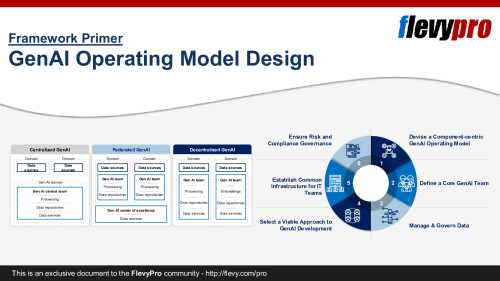
This PPT presentation outlines the missing piece: an effective GenAI Operating [read more]
Readers of This Article Are Interested in These Resources
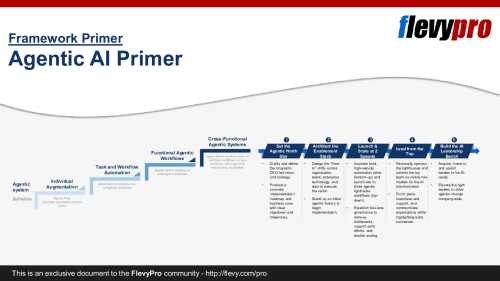
Agentic AI addresses a critical challenge in enterprise adoption: while most organizations achieve early success with individual models, few connect them into cohesive systems that transform business performance.
Traditional automation improves efficiency, yet it rarely redefines how decisions [read more]
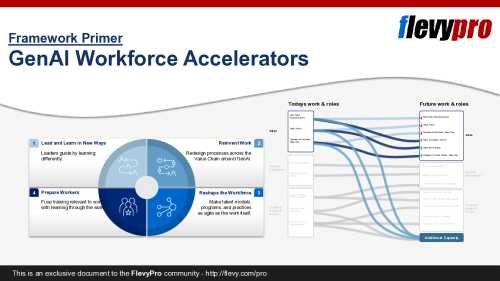
Generative AI (GenAI) is the most significant shift to work since the industrial revolution--and the Trifecta of Opportunities it unlocks (the economic, business, and people upsides) is the strategic objective. This presentation moves from the opportunity to the path: how leaders capture [read more]
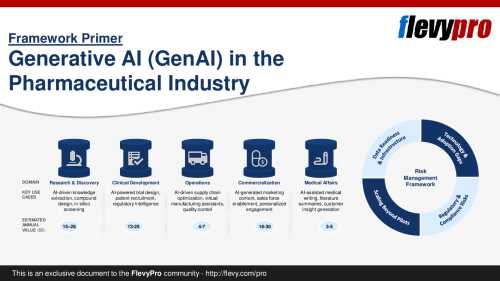
Pharmaceutical companies recognize the immense potential of Generative AI (GenAI) to accelerate drug discovery, improve clinical trials, and optimize commercial operations. Yet, capturing real value requires moving beyond hype to structured implementation strategies.
The McKinsey Global [read more]
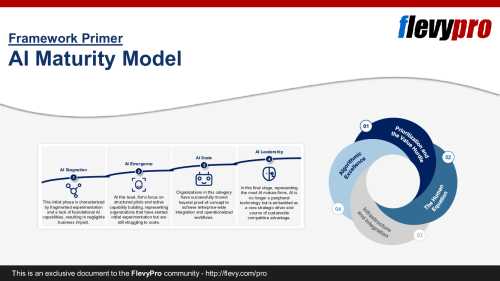
While 72% of organizations have initiated AI deployments, a critical "value gap" persists where only 26% of organizations successfully move beyond proof-of-concept to realize measurable impact. This deck presents an AI Maturity Model to diagnose this disparity, based on the evaluation of 1,000 [read more]
 GenAI adoption has moved at record speed. Employees generate content in seconds. Analysts synthesize complex material instantly. Developers accelerate output. Internal surveys show enthusiasm. Usage metrics climb.