Editor's Note: Take a look at our featured best practice, Agentic AI Playbook (562-slide PowerPoint presentation). Curated by McKinsey-trained Executives
Unlock the Future of Business with the Ultimate Agentic AI Playbook: The Only Resource You'll Ever Need to Dominate the AI Revolution
In today's fast-paced, tech-driven world, the companies that stay ahead of the curve are the ones that fully [read more]
* * * *
Agentic AI has crossed an invisible line. Organizations no longer experiment with clever copilots that draft emails or summarize documents. Agents now plan, act, and adapt across workflows. They touch systems. They trigger decisions. They operate continuously. This shift creates enormous upside and exposes a structural problem most leaders underestimated.
Piloting agents is easy. Scaling them safely and profitably is not. Many organizations discover this the hard way. Early agent deployments work in isolation, then fracture under real operating conditions. Risk accumulates quietly. Integration becomes brittle. Each new agent adds complexity rather than leverage. Architecture collapses under its own improvisation.
The Agentic AI Mesh framework exists to address this moment. It defines a foundational architectural model that allows agentic AI to scale across the enterprise without sacrificing control, adaptability, or trust. This is not a tooling discussion. This is an operating architecture conversation that belongs squarely at the executive table.
Value compounds when agents operate inside priority journeys and redesigned workflows. Cost, growth, and risk profiles shift only when decisions repeat and reinforce. That requires autonomy. Autonomy introduces new exposure.
Leadership teams quickly encounter three tensions. Risk expands as agents act independently. Integration complexity explodes as custom and vendor agents coexist. Technology choices age poorly in an ecosystem that evolves by the quarter. Traditional AI stacks were never designed for this.
The Agentic AI Mesh responds by rethinking architecture from first principles.
A Snapshot of the Framework
The Agentic AI Mesh is a dynamic, modular environment purpose built for agent based intelligence. It replaces static, LLM centric stacks with an ecosystem that supports autonomy, coordination, and evolution.
At its core are 5 mutually reinforcing design principles:
Composable Building Blocks
Distributed Intelligence
Decoupled Architectural Layers
Vendor Neutrality
Governed Autonomy
These principles work together. Each addresses a specific failure mode that emerges as agents scale. Collectively they convert fragile experimentation into durable enterprise capability.
The framework also defines 7 core capabilities that operationalize the mesh across discovery, governance, observability, and risk control. Architecture without capability remains theoretical. Capability without architecture becomes chaos.
Why This Framework Is Useful in the Real World
Most organizations stumble into agentic AI with accidental architecture. Teams bolt new agents onto existing stacks. Governance lags deployment. Integration becomes bespoke. Leaders then wonder why scale feels dangerous rather than empowering.
This framework forces intentionality. It treats architecture as a strategic asset rather than a byproduct of tooling decisions. That shift matters because agentic systems do not fail loudly at first. They drift. Performance degrades. Risk accumulates. Costs spike. Leaders lose visibility.
The Agentic AI Mesh creates separation of concerns. Reasoning, memory, orchestration, and execution no longer live inside monolithic solutions. Components evolve independently. Failure stays contained. Innovation accelerates without destabilizing operations.
The framework also preserves choice. Vendor neutrality prevents early commitments from becoming long term constraints. As models, tools, and orchestration platforms evolve, organizations retain leverage.
Most importantly, governance moves inside the system. Oversight stops being an afterthought layered on through policy documents and manual reviews. Control becomes architectural.
Composable Building Blocks: Designing for Change
Composable Building Blocks anchor the entire mesh. This principle rejects the idea of tightly integrated end to end agent solutions. Instead, agent capabilities become modular components assembled dynamically based on workflow needs.
Reasoning engines, memory stores, orchestration logic, and execution tools remain distinct. Standardized interfaces allow reuse. Loose coupling prevents cascading change. New agents inherit existing components rather than reinventing them.
This matters because agentic AI evolves unevenly. Reasoning improves faster than orchestration. Memory strategies mature differently from execution tooling. Composability absorbs that unevenness.
Organizations gain the ability to upgrade a reasoning component without rewriting workflows. They reuse shared context across agents operating in different domains. Custom agents coexist with vendor provided components without architectural contortions.
Composability turns agent systems into platforms. Platforms scale. Point solutions do not.
Distributed Intelligence shifts decision making away from a single centralized brain. Each agent operates with localized context and authority. Coordination happens when workflows intersect, not by default.
This design improves responsiveness. Agents act without waiting for global consensus. Bottlenecks disappear. Systems degrade gracefully when individual agents fail.
In practical terms, this allows separate agents to manage forecasting, execution, and communication within a single value stream. Each agent optimizes locally while contributing to shared outcomes. Escalation becomes intentional rather than habitual.
Distributed intelligence also aligns with organizational reality. Enterprises already operate through semi autonomous units. Agentic systems mirror that structure instead of fighting it.
The result is scale without paralysis.
Decoupled Architectural Layers: Stability Through Separation
Decoupled Architectural Layers protect live operations from constant change. Models evolve. Orchestration tools mature. Enterprise systems shift. Without decoupling, every upgrade becomes a rewrite.
Layer separation introduces explicit contracts. Foundation models, agent logic, orchestration layers, and system interfaces evolve independently. Lifecycle management happens at the layer level.
This design contains failure. Instability in one layer does not cascade. Organizations adopt new capabilities while agents continue operating. Innovation accelerates without operational risk.
Decoupling also clarifies ownership. Teams manage layers rather than tangled stacks. Accountability improves. Delivery discipline follows.
A Modern Example: Scaling Agents in Operations
Consider a global industrial organization deploying agents across supply chain operations. Early pilots succeeded. Scaling stalled. Each new agent required custom integration. Risk teams lost visibility. Costs crept upward.
Agent deployment accelerated. Risk decreased. Leadership regained confidence. Architecture stopped being the bottleneck.
Frequently Asked Questions
Why do agent pilots fail to scale?
Pilots succeed in isolation. Scale exposes architectural gaps in governance, integration, and adaptability.
Is the Agentic AI Mesh a product or a platform?
It is an architectural paradigm. Tools implement it. The value comes from the design principles.
Does this slow down innovation?
It accelerates sustainable innovation by preventing rework and reducing fragility.
Can organizations adopt this incrementally?
Yes. The mesh supports gradual migration without big bang rewrites.
Who should own this architecture?
Shared ownership across strategy, technology, and operations. This is not an IT side project.
Closing Reflections From the Field
Agentic AI exposes the cost of architectural shortcuts. Early success masks long term fragility. Leaders feel momentum until they feel risk. At that point, reversal becomes expensive.
The Agentic AI Mesh reframes architecture as a control system for autonomy. Autonomy without structure amplifies risk. Structure without flexibility kills value. The mesh balances both.
Organizations that adopt this framework early will scale agents with confidence while others hesitate. The gap will widen quietly. Architecture rarely makes headlines. It determines who survives the next wave.
You can download in-depth presentations on this and hundreds of similar business frameworks from the FlevyPro Library. FlevyPro is trusted and utilized by 1000s of management consultants and corporate executives.
For even more best practices available on Flevy, have a look at our top 100 lists:
Agentic AI represents a shift toward autonomous, intelligent systems that can make decisions and take actions with minimal human intervention. Evolving from traditional machine learning, this technology enhances operations by automating complex workflows, optimizing decision-making, and enabling [read more]
Readers of This Article Are Interested in These Resources
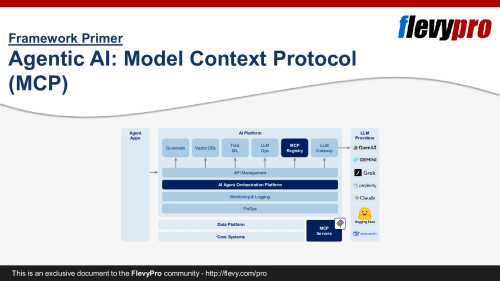
As AI agents spread across organizations, they need access to the tools where work and data already live. Connecting agents to databases, project management platforms, ERP suites, CRM systems, and similar applications remains a major integration hurdle.
This slide deck provides a detailed [read more]
Curated by McKinsey-trained Executives
100+ Agentic Organization SOPs Library
Complete AI-First Operating System -- Delivered in a Scalable Excel Template
Build, govern, and scale a fully Agentic Organization with confidence.
This 100+ Agentic Organization SOPs Library is a [read more]
Most organizations have realized wins by developing AI and analytics capabilities. The challenge is scaling those wins so they are seen in operations, customer experience and financial results, however, tools alone rarely deliver that outcome.
An Agentic AI Strategy focuses on building the [read more]
Agentic AI addresses a critical challenge in enterprise adoption: while most organizations achieve early success with individual models, few connect them into cohesive systems that transform business performance.
Traditional automation improves efficiency, yet it rarely redefines how decisions [read more]