Editor's Note: Take a look at our featured best practice, Digital Transformation Strategy (145-slide PowerPoint presentation). Digital Transformation is being embraced by organizations across most industries, as the role of technology shifts from being a business enabler to a business driver. This has only been accelerated by the COVID-19 global pandemic. Thus, to remain competitive and outcompete in today's fast paced, [read more]
* * * *
 If your business is still stuck with clunky payment systems from 2015, you’re probably losing customers. Today’s shoppers expect payment processes that are fast, secure, and dead simple to use. They don’t want to fumble around with complicated checkout forms or worry about whether their card info is safe
The reality? Companies that haven’t upgraded their payment infrastructure are getting left in the dust. But here’s the good news — modernizing doesn’t have to be overwhelming. We’ve identified five key strategies that actually work.
Strategy 1: Embracing Digital Wallets
Digital wallets aren’t just trendy anymore — they’re essential. Apple Pay, Google Wallet, and similar platforms have completely changed the game. Think about it: when was the last time you saw someone struggle to find their wallet at a coffee shop when they could just tap their phone?
Digital wallets are ridiculously fast and way more secure than traditional cards. The tokenization technology basically creates a unique code for each transaction, so your actual card details never get exposed. Plus, biometric authentication means even if someone steals your phone, they can’t use your payment apps.
Businesses that integrate these options aren’t just keeping up with trends. They’re showing customers they actually care about making things easier. And trust me, customers notice.
Strategy 2: Leveraging Cloud-Based Payment Infrastructure
Cloud-based payment solutions are game-changers, especially if you’re dealing with fluctuating transaction volumes.
The scalability is incredible — your system can handle 10 transactions or 10,000 without breaking a sweat. And the cost savings are significant. You’re not maintaining expensive on-site servers that might become obsolete in two years.
Strategy 3: Implementing Advanced Security Measures
Cyber threats aren’t slowing down. If anything, they’re getting more sophisticated. Last year alone, payment fraud cost businesses billions. The companies that get proactive about security don’t just protect themselves — they build serious customer trust.
End-to-end encryption and multi-factor authentication aren’t optional anymore. They’re baseline requirements. And staying PCI-DSS compliant is non-negotiable.
But security isn’t just about technology. It’s about giving customers confidence. When people feel safe using your payment system, they’re more likely to complete purchases and come back. That peace of mind is worth its weight in gold.
For teams upgrading security and UX in tandem, a practical way to implement these controls is through your gateway layer. This payment gateway api integration guide walks through API authentication, encryption and tokenization, 3‑D Secure/SCA, fraud screening, multi-currency and crypto support, sandbox testing, and go‑live monitoring helping engineering and product teams translate security requirements into a streamlined checkout experience.
Strategy 4: Offering Omnichannel Payment Experiences
Your customers don’t live in just one channel, so why should your payment system? Someone might browse products on their phone during lunch, add items to the cart on their laptop at home, then complete the purchase in your physical store the next day.
If those experiences don’t connect seamlessly, you’ll lose sales.
The best omnichannel systems make transitions invisible. Customers can start a transaction anywhere and finish it anywhere else without missing a beat. With mobile commerce growing like crazy, this isn’t just nice to have — it’s survival.
Companies that nail this strategy show they understand how people actually shop today. And customers reward that understanding with loyalty.
Strategy 5: Incorporating Artificial Intelligence for Payment Optimization
AI in payments isn’t science fiction anymore — it’s happening right now. The fraud detection capabilities alone are worth the investment. AI can spot suspicious patterns in milliseconds, often catching fraudulent transactions that would slip past traditional systems.
But it goes deeper than security. AI can analyze purchasing behavior to offer personalized payment options. Maybe it suggests installment plans for larger purchases or recommends the fastest checkout method based on past behavior.
The data insights are incredible, too. You can predict busy periods, optimize processing speeds, and even anticipate which payment methods customers prefer for different types of purchases.
Conclusion
Modernizing payment solutions isn’t just about staying current with technology — it’s about survival. The companies thriving today are the ones that made these upgrades before they absolutely had to.
The payment landscape changes fast. But if you implement these strategies thoughtfully, you won’t just keep up — you’ll stay ahead. And in today’s market, that’s exactly where you need to be.
206-slide PowerPoint presentation
This is again a "new improved" A Comprehensive Guide to Digital Transformation. What was one 173 slides has now increased to 206 because I have added a number of latest slides to the deck about Why People are the Critical Factor. The Value of Change Management. The deck is not intended to provide
[read more]
Do You Want to Implement Business Best Practices?
You can download in-depth presentations on Digital Transformation and 100s of management topics from the FlevyPro Library. FlevyPro is trusted and utilized by 1000s of management consultants and corporate executives.
For even more best practices available on Flevy, have a look at our top 100 lists:
These best practices are of the same as those leveraged by top-tier management consulting firms, like McKinsey, BCG, Bain, and Accenture. Improve the growth and efficiency of your organization by utilizing these best practice frameworks, templates, and tools. Most were developed by seasoned executives and consultants with over 20+ years of experience.
Readers of This Article Are Interested in These Resources
35-slide PowerPoint presentation
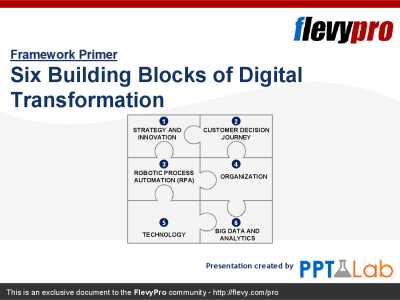
Digital Transformation touches practically every function in the entire organization. This thus requires an unprecedented amount of coordination among people, process, and technologies throughout the organization, leading to a difficult Transformation program.
The Six Building Blocks of
[read more]
87-slide PowerPoint presentation
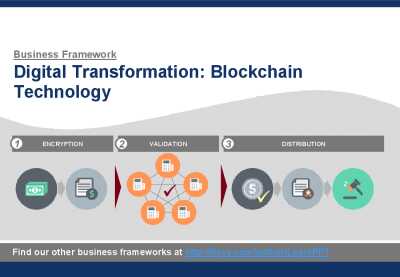
Blockchain Technology is an emerging database technology that has gained widespread appeal across many industries, mostly driven by the rise of cryptocurrencies--most notably Bitcoin. It provides numerous process benefits, including efficiency, security, transparency/openness, low cost, data
[read more]

21-slide PowerPoint presentation
Most organizations recognize the significant potential in creating value through Digital Transformation. However, they may struggle with the question of exactly how much value they can create and where within the organization the value will come from. This presentation deals with the various
[read more]
81-slide PowerPoint presentation
We are living in the Digital Age. For organizations to remain competitive, they must develop and execute robust Digital Transformation Strategies.
Organizations that have excelled in Digital Transformation distinguish themselves through their mastery of the 4 critical Business Ecosystems.
[read more]