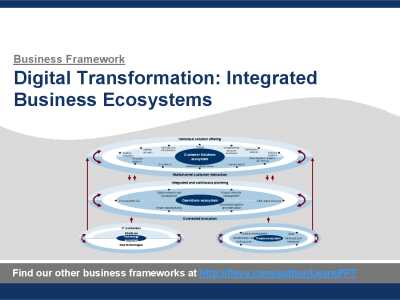
Editor's Note: Take a look at our featured best practice, Digital Transformation Strategy (145-slide PowerPoint presentation). Digital Transformation is being embraced by organizations across most industries, as the role of technology shifts from being a business enabler to a business driver. This has only been accelerated by the COVID-19 global pandemic. Thus, to remain competitive and outcompete in today's fast paced, [read more]
* * * *
The plumbing business has always been about speed of response and precision. A pipe bursts at three in the morning – the client won’t wait until sunrise. But when you’ve got fifteen crews out on calls, three on standby, dozens of requests daily – keeping everything in your head is impossible. This is where digital tools enter the scene, having made a real leap in functionality over the past two years.
In this article, we’ll look at which specific solutions help plumbing companies save hours daily, reduce operating costs, and earn more. No marketing fluff – just practical experience and numbers from real businesses.
Why Now Is the Time to Automate Your Plumbing Business
The pandemic made many think about digitization, but the real push came later. Rising wages, problems finding qualified workers, growing competition – all this made efficiency not just desirable, but critically important.
According to a 2024 industry study, the average plumbing company loses about 18 hours per week due to inefficient logistics and paperwork. That’s almost half of one person’s work week. Multiply that by the cost of a specialist’s hour – you get substantial money down the drain.
Another point: customers have become more demanding. They want to know the exact arrival time, see estimates before work begins, pay with a card on site. Nobody’s going to call every hour asking “when will the technician arrive?” anymore – they’ll just call another company that sends SMS with crew tracking.
Dispatching and Routing: The First Step to Order
The biggest headache for any plumbing business is distributing calls so they don’t overlap, so technicians aren’t driving from one end of the city to another, so urgent cases get serviced first.
Modern systems do this automatically. You enter an address – the algorithm suggests which specialist is closest and has the necessary skills. Everything is considered: real-time traffic, duration of the previous job, availability of parts with the technician.
GPS integration deserves special mention. The customer sees on their phone screen where the technician is now and when they’ll arrive. The dispatcher monitors all crews in real time. If someone gets stuck on a complicated site – other calls can be quickly redistributed.
Estimates and Invoices without Errors
Proper plumbing contractor software allows you to create estimates right on a tablet or phone. Databases with prices for labor and materials are already loaded, photos of the problem can be attached in just two clicks. The customer sees a transparent breakdown of costs, signs an electronic document – done.
This significantly increases trust. People don’t like surprises in bills. When you show in advance that replacing a pipe will cost this much plus materials at current prices – there are far fewer questions.
There’s also automated margin control. The system will suggest if your markup on specific services is below market average or if you forgot to account for difficult access to utilities. Small things, but over a year that’s thousands of dollars in difference.
Inventory Management: Stop Losing Money in the Warehouse
Plumbing specifics mean a huge range of parts. Fittings, gaskets, faucets, pipes of different diameters. It’s easy to lose control: you buy something in excess, something runs out at the most inappropriate moment.
Good programs integrate with inventory accounting. The technician used two gaskets on site – marked it in the app, the warehouse automatically updated. When the quantity of a certain item falls below the set minimum, the system itself generates an order to the supplier.
Another plus – transparency for accounting. All write-offs are recorded tied to specific orders. No more “someone took it, didn’t write it down,” no discrepancies between fact and documents.
Mobile Apps for Technicians: Office in Your Pocket
Technical specialists are rarely thrilled about extra bureaucracy. But when an app genuinely simplifies life – they use it willingly.
Imagine: a technician arrived on a call, opened the task on his phone, saw the history of this client’s previous requests, instructions for installed equipment. Completed the work, photographed the result, client put a signature on the screen – everything immediately went to the central database.
No need to sit evenings filling out paper reports. No need to drive to the office to submit documents. More time for real work, less for administrative hassle.
Special respect for systems with offline mode. Internet in basements is often weak or absent. The app saves data locally, syncs when connection appears. The technician works without problems regardless of network coverage.
Integration with Accounting and CRM
The biggest pain of separate systems is the need to manually transfer data back and forth. Completed an order in one program, now duplicate information in accounting, then don’t forget to enter it in the customer database.
Now market leaders integrate with popular systems like QuickBooks, Xero and others. A completed order automatically creates an invoice, payment is recorded, client data updates. Without manual labor, without errors, without wasted hours.
CRM integration allows building long-term relationships. The system will remind you that it’s time for the client to conduct preventive maintenance on the water heater. Automatically send SMS or email with a proposal. You get a loyal customer, the customer gets timely service.
According to statistics, maintaining an existing customer costs five times less than attracting a new one. Automated database work is a direct path to a stable flow of orders without huge advertising expenses.
Online Booking: Convenience for Customers
The generation that grew up on Uber and online delivery expects the same convenience everywhere. The ability to go to a website, choose a convenient time, describe the problem and get confirmation – this is no longer “nice to have,” but a standard.
Systems with online booking functionality integrate a widget right on the company website. The customer sees available slots, chooses, the system automatically creates an order and enters it into the technicians’ schedule.
This unloads the phone. Not all calls happen during business hours. A person can arrange a call at midnight when they remembered the problem – by morning the request is already in the system, the dispatcher just confirms and assigns a technician.
Plus reduction of human factor. When a dispatcher takes dozens of calls per day, mistakes are possible: wrote the address wrong, mixed up the time, forgot to clarify something. An online form is clearly structured, the client fills everything out themselves.
What to Choose: Universal or Specialized Solution
There are two types of products on the market: general systems for any service business and specialized software specifically for plumbers.
Universal ones are usually cheaper and have broader functionality. But they don’t account for professional specifics: nomenclature features, typical work scenarios, industry standards.
Specialized programs are more expensive, but contain ready templates specifically for plumbing. They already have typical prices loaded, there are hints about necessary permits for different types of work, integrations with plumbing equipment suppliers.
What to choose depends on business size and ambitions. A small firm with two technicians can get by with a simple universal solution for 50 dollars a month. A company with thirty employees and regional presence will get more benefit from a powerful industry platform.
Implementation without Headaches
The biggest fear of owners is that system implementation will paralyze work for weeks. Technicians won’t be able to figure it out, everything will hang, clients will scatter.
Actually quality providers offer detailed training. Usually these are video tutorials, webinars, documentation, direct support. Basic functions are mastered in a day or two. Full deployment of all modules takes a week or two, but in parallel the company continues working in the old mode.
The right strategy is gradual implementation. First you launch dispatching, get used to it. Then add a mobile app for technicians. Then integration with accounting. Don’t try to switch to all modules at once in one day.
It’s critically important to involve the team. If technicians perceive the system as “control from above” – they’ll sabotage. If you explain that it primarily makes their life easier (less paperwork, faster work, transparent bonus calculations) – they’ll support it.
Looking to the Future: What Awaits the Industry
Artificial intelligence is already knocking on the door. Some systems are experimenting with automatic problem classification from customer description, predicting necessary repair time, even hints to technicians right on site through augmented reality.
The Internet of Things will allow water heaters and boilers to signal themselves about the need for service before breakdown. Imagine: the system sees that pressure in a client’s pipes is dropping, automatically offers a check, the client confirms in one click – the technician is already on the way.
Blockchain can change document flow: permits, certificates, warranties stored in unchangeable form, accessible to all participants in the chain. Less bureaucracy, plus transparency.
But even without futuristic technologies, right now proper software gives a tangible advantage. In an industry where margins are often small and competition is high – every percentage of efficiency matters.
Companies investing in automation now will dominate local markets in a couple years.
This is again a "new improved" A Comprehensive Guide to Digital Transformation. What was one 173 slides has now increased to 206 because I have added a number of latest slides to the deck about Why People are the Critical Factor. The Value of Change Management. The deck is not intended to provide [read more]
Do You Want to Implement Business Best Practices?
You can download in-depth presentations on Digital Transformation and 100s of management topics from the FlevyPro Library. FlevyPro is trusted and utilized by 1000s of management consultants and corporate executives.
For even more best practices available on Flevy, have a look at our top 100 lists:
These best practices are of the same as those leveraged by top-tier management consulting firms, like McKinsey, BCG, Bain, and Accenture. Improve the growth and efficiency of your organization by utilizing these best practice frameworks, templates, and tools. Most were developed by seasoned executives and consultants with over 20+ years of experience.
Readers of This Article Are Interested in These Resources
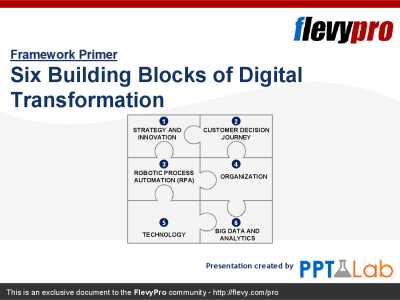
Digital Transformation touches practically every function in the entire organization. This thus requires an unprecedented amount of coordination among people, process, and technologies throughout the organization, leading to a difficult Transformation program.
The Six Building Blocks of [read more]
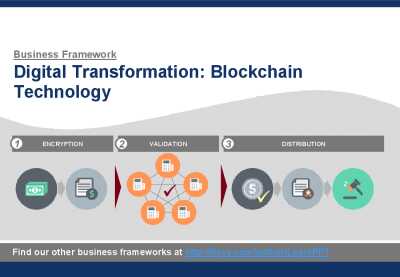
Blockchain Technology is an emerging database technology that has gained widespread appeal across many industries, mostly driven by the rise of cryptocurrencies--most notably Bitcoin. It provides numerous process benefits, including efficiency, security, transparency/openness, low cost, data [read more]
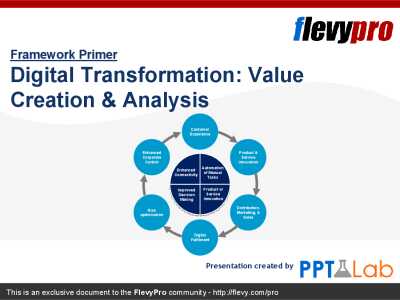
Most organizations recognize the significant potential in creating value through Digital Transformation. However, they may struggle with the question of exactly how much value they can create and where within the organization the value will come from. This presentation deals with the various [read more]
We are living in the Digital Age. For organizations to remain competitive, they must develop and execute robust Digital Transformation Strategies.
Organizations that have excelled in Digital Transformation distinguish themselves through their mastery of the 4 critical Business Ecosystems. [read more]
 The plumbing business has always been about speed of response and precision. A pipe bursts at three in the morning – the client won’t wait until sunrise. But when you’ve got fifteen crews out on calls, three on standby, dozens of requests daily – keeping everything in your head is impossible. This is where digital tools enter the scene, having made a real leap in functionality over the past two years.