Editor's Note: Take a look at our featured best practice, Organizational Velocity - Improving Speed, Efficiency & Effectiveness of Business (47-slide PowerPoint presentation). Lack of efficiency and effectiveness in an organization can have a significant impact on the overall cost of operation.
Organizational Velocity - Improving Speed, Efficiency & Effectiveness of Business provides a framework for diagnosing, assessing and implementing to improve the speed at which [read more]
Also, if you are interested in becoming an expert on Process Improvement, take a look at Flevy's Process Improvement Frameworks offering here. This is a curated collection of best practice frameworks based on the thought leadership of leading consulting firms, academics, and recognized subject matter experts. By learning and applying these concepts, you can you stay ahead of the curve. Full details here.
* * * *
 Most companies today are drowning in inefficiency. You’ve got teams that can’t communicate properly, outdated processes that waste everyone’s time, and managers making decisions based on gut feelings rather than actual data.
The good news is that it doesn’t have to be this way. I’ve seen organizations completely transform their operations by focusing on five key areas. These aren’t revolutionary concepts, but they work when you actually implement them properly.
1. Fix Your Communication Mess
Corporate communication is usually terrible. People are juggling emails, Slack messages, text chains, and random phone calls. No wonder nothing gets done on time.
The solution isn’t rocket science. Pick one main platform and stick with it. Slack works great. So does Microsoft Teams.
A client of mine–a manufacturing company with offices in twelve countries–was spending weeks just trying to coordinate simple projects. After they consolidated everything into Teams, their project timelines dropped by 30%. That’s not some made-up statistic. That’s real money saved and real headaches eliminated.
2. Embrace Agile (But Actually Do It Right)
Everyone talks about being “agile” these days. Most companies think it means having more meetings and calling them “standups.” Wrong.
Real agile methodology is about small teams, quick iterations, and constant feedback. You try something, see if it works, then adjust. No six-month planning cycles that become obsolete before they’re finished.
I’ve worked with tech startups and old-school manufacturers who’ve adopted this approach. Teams solve problems in days instead of months. When managers provide effective HR guidance during this transition, employees actually buy into the change instead of resisting it.
The key is starting small. Pick one team, one project. Test it out, then expand from there.
3. Stop Guessing–Use Your Data
Companies collect tons of data, then make decisions based on what the loudest person in the room thinks. Why?
Tools like Tableau and Power BI aren’t just fancy dashboards. They’re your crystal ball into what’s actually happening in your business. Customer behavior, operational bottlenecks, market trends–it’s all there if you know how to look.
Take this retail chain I worked with. They were convinced their supply chain problems were due to shipping delays. The data told a different story–their ordering system was the real culprit. Once they fixed that, they cut operational costs by 15%. Imagine if they’d kept guessing for another year.
4. Automate the Boring Stuff
Your employees didn’t go to college to manually process invoices for eight hours a day. Yet that’s exactly what many of them are doing.
Robotic Process Automation isn’t just for big corporations anymore. Small and medium businesses can automate payroll, customer service responses, data entry–basically anything that makes your team want to bang their heads against their desks.
A financial services firm I know automated its customer inquiry system last year. Response times improved by 40%, and their customer service team actually started enjoying their jobs again because they could focus on complex problems instead of answering the same basic questions all day.
5. Invest in Your People (Seriously)
Here’s what most companies get wrong about training–they treat it like a checkbox exercise. Send everyone to a generic seminar once a year and call it professional development. That’s not development. That’s just expensive babysitting.
Look at companies like Google or Amazon. They’re constantly upskilling their teams because they know technology changes fast. Your competition isn’t standing still, so why should your team’s skills?
Create real learning opportunities. Give people time to actually use what they learn. When employees see you’re genuinely invested in their growth, they stick around longer and work harder.
The Bottom Line
None of these strategies is groundbreaking. But they work when you actually commit to implementing them properly.
Start with communication–it’s usually the biggest pain point and gives you the quickest wins. Then tackle the others one by one. Don’t try to transform everything overnight. That’s how you end up with frustrated employees and failed initiatives.
The companies that get this right aren’t necessarily the smartest or best-funded. They’re just the ones willing to admit their current approach isn’t working and do something about it. The question is: are you ready to be one of them?
254-slide PowerPoint presentation
[NOTE: Our Kaizen presentation has been trusted by an array of prestigious organizations, including industry leaders such as Apple, Bayer, University of Michigan, General Motors, Cummins, Baxter, Johnson Controls, Ulta, Daimler Truck, Aramark, Parsons Corporation, to name just a few.]
Explore
[read more]
Want to Achieve Excellence in Process Improvement?
Gain the knowledge and develop the expertise to become an expert in Process Improvement. Our frameworks are based on the thought leadership of leading consulting firms, academics, and recognized subject matter experts. Click here for full details.
Process Improvement involves analyzing and improving existing business processes in the pursuit of optimized performance. The goals are typically to continuously reduce costs, minimize errors, eliminate waste, improve productivity, and streamline activities.
As we continue to deal with COVID-19 and its economic aftermath, most organizations will prioritize Business Process Improvement initiatives. This is true for a few reasons. First, Process Improvement is one of the most common and effective ways of reducing costs. As the global economy slows down, Cost Management will jump to the forefront of most corporate agendas.
Secondly, a downturn typically unveils ineffective and broken business processes. Organizations that once seemed agile and focused during periods of growth may become sluggish and inefficient when demand drops off.
Lastly, COVID-19 has expedited Digital Transformation for most organizations. One of the quickest and most impactful forms of Digital Transformation is Robotic Process Automation (RPA). Thus, we have included numerous RPA frameworks within this Stream.
Learn about our Process Improvement Best Practice Frameworks here.
Readers of This Article Are Interested in These Resources
139-slide PowerPoint presentation
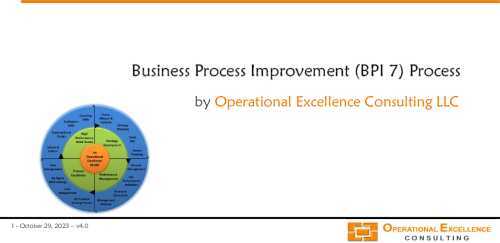
Our business process improvements methodology BPI 7 is a proven and systematic approach to continuously improve an organization's existing business processes.
The Business Process Improvement (BPI 7) Training Module includes:
1. MS PowerPoint Presentation including 141 slides covering
[read more]
184-slide PowerPoint presentation
This presentation is a collection of PowerPoint diagrams and templates used to convey 40 different business performance improvement models/frameworks. (Please note that these are diagrams and charts that are to be used in your own business or classroom presentations. These are not instructional
[read more]
41-slide PowerPoint presentation
The Process Automation & Digitalization Assessment is a comprehensive framework designed to help organizations identify opportunities for streamlining operations, reducing manual efforts, and leveraging technology to drive efficiency and scalability. The assessment provides a structured approach to
[read more]
190-slide PowerPoint presentation
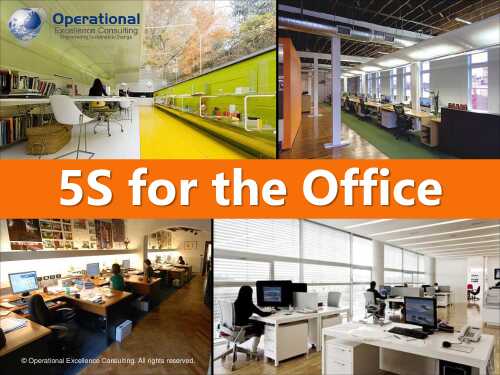
The office, by any name, is a paperwork factory. To become a Lean enterprise, office activities must fully support shop-floor manufacturing operations to eliminate waste. The adoption of 5S throughout all office functions is the first step to increase efficiency. 5S principles are dedicated to
[read more]