Editor's Note: Take a look at our featured best practice, Cost Segregation Study: Multiple Property Class Analysis (Excel workbook). Accountants, accounting firms, and real estate property owners can all benefit from this cost segregation study (CSS) template. It makes the estimated benefit easy to figure out and has flexible assumptions for high level or detailed segregation analysis. You get a summary of cost allocations [read more]
* * * *
Real estate firms have invested considerably in digital marketing infrastructure over the past decade — CRM systems, listing platforms, programmatic advertising, social media distribution. Yet a persistent friction point remains largely unaddressed: the gap between what a static listing communicates and what a prospective buyer or tenant actually needs to understand in order to move confidently through the purchase or leasing process.
This is not a design problem. It is a customer experience problem with measurable commercial consequences.
The Structural Friction in the Traditional Property Journey
Customer journey mapping in real estate consistently surfaces the same pattern. Prospects at the awareness and consideration stages are making preliminary qualification decisions based on limited information — typically photographs, written descriptions, and, where available, floor plans. These assets communicate some of what a prospect needs to know, but they systematically fail to convey layout legibility, spatial proportion, room flow, and the relationship between spaces. These are precisely the dimensions that determine whether a property is functionally suitable for a given buyer or tenant’s life.
The consequence is decision latency. Prospects who cannot form a clear mental model of a property from its listing tend to delay enquiry, engage sales teams with unresolved basic questions, or schedule viewings that resolve quickly — and negatively — upon arrival. Each of these outcomes represents a cost: extended sales cycles, inefficient use of sales team time, and a higher proportion of low-fit leads entering the funnel.
Research from the National Association of Realtors consistently indicates that the majority of buyers now begin their search online, spending significant time evaluating listings before engaging any human touchpoint. The quality of the digital experience at this self-service stage of the journey is therefore a meaningful determinant of lead quality downstream.
In the early evaluation stage, virtual tour 3D rendering can reduce customer uncertainty by giving prospects a more intuitive understanding of layout and space before they engage sales or leasing teams. By enabling richer self-service discovery at the top of the funnel, immersive visualization acts as a pre-qualification mechanism — filtering for prospects who have formed a genuine and informed interest in the property rather than a provisional curiosity that a viewing may quickly dispel.
Where Immersive Visualization Creates Measurable Business Value
Listing Pages and the Self-service Discovery Stage
The listing page is the primary touchpoint at the awareness and consideration stages of the real estate customer journey. At this stage, the prospect is evaluating multiple options in parallel, often across competing platforms, and is forming rapid judgments about which properties merit further investigation.
Properties that enable more complete spatial understanding at the listing stage benefit from a structural advantage: they allow prospects to move further through the evaluation process independently, arriving at the enquiry stage with a higher level of existing conviction. This improves the quality of the sales interaction — the prospect already has a clearer picture of the property and is asking more specific, higher-intent questions rather than seeking basic orientation.
Remote Qualification and the Distributed Workforce Effect
Post-pandemic patterns have permanently altered the composition of buyer and tenant markets. A significant proportion of property decisions are now being made by prospects operating across geographic boundaries — relocating professionals, remote workers considering markets other than their current location, corporate tenants evaluating space in cities where their teams may not yet be based.
For these segments, the ability to form a substantive view of a property through digital means — without requiring an in-person viewing at an early stage — is not a convenience feature. It is a functional requirement for entering the funnel at all. Firms that cannot meet this requirement lose a meaningful portion of addressable demand to competitors that can.
Leasing, Sales, and Investor Communication Workflows
For firms looking to modernize the buyer or tenant journey, 3D property tours can function as a practical digital-experience layer across listings, landing pages, and remote qualification workflows. Beyond the B2C application, this extends to investor relations and stakeholder communication, where the ability to present a property compellingly to parties who may not conduct in-person site visits is increasingly expected.
The digitization case study from Flevy’s own archives illustrates the broader dynamic: a real estate firm that implemented digital leasing platforms achieved a 15% improvement in operational efficiency and a 40% improvement in tenant satisfaction. Immersive property visualization is a component of this transformation logic — not a standalone marketing enhancement, but an element of the broader shift toward digital-first customer journeys.
A Management Framework for Evaluating Impact
Organizations considering investment in immersive property visualization should evaluate impact across three measurement dimensions:
Customer experience metrics provide the leading indicators. Time-on-page for listings with immersive content versus static listings, enquiry rates from properties with virtual tour capability, and customer satisfaction scores (NPS or equivalent) from prospects who engaged immersive content prior to enquiry all offer directional evidence of CX improvement.
Conversion and lead-quality metrics capture the funnel efficiency implications. The relevant indicators include the ratio of viewings to enquiries (lower is better, indicating higher self-qualification), the proportion of viewings that convert to offers or lease agreements, and the average time from initial enquiry to decision. Firms that have implemented virtual property experiences in comparable sectors report improvements across all three dimensions, though the magnitude varies by segment and market context.
Operational efficiency metrics capture the downstream effects on sales team productivity. Average number of viewings required per transaction, time spent by leasing or sales staff on basic property orientation questions that could be resolved through self-service digital content, and the proportion of enquiries that result in wasted viewings are the key metrics in this category.
Strategic Considerations before Implementation
Match the experience to customer segment. The value proposition of immersive visualization varies across buyer and tenant profiles. High-frequency, lower-involvement transactions — such as urban rental properties in competitive markets — benefit primarily from the self-qualification and enquiry efficiency effects. Longer-cycle, higher-involvement transactions — such as premium residential purchases, commercial leasing, or off-plan sales — derive additional value from the confidence and stakeholder alignment effects. A segmented implementation approach is more likely to generate returns than a uniform deployment.
Integrate with the wider digital journey. Immersive content that exists as a standalone asset, disconnected from the broader listing experience and CRM workflow, delivers limited value. The operational benefits depend on integration: virtual tour engagement data should inform lead scoring, sales team preparation, and follow-up communication. This requires coordination between marketing, digital, and sales functions — a change-management consideration that should be addressed in implementation planning.
Treat immersive content as part of a transformation roadmap. Organizations that have achieved the most significant results from digital property experience investments have done so as part of broader digital transformation programs, not as isolated marketing initiatives. The Flevy case study referenced above achieved its results through comprehensive platform digitization, of which customer-facing visualization was one component. This framing — immersive property visualization as a customer experience and digital transformation lever rather than a marketing asset — is the appropriate lens for executive decision-making.
The Strategic Imperative
Real estate firms operating in competitive markets cannot rely indefinitely on the assumption that prospects will tolerate high friction at the self-service stage of the customer journey. Buyer and tenant expectations are being shaped by digital experiences in adjacent sectors — e-commerce, financial services, hospitality — where rich, informative, spatially intuitive digital experiences have become the baseline.
The question for real estate leadership is not whether immersive property visualization creates customer experience value. The accumulated evidence from adjacent sectors and early real estate adopters indicates that it does. The strategic question is whether the organization has the capability, integration, and change-management discipline to capture that value systematically rather than episodically — and whether it will do so before competitors establish a durable advantage in customer experience quality.
Real Estate - Multiphase Lot Development
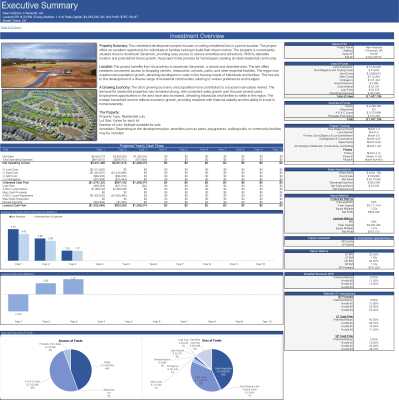
The Raw Land Development Model is an Excel-based analysis tool designed to assist in the financial analysis of a land development project.
It provides a comprehensive overview of the project's financial performance and allows for the evaluation of [read more]
Do You Want to Implement Business Best Practices?
You can download in-depth presentations on Real Estate and 100s of management topics from the FlevyPro Library. FlevyPro is trusted and utilized by 1000s of management consultants and corporate executives.
For even more best practices available on Flevy, have a look at our top 100 lists:
These best practices are of the same as those leveraged by top-tier management consulting firms, like McKinsey, BCG, Bain, and Accenture. Improve the growth and efficiency of your organization by utilizing these best practice frameworks, templates, and tools. Most were developed by seasoned executives and consultants with over 20+ years of experience.
Readers of This Article Are Interested in These Resources
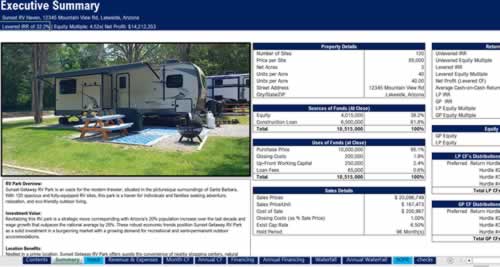
This Excel template is a specialized tool for assessing RV park acquisitions' feasibility. Developed with the precision needed for real estate investment decision-making, this dynamic financial model simplifies the evaluation process for purchasing, operating, and selling an RV park property. It [read more]
Key Template Features
- 20-Year Modeling: Allows annual period analysis for up to 20 years, ensuring a thorough long-term financial evaluation.
- Four Distinct Scenarios: Covers tenant buy-and-finance, tenant sale-leaseback, landlord sale-leaseback, and landlord third-party-tenant [read more]
REAL ESTATE - FIX AND FLIP PRO-FORMA MODEL
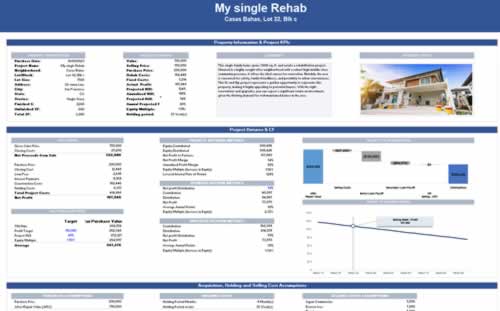
This meticulously crafted Financial Model for Analyzing Fix and Flip Deals is a powerful yet user-friendly template designed to provide you with all the essential metrics you need for successful house-flipping ventures.
KEY FEATURES
Property [read more]
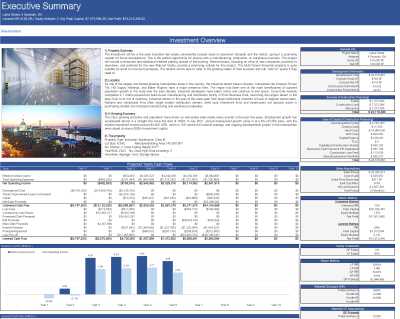
An Excel-based analysis tool for the ground-up development, operation, and ultimate disposition of a single- or multi-tenant Industrial/retail property with or without streams.
The model is monthly in nature, and it is a 100% unlocked Excel file with fully transparent formulas that can be [read more]
 Real estate firms have invested considerably in digital marketing infrastructure over the past decade — CRM systems, listing platforms, programmatic advertising, social media distribution. Yet a persistent friction point remains largely unaddressed: the gap between what a static listing communicates and what a prospective buyer or tenant actually needs to understand in order to move confidently through the purchase or leasing process.