Editor's Note: Take a look at our featured best practice, GenAI Roadmap Design (30-slide PowerPoint presentation). Organizations worldwide are embracing GenAI for its ability to generate actionable insights, predict outcomes, personalize at scale, and process natural language with human-like fluency.
Leading organizations already deploy GenAI in AI-assisted software development, workflow automation, [read more]
* * * *
GenAI is showing up everywhere—from Supply Chain copilot tools to boardroom pitch decks—but most organizations remain stuck in pilot purgatory. The failure point is not the model. It is the Operating Model. A shiny GenAI Strategy means little without a clear way to build, deploy, govern, and scale. That is where the GenAI Operating Model comes in. It is the blueprint to turn GenAI ambition into tangible, measurable outcomes.
The GenAI Operating Model framework defines the machinery underneath GenAI: ownership, architecture, data flows, decision rights, team structure, infrastructure, and controls. It avoids the trap of scattered pilots and vendor fatigue by enforcing repeatability. Organizations that treat GenAI like another tool rollout will find themselves bleeding budget on disconnected use cases with no path to scale. Leaders must hardwire GenAI into how work gets done, workflows run, decisions get made, and impact gets tracked.
Most large enterprises now claim to use GenAI somewhere. A global study pegs adoption at 65 percent across at least one function. But that does not translate into impact. That’s because leaders are chasing hype and disconnected tool tests instead of architecting for scale. They fund flashy demos without aligning on ownership, guardrails, or infrastructure. This results in inflated costs, stalled rollouts, and no measurable value. The GenAI Operating Model flips the approach. It prioritizes architecture over experimentation and systematizes what is otherwise chaos.
A brief summary of the core themes outlined in the GenAI Operating Model framework follows:
Organizations are heavily experimenting with GenAI but most never move past proof-of-concept phase.
The missing link is a GenAI Operating Model that defines how to fund, deploy, scale, and govern AI across the organization.
Common pitfalls include building tech without purpose and running uncoordinated pilots.
A component-based rollout enables fast deployment and future flexibility.
Risk governance must be baked into delivery, not patched on later.
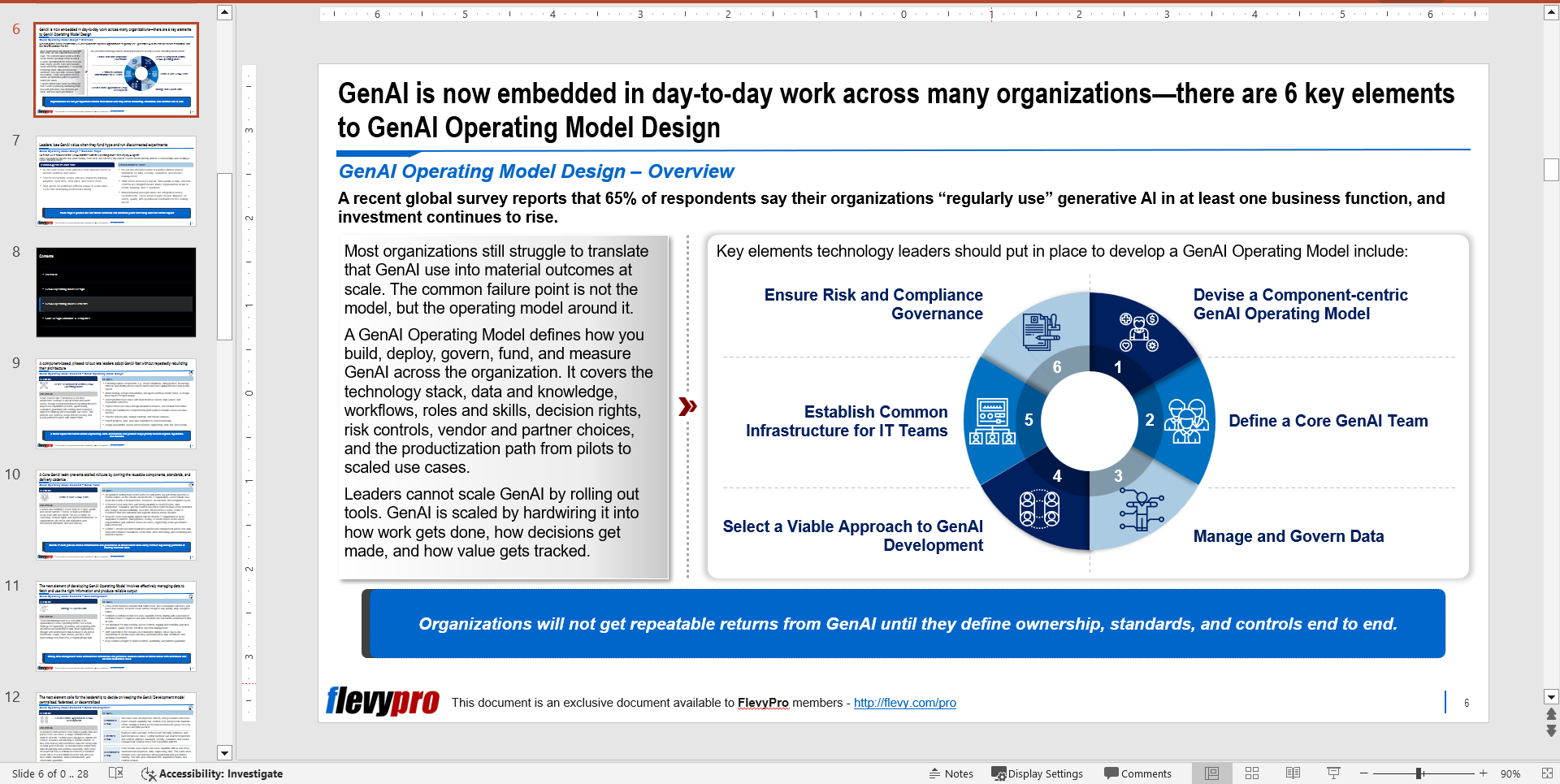
The GenAI Operating Model framework consists of 6 essential components:
Devise a Component-centric GenAI Operating Model
Define a Core GenAI Team
Manage & Govern Data
Select a Viable Approach to GenAI Development
Establish Common Infrastructure for IT Teams
Ensure Risk and Compliance Governance
Why Strategy Alone Isn’t Enough
Without a GenAI Operating Model, GenAI efforts decay into chaos due to duplicated tools, disconnected workflows, and data silos that kill scale. Worse, no one is quite sure who owns what. The GenAI Operating Model provides the foundation for durable results. It creates shared standards for IT and domain teams, assigns accountability, and codifies how GenAI integrates into daily work.
A strong operating model also unlocks the real power of GenAI, i.e., reuse. Pilots cannot be one-off science projects. They need to feed into reusable components, shared infrastructure, and consistent governance. Otherwise, every new use case becomes a reinvention exercise.
The Operating Model is not just about governance. It is also a defense against vendor fatigue. Every week, a new GenAI vendor shows up promising magic. But without a framework, it is impossible to evaluate them consistently or plug them into existing architecture. The model turns random experiments into a coherent roadmap.
And do not forget risk. GenAI introduces real exposure: hallucinated outputs, data leakage, bias amplification. A well-designed operating model embeds Risk Management from day one. It defines where tighter controls are needed, how governance is enforced, and how to continuously monitor for emerging issues.
Let’s take a closer look at the first 2 components of the GenAI Operating Model framework.
Devise a Component-centric GenAI Operating Model
This is the architectural backbone. GenAI evolves too fast for a static platform. Today’s vendor toolkit will be obsolete in 18 months. Treating GenAI like a once-and-done architecture project is a costly mistake.
Design a modular, component-based model. Think of it like Lego blocks: model hosting, orchestration, retrieval, and governance are all pluggable. This lets us phase in capabilities without blowing up our core stack. It also allows targeted upgrades without requiring full-stack rewrites.
Mature components like data pipelines or cloud foundations need deliberate planning. They are not easy to retrofit. Meanwhile, faster-moving layers like agent orchestration should be built for agility. The goal is to keep the engine running while parts evolve. Teams should prioritize use cases with high volume, clear business ownership, and measurable impact.
Define a Core GenAI Team
Ownership cannot be outsourced. A dedicated GenAI team ensures someone is actually steering the ship. Leaders have two options: upskill existing teams or build a focused GenAI group. Early pilots can work with cross-functional skunkworks teams. But when the organization starts scaling, things become tricky.
That is because GenAI demands dedicated attention. Model tuning, evaluation protocols, data pipeline integration, and risk reviews are not side gigs. A GenAI team with clear decision rights and its own budget moves faster and avoids the gridlock of shared bandwidth.
This team eventually becomes a GenAI Center of Excellence. It sets standards, supports rollout, and keeps IT aligned. Central IT should own the core stack: data layers, containerized models, observability, and lifecycle ops. The GenAI team drives enablement, not just delivery.
Case Study
Let us apply this model through a live lens. Imagine a bank launching GenAI for customer service. They start with a centralized GenAI team, which makes sense early on. They build a copilot for call center representatives, using a governed data pipeline and shared prompt framework.
As adoption grows, business units want to build their own tools, e.g., mortgage underwriting or fraud detection copilots. At this point, a shift to federated delivery is essential. The center owns the stack and standards, but domains build on top. They own their workflows and data but plug into a common layer.
If the bank skipped the operating model and let each unit build on its own, they would end up with four different stacks, no shared evaluation tools, and duplicative vendor spend. Instead, the federated model gives them speed and scale without losing control.
FAQs
Why is a GenAI Operating Model necessary when we already have a Strategy? Strategy tells you what to do. The operating model tells you how to do it. Without the latter, Strategy remains stuck in PowerPoint.
How should we structure our GenAI team?
Start with a small, dedicated squad that owns delivery, standards, and enablement. Scale it into a Center of Excellence as you expand use cases.
Where should we start deployment?
Begin in domains with high-volume workflows, clean data, and clear owners. Retail, banking, and IT functions are good bets. Avoid complex integration zones like manufacturing until governance is mature.
How do we manage risk and compliance?
Treat governance as a built-in component. Define risk thresholds by domain, implement testing protocols, and train teams regularly on evolving GenAI risks.
What infrastructure should be shared vs. domain-specific?
Central IT owns shared layers: libraries, prompt templates, cloud infra. Domains own agents and workflows. Shared infra avoids duplication and enforces standards.
Concluding Thoughts
Most GenAI failures aren’t technical. They are organizational. They don’t need the smartest model. They need the cleanest handoff between teams, clearest governance, and the most reusable stack.
This is why the Operating Model matters. It prevents GenAI from becoming just another innovation theater. It creates structure around a fluid technology, turning chaos into repeatable value.
CIOs and CTOs need to ask: do we want more GenAI pilots or actual impact? The answer lies in whether they have defined how to build, run, and govern GenAI at scale. That is not a Strategy slide; it is an operating model. Build it or stay stuck in demo mode.
You can download in-depth presentations on this and hundreds of similar business frameworks from the FlevyPro Library. FlevyPro is trusted and utilized by 1000s of management consultants and corporate executives.
For even more best practices available on Flevy, have a look at our top 100 lists:
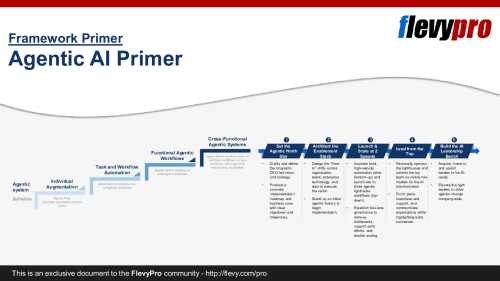
Agentic AI addresses a critical challenge in enterprise adoption: while most organizations achieve early success with individual models, few connect them into cohesive systems that transform business performance.
Traditional automation improves efficiency, yet it rarely redefines how decisions [read more]
Readers of This Article Are Interested in These Resources
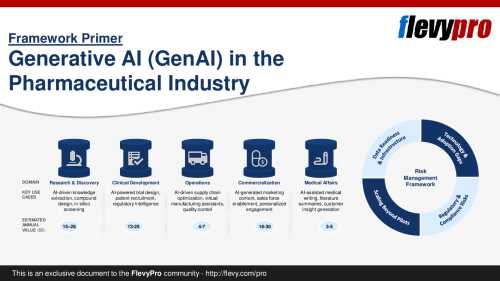
Pharmaceutical companies recognize the immense potential of Generative AI (GenAI) to accelerate drug discovery, improve clinical trials, and optimize commercial operations. Yet, capturing real value requires moving beyond hype to structured implementation strategies.
The McKinsey Global [read more]
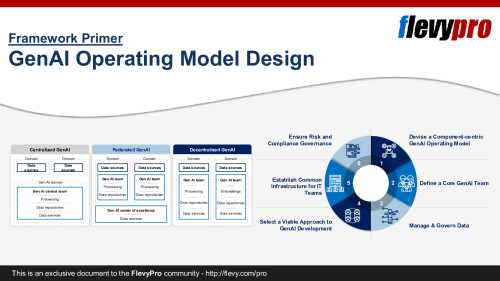
GenAI use is rising globally. Many organizations set GenAI strategies and launch pilots across functions. Yet most stall at the proof-of-concept stage and never show measurable financial or operational results.
This PPT presentation outlines the missing piece: an effective GenAI Operating [read more]
Generative Artificial Intelligence (GenAI) refers to foundation models that create new content, code, analyses, and decisions based on large-scale training data. Unlike traditional automation and analytics, GenAI operates as a reasoning and production layer embedded directly into daily [read more]
Curated by McKinsey-trained Executives
The GenAI Playbook -- The Ultimate 800+ Slide Powerhouse for Building, Scaling & Monetizing Generative AI in the Enterprise
If your organization is serious about winning in the age of Generative AI, The GenAI Playbook is the definitive resource you [read more]