Editor's Note: Take a look at our featured best practice, 6 Core Elements of Agentic AI (36-slide PowerPoint presentation). Agentic AI represents a shift toward autonomous, intelligent systems that can make decisions and take actions with minimal human intervention. Evolving from traditional machine learning, this technology enhances operations by automating complex workflows, optimizing decision-making, and enabling [read more]
* * * *
Agentic AI is moving beyond simple chat interfaces. These systems can retrieve data, call tools, trigger workflows, and make decisions with limited supervision. That capability opens the door to real efficiency gains. It also creates exposure that feels different from traditional software risk.
When an AI agent can take action instead of just generating text, mistakes compound faster. And if an attacker finds a way to influence that agent, the consequences extend beyond bad outputs. They can affect systems, data, and operations.
Below are seven risks organizations should have on their radar, along with grounded mitigation strategies that actually make sense in practice.
1. Prompt Injection and Poisoning
Datadome can help reduce exposure to prompt injection poisoning, particularly when hostile automated traffic is involved in distributing manipulated content.
Prompt injection works because agents trust the inputs they receive. An attacker hides instructions inside content that appears harmless. When the agent processes it, those instructions become part of its working context. In certain setups, that can lead to data exposure or unintended actions.
Poisoning takes longer but can be just as damaging. If malicious data enters the pipeline repeatedly, it may influence how an agent responds over time.
Mitigation is layered. Validate inputs before they reach the model, restrict what actions the agent is allowed to perform, even if prompted, monitor outputs for abnormal patterns, and limit large-scale scraping or automated manipulation that could feed harmful content into agent workflows. No single control solves this. Defense has to happen at multiple points.
2. Privilege Creep inside Autonomous Systems
Agentic tools are often granted broad permissions because they need to be useful, such as access to internal documents, the ability to query databases, and permission to trigger processes.
Over time, those permissions can expand, a new integration here, a wider API scope there. If something goes wrong, that accumulated access becomes the real risk. An agent that can read and write across systems creates more surface area than one operating in a narrow sandbox.
The mitigation is discipline. Apply least privilege, review access regularly, and remove capabilities that are no longer essential. Logging should not be optional. If an agent performs an action, there should be a trace.
3. Data Leakage through Conversation Engineering
Not every breach looks like a breach. Attackers can guide an agent through a series of normal-looking prompts that gradually extract protected information. Instead of asking for sensitive data outright, they request fragments that can be assembled later.
This is especially relevant when agents connect to internal knowledge repositories.
Mitigation starts at the data layer. Tag sensitive information and enforce response restrictions and train agents to decline certain categories of output regardless of phrasing. Monitor for unusual query sequences rather than single suspicious questions. The pattern often tells the story.
4. External Content Manipulation
Many agentic systems rely on outside information like news feeds, vendor listings, and even public datasets. That reliance introduces risk.
There are public demonstrations showing how AI agents can be influenced by manipulated content. If an agent trusts external inputs without validation, it may act on false or malicious information.
Imagine an automated sourcing assistant selecting a supplier based on falsified credibility signals. Or a financial agent incorporating altered pricing data into decision-making.
The solution is simple in theory but harder in practice. Validate external sources and assign trust tiers. In higher-impact workflows, require corroboration before taking action. Autonomy should not mean blind acceptance.
5. API Misuse at Machine Speed
Agentic systems interact with APIs constantly. If credentials are exposed or the agent is manipulated, that interaction can become risky very quickly, with repeated calls, bulk extraction, and serious service disruption.
Mitigation here looks familiar to seasoned security teams. Strong authentication, narrow token scopes, rate limits, and anomaly detection tied to behavior rather than raw volume. When APIs are the engine behind the agent, they must be hardened accordingly.
6. Third-Party Dependency Risk
Few agentic deployments operate in isolation. They connect to SaaS tools, cloud services, analytics platforms, and external data providers. Each connection expands the trust boundary.
If one of those providers is compromised or begins delivering tainted data, the agent may process and act on it without recognizing the issue.
Organizations should evaluate partner security practices and validate incoming data streams. In sensitive environments, isolating external inputs in controlled execution environments adds resilience. Supply chain awareness matters just as much in AI as it does in traditional software ecosystems.
7. Governance Gaps and Informal Expansion
One of the less technical but equally serious risks is governance drift.
Agentic AI often starts as a pilot, a controlled deployment. Over time, more teams adopt it, more features are layered on, and access expands because it is convenient.
Without clear oversight, that expansion can outpace security review.
Mitigation requires structure. Define ownership and establish review checkpoints before expanding capabilities. Conduct adversarial testing to explore failure scenarios. Governance is not a blocker to innovation, it’s what makes innovation sustainable.
Final Thoughts
Agentic AI changes the equation because it combines decision-making with action. The system is no longer just producing output, it’s interacting with the environment. That interaction multiplies risk when boundaries are weak.
Organizations adopting agentic AI should think in layers. Restrict what agents can access, validate what they consume, monitor what they produce, and review how they evolve.
Autonomy can deliver real value. But without guardrails, it can also create blind spots that are difficult to detect until damage is done. The difference will come down to how seriously oversight is built into the architecture from day one.
Curated by McKinsey-trained Executives
Unlock the Future of Business with the Ultimate Agentic AI Playbook: The Only Resource You'll Ever Need to Dominate the AI Revolution
In today's fast-paced, tech-driven world, the companies that stay ahead of the curve are the ones that fully [read more]
Do You Want to Implement Business Best Practices?
You can download in-depth presentations on Agentic AI and 100s of management topics from the FlevyPro Library. FlevyPro is trusted and utilized by 1000s of management consultants and corporate executives.
For even more best practices available on Flevy, have a look at our top 100 lists:
These best practices are of the same as those leveraged by top-tier management consulting firms, like McKinsey, BCG, Bain, and Accenture. Improve the growth and efficiency of your organization by utilizing these best practice frameworks, templates, and tools. Most were developed by seasoned executives and consultants with over 20+ years of experience.
Readers of This Article Are Interested in These Resources
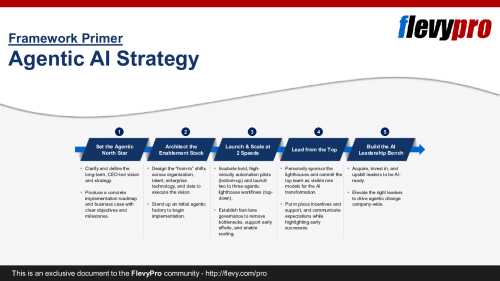
Most organizations have realized wins by developing AI and analytics capabilities. The challenge is scaling those wins so they are seen in operations, customer experience and financial results, however, tools alone rarely deliver that outcome.
An Agentic AI Strategy focuses on building the [read more]
Curated by McKinsey-trained Executives
100+ Agentic Organization SOPs Library
Complete AI-First Operating System -- Delivered in a Scalable Excel Template
Build, govern, and scale a fully Agentic Organization with confidence.
This 100+ Agentic Organization SOPs Library is a [read more]
The model treats revenue generation as a cascade that begins with customer acquisition and ends with token consumption. It starts with seat‑based subscriptions--the predictable, high‑margin engine that investors look for in ARR‑oriented businesses. Customer logos grow at tier‑specific [read more]
Curated by McKinsey-trained Executives
🚀 McKinsey-Style Agentic AI Skills Toolkit
The Most Advanced Enterprise AI Operating System for Strategic Decision Intelligence
Stop using AI as a chatbot. Start deploying it as a multi-agent executive intelligence system.
This is not a prompt [read more]
 Agentic AI is moving beyond simple chat interfaces. These systems can retrieve data, call tools, trigger workflows, and make decisions with limited supervision. That capability opens the door to real efficiency gains. It also creates exposure that feels different from traditional software risk.