Editor's Note: Take a look at our featured best practice, 6 Core Elements of Agentic AI (36-slide PowerPoint presentation). Agentic AI represents a shift toward autonomous, intelligent systems that can make decisions and take actions with minimal human intervention. Evolving from traditional machine learning, this technology enhances operations by automating complex workflows, optimizing decision-making, and enabling [read more]
* * * *
Artificial Intelligence (AI) agents are entering the enterprise world fast. But most stall out for the same reason—connecting to the tools that matter is a mess. Everyone wants agents that can update CRMs, scan ERP systems, message teams, query data warehouses. But without a standard approach to integration, each connection becomes a handcrafted headache.
Enter the Agentic AI Model Context Protocol (MCP), a framework designed to eliminate custom wiring by creating a shared interface layer between AI agents and enterprise systems.
Think of MCP as the TCP/IP for AI agents. Instead of building point-to-point bridges between every tool and agent, MCP gives you one reusable socket. Developed by Anthropic and opened to the public in late 2024, this protocol is a consulting-grade solution to a real architectural problem: how to make agent deployment predictable, scalable, and compliant across large organizations.
AI agents are taking hold in Supply Chains, where orchestration across Logistics, Inventory, and Planning Systems demands fluid coordination. A siloed setup means each agent needs a unique integration with every platform, which is a total nightmare. With MCP, each system connects once to an MCP server. Agents route through MCP clients and draw from a single access layer. You get reusability, version control, and centralized governance. In short, you scale agents, not headaches.
Here’s a quick recap of what MCP offers:
A standardized protocol to connect agents with enterprise systems
5 core primitives that govern access and guardrails
A shared client-server structure that avoids redundant integrations
Architecture support for orchestration, monitoring, and compliance
Templates and practices for production-scale agent design.
MCP Architecture
As defined by Anthropic, the MCP framework consists of 5 key elements:
Resources – Queryable datasets that provide context to agents
Tools – System actions like queries, updates, and triggers
Prompts – Instruction templates that enforce logic and safety
Roots – Boundaries that define what data is in-scope
Sampling – Optional controlled model completions gated by review.
MCP brings coherence to an otherwise fragmented environment of SaaS agents, desktop bots, and internal Automation tools. Every team wants to experiment. But without a repeatable integration layer, scale is a mirage. MCP shifts the integration model from exponential to linear where your effort grows with the number of tools, not the square of tool-agent combinations, which is game-changing.
Organizations also benefit from centralized governance. MCP servers expose only what agents need; no more, no less. Prompts act as railings that enforce workflows, and Sampling introduces model calls with human-in-the-loop review. This means you can give agents power without losing control. Legal, security, and compliance teams get clarity into what agents can see and do.
Orchestration becomes another layer of leverage. MCP plugs neatly into agent orchestration platforms, which handle agent routing, versioning, and monitoring. Layer on an MCP Registry and you get a discoverable, governable directory of integration points. Each MCP server becomes a modular block—map one server to one system, and your Information Architecture stays clean. It is composable as well as rational.
Let’s take a closer look at 2 of the foundational primitives of MCP framework, for now.
Resources
Resources are how agents get their bearings. Think of them as structured context—datasets, records, or metadata that the agent can query to understand the environment. They are exposed by MCP servers and consumed by MCP clients. Without Resources, agents are blind. With them, they are not just reactive—they are contextual. An agent tasked with adjusting supplier allocations, for example, can pull historical demand, inventory levels, and partner Performance in real-time, all from Resources wired to the same protocol.
Tools
Tools are how agents get things done. These are not just APIs. They are curated, scoped actions that MCP servers expose—like “update opportunity,” “trigger message,” or “retrieve record.” Each Tool has parameters, constraints, and safety boundaries. The Tool abstraction simplifies agent reasoning and makes validation easier. Agents don’t build HTTP calls from scratch—they select from governed tools, which dramatically reduces brittleness and injection risk. Tools give agents agency—without chaos.
Case Study
In a forward-looking Supply Chain Architecture, a fleet of agents collaborates with humans to manage complexity. At the top, an Orchestration Agent governs the flow. Below it, specialized agents handle Demand Planning, Logistics, Supply Planning, and SKU-level Product Planning. Each agent talks to different systems—ERP, CRM, warehouse platforms, supplier networks. With MCP, every system is mapped to a single server. Agents pull what they need, perform updates, and log every action through the same governed channel.
The payoff is massive. Adding a new agent no longer means engineering a new integration. You plug it into the MCP layer. Rolling out a new workflow? Just define the Prompts and Tools. MCP turns the Supply Chain into an agent-ready ecosystem—coordinated, safe, and modular. The system no longer groans under scale, it invites it.
FAQs
Is MCP proprietary or open?
MCP was developed by Anthropic and released as an open standard in November 2024. Anyone can implement it.
How does MCP reduce integration effort?
You integrate each enterprise system once via an MCP server. Then all agents can reuse that access through standard clients.
What kind of actions can agents perform through MCP?
Anything exposed as a Tool—updates, queries, messaging, approvals—provided it is governed and within scope.
How is security handled in MCP?
Roots define scoped data access. Prompts enforce behavior. Sampling allows gated model output. Logs and audit trails are expected.
What is the role of orchestration platforms with MCP?
They manage the agent lifecycle—routing, monitoring, deployment—and work hand-in-hand with MCP to deliver safe, repeatable execution.
FinalThoughts
MCP isn’t just about scale. It’s about clarity. It forces your architecture to take a position. You can’t build wildcat agents anymore. Every action routes through something explicit. Every connection is defined. That sounds like a constraint. But constraints breed reliability.
Most organizations don’t fail at AI because they lack ambition. They fail because the wiring doesn’t hold. MCP is the missing protocol between the dream of autonomous workflows and the grubby reality of enterprise technology. It won’t do your job for you. But it will let your agents do theirs.
So, if you are serious about AI at scale—stop soldering wires. Start laying tracks. Build with MCP.
You can download in-depth presentations on this and hundreds of similar business frameworks from the FlevyPro Library. FlevyPro is trusted and utilized by 1000s of management consultants and corporate executives.
For even more best practices available on Flevy, have a look at our top 100 lists:
Curated by McKinsey-trained Executives
Unlock the Future of Business with the Ultimate Agentic AI Playbook: The Only Resource You'll Ever Need to Dominate the AI Revolution
In today's fast-paced, tech-driven world, the companies that stay ahead of the curve are the ones that fully [read more]
Readers of This Article Are Interested in These Resources
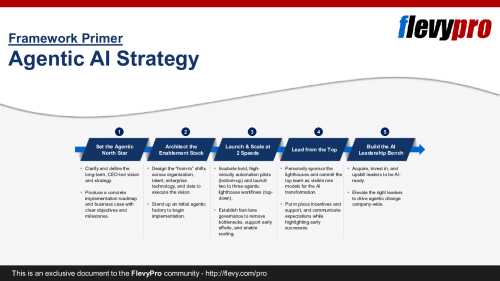
Most organizations have realized wins by developing AI and analytics capabilities. The challenge is scaling those wins so they are seen in operations, customer experience and financial results, however, tools alone rarely deliver that outcome.
An Agentic AI Strategy focuses on building the [read more]
Curated by McKinsey-trained Executives
100+ Agentic Organization SOPs Library
Complete AI-First Operating System -- Delivered in a Scalable Excel Template
Build, govern, and scale a fully Agentic Organization with confidence.
This 100+ Agentic Organization SOPs Library is a [read more]
Curated by McKinsey-trained Executives
🚀 McKinsey-Style Agentic AI Skills Toolkit
The Most Advanced Enterprise AI Operating System for Strategic Decision Intelligence
Stop using AI as a chatbot. Start deploying it as a multi-agent executive intelligence system.
This is not a prompt [read more]