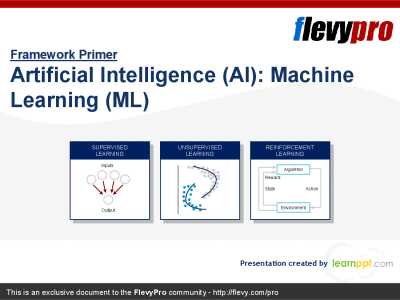
Editor's Note: Take a look at our featured best practice, Complete Artificial Intelligence (AI) Handbook (158-slide PowerPoint presentation). Unleash the Power of Artificial Intelligence: The Complete Handbook
In a world driven by innovation, Artificial Intelligence (AI) stands as the cornerstone of technological advancement. Are you ready to tap into the limitless potential of AI? Welcome to the comprehensive guide that will [read more]
Also, if you are interested in becoming an expert on Digital Transformation, take a look at Flevy's Digital Transformation Frameworks offering here. This is a curated collection of best practice frameworks based on the thought leadership of leading consulting firms, academics, and recognized subject matter experts. By learning and applying these concepts, you can you stay ahead of the curve. Full details here.
* * * *
 Speed is a competitive advantage in machine learning, and most conversations about it focus on the wrong thing. TFLOPS benchmarks dominate GPU comparison guides. What they skip is the speed that actually determines how productive an ML team is day to day: the time between writing code and running it. A platform that provisions a GPU cluster in 30 seconds versus one that takes 20 minutes isn’t just more convenient – it changes how teams iterate, how many experiments they run, and how quickly they reach usable results.
Cost, similarly, is not just about the hourly rate. Egress fees on large dataset transfers can easily exceed GPU costs for a training run. Idle time on hourly billing rounds up costs on jobs that complete in 40 minutes. A platform that bills per-second and charges nothing for egress can cost 30 to 40% less in practice than a platform with a lower headline rate but an opaque fee structure. This comparison evaluates five GPU cloud providers on the full picture.
| # |
Provider |
H100 Rate |
B200 Rate |
Egress Fees |
Kubernetes-Native |
Sovereign Cloud |
Free Trial |
| 1 |
Civo |
Competitive |
$2.69/hr preemptible |
None |
Yes |
Yes |
$250 credit |
| 2 |
RunPod |
From $2.39/hr |
From $5.98/hr |
None |
No |
No |
Variable |
| 3 |
Scaleway |
On-demand |
Pre-register |
EU standard |
Yes (Kapsule) |
Yes (EU) |
Free tier |
| 4 |
TensorDock |
From $2.25/hr |
Not listed |
Not published |
No |
No |
No |
| 5 |
Vast.ai |
From ~$0.90/hr |
Variable |
By host |
No |
No |
No |
Civo
The combination that Civo offers – Kubernetes-native architecture, on-demand GPU access, zero egress fees, and sovereign cloud options – is genuinely unusual in the GPU cloud market. Most platforms make you choose between developer convenience and infrastructure seriousness. Civo’s argument is that you shouldn’t have to.
Clusters provision in under 90 seconds. A100, H100, and B200 GPU instances are available on-demand and preemptible. The B200 preemptible starts at $2.69/GPU/hr, which is competitive for Blackwell-generation hardware. Egress is free within the platform, which removes a common budget surprise on high-volume training jobs. For teams running distributed training across multiple nodes, Kubernetes-native multi-node cluster support means that scaling a workload doesn’t require a separate orchestration layer.
The $250 free trial credit covers a month of real workloads, not just a toy deployment. For ML teams evaluating platforms before committing, that’s a structured way to run actual experiments rather than synthetic benchmarks. And for teams in regulated sectors who need sovereign cloud for their AI workloads – a requirement that eliminates most GPU cloud providers from consideration – Civo’s UK and EU sovereign deployments are the practical option.
- A100, H100, and B200 GPU instances; B200 preemptible from $2.69/GPU/hr
- Kubernetes-native multi-node cluster support; sub-90-second provisioning
- Zero egress fees within the platform
- UK and EU sovereign cloud options for regulated workloads
- ISO 27001, SOC 2, and Cyber Essentials certified
- $250 free trial credit for one month
Visit Civo: https://www.civo.com
RunPod
RunPod’s pricing model is built around per-second billing and a two-tier structure: Community Cloud for cost efficiency, Secure Cloud for teams that need stronger isolation. H100 PCIe starts at around $2.39/hr on the Community tier; H100 SXM at $2.69/hr; B200 on-demand at $5.98/hr. No egress fees, which simplifies total-cost calculations compared to platforms that charge for outbound data.
The pre-built AI template library reduces environment setup time, which matters for iteration speed even if it doesn’t appear on a benchmark. 30+ global regions means low-latency access from most locations. RunPod doesn’t offer Kubernetes-native orchestration or sovereign cloud options, which limits its suitability for regulated workloads or teams that need orchestration to be built into the platform rather than layered on top.
Best for: ML teams that want per-second billing, pre-built AI templates, and competitive H100 access without enterprise compliance requirements.
- H100 PCIe from $2.39/hr (Community Cloud); H100 SXM from $2.69/hr; B200 from $5.98/hr
- Per-second billing; no egress fees
- Pre-built AI and ML templates; Docker-native
- 30+ global regions
Scaleway
Scaleway is the most capable European GPU cloud option in this comparison, offering H100 SXM instances and L40S instances on-demand from its Paris and Amsterdam data centers, with Blackwell B300 hardware available for pre-registration. Managed Kubernetes via Kapsule means that teams who want Kubernetes orchestration without running their own cluster management have a supported option.
As a French-owned EU provider, Scaleway’s data residency is EU-native, which is relevant for teams with GDPR requirements or EU regulatory exposure. The renewable energy-powered data center commitment is one of the more substantive sustainability claims in the European market. Pricing is competitive for EU-based GPU access; the free tier allows initial evaluation without upfront cost.
Best for: European ML teams that need EU-sovereign GPU infrastructure, managed Kubernetes, and competitive pricing.
- H100 SXM and L40S GPU instances on-demand; B300 Blackwell in pre-registration
- Managed Kubernetes (Kapsule); EU sovereign data centers
- French-owned; GDPR-compliant; renewable energy-powered data centers
- Free tier available
TensorDock
TensorDock’s H100 SXM5 instances start at $2.25/hr on-demand, with spot pricing from $1.30/hr – the latter is particularly competitive for checkpointable training runs. The platform uses KVM virtualization with full VM access, supporting Windows workloads and custom OS configurations that container-based platforms don’t accommodate. TensorDock holds its hosts to a 99.99% uptime standard, which is higher than marketplace-based platforms typically offer.
Egress pricing is not publicly published in detail, which introduces some uncertainty into total-cost calculations at scale. There’s no Kubernetes-native offering or sovereign cloud capability. For ML teams with Windows-based pipelines or specific OS requirements, TensorDock’s KVM model is a practical differentiator.
Best for: ML teams that need competitive H100 access with full VM control and Windows support, where KVM flexibility matters more than managed orchestration.
- H100 SXM5 from $2.25/hr on-demand; spot from $1.30/hr; RTX 4090 from $0.37/hr
- KVM virtualization; full VM access; Windows support
- 99% uptime standard applied to all hosts
- No managed Kubernetes; no sovereign cloud
Vast.ai
Vast.ai’s marketplace model can surface H100 instances from around $0.90/hr and A100 PCIe from around $0.52/hr – rates that make dedicated platforms look expensive on the headline rate. For researchers running cost-sensitive experiments that checkpoint regularly and can tolerate occasional interruptions, the economics are genuinely compelling.
The trade-off is reliability and predictability. Hardware quality, host behavior, and egress costs vary by individual host. There’s no platform-level SLA. For production inference, regulated workloads, or jobs where a failed run has significant cost implications, the risk profile doesn’t suit the use case regardless of the headline rate.
Best for: Researchers running checkpoint-friendly experiments on a tight budget, where cost savings outweigh the risk of variable reliability.
- H100 from ~$0.90/hr marketplace; A100 PCIe from ~$0.52/hr
- Competitive bidding drives the lowest raw rates in this comparison
- Reliability variable by host; no platform-wide SLA
- Not suited to production inference or regulated workloads
What to Look for in a GPU Cloud Service for Machine Learning
- Provisioning speed. Time to a running cluster is a genuine productivity metric. Platforms that provision GPU instances in under a minute enable significantly faster iteration cycles than those with 15 to 20 minute setup times.
- Billing model. Per-second billing reduces waste on short jobs. Hourly billing is often fine for sustained training runs, but can add up quickly on jobs that complete in fractions of an hour.
- Egress fees. Moving large datasets and model checkpoints costs money on many platforms. Zero-egress platforms eliminate this variable from total-cost calculations.
- Multi-node support. Single-GPU training is fine for smaller models. For large-scale distributed training, the platform needs to support multi-node clusters natively or with minimal configuration overhead.
- Regulatory suitability. If the workload involves sensitive data or operates under sector-specific compliance requirements, GPU access is only part of the question. The sovereignty and certification picture matters as much as the compute.
- GPU generation. A100 handles most current training tasks well. H100 offers meaningful improvements for transformer-based workloads. B200 Blackwell is the current generation but has more limited availability across providers.
Frequently Asked Questions
Is a lower GPU hourly rate always cheaper in practice? Not reliably. Egress fees, storage costs, billing granularity, and the engineering time required to work around platform limitations all contribute to the real cost. A platform with a lower headline rate and undisclosed egress fees can cost more than a higher-rate platform with zero egress, particularly for workloads that move data frequently.
What is the difference between on-demand and preemptible GPU instances for ML? On-demand instances run until you stop them and can’t be interrupted. Preemptible instances are cheaper but can be reclaimed by the provider when capacity is needed. For training runs with checkpointing – saving state at regular intervals so a job can resume if interrupted – preemptible instances are cost-effective. For inference workloads or time-sensitive jobs, on-demand is the appropriate choice.
Does billing model matter as much as hourly rate for GPU cloud? It depends on workload profile. Per-second billing meaningfully reduces costs for short, bursty jobs. For sustained runs lasting hours, hourly and per-second billing converge. The more important variable for long training runs is the hourly rate itself and total-cost factors like egress.
When should a GPU cloud include sovereign cloud capability? When the workload involves personal data subject to GDPR, proprietary model weights that can’t leave a specific jurisdiction, or compliance requirements in sectors like financial services, healthcare, or government. In those cases, GPU compute within a sovereign boundary is a requirement, not a preference.
How do multi-node GPU clusters work on cloud platforms? Multi-node clusters link multiple GPU instances via high-speed networking (InfiniBand or NVLink where available), allowing large models to be trained across more GPU memory than any single machine can hold. Kubernetes-native platforms handle multi-node orchestration natively. Other platforms require manual configuration or external orchestration tools, adding complexity that compounds at scale.
Want to Achieve Excellence in Digital Transformation?
Gain the knowledge and develop the expertise to become an expert in Digital Transformation. Our frameworks are based on the thought leadership of leading consulting firms, academics, and recognized subject matter experts. Click here for full details.
Digital Transformation is being embraced by organizations of all sizes across most industries. In the Digital Age today, technology creates new opportunities and fundamentally transforms businesses in all aspects—operations, business models, strategies. It not only enables the business, but also drives its growth and can be a source of Competitive Advantage.
For many industries, COVID-19 has accelerated the timeline for Digital Transformation Programs by multiple years. Digital Transformation has become a necessity. Now, to survive in the Low Touch Economy—characterized by social distancing and a minimization of in-person activities—organizations must go digital. This includes offering digital solutions for both employees (e.g. Remote Work, Virtual Teams, Enterprise Cloud, etc.) and customers (e.g. E-commerce, Social Media, Mobile Apps, etc.).
Learn about our Digital Transformation Best Practice Frameworks here.
Readers of This Article Are Interested in These Resources

116-slide PowerPoint presentation
Introduction:
From the ambitious vision of the Dartmouth Conference in 1956, which proclaimed that "Every aspect of learning or other feature of intelligence can, in principle, be so precisely described that a machine can be made to simulate it," to Larry Page's futuristic dream of AI as the
[read more]
15-page PDF document
Learn about the most common machine learning algorithms in regression, classification, and clustering problems which include linear regression, logistic regression, naive Bayes, support vector machine, and k-means. Then an introduction to the Python code for a classic classification problem,
[read more]

24-slide PowerPoint presentation
Artificial Intelligence has come a long way from playing "chess" against a human. It has not only increased in breadth of applicability, but has also increased greatly in accessibility.
These days, there is an increasing trend in organizations to use Machine Learning (ML) to improve
[read more]

23-page PDF document
Introduction of one of the most wide-used categories of models-supervised learning. Detailed descriptions of the methods, application, and characteristics of several models. A coding example also provided for the audience to be familiar with how to prepare data and construct a model using sklearn
[read more]