Editor's Note: Take a look at our featured best practice, AI Strategy Playbook (1084-slide PowerPoint presentation). Curated by McKinsey-trained Executives
Unlock the Future of Your Business with the Ultimate AI Strategy Playbook: 1000+ Slides to Master AI and Dominate Your Industry
In today's fast-evolving digital landscape, Artificial Intelligence (AI) is no longer a luxury -- it's a [read more]
Also, if you are interested in becoming an expert on Digital Transformation, take a look at Flevy's Digital Transformation Frameworks offering here. This is a curated collection of best practice frameworks based on the thought leadership of leading consulting firms, academics, and recognized subject matter experts. By learning and applying these concepts, you can you stay ahead of the curve. Full details here.
* * * *
The way search engines work has fundamentally changed. What began as a system of crawling, indexing, and ranking ten blue links has evolved into something far more sophisticated. An ecosystem of AI-powered answer engines, generative summaries, and conversational interfaces that synthesize information before a user ever clicks a single result.
For SEO professionals, this is both a disruption and an opportunity. The technical foundations of the discipline haven’t disappeared, but they now need to serve two masters at once: traditional search engines and the AI systems layered on top of them. Understanding what this shift actually demands requires moving past the surface-level noise and digging into the specific technical signals that determine whether your content gets found, cited, or ignored entirely in this new landscape.
The pressure on technical SEO teams has intensified considerably. As more businesses recognize that visibility in AI-generated answers is now a legitimate traffic channel, the demand for specialists who genuinely understand the intersection of infrastructure and machine learning has grown accordingly.
It’s no coincidence that working with a partner like SeoProfy — widely regarded as the best SEO company for data-driven technical audits and scalable optimization — has become a serious consideration for many organizations. The complexity of modern search demands expertise that goes beyond plug-in fixes and surface-level audits.
The Shift from Ranking to Retrieval
Traditional SEO operated on a relatively straightforward principle: earn enough authority and relevance signals, and your page climbs the rankings. AI search changes this dynamic at its core. Platforms like Google’s AI Overviews, Perplexity, and ChatGPT’s web search mode don’t just rank pages — they retrieve content, extract meaning, and synthesize responses. Your page might never appear as a clickable result, yet still be cited as a source within a generated answer.
This distinction matters enormously from a technical standpoint. A page that is slow to load, poorly structured, or inaccessible to crawlers doesn’t just rank lower. It gets excluded from the retrieval pool entirely. AI systems operating with tight response windows and high precision requirements simply move on to better-structured sources. The technical barrier to entry for AI visibility, therefore, is arguably higher than it ever was for traditional ranking.
The implication is clear: technical SEO is no longer a prerequisite for ranking. It’s a prerequisite for existing in the new search ecosystem at all.
Crawlability and Indexation: The Non-Negotiable Foundation
Before any AI system can cite your content, it needs to find it. Crawlability remains the bedrock of everything that follows, and yet it’s the area where many sites continue to accumulate silent, costly errors.
What AI Crawlers Actually Need
AI-driven platforms use their own crawlers alongside traditional search bots. OAI-SearchBot (OpenAI), ClaudeBot (Anthropic), PerplexityBot, and Google’s various AI-adjacent crawlers all operate according to their own access rules. A poorly configured robots.txt that inadvertently blocks these agents can quietly exclude a site from AI citation pools without triggering any obvious alarm in standard analytics dashboards.
Key crawlability requirements in the AI search era:
Robots.txt precision: Review your directives specifically for AI crawlers. Blocking OAI-SearchBot or ClaudeBot may be intentional for some publishers, but it should be a deliberate, informed decision — not an accident.
XML sitemaps: Keep them current, correctly segmented by content type, and submitted to both Google Search Console and Bing Webmaster Tools. Fresh content that isn’t in your sitemap takes longer to enter the retrieval index.
Crawl budget management: For large sites, internal duplicate content, redirect chains, and orphaned pages consume crawl budget that should be directed at your most valuable URLs.
Clean URL architecture: Logical hierarchies with descriptive URLs help AI systems understand content relationships, not just humans.
HTTPS and technical hygiene: Valid SSL certificates, resolved mixed content errors, and no redirect loops are table stakes.
A site that AI crawlers can navigate efficiently gains a consistent advantage in retrieval frequency — meaning its content stays fresher in the systems that generate answers.
Structured Data: From Nice-to-Have to Mission-Critical
If crawlability determines whether your content enters the pool, structured data determines how well AI systems understand what’s in it. Structured data, implemented via JSON-LD (Google’s officially recommended format), essentially translates your page’s meaning into a machine-readable layer that AI systems can parse efficiently. Rather than inferring context from prose alone, AI engines can read explicit signals about what a page represents, who wrote it, what organization it belongs to, and how it relates to other entities.
Schema Types With the Highest AI Impact
Schema Type
Primary AI Benefit
Key Properties to Include
Article/NewsArticle
Enables authorship and publication signals for E-E-A-T verification
author, datePublished, dateModified, publisher
FAQPage
Surfaces directly in AI answer generation for question-type queries
mainEntity, acceptedAnswer, text
Product
Powers product retrieval in ChatGPT and Google AI Overviews
name, offers, review, aggregateRating
Organization
Establishes entity identity and brand trust signals
name, url, logo, sameAs, contactPoint
HowTo
Cited in procedural AI responses
step, tool, supply, totalTime
LocalBusiness
Improves geographic AI retrieval
address, openingHours, geo, telephone
Beyond individual schema types, the concept of a connected content knowledge graph is becoming increasingly relevant. When your Organization entity links to your Article entities, which in turn reference Author entities with verified profiles, you’re giving AI systems a coherent web of meaning rather than isolated signals. Clean, non-redundant, and internally consistent structured data — using stable @id identifiers and clear sameAs references — is what separates a site that’s occasionally cited from one that’s consistently retrieved.
One controlled experiment published by Search Engine Land in September 2025 found that only the page with a well-implemented schema appeared in AI Overviews, reaching Position 3 in traditional search. The page with no schema was never indexed at all. While a single test doesn’t establish universal causation, the direction of the evidence is consistent across multiple independent sources.
Core Web Vitals and Page Speed: Performance as a Retrieval Signal
AI retrieval systems operate under tight latency constraints. A page that fails to respond quickly enough simply might not make the cut, regardless of how authoritative or well-structured its content might be. This gives Core Web Vitals a dual purpose in the AI era. They remain a confirmed Google ranking signal, and they now function as a practical eligibility filter for AI inclusion.
Current Core Web Vitals Benchmarks
Metric
What It Measures
Target Threshold
Largest Contentful Paint (LCP)
Loading speed of the main visible content
Under 2.5 seconds
Interaction to Next Paint (INP)
Page responsiveness across all interactions
Under 200 milliseconds
Cumulative Layout Shift (CLS)
Visual stability during page load
Under 0.1
Google introduced INP as a Core Web Vitals in March 2024, replacing First Input Delay. Unlike FID, which only captured the first interaction, INP measures responsiveness across the entire session. For content-heavy sites with dynamic elements, this distinction is significant. A page can feel fast on arrival and still score poorly if interactive elements lag under real user conditions.
Practically speaking, the optimization priorities haven’t changed dramatically, but the urgency has:
Compress and serve images in modern formats (WebP, AVIF)
Eliminate render-blocking JavaScript and CSS
Use a Content Delivery Network to reduce global latency
Implement lazy loading for off-screen assets
Minimize redirect chains and reduce server response time (TTFB).
It’s worth noting that mobile performance takes precedence, since Google’s mobile-first indexing means mobile scores carry the ranking weight. A site that performs well on desktop but struggles on mobile is operating with a significant structural disadvantage.
E-E-A-T Signals and Technical Reinforcement
Experience, Expertise, Authoritativeness, and Trustworthiness — E-E-A-T — are editorial criteria, but they have technical expression. AI systems cite sources they trust, and trust is built through signals that technical SEO can directly influence.
Technical Signals That Reinforce E-E-A-T
Signal
Technical Implementation
AI Relevance
Author identity
Person schema with sameAs linking to verified profiles (LinkedIn, Google Scholar)
AI systems use authorship to assess expertise credibility
Organization entity
Organization schema with consistent NAP, logo, and social profiles
Establishes brand as a trusted named entity
Publication freshness
dateModified in Article schema, consistent sitemap timestamps
Some AI models weigh content recency heavily
HTTPS and security
Valid SSL, no mixed content, clear privacy signals
Trust and safety layer for AI citation decisions
External citation profile
Clean, editorial backlinks from established domains
AI training and retrieval systems weigh domain authority
The connection between E-E-A-T and technical SEO is often framed as two separate conversations. In practice, they’re deeply intertwined. Structured data that accurately attributes content to verified authors, combined with a technically sound site that loads reliably and stays crawlable, creates the kind of coherent trust signal that both Google’s quality systems and AI retrieval layers respond to.
Site Architecture and Internal Linking in an AI-First World
How a site is organized sends signals about topical authority. A concept that has become more important as AI systems evaluate whether a source is genuinely comprehensive on a subject or merely has a single well-optimized page.
Modular, hierarchically structured content performs better in AI retrieval because it mirrors how AI systems process queries through fan-out — breaking a complex question into sub-questions and gathering relevant answers from multiple related pages. A well-architected site with strong internal linking essentially pre-answers that fan-out process, giving AI systems a connected web of topical coverage rather than isolated articles.
Practically, this means:
Pillar-cluster structures organize content into a clear hierarchy, with cornerstone pages linking to and from supporting content
Descriptive anchor text provides semantic context that helps AI understand the relationship between linked pages
Breadcrumbs with BreadcrumbList schema reinforce hierarchy for both crawlers and AI systems
No orphaned pages — every indexable URL should be reachable within three to four clicks from the homepage and connected through relevant internal links.
Shallow site architecture, where key pages are buried six or seven levels deep, actively limits how thoroughly AI systems can explore and understand the topical scope of a domain.
Robots.txt, Canonical Tags, and Controlling What Gets Retrieved
As AI systems become more active consumers of web content, site owners have gained new levers for controlling how that content is accessed and attributed. robots.txt now governs not just Googlebot, but a growing roster of AI crawlers — each with its own user-agent string and its own access behavior.
Meanwhile, canonical tags have taken on added importance in preventing AI systems from indexing duplicate or near-duplicate content that could dilute an entity’s clarity in knowledge graphs. If an AI system encounters three versions of the same page, it may cite any of them, or none of them, with confidence. A clean canonical structure ensures that the authoritative version receives the retrieval credit.
Similarly, hreflang tags for multilingual sites help AI systems serve geographically and linguistically appropriate content — a consideration that becomes especially relevant as AI-generated answers increasingly adapt to regional context.
Monitoring Technical Health in a Multi-Platform Search Environment
Traditional technical SEO monitoring focused almost exclusively on Google Search Console. That’s no longer sufficient. With Bing, Perplexity, ChatGPT, and other AI-powered platforms operating as independent search surfaces, technical health needs to be assessed across a wider set of signals.
Key monitoring priorities for technical SEO teams now include:
Google Search Console and Bing Webmaster Tools for indexation, crawl errors, and Core Web Vitals reports
AI visibility tracking tools (such as Semrush’s AI Visibility Toolkit) for monitoring brand appearances in AI-generated answers
Server log analysis to identify which crawlers are accessing the site, how frequently, and what they’re finding
Schema validation via Google’s Rich Results Test and the Schema Markup Validator, run after any significant content or template change
Crawl simulation tools like Screaming Frog (which now integrates with OpenAI and Gemini for AI-assisted auditing) to surface technical issues before they affect retrieval.
The monitoring cadence matters, too. A site that audits technical health quarterly will be consistently behind a competitor that treats technical SEO as a continuous, near-real-time practice. Given how quickly AI search surfaces evolve, the gap between those two approaches is widening.
The Technical Foundation Hasn’t Changed — Its Stakes Have
It would be tempting to conclude that AI search requires an entirely new technical playbook. That’s not quite accurate. The fundamentals — crawlability, structured data, page speed, clean architecture, and trustworthy signals — are the same ones that have always underpinned strong technical SEO. What has changed is how much these fundamentals matter and how precisely they need to be executed.
In the traditional ranking paradigm, a site with mediocre technical health could still compete on the strength of good content and strong backlinks. In the AI retrieval paradigm, technical deficiencies create hard exclusion points. A page that can’t be crawled won’t be retrieved. A page that loads too slowly won’t make it through the latency window. A page with no structured data forces AI systems to guess at its meaning — and in a landscape where better-marked-up competitors exist, guessing is rarely the outcome.
The bar has risen. Technical SEO is no longer the groundwork you lay before doing the “real” work. It is the work in the age of AI search.
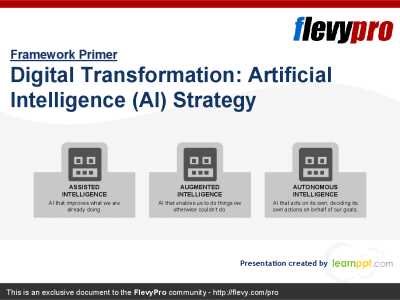
The rise of the machines is becoming an impending reality. The Artificial Intelligence (AI) revolution is here. Most businesses are aware of this and see the tremendous potential of AI.
This presentation defines AI and explains the 3 basic forms of AI:
1. Assisted Intelligence
2. [read more]
Want to Achieve Excellence in Digital Transformation?
Gain the knowledge and develop the expertise to become an expert in Digital Transformation. Our frameworks are based on the thought leadership of leading consulting firms, academics, and recognized subject matter experts. Click here for full details.
Digital Transformation is being embraced by organizations of all sizes across most industries. In the Digital Age today, technology creates new opportunities and fundamentally transforms businesses in all aspects—operations, business models, strategies. It not only enables the business, but also drives its growth and can be a source of Competitive Advantage.
For many industries, COVID-19 has accelerated the timeline for Digital Transformation Programs by multiple years. Digital Transformation has become a necessity. Now, to survive in the Low Touch Economy—characterized by social distancing and a minimization of in-person activities—organizations must go digital. This includes offering digital solutions for both employees (e.g. Remote Work, Virtual Teams, Enterprise Cloud, etc.) and customers (e.g. E-commerce, Social Media, Mobile Apps, etc.).
Artificial Intelligence (AI) is no longer a future concept - it's a present-day business imperative. AI is transforming how organizations operate, compete, and create value. Yet, with its rapid evolution, many enterprises struggle to keep pace. The A.R.I.S.E. Framework is a proven, [read more]
Artificial Intelligence has moved from experimentation to everyday operations across industries--customer, supply chain, finance, and tech.
Organizations that adopt AI systematically are widening performance gaps in speed, cost, and experience. In McKinsey's 2025 State of AI, 71% of [read more]
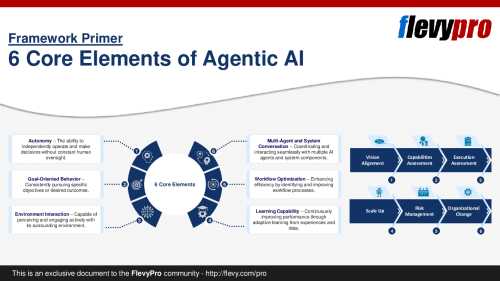
Agentic AI represents a shift toward autonomous, intelligent systems that can make decisions and take actions with minimal human intervention. Evolving from traditional machine learning, this technology enhances operations by automating complex workflows, optimizing decision-making, and enabling [read more]
Curated by McKinsey-trained Executives
Unlock the Future of Business: The Ultimate Strategic AI Implementation Guide (500+ Slides of Executive-Grade Insight)
Is your business prepared for the AI revolution--or are you about to be left behind?
If you're not actively integrating [read more]
 The way search engines work has fundamentally changed. What began as a system of crawling, indexing, and ranking ten blue links has evolved into something far more sophisticated. An ecosystem of AI-powered answer engines, generative summaries, and conversational interfaces that synthesize information before a user ever clicks a single result.
 One controlled experiment published by Search Engine Land in September 2025 found that only the page with a well-implemented schema appeared in AI Overviews, reaching Position 3 in traditional search. The page with no schema was never indexed at all. While a single test doesn’t establish universal causation, the direction of the evidence is consistent across multiple independent sources.
 It would be tempting to conclude that AI search requires an entirely new technical playbook. That’s not quite accurate. The fundamentals — crawlability, structured data, page speed, clean architecture, and trustworthy signals — are the same ones that have always underpinned strong technical SEO. What has changed is how much these fundamentals matter and how precisely they need to be executed.