Editor's Note: Take a look at our featured best practice, AI Strategy Playbook (1084-slide PowerPoint presentation). Curated by McKinsey-trained Executives
Unlock the Future of Your Business with the Ultimate AI Strategy Playbook: 1000+ Slides to Master AI and Dominate Your Industry
In today's fast-evolving digital landscape, Artificial Intelligence (AI) is no longer a luxury -- it's a [read more]
Also, if you are interested in becoming an expert on Digital Transformation, take a look at Flevy's Digital Transformation Frameworks offering here. This is a curated collection of best practice frameworks based on the thought leadership of leading consulting firms, academics, and recognized subject matter experts. By learning and applying these concepts, you can you stay ahead of the curve. Full details here.
* * * *
Enterprise AI stalls for one simple reason. Leaders treat it like a set of experiments instead of a Strategic Transformation. That error sounds harmless. It is not. It creates scattered pilots, local enthusiasm, thin funding, and a very expensive pile of clever demos that never touch the operating core. The AI Maturity Transformation Journey framework here forces a different posture. It treats AI as a managed journey from fragmented activity to organization wide capability.
Context matters. AI is now moving from novelty to infrastructure. Boards want measurable returns. Operating leaders want productivity. Risk leaders want control. The workforce wants clarity on what changes, what stays, and who owns the new decisions. That tension is exactly why this framework works. It converts ambition into sequence.
The 7 AI Maturity Transformation Steps are:
Set Bold Executive Commitment
Build a Balanced Portfolio
Start with Lighthouse Programs
Ensure Minimal Viable Infrastructure
Close Capability Gaps
Implement End to End Governance
Establish AI Guardrails
This sequence is practical because it resolves the usual executive dilemma. Do you fund near term wins or bet on bigger reinvention? The answer is both, but in a disciplined portfolio. Do you push tools first or operating model first? Again, both, but not blindly.
Key benefits are straightforward. The framework reduces strategic drift. It creates a funding logic for AI investments. It improves adoption because leaders stop asking the organization to believe in vague potential. They show proof, then scale.
Where the Real Game Begins
The first element, Set Bold Executive Commitment, is the non negotiable starting point. AI maturity demands a multi year mandate. An organization cannot industrialize AI while budgeting it like office supplies. Early ROI often lags investment. That is the famous value dip that kills weak resolve. Executive Commitment provides the financial and political air cover to survive that dip.
This step also resets accountability. AI cannot sit in a digital lab with a few enthusiasts and a heroic Chief Data Officer. Every business unit leader needs AI targets in Performance Management. Every capital committee needs a lens for AI enabled returns. Every Transformation office needs a live view of use cases, costs, risks, and adoption. No one gets to say, “Interesting, but not my problem.”
The second element, Build a Balanced Portfolio, prevents two bad habits. One is chasing only productivity use cases because they feel safe. The other is chasing only moonshots because they look visionary in a board deck. Mature leaders mix horizons. They fund rapid efficiency gains, functional reinvention, and new AI enabled offerings. That blend creates near term credibility and long term strategic muscle.
A balanced portfolio also creates strategic options. Some initiatives will save labor hours. Some will reshape core processes like procurement, risk review, pricing, or service resolution. A select few will create new revenue logic. The point is not to predict perfectly. The point is to avoid betting the program on one category of value.
A Case that Makes the Framework Tangible
Consider JPMorgan and its long arc in AI adoption. The organization did not treat AI as a side hustle. It embedded analytics and machine learning into fraud detection, document analysis, risk processes, and service operations. Executive sponsorship made the difference. Capital was available across multiple cycles. AI did not have to prove its right to exist every quarter.
The portfolio was also balanced. Some use cases targeted process speed and control. Others supported higher order judgment and better client experience. That matters. A bank does not win by automating one workflow and calling it transformation. It wins when AI reshapes decision quality, throughput, and risk discipline across the stack.
The lesson for any organization is blunt. If your AI agenda consists of disconnected pilots owned by local teams, you are not on a maturity journey. You are running a science fair. Science fairs are fun. They do not move enterprise economics.
Why This Framework Is Useful
This framework is useful because it forces executive sequence. Many organizations know what AI can do in theory. Few know how to build the conditions required to scale it. The framework closes that gap. It tells leaders what to do first, what to fund next, and what to hardwire before the stakes get higher.
It is also useful because it aligns Strategy with Operating Model. Too many AI programs chase technical sophistication while ignoring workflows, incentives, and decision rights. That is how expensive models end up producing neat outputs that nobody uses. The framework pushes leaders to integrate technology with the way work actually happens.
Another strength is its realism about people. Capability does not magically appear when licenses are purchased. Human capital, Management Systems, and Culture all need to shift. The organization needs specialists, yes. It also needs broad AI literacy so managers know when to trust the machine, challenge it, or override it.
The framework also protects the organization from its own enthusiasm. AI excitement can create reckless speed. Guardrails and governance make sure speed does not become self sabotage. That is not bureaucracy. That is adult supervision.
FAQs
Why start with Executive Commitment instead of technology?
Because funding, incentives, and accountability determine scale. Technology without sponsorship stays local.
What makes a Balanced Portfolio work?
Clear allocation across efficiency, functional reinvention, and new AI enabled growth opportunities.
How many Lighthouse Programs should an organization launch first?
Usually one to three. More than that and focus starts leaking.
What does Minimal Viable Infrastructure really mean?
A practical data and systems foundation that lets models run in production with reliable access, governance, and interoperability.
Why do AI Guardrails need early attention?
Risk compounds at scale. Privacy failures, bias, and unclear ownership become very expensive very fast.
Closing Thoughts
AI Maturity is less about model sophistication and more about institutional discipline. The strongest organizations are not the ones with the flashiest demos. They are the ones that can translate ambition into repeatable execution, with Decision Rights, talent, data, and Governance all pointing in the same direction.
Executives should ask a hard question. Is AI changing how your organization allocates capital, measures performance, redesigns work, and manages risk? If the answer is no, then the agenda is still cosmetic. The framework is valuable because it strips away that illusion and replaces it with a serious consulting template for Strategy Development.
One final truth deserves attention. AI does not remove the need for Leadership. It raises the standard for it. Machines can surface patterns. They do not create organizational resolve. That job stays in the executive suite, where it belongs.
You can download in-depth presentations on this and hundreds of similar business frameworks from the FlevyPro Library. FlevyPro is trusted and utilized by 1000s of management consultants and corporate executives.
For even more best practices available on Flevy, have a look at our top 100 lists:
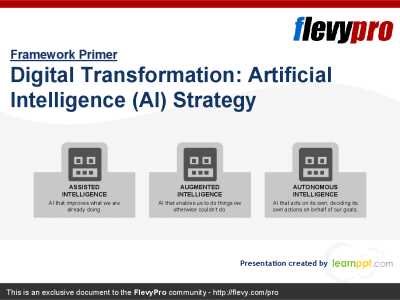
The rise of the machines is becoming an impending reality. The Artificial Intelligence (AI) revolution is here. Most businesses are aware of this and see the tremendous potential of AI.
This presentation defines AI and explains the 3 basic forms of AI:
1. Assisted Intelligence
2. [read more]
Want to Achieve Excellence in Digital Transformation?
Gain the knowledge and develop the expertise to become an expert in Digital Transformation. Our frameworks are based on the thought leadership of leading consulting firms, academics, and recognized subject matter experts. Click here for full details.
Digital Transformation is being embraced by organizations of all sizes across most industries. In the Digital Age today, technology creates new opportunities and fundamentally transforms businesses in all aspects—operations, business models, strategies. It not only enables the business, but also drives its growth and can be a source of Competitive Advantage.
For many industries, COVID-19 has accelerated the timeline for Digital Transformation Programs by multiple years. Digital Transformation has become a necessity. Now, to survive in the Low Touch Economy—characterized by social distancing and a minimization of in-person activities—organizations must go digital. This includes offering digital solutions for both employees (e.g. Remote Work, Virtual Teams, Enterprise Cloud, etc.) and customers (e.g. E-commerce, Social Media, Mobile Apps, etc.).
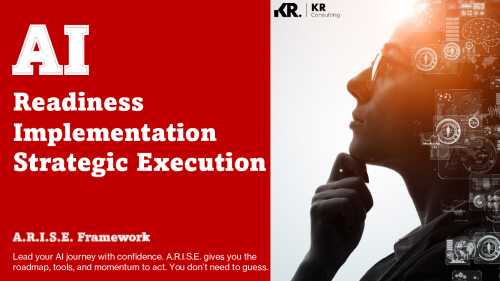
Artificial Intelligence (AI) is no longer a future concept - it's a present-day business imperative. AI is transforming how organizations operate, compete, and create value. Yet, with its rapid evolution, many enterprises struggle to keep pace. The A.R.I.S.E. Framework is a proven, [read more]
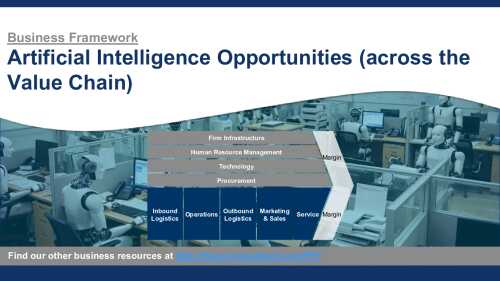
Artificial Intelligence has moved from experimentation to everyday operations across industries--customer, supply chain, finance, and tech.
Organizations that adopt AI systematically are widening performance gaps in speed, cost, and experience. In McKinsey's 2025 State of AI, 71% of [read more]
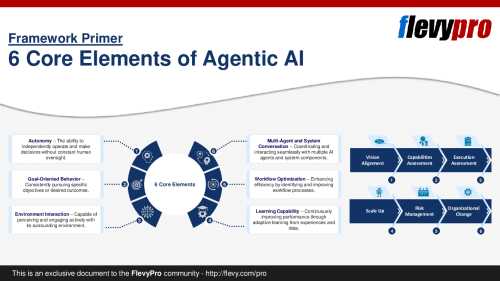
Agentic AI represents a shift toward autonomous, intelligent systems that can make decisions and take actions with minimal human intervention. Evolving from traditional machine learning, this technology enhances operations by automating complex workflows, optimizing decision-making, and enabling [read more]
Curated by McKinsey-trained Executives
Unlock the Future of Business: The Ultimate Strategic AI Implementation Guide (500+ Slides of Executive-Grade Insight)
Is your business prepared for the AI revolution--or are you about to be left behind?
If you're not actively integrating [read more]