Editor's Note: Take a look at our featured best practice, Five Stages of Business Growth (25-slide PowerPoint presentation). This presentation introduces a framework for entrepreneurs to use when building and navigating their business from a nascent, startup state to an enterprise with a global footprint. This framework, called the 5 Stages of Business Growth, is based on the fact that all businesses experience common [read more]
* * * *
A domain is like an online business card. It creates a visual impact and establishes a brand’s credibility among visitors. Domain basics are essential considerations for small business owners seeking to develop a strong online presence and promote their business.
When you buy domain names, focusing on elements that simplify user recognition can make a massive difference. A domain name can significantly impact the credibility and success of a website, and it should be managed carefully. This post provides key insights into domains that every founder seeking to succeed in today’s competitive digital world should consider.
Things Small Business Owners Should Know about Domains
Small business owners can make sound decisions when they understand the basics of choosing and managing domain names. Here’s a list of the things you should consider if you’re a small business owner:
Why Domain Names Matter
A memorable domain name helps customers easily find a business online. It operates as an address that directs customers to specific product or service offerings. A good name makes it easier to recognize and revisit. In every interaction, a well-defined domain eliminates confusion, fosters trust and professionalism, and underscores the importance of purchasing a domain that aligns with your brand.
Choosing the Right Domain Name
Customers can easily remember short domain names. However, avoiding difficult spelling makes it easy for users to enter errors. Including relevant keywords in a domain name helps improve search visibility, making it easier for potential customers to discover the business. Securing a name that reflects the brand is ideal, as it supports long-term consistency and enhances overall recognition.
What Domain Extensions Mean
The extension, or the text appearing after the dot in a domain name, signifies the type or purpose of a website. Common extensions include .com, .org, and .net. Although these are widely recognized, certain industries or communities may also benefit from alternative extensions tailored to their niche. Selecting an appropriate extension helps set the tone for visitors and strengthens overall brand positioning.
Taking Steps for Domain Registration
Domain registration involves verifying the availability of a preferred domain and securing the rights to use it for a designated period. Most domain registrars offer tools that help you search and compare suitable options. Once an appropriate name is identified, registering it promptly helps prevent others from acquiring it. Timely renewal further ensures continued ownership and uninterrupted use of the business’s online address.
Protecting Business Identity with Domains
Having a domain saves the brand from copycat brands. Registering closely related names or common misspellings helps add an extra layer of protection. Many also purchase multiple extensions, making it even less likely that someone else can confuse them with a similar name. This practice protects reputation and prevents customers from falling for similar addresses.
Ensuring Domain Privacy and Security
Unless privacy protection is enabled, personal information, such as registration details, is publicly accessible. These services protect sensitive owner information, which limits unwanted contact or spam. It is advisable to use security features, such as domain locking, to prevent any unauthorized changes. These measures are helpful in keeping everything under control and are perfectly designed to keep the business and its customers safe.
Managing Domain Renewals
Failing to renew a domain can result in a business losing its active online presence. Utilizing reminders and automated renewal settings helps prevent costly disruptions. A domain name represents essential digital authority, and once it expires, it becomes available for others to acquire, often leading to competition for established search visibility. When this happens, visitors may no longer be able to locate the original website, resulting in diminished trust and credibility.
Domain Ownership and Legal Considerations
Keeping the latest ownership records remains crucial for the transfer of domains. Updating contact information with the registrar prevents delays when problems arise. Learning about the terms of service helps business owners understand their rights and responsibilities. Preparation safeguards the business and its digital assets.
Expanding with Subdomains
This will help build subdomains. Visitors can be directed to specific sections, such as a blog or an online store. Subdomains enable businesses to offer distinct experiences while maintaining a unified domain. This structure supports growth without the need to register a separate domain for each new section, though it also introduces certain risks that should be managed.
Transferring Domains
The domain may need to be transferred to another provider when a business evolves due to changes or growth. Transfer preparation includes unlocking the domain and getting the authorization code. This approach ensures the transition proceeds as smoothly as possible, minimizing the disruptions often associated with online services. Careful planning helps mitigate risks while maintaining continuous operations.
Avoiding Common Pitfalls
Using a domain that closely resembles that of another major brand will likely result in legal trouble or confusion. These troubles can be prevented if a person conducts thorough research before registering a domain. While free domains or third-party platforms may be tempting at first, they might restrict the level of control and flexibility in the long run. Having a custom domain offers more freedom and security since it is yours and paid for.
Conclusion
A domain name serves as a foundation for building an online presence. Small business owners who understand domain basics can establish credibility and protect their brand. Making informed choices about name selection, registration, and management ensures ongoing success and continuity. Careful planning and attention to detail are essential for any business to thrive in the digital space.
The Consolidation Curve, or Endgame Curve, is a framework based on the theory that all industries consolidate and follow a similar course through the 4 stages of: Opening, Scale, Focus, and Balance & Alliance. This framework is based on a study of 25,000 firms globally, representing 98% of the [read more]
Do You Want to Implement Business Best Practices?
You can download in-depth presentations on Small Business and 100s of management topics from the FlevyPro Library. FlevyPro is trusted and utilized by 1000s of management consultants and corporate executives.
For even more best practices available on Flevy, have a look at our top 100 lists:
These best practices are of the same as those leveraged by top-tier management consulting firms, like McKinsey, BCG, Bain, and Accenture. Improve the growth and efficiency of your organization by utilizing these best practice frameworks, templates, and tools. Most were developed by seasoned executives and consultants with over 20+ years of experience.
Readers of This Article Are Interested in These Resources
The Greiner Growth Model (Stages of Evolution and Revolution), developed by Larry Greiner, is a maturity model describing how organizations evolve through 5 stages of growth. Each stage requires appropriate strategies and structures to cope. The Greiner Growth Model is a descriptive framework [read more]
This financial policy manual is suitable for a small business. This manual aims to provide guidance :
1. By ensuring that all staff are aware of finance transactions with the business; and
2. Is a way for finance staff to make consistent decisions.
The aim of this manual is to assist in [read more]
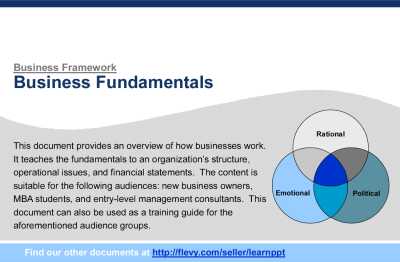
This presentation provides an overview of how businesses work. It teaches the fundamentals to understanding how modern businesses work, covering the business topics of Organizational Structures, Operational Issues, and Financial Statements.
The content is suitable for the following audiences: [read more]
Introducing the Ultimate Business Exit Strategy Framework: Achieve Seamless Transition and Maximize Your Returns
Are you a business owner or entrepreneur looking to ensure a smooth and profitable transition out of your current venture? The world of business exits can be complex and daunting, but [read more]
 A domain is like an online business card. It creates a visual impact and establishes a brand’s credibility among visitors. Domain basics are essential considerations for small business owners seeking to develop a strong online presence and promote their business.