 Click main image to view in full screen.
Equipment Purchase Cost / Benefit Analysis – Excel XLSX
Excel (XLSX)


VIDEO DEMO
BENEFITS OF THIS DOWNLOADABLE EXCEL DOCUMENT
- A simple framework for analyzing the financial impact of new equipment purchases.
RETURN ON INVESTMENT EXCEL DESCRIPTION
For a manufacturing company considering the purchase of new equipment, a comprehensive cost/benefit analysis is essential. Here are the key elements to include in your analysis:
Initial Purchase Cost: This is the upfront cost of acquiring the equipment. Include not just the price of the equipment, but also any shipping, installation, and setup costs.
Operational Costs: Factor in ongoing expenses such as power consumption, maintenance, supplies, and any additional labor costs associated with operating the new equipment.
Productivity Gains: Estimate the increase in production capacity or efficiency the new equipment will bring. This could include faster production times, higher product quality, or the ability to produce new types of products.
Depreciation and Lifespan: Consider the expected lifespan of the equipment and how its value will depreciate over time. This is important for accounting purposes and for assessing the long-term value of the investment.
Cost of Capital: If you're financing the purchase, include the cost of capital or interest on loans. This is a real expense that affects the overall cost of the equipment.
Tax Implications and Incentives: Understand any tax deductions or credits available for the purchase, such as depreciation deductions or investment tax credits.
Risk Assessment: Evaluate any potential risks associated with the new equipment, such as the risk of it becoming obsolete due to technological advancements, or the risk of breakdowns and repairs.
Environmental and Energy Efficiency: Consider any environmental impacts or energy efficiency gains, which can sometimes lead to cost savings or qualify for additional incentives.
Impact on Labor: Assess how the new equipment will affect labor needs. It might reduce labor costs by automating certain tasks, or it might require new skills and additional training for your workforce.
Resale Value: Estimate the potential resale value of the equipment at the end of its useful life in your operation.
Comparison to Alternatives: Compare the costs and benefits of the new equipment to alternative solutions, such as upgrading existing equipment, outsourcing the production process, or not making the purchase.
For the timeframe of your analysis, it typically depends on the expected lifespan of the equipment. A common period is 5-10 years, but it can be longer for equipment with a longer useful life. It's important to model out the analysis over the entire period you expect to use the equipment, to get a full picture of its cost and benefits over its lifetime.
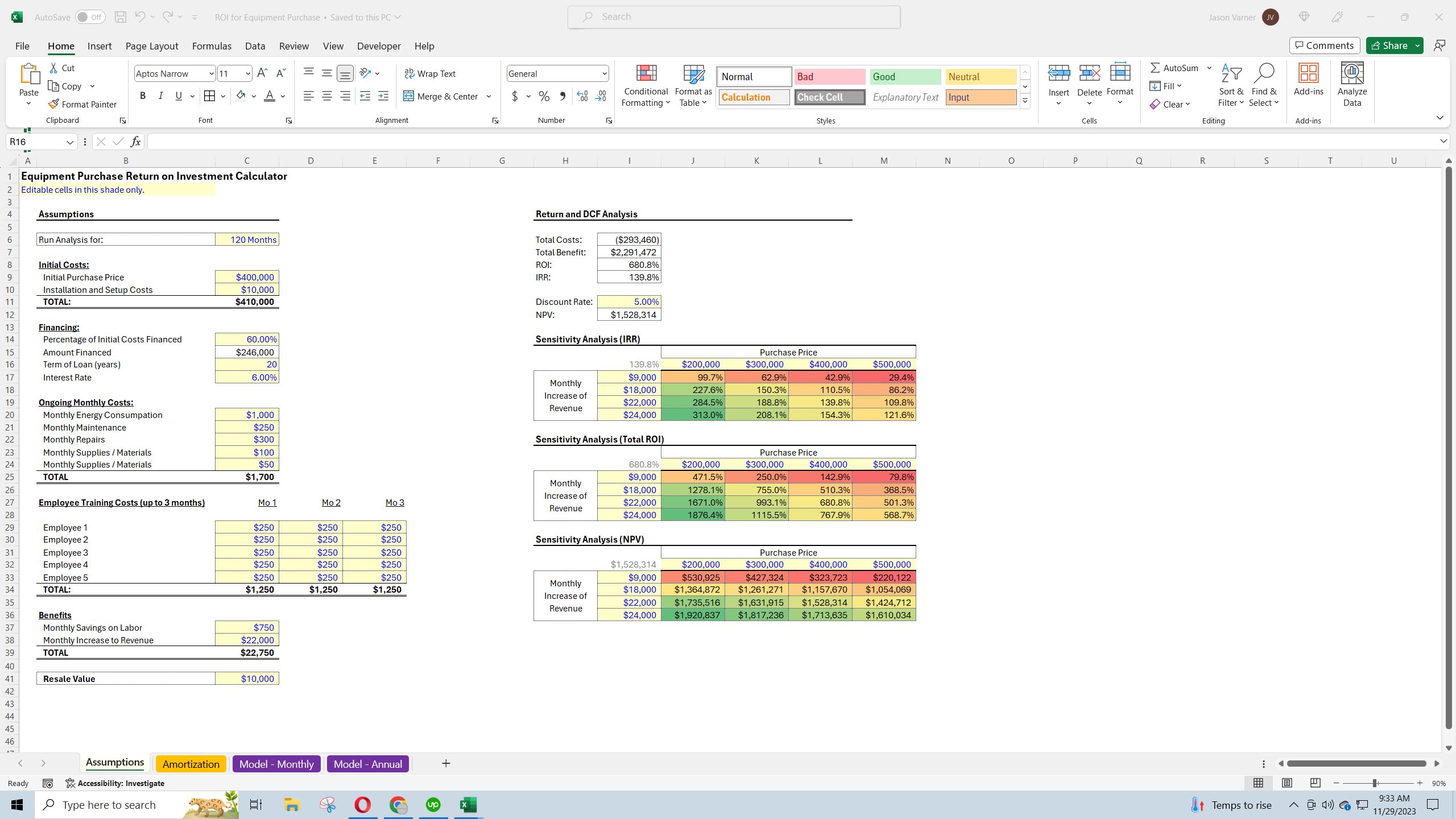
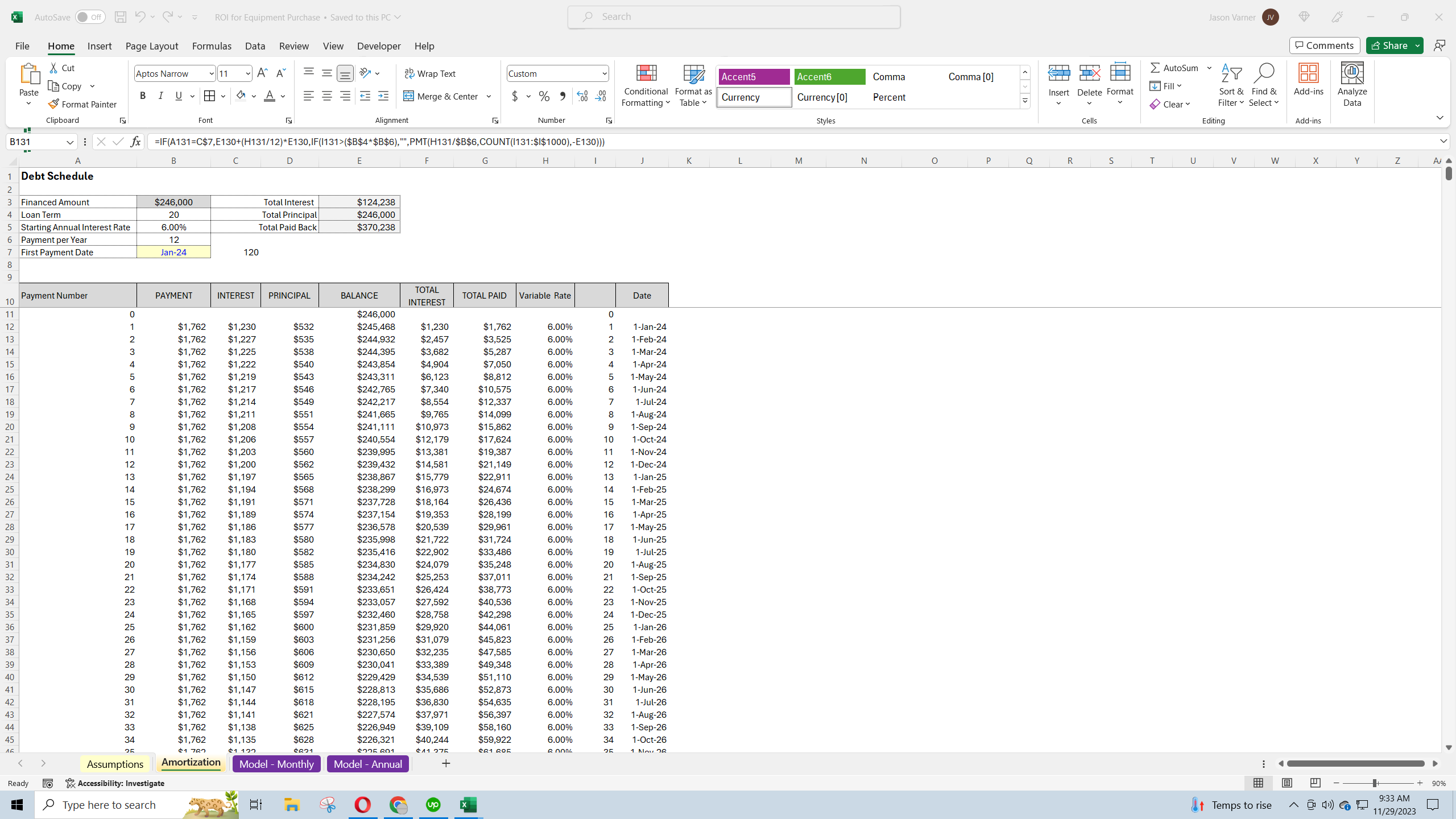
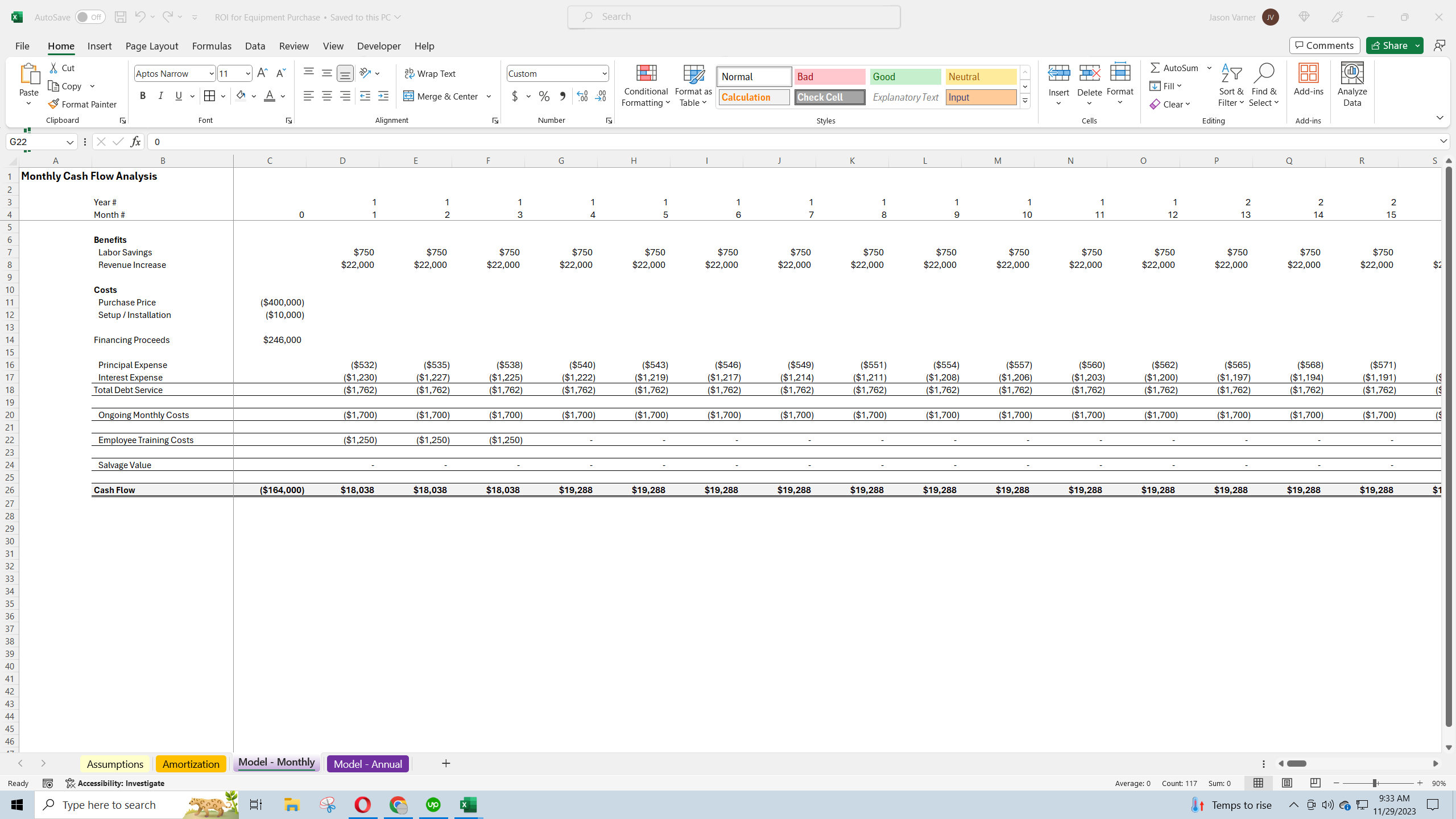
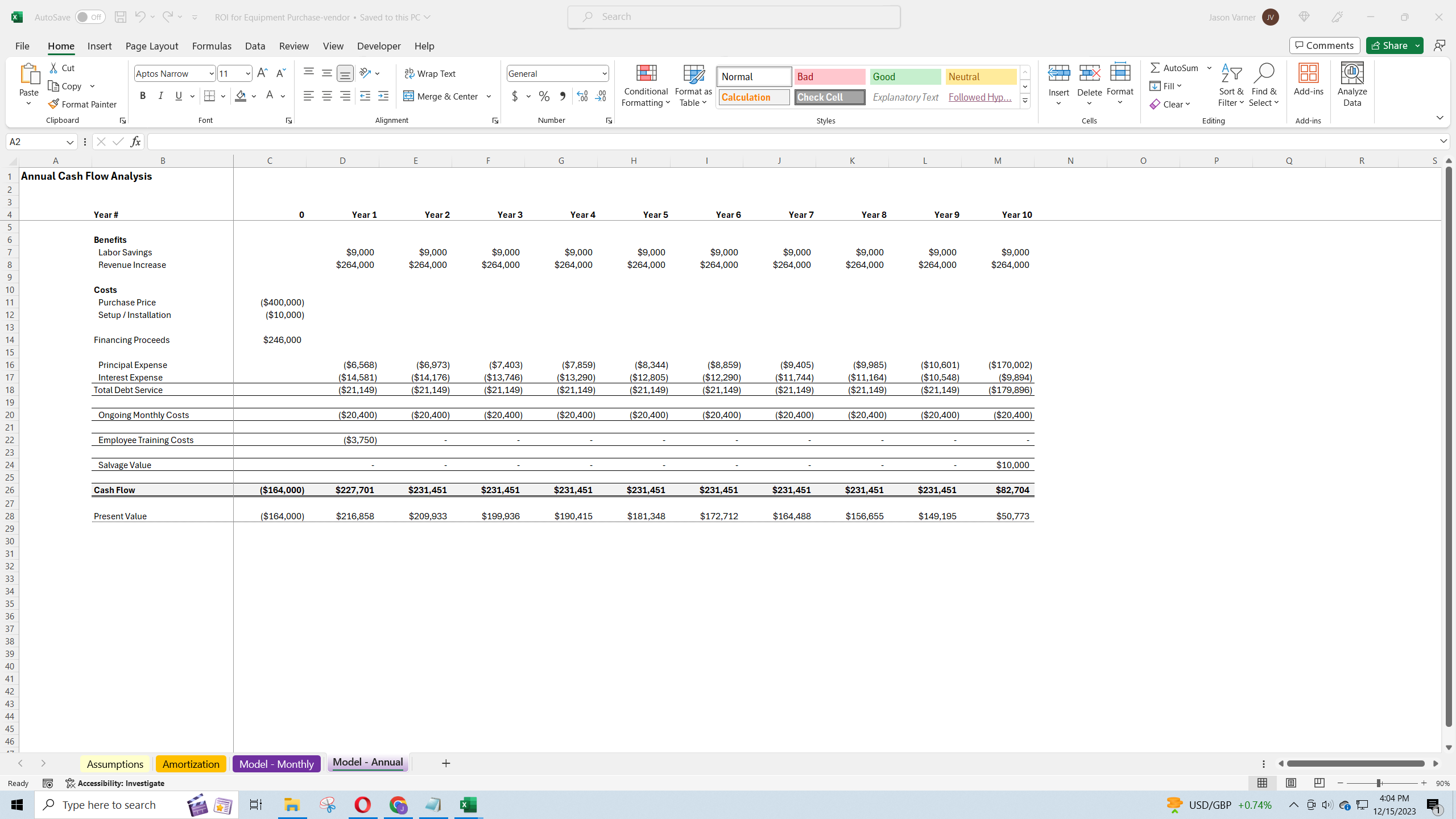
Analyze the return on investment (ROI) with detailed sensitivity analysis for varying purchase prices and monthly revenue increases. Includes a comprehensive debt schedule and cash flow analysis to ensure robust financial planning.
Got a question about the product? Email us at support@flevy.com or ask the author directly by using the "Ask the Author a Question" form. If you cannot view the preview above this document description, go here to view the large preview instead.
TOPIC FAQ
What cost and benefit items should I include in an equipment purchase analysis?
Include upfront acquisition, shipping, installation, ongoing operational costs (power, maintenance, supplies, labor), productivity gains, depreciation and lifespan, cost of capital, tax implications or incentives, risk, environmental/energy impacts, resale value, and comparison to alternatives — 11 cost/benefit elements.Over what timeframe should I model equipment ROI and why?
Model over the equipment’s expected useful life to capture full lifecycle effects; a common analysis period cited is 5–10 years to include depreciation, operating costs, financing, and potential resale value over that horizon.How should financing and interest be modeled in an equipment purchase analysis?
Incorporate the cost of capital or loan interest into cash flows and build a comprehensive debt schedule showing principal, interest, and repayment timing; use integrated cash flow analysis to see financing effects on ROI and liquidity, including a detailed debt schedule.What features should I expect from a spreadsheet template for equipment cost/benefit analysis?
Look for structured inputs for initial and operational costs, productivity gains, depreciation, tax implications, sensitivity analysis for price and revenue changes, and built-in debt scheduling and cash flow analysis; Flevy’s Equipment Purchase Cost / Benefit Analysis XLSX includes sensitivity analysis, a debt schedule, and cash flow analysis.How much preparation is required before populating an equipment ROI model?
Preparation depends on data availability: gather purchase price, shipping/installation costs, operating cost estimates, expected productivity improvements, financing terms, tax treatment, and expected resale value; the model timeframe commonly spans 5–10 years to capture lifecycle impacts.How do I compare buying new equipment versus upgrading existing machines or outsourcing?
Compare total lifecycle costs and benefits across options: upfront and installation costs, ongoing operational expenses, productivity differentials, depreciation/lifespan, tax implications, and resale value; run sensitivity analysis on key assumptions to test robustness of the comparison.What inputs help quantify the impact of new equipment on labor costs and productivity?
Include estimates for labor hours changed, training costs, wage rates, expected output increases, quality improvements, and any changes in spare parts or maintenance; model resulting monthly revenue or cost changes and test them with sensitivity analysis on monthly revenue increases.Are pre-built equipment ROI templates cost-effective compared with building a model from scratch?
A pre-built template provides a structured checklist of lifecycle inputs (the 11 cost/benefit elements), and often includes built-in analyses such as sensitivity testing, debt scheduling, and cash flow projections, which can reduce model-building time and standardize outputs like a sensitivity analysis for purchase price and revenue.Source: Best Practices in Return on Investment, Asset Management Excel: Equipment Purchase Cost / Benefit Analysis Excel (XLSX) Spreadsheet, Jason Varner | SmartHelping
ABOUT THE AUTHOR

I graduated in 2011 with a Bachelor's degree in Accounting and began my career as a financial analyst at a small chain of auto repair shops. After gaining valuable experience, I launched my own practice specializing in real estate underwriting, later expanding into general business modeling.
I honed my spreadsheet modeling expertise by completing over 400 projects on Upwork with a 100% success
... [read more]
Ask the Author a Question
You must be logged in to contact the author.




























