Editor's Note: Take a look at our featured best practice, Kaizen (254-slide PowerPoint presentation). [NOTE: Our Kaizen presentation has been trusted by an array of prestigious organizations, including industry leaders such as Apple, Bayer, University of Michigan, General Motors, Cummins, Baxter, Johnson Controls, Ulta, Daimler Truck, Aramark, Parsons Corporation, to name just a few.]
Explore [read more]
* * * *
Running a mid-sized business efficiently is difficult because the easy gains of small business expansion are unrepeatable, and finding areas to improve upon is not always apparent.
In fact, the larger the company becomes, the harder it is to keep track of your employees, the efficiency of company processes, and how happy your customer base is. This is where many executives become unstuck because they are not close enough to the action to be able to make the necessary changes for greater efficiency.
However, this is not to say that the task of improving company efficiency is impossible – far from it. In fact, the secret to great business management (like all leadership) lies in basic principles that can be referred back to repeatedly.
Applying these principles can vary, but the basics of business leadership are largely the same regardless of the circumstances.
Here is how to run a mid-sized business more efficiently:
Invoice factoring can help big companies keep their cash flow circulating healthily
Maintaining a healthy flow of income is key to the success of any commercial enterprise. It is at the very core of your company, and you need to maintain it at all costs.
Of course, the larger the enterprise becomes, the larger the number of sales or orders you take on, many of which won’t be paid upfront. For instance, if you are a parts supplier, then products will cost you a great deal of money to produce, store, and deliver. Your company will be out of pocket until your client pays up, but this could be months after you originally submit an invoice.
As a result, the company could be left vulnerable to cash flow stagnation, or at the very least, suffer from unpredictable financial health. To help solve this, you could use invoice factoring so that you can receive payment upfront.
Basically, you hand over your invoice to a third party who will pay you what you’re owed straight away and then wait to collect the original payment themselves, whenever that may be.
Keep the channels of communication open
One of the best ways to improve the efficiency of a mid-sized business is to open the channels of communication between executives and other staff members and customers. Many business leaders’ common fault is losing touch with the ‘shop floor’, making decisions that are not in the best interest of their employees or customers.
What a spreadsheet tells you is not always representative of reality. It is easy to fall into the trap of following data rather than the human beings working in your organization, especially when cost-cutting is involved. To combat this, hold regular meetings with staff members at all levels of your company. Simply talking to your employees will give you invaluable information about the inner workings of the business and allow you to make informed decisions at an executive level.
Similarly, reach out to your customers and ask them about their experience. If you build a strong enough bridge of trust between you and your customers, you will likely discover new ways to improve your products and deliver a better service.
Improve staff morale with flexible working options
When a channel of communication is opened between you and your employees, you may discover new suggestions about improving staff morale. An increasingly popular option (especially in light of the pandemic), is flexible working options.
This allows staff members to choose whether they want to work from home or the office. While it sounds like a recipe for disaster, it can actually improve productivity levels. Staff members feel more independent and trusted, while executives don’t have to pay for such a large office.
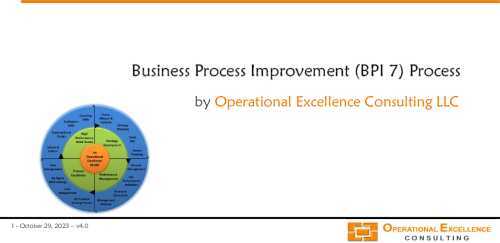
Our business process improvements methodology BPI 7 is a proven and systematic approach to continuously improve an organization's existing business processes.
The Business Process Improvement (BPI 7) Training Module includes:
1. MS PowerPoint Presentation including 141 slides covering [read more]
Do You Want to Implement Business Best Practices?
You can download in-depth presentations on Process Improvement and 100s of management topics from the FlevyPro Library. FlevyPro is trusted and utilized by 1000s of management consultants and corporate executives.
For even more best practices available on Flevy, have a look at our top 100 lists:
These best practices are of the same as those leveraged by top-tier management consulting firms, like McKinsey, BCG, Bain, and Accenture. Improve the growth and efficiency of your organization by utilizing these best practice frameworks, templates, and tools. Most were developed by seasoned executives and consultants with over 20+ years of experience.
Readers of This Article Are Interested in These Resources
Lack of efficiency and effectiveness in an organization can have a significant impact on the overall cost of operation.
Organizational Velocity - Improving Speed, Efficiency & Effectiveness of Business provides a framework for diagnosing, assessing and implementing to improve the speed at which [read more]
The office, by any name, is a paperwork factory. To become a Lean enterprise, office activities must fully support shop-floor manufacturing operations to eliminate waste. The adoption of 5S throughout all office functions is the first step to increase efficiency. 5S principles are dedicated to [read more]
In this Business Process Reengineering (BPR) presentation, we delve into the dynamic landscape of modern business, influenced by the three Cs: customers, competition, and change. Traditional organizations, originally designed for stability and mass production, now face challenges in a world [read more]
The Process Automation & Digitalization Assessment is a comprehensive framework designed to help organizations identify opportunities for streamlining operations, reducing manual efforts, and leveraging technology to drive efficiency and scalability. The assessment provides a structured approach to [read more]
 Running a mid-sized business efficiently is difficult because the easy gains of small business expansion are unrepeatable, and finding areas to improve upon is not always apparent.