
Editor Summary
Comprehensive Guide to Financial Statement Analysis is an 89-slide PowerPoint (PPTX) presentation by STRATICX that teaches how to read and interpret the income statement, balance sheet, and cash flow statement.
Read moreThe deck includes 4 deliverable tools—financial statement templates, ratio analysis worksheets, DuPont calculation models, and cash flow management tools—organized across 9 sections. Target users include financial analysts, corporate executives, consultants, and business students. Sold as a digital download on Flevy with immediate digital download.
Use this deck when an organization needs a structured review of financial health for audits, strategic planning, training, or due diligence, or when teams must build financial literacy.
Financial analysts building ratio-based assessments of profitability, liquidity, and asset turnover using ratio analysis worksheets.
Corporate executives aligning strategic plans to cash generation by modelling cash flow impacts and working capital changes.
Consultants performing performance diagnostics and decomposition via the DuPont equation to identify operational and leverage drivers.
Finance trainers delivering stepwise workshops on income statement, balance sheet, and cash flow concepts.
The slide-based decomposition and stepwise diagnostic sequence mirror the structured analytical sequencing used in consulting practices such as McKinsey, Bain, and BCG.
This document provides a detailed step-by-step guide on how to analyse financial statements. Designed for anyone who wants to understand how to review financial data and interpret the findings, the document is split into the following sections:
Introduction to financial statements
1. Income Statement
2. Balance Sheet
3. Cash Flow Statement
4. Linkages between financial statements
Financial analysis
1. DuPont equation
2. Ratio analysis
The document flows in logical manner and offers key points to note throughout to build your knowledge as you work through it.
This guide delves into the intricacies of financial statements, breaking down the Income Statement, Balance Sheet, and Cash Flow Statement with precision. It emphasizes the importance of understanding gross income, operating expenses, and net income, providing clear definitions and examples. The PPT also covers how these elements interconnect, offering insights into the financial health and performance of a business.
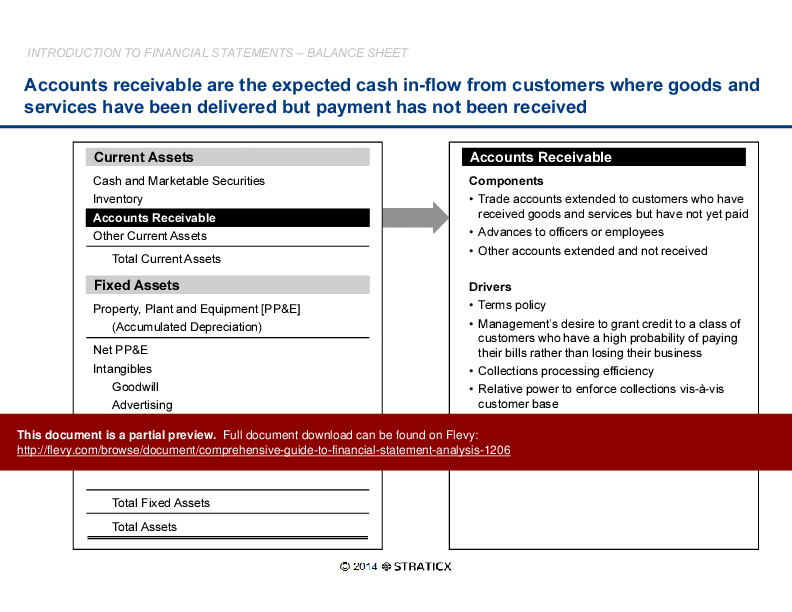
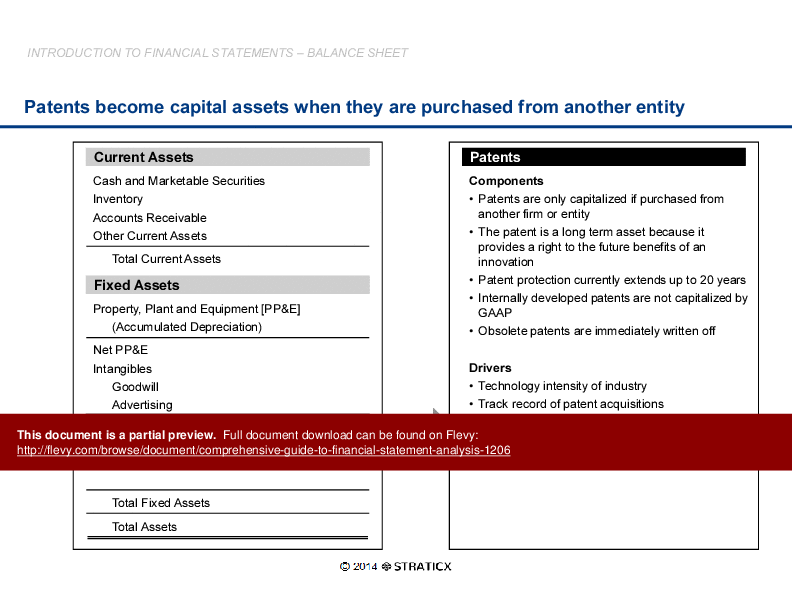
The section on the Balance Sheet is comprehensive, detailing current assets, fixed assets, and various liabilities. It explains the significance of accounts receivable, accumulated depreciation, and patents as capital assets. The guide also highlights the role of short-term and long-term debt, and how these impact the company's financial leverage and overall financial strategy.
In the financial analysis segment, the document introduces the DuPont equation and ratio analysis as essential tools for evaluating a firm's performance. It breaks down key ratios like ROI, ROE, and ROA, and provides practical hints for their calculation. This section is designed to equip executives with the knowledge to make informed decisions based on detailed financial data.
Got a question about the product? Email us at support@flevy.com or ask the author directly by using the "Ask the Author a Question" form. If you cannot view the preview above this document description, go here to view the large preview instead.
MARCUS OVERVIEW
This synopsis was written by Marcus [?] based on the analysis of the full 89-slide presentation.
Executive Summary
This presentation, titled "Comprehensive Guide to Financial Statement Analysis," is designed to equip corporate executives and consultants with a thorough understanding of key financial statements—namely, the income statement, balance sheet, and cash flow statement. This consulting-grade resource, reflecting the quality of McKinsey, Bain, or BCG, provides actionable insights into evaluating business performance through financial analysis. Users will learn to interpret financial data, apply the DuPont equation, and utilize ratio analysis to assess economic performance and strategic insight effectively.
Who This Is For and When to Use
• Financial analysts seeking to deepen their understanding of financial statements
• Corporate executives responsible for strategic financial decision-making
• Consultants advising clients on financial performance and analysis
• Business students or professionals preparing for roles in finance or accounting
Best-fit moments to use this deck:
• During financial audits or assessments to evaluate company performance
• In strategic planning sessions to align financial objectives with operational goals
• When training teams on financial literacy and analysis techniques
Learning Objectives
• Define the components and significance of the income statement, balance sheet, and cash flow statement
• Build a comprehensive understanding of the linkages between financial statements
• Establish proficiency in using the DuPont equation for performance analysis
• Apply ratio analysis to assess profitability, asset utilization, and liquidity
• Identify key financial metrics that drive business performance
Primary Topics Covered
• Why Review Financial Statements? - Understanding the importance of financial statements in evaluating business performance and strategic insight.
• Introduction to Financial Statements - Overview of the 3 key financial statements and their interconnections.
• Income Statement - Detailed examination of revenue, expenses, and net income, including cost structures and revenue drivers.
• Balance Sheet - Analysis of assets, liabilities, and shareholder equity, focusing on working capital and financial structure.
• Cash Flow Statement - Insights into cash sources and uses, emphasizing operational cash flow management.
• Financial Analysis - Application of the DuPont equation and ratio analysis to assess financial performance.
Deliverables, Templates, and Tools
• Financial statement templates for income, balance, and cash flow statements
• Ratio analysis worksheets for profitability and liquidity metrics
• DuPont equation calculation models for performance evaluation
• Cash flow management tools for operational efficiency
Slide Highlights
• Overview of the 3 key financial statements and their roles in business performance
• Detailed breakdown of the income statement components, including revenue and expenses
• Visual representation of the balance sheet structure and working capital metrics
• Flowchart illustrating the linkages between the income statement, balance sheet, and cash flow statement
Potential Workshop Agenda
Introduction to Financial Statements (60 minutes)
• Discuss the importance of financial statements
• Review the 3 key financial statements and their components
Income Statement Deep Dive (90 minutes)
• Analyze revenue generation and cost structures
• Explore the significance of gross income and net income
Balance Sheet Analysis (60 minutes)
• Examine asset and liability classifications
• Discuss working capital management and financial structure
Cash Flow Management (60 minutes)
• Review sources and uses of cash
• Discuss strategies for improving cash flow performance
Customization Guidance
• Tailor financial statement templates to reflect specific industry standards
• Adjust ratio analysis metrics based on company-specific financial goals
• Incorporate regional financial terminology and practices as needed
Secondary Topics Covered
• Economic performance indicators and strategic insights
• The role of non-interest bearing liabilities in financial analysis
• Impact of capital structure on financial performance
Topic FAQ
What are the 3 key financial statements and what does each show?
The 3 key financial statements are the income statement, which measures income flows (revenues minus expenses); the balance sheet, which provides a snapshot of assets, liabilities, and shareholder equity at a point in time; and the cash flow statement, which measures cash inflows and outflows. These are the income statement, balance sheet, and cash flow statement.
How does the DuPont equation help break down return performance?
The DuPont equation decomposes return into component drivers—profitability, asset utilization, and financial leverage—allowing analysts to trace whether ROE or ROI changes are driven by margins, turnover, or leverage. It is presented as a diagnostic tool to evaluate operating and financing performance in the DuPont equation.
What is ratio analysis and which ratios are typically examined?
Ratio analysis quantifies financial data to assess profitability, asset utilization, and liquidity. Commonly examined ratios include profitability ratios (ROI, ROE, net margin), asset turnover metrics, and liquidity ratios for short-term obligations. Practical calculation hints and ratio worksheets are provided in the guide via ratio analysis worksheets.
How do the income statement, balance sheet, and cash flow statement link together?
The statements interconnect: net income from the income statement affects equity on the balance sheet and is the starting point for operating cash flow on the cash flow statement; balance sheet changes (working capital, assets, liabilities) drive cash flows. The guide includes a flowchart illustrating these linkages as a visual aid.
What should I look for when buying a financial statement analysis deck for team training?
Look for clear section sequencing (statements, linkages, analysis), practical templates for income/balance/cash flow statements, ratio analysis worksheets, and DuPont calculation models to enable hands-on exercises. The Comprehensive Guide to Financial Statement Analysis specifically lists templates, worksheets, and models across an 89-slide structure.
How much instructional time does a typical workshop based on a financial statements deck require?
The guide proposes a sample workshop agenda with timed modules: Introduction (60 minutes), Income Statement deep dive (90 minutes), Balance Sheet analysis (60 minutes), and Cash Flow management (60 minutes), totaling 270 minutes of structured instruction in the suggested agenda.
I need to diagnose cash flow problems—what analysis steps should I take?
Focus on the cash flow statement to identify sources and uses of cash, examine operating cash flow drivers, and review working capital movements—receivables, payables, and inventory. The guide provides cash flow management tools and practical steps for improving operational cash flow in its cash flow management tools.
How can consultants use financial statement analysis to support strategic planning?
Consultants use statement linkage mapping and diagnostic tools to translate financial metrics into strategic priorities: identify margin and turnover weaknesses via DuPont decomposition, assess leverage impacts, and prioritize working capital initiatives using ratio analysis and DuPont insights to inform strategy, using tools like the DuPont equation.
Document FAQ
These are questions addressed within this presentation.
Why are financial statements important?
Financial statements provide critical insights into a company's performance, enabling stakeholders to make informed decisions regarding strategy and operations.
What are the 3 key financial statements?
The 3 key financial statements are the income statement, balance sheet, and cash flow statement, each serving a unique purpose in financial analysis.
How does the DuPont equation assist in financial analysis?
The DuPont equation breaks down return on investment into its components, allowing for a detailed assessment of operational efficiency and financial leverage.
What is the significance of ratio analysis?
Ratio analysis quantifies financial data, providing insights into profitability, asset utilization, and liquidity, which are essential for evaluating business performance.
How can I improve cash flow management?
Effective cash flow management involves minimizing receivables, maximizing payables, and optimizing inventory levels to enhance liquidity.
What are non-interest bearing liabilities?
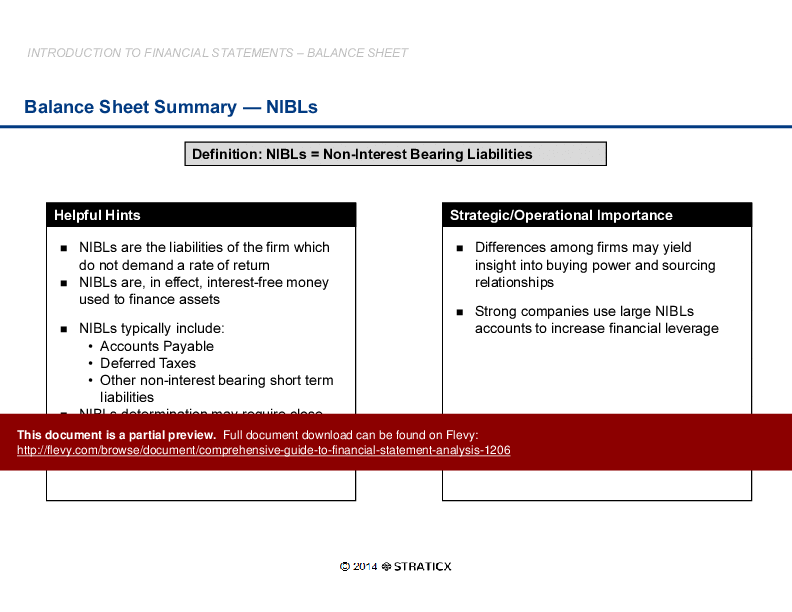
Non-interest bearing liabilities are obligations that do not incur interest, such as accounts payable, and can be used to finance assets without cost.
How do I interpret the balance sheet?
The balance sheet provides a snapshot of a company's financial position, detailing assets, liabilities, and shareholder equity at a specific point in time.
What factors influence revenue growth?
Revenue growth is influenced by market share, pricing strategies, and sales volume, all of which should be analyzed for strategic planning.
Glossary
• Income Statement - A financial statement that measures income flows, showing revenues minus expenses.
• Balance Sheet - A snapshot of a company's financial position, detailing assets, liabilities, and shareholder equity.
• Cash Flow Statement - A financial statement that measures cash flows, reflecting changes in cash available.
• DuPont Equation - A framework for evaluating a firm's operating and financing performance through return on investment.
• Ratio Analysis - A quantitative method for assessing financial performance through various financial ratios.
• Working Capital - The difference between current assets and current liabilities, indicating a firm's short-term financial health.
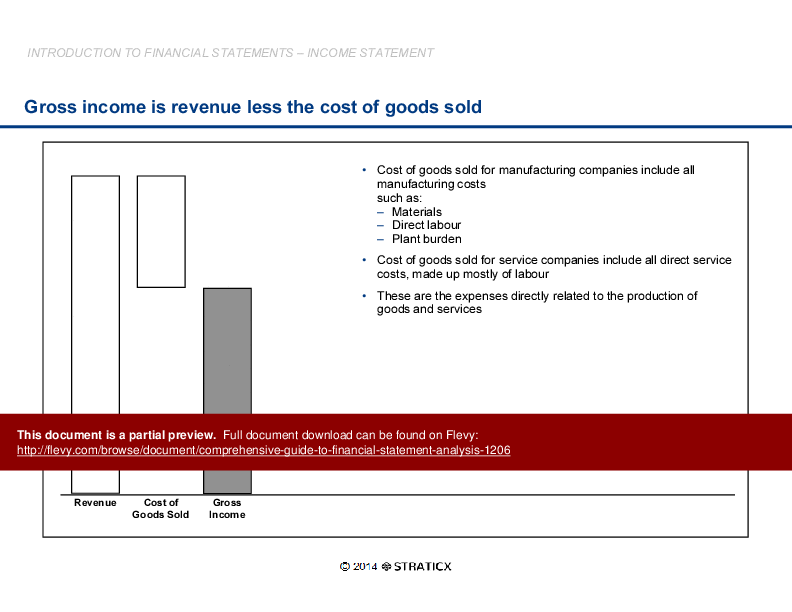
• Gross Income - Revenue minus the cost of goods sold, representing the profit before operating expenses.
• Net Income - The profit remaining after all expenses, including taxes and interest, have been deducted from revenues.
• Liquidity Ratios - Financial metrics used to assess a company's ability to meet its short-term obligations.
• Profitability Ratios - Ratios that measure a company's ability to generate profit relative to its revenue, assets, or equity.
• Asset Turnover - A measure of how efficiently a company uses its assets to generate sales.
• Financial Leverage - The use of debt to acquire additional assets, which can amplify returns, but also increases risk.
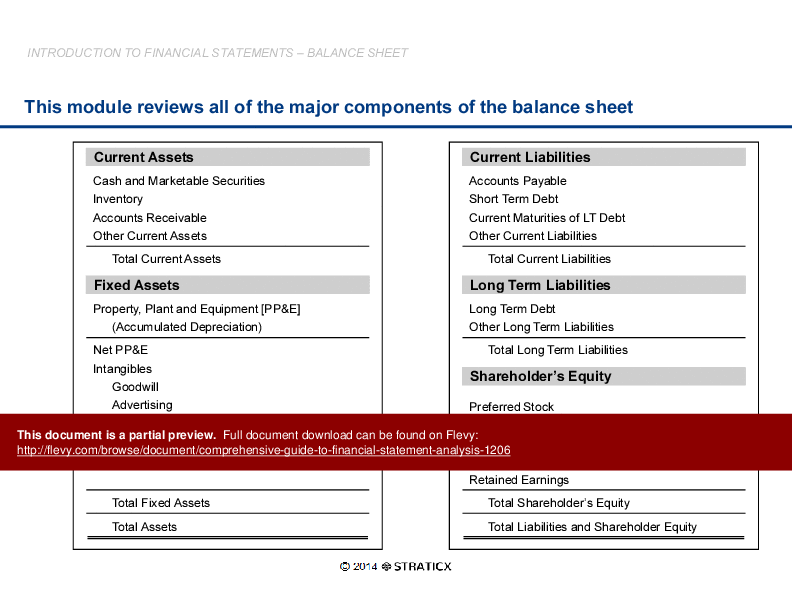
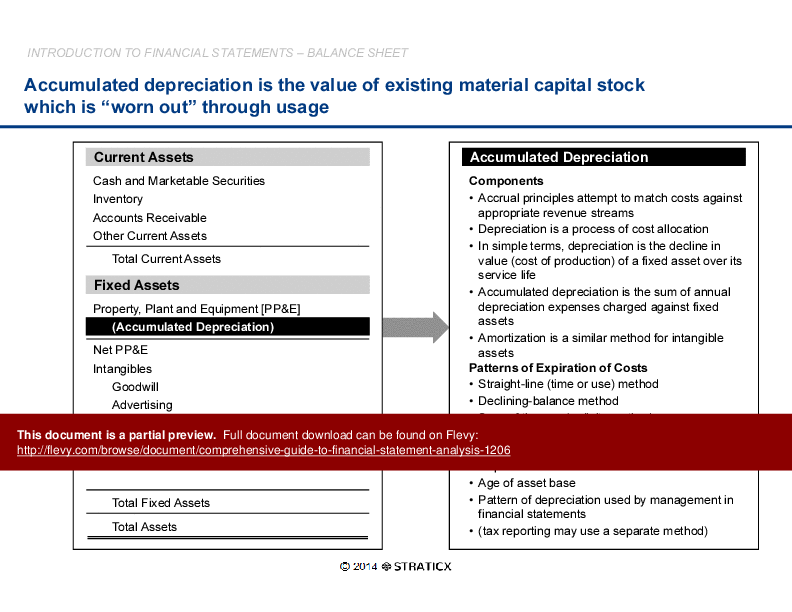
This PPT slide provides an overview of a balance sheet's key components: Current Assets, Fixed Assets, Current Liabilities, Long Term Liabilities, and Shareholder’s Equity. Current Assets include Cash, Marketable Securities, Inventory, and Accounts Receivable, indicating liquidity and the ability to meet short-term obligations. Fixed Assets encompass Property, Plant, and Equipment (PP&E), accumulated depreciation, and intangible assets like Goodwill and Patents, vital for evaluating long-term investment. Current Liabilities include Accounts Payable and Short Term Debt, essential for understanding short-term financial obligations. Long Term Liabilities detail Long Term Debt, critical for assessing long-term financial commitments. Shareholder’s Equity summarizes ownership interest, including Preferred Stock and Retained Earnings, providing insight into financial stability and capital structure. This foundational tool aids in financial analysis and investment decision-making.
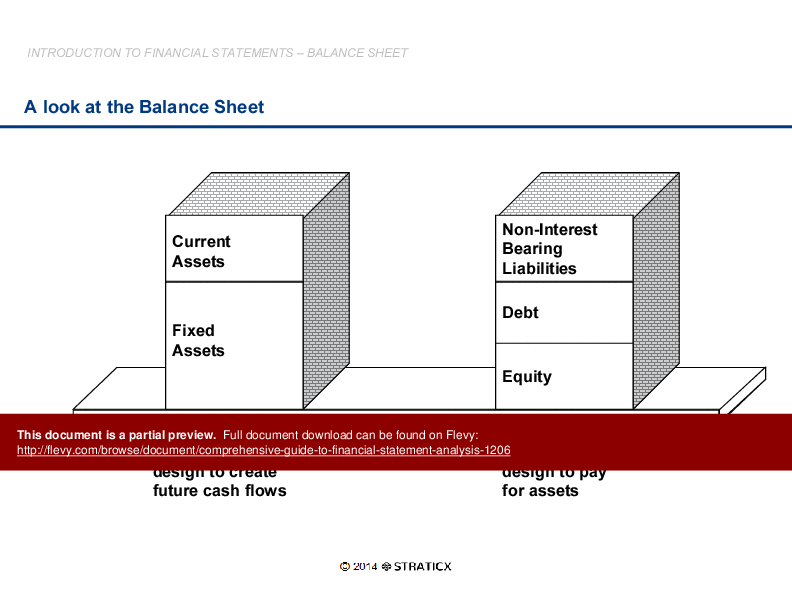
This PPT slide provides an overview of a balance sheet, focusing on 2 primary components: assets and liabilities. On the left, "Current Assets" include cash, inventory, and receivables essential for operations, while "Fixed Assets" represent long-term investments like property and equipment crucial for future cash flows. The structure of these assets is designed to generate cash flow, highlighting their role in financial planning. On the right, "Non-Interest Bearing Liabilities" include accounts payable, which provide cost-effective financing, while "Debt" represents borrowed funds requiring repayment, and "Equity" reflects ownership interest. This structure links how a company finances operations to its asset management strategy, emphasizing the balance sheet's role in assessing financial health.
This PPT slide outlines the structure of revenue generation from product lines, emphasizing that total revenue is the sum of revenues from multiple lines, broken down into average price and volume. Average price is influenced by price premiums, discounts, and market price. Volume is determined by market share and market volume. Revenue is calculated by multiplying volume by average price, indicating that changes in these factors directly affect revenue outcomes. Pricing strategies, such as price premiums and discounts, play a significant role in revenue generation. Competitive positioning and market demand are crucial for assessing potential revenue. The slide warns against unrealistic forecasting, noting that gaining market share while raising prices may not be feasible. Understanding these revenue mechanics is essential for optimizing financial strategies.
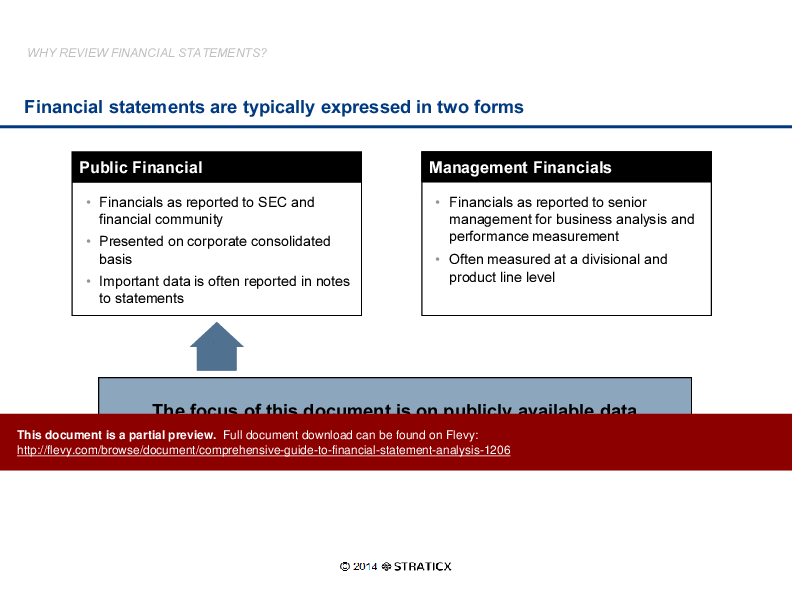
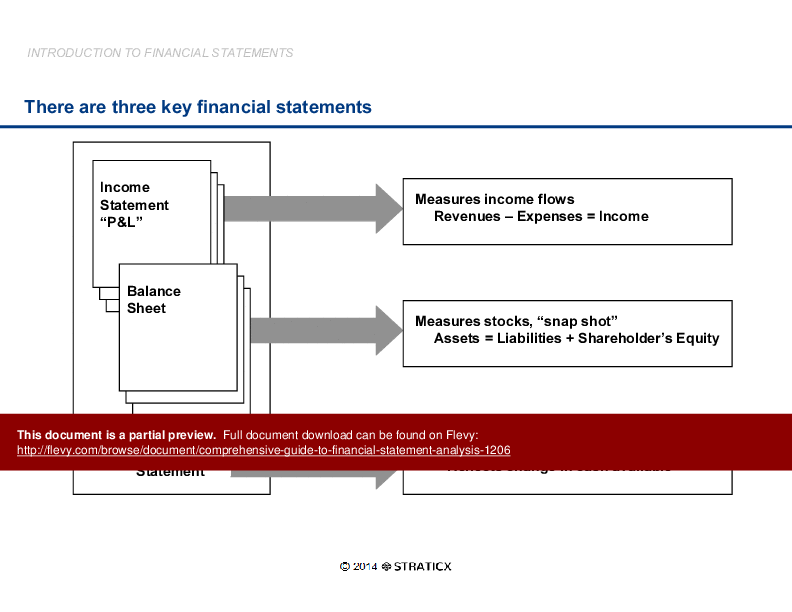
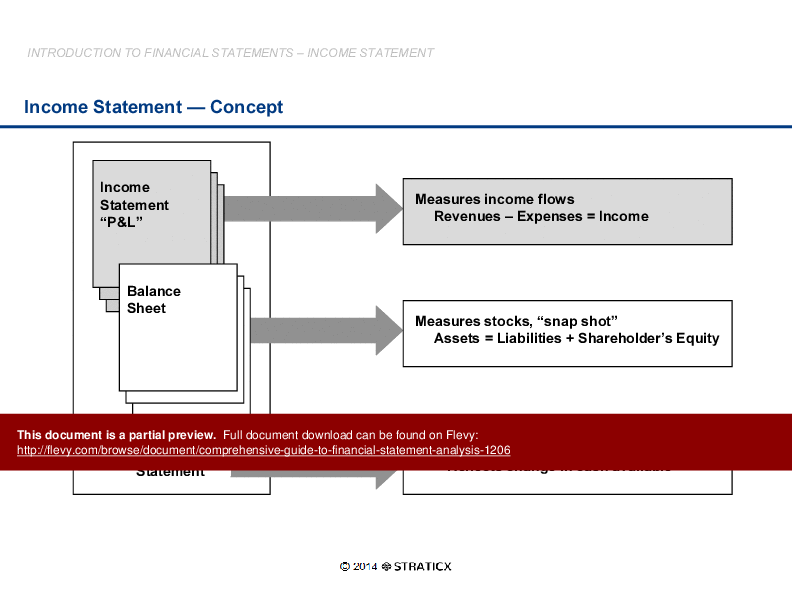
This PPT slide provides an overview of 3 fundamental financial statements: the Income Statement, Balance Sheet, and Cash Flow Statement. The Income Statement, or P&L, measures profitability by calculating revenues minus expenses, resulting in net income. The Balance Sheet presents a snapshot of financial position, detailing assets, liabilities, and shareholder equity, adhering to the equation: Assets = Liabilities + Shareholder’s Equity. The Cash Flow Statement tracks cash inflows and outflows, categorizing them into operating, investing, and financing activities, which reflect liquidity and cash management. Together, these statements form the backbone of financial reporting, offering critical insights into a company's performance and financial health.
This PPT slide presents the DuPont equation, a structured approach for assessing a firm's operational and financial performance. It breaks down Return on Investment (ROI) into key components: ROI equals EBIT Margin multiplied by Asset Turnover and Financial Leverage. This highlights the critical relationship between profitability (EBIT Margin) and asset utilization (Asset Turnover). EBIT Margin is defined as EBIT divided by Revenue, emphasizing operational efficiency in profit generation. Asset Turnover is Revenue divided by Total Assets, showcasing asset efficiency in revenue generation. Financial leverage connects liabilities and shareholder equity to total capital, impacting overall financial health. The DuPont equation can also evaluate Return on Equity (ROE) by substituting equity for total capital, providing additional analytical insights for stakeholders.
This PPT slide focuses on current maturities of long-term debt, highlighting their significance as principal payments due in the current period, which directly affects a company's short-term liquidity position. It differentiates current maturities from long-term debt, ensuring immediate liquidity concerns are visible on the balance sheet. Current maturities include principal payments due within the current period, essential for stakeholders assessing financial health. Key drivers influencing these maturities include the term structure of long-term debt, financial strategy, debt market strategies, the current yield curve environment, and a corporation’s bond rating, all of which impact interest rates, borrowing costs, and investor confidence. Monitoring these elements is vital for evaluating financial stability and making informed investment or creditworthiness decisions.
This PPT slide outlines the relationship between key financial statements: the Income Statement, Balance Sheet, and Cash Flow Statement. The calculation of changes in retained earnings is defined as net income minus dividends, illustrating how profits are retained versus distributed. The Income Statement includes gross revenue, cost of goods sold (COGS), gross income, operating expenses, and net income, demonstrating revenue transformation into profit for assessing operational efficiency. The Balance Sheet details assets, liabilities, and shareholder equity, linking changes in retained earnings to net income, highlighting profitability's role in equity for reinvestment or distribution. The Cash Flow Statement shows cash generation from operations, investments, and financing, specifying that net income contributes to cash from operations, while dividends paid are cash outflows affecting overall cash position. Understanding these interconnections is vital for financial analysis and strategic decision-making.
This PPT slide provides an overview of 7 key profitability measures for financial analysis: Return on Investment (ROI), Return on Equity (ROE), Return on Assets (ROA), Gross Margin, Operating Margin, EBT Margin, and Return on Sales (ROS). ROI measures profitability relative to capital invested, calculated as EBIT divided by average total book capital. ROE assesses net income against average book equity, indicating equity utilization effectiveness. ROA measures net income against average assets, highlighting asset management efficiency. Gross Margin is calculated as sales minus cost of goods sold, expressed as a percentage of sales, reflecting core operational profitability. Operating Margin evaluates operating income relative to sales, while EBT Margin focuses on earnings before tax as a percentage of sales, providing insights into operational efficiency. ROS measures net income as a percentage of sales, equipping decision-makers with essential tools for evaluating financial health and guiding strategic resource allocation.
This PPT slide presents a framework for understanding how changes in equity contribute to cash flow, focusing on the income statement, balance sheet, and cash flow statement. It categorizes changes into 3 areas: operations, investments, and financing, illustrating their impact on liquidity. Sources of cash include net income and depreciation, while uses of cash encompass increases in working capital and investments in fixed assets. An increase in debt and equity financing enhances cash flow, with equity increases arising from stock issues or dividends, essential for raising capital. The visual representation clarifies the relationship between these elements, guiding decision-makers in understanding how equity impacts overall cash flow and informing financial strategies.
This PPT slide illustrates the connection between financial statements and a company's strategic vision for economic value creation. The strategic vision encompasses products, markets, and competencies, driving financial outcomes reflected in the Income Statement, which captures revenues and expenses leading to retained earnings on the Balance Sheet. The Balance Sheet provides a snapshot of assets, liabilities, and equity, linking resource allocation to business objectives. The Cash Flow Statement tracks cash flow, essential for understanding liquidity and operational efficiency, supporting the strategic vision. Capital investments are influenced by insights from these financial statements, highlighting the integration of financial analysis into strategic planning. This interplay between strategic intent and financial performance is crucial for informed decision-making and value creation.
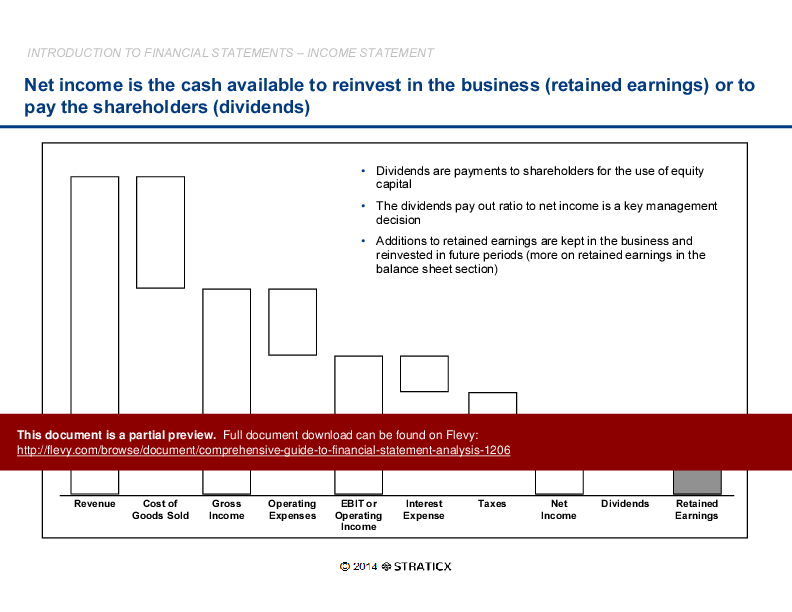
This PPT slide provides an overview of net income and its implications for business reinvestment and shareholder returns. Net income represents cash available for 2 primary uses: reinvesting through retained earnings or distributing dividends to shareholders. Key financial metrics illustrated include Revenue, Cost of Goods Sold, Gross Profit, Operating Income, EBIT, Interest, Taxes, Net Income, Dividends, and Retained Earnings. Dividends are payments to shareholders, with the dividend payout ratio being a crucial decision-making factor for management. Retained earnings represent funds kept within the business for future growth, essential for sustaining operations and funding expansions. Understanding the relationship between net income, dividends, and retained earnings is critical for strategic financial planning.
This PPT slide presents a year-to-year financial analysis for ABC Company using the DuPont equation framework. Key financial metrics include a gross margin of 33.50% and a COGS of 66.50%. The EBIT margin stands at 11.24%, with operational expenses at 22.30%. Asset turnover ratios reveal a current asset turnover of 3.30 and a net fixed asset turnover of 2.05, indicating efficient asset utilization, although an overall asset turnover of 1.14 suggests room for improvement. The return on investment (ROI) is 15.89%, and financial leverage is 1.24, indicating moderate debt use. Strong liquidity management is highlighted by a cash turnover ratio of 9.73 and accounts receivable turnover of 14.23, essential for operational stability.
Source: Best Practices in Financial Analysis PowerPoint Slides: Comprehensive Guide to Financial Statement Analysis PowerPoint (PPTX) Presentation Slide Deck, STRATICX
Straticx is redefining strategy and innovation consulting through online access to high value consulting partners, who work with senior executives and boards of corporations to frame key business issues, develop hypothesis, apply structured problem solving and commercial acumen to drive development of solutions. The partners all have 10+ consulting experience covering a broad range of sectors and
... [read more] have delivered a range of engagements such as corporate and business unit strategy, business transformation, business case development, M&A, and operational improvement.
Since 2012, we have provided business templates to over 10,000 businesses and organizations of all sizes, from startups and small businesses to the Fortune 100, in over 130 countries.
Read Customer Testimonials
"Flevy.com has proven to be an invaluable resource library to our Independent Management Consultancy, supporting and enabling us to better serve our enterprise clients.
The value derived from our [FlevyPro] subscription in terms of the business it has helped to gain far exceeds the investment made, making a subscription a no-brainer for any growing consultancy – or in-house strategy team."
– Dean Carlton, Chief Transformation Officer, Global Village Transformations Pty Ltd.
"I have used FlevyPro for several business applications. It is a great complement to working with expensive consultants. The quality and effectiveness of the tools are of the highest standards."
– Moritz Bernhoerster, Global Sourcing Director at Fortune 500
"I am extremely grateful for the proactiveness and eagerness to help and I would gladly recommend the Flevy team if you are looking for data and toolkits to help you work through business solutions."
– Trevor Booth, Partner, Fast Forward Consulting
"As a young consulting firm, requests for input from clients vary and it's sometimes impossible to provide expert solutions across a broad spectrum of requirements. That was before I discovered Flevy.com.
Through subscription to this invaluable site of a plethora of topics that are key and crucial to consulting, I
have been able to exceed expectations and deliver quality advice and solutions to my clients. The quality and expertise of the authors are exemplary and gives me great confidence to use as part of my service offerings.
I highly recommend this company for any consultant wanting to apply international best practice standards in their service offerings.
"
– Nishi Singh, Strategist and MD at NSP Consultants
"One of the great discoveries that I have made for my business is the Flevy library of training materials.
As a Lean Transformation Expert, I am always making presentations to clients on a variety of topics: Training, Transformation, Total Productive Maintenance, Culture, Coaching, Tools, Leadership Behavior, etc. Flevy
It is well worth the money to purchase these presentations. Sure, I have the knowledge and information to make my point. It is another thing to create a presentation that captures what I want to say. Flevy has saved me countless hours of preparation time that is much better spent with implementation that will actually save money for my clients.
"
– Ed Kemmerling, Senior Lean Transformation Expert at PMG
"As an Independent Management Consultant, I find Flevy to add great value as a source of best practices, templates and information on new trends. Flevy has matured and the quality and quantity of the library is excellent. Lastly the price charged is reasonable, creating a win-win value for
the customer, Flevy and the various authors. This is truly a service that benefits the consulting industry and associated clients. Thanks for providing this service.
"
– Jim Schoen, Principal at FRC Group
"The wide selection of frameworks is very useful to me as an independent consultant. In fact, it rivals what I had at my disposal at Big 4 Consulting firms in terms of efficacy and organization."
– Julia T., Consulting Firm Owner (Former Manager at Deloitte and Capgemini)
"As a consultant requiring up to date and professional material that will be of value and use to my clients, I find Flevy a very reliable resource.
The variety and quality of material available through Flevy offers a very useful and commanding source for information. Using Flevy saves me time, enhances my expertise and ends up being a good decision."
– Dennis Gershowitz, Principal at DG Associates
Save with Bundles
This document is available as part of the following discounted bundle(s):
This deck from the Strategy & Innovation consultancy, STRATICX, provides an introduction to strategy, separating out the concepts of Corporate Strategy vs. Business (Unit) Strategy.
Receive our FREE Primer on Corporate Strategy
Get Our FREE Product.
This deck from the Strategy & Innovation consultancy, STRATICX, provides an introduction to strategy, separating out the concepts of Corporate Strategy vs. Business (Unit) Strategy.