 Click main image to view in full screen.
Balanced Scorecard - Self Assessment Checklist – Word DOC
Word (DOC) + Zip archive file (ZIP) 6 Pages


BENEFITS OF THIS DOWNLOADABLE WORD DOCUMENT
- Understand your current situation with respect to measurement to set goals for improvement.
BALANCED SCORECARD WORD DESCRIPTION
Balanced Scorecard – Self Assessment Of Existing System
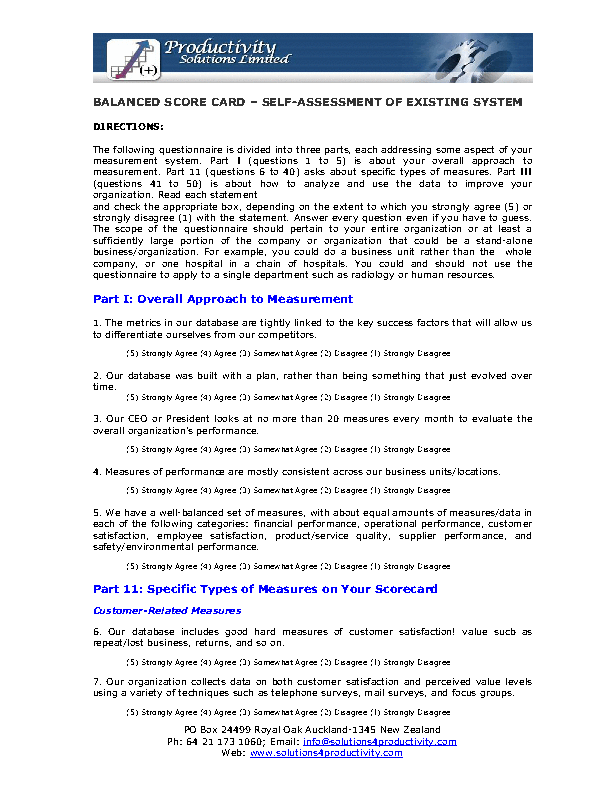
The questionnaire is divided into three parts, each addressing some aspect of your measurement system.
Part I (questions 1 to 5) is about your overall approach to measurement.
Part 11 (questions 6 to 40) asks about specific types of measures.
Part III (questions 41 to 50) is about how to analyze and use the data to improve your organization.
Read each statement and check the appropriate box, depending on the extent to which you strongly agree (5) or strongly disagree (1) with the statement. Answer every question even if you have to guess. The scope of the questionnaire should pertain to your entire organization or at least a sufficiently large portion of the company or organization that could be a stand-alone business/organization. For example, you could do a business unit rather than the whole company, or one hospital in a chain of hospitals. You could and should not use the questionnaire to apply to a single department such as radiology or human resources.
Also included with this document is a bonus zip of 41 Lean documents (includes templates, case studies, articles, posters, charts, and more).
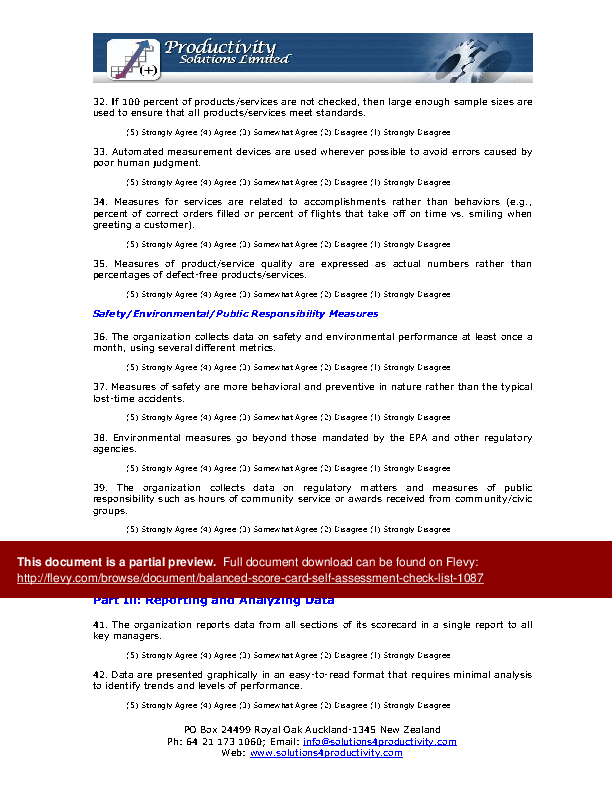
This comprehensive checklist is designed to provide a thorough evaluation of your current Balanced Scorecard system. It includes a detailed examination of safety, environmental, and public responsibility measures. The Word document ensures that all critical aspects of your organization's performance metrics are scrutinized, offering a holistic view of your measurement system's effectiveness.
The checklist also delves into the nuances of reporting and analyzing data, guiding you through the process of leveraging collected data to drive organizational improvements. This resource is essential for executives looking to refine their performance measurement systems and achieve strategic objectives efficiently.
Got a question about the product? Email us at support@flevy.com or ask the author directly by using the "Ask the Author a Question" form. If you cannot view the preview above this document description, go here to view the large preview instead.
TOPIC FAQ
What are the typical parts of a balanced scorecard self-assessment?
A balanced scorecard self-assessment typically separates overall measurement approach, the specific measures in use, and how data is analyzed and applied for improvement. The format in this category often uses scored statements across those areas, for example a three-part structure totaling 50 questions in the referenced checklist.How should I scope a Balanced Scorecard self-assessment across my organization?
Scope the assessment to the entire organization or a sufficiently large business unit that could stand alone; avoid applying it to a single department. The questionnaire referenced recommends using it for whole organizations or standalone units, such as one hospital in a chain, rather than single departments.How can I evaluate safety and environmental measures within a scorecard?
Include targeted statements that probe whether safety, environmental, and public-responsibility metrics exist, are measurable, and are reported consistently. The Balanced Scorecard - Self Assessment Checklist explicitly examines safety, environmental, and public-responsibility measures as part of its specific-measures section.What should I look for when buying a balanced scorecard assessment template?
Prioritize a template with structured sections on approach, types of measures, and data analysis, a clear scoring scale (e.g., 1–5), scope guidance for organization vs. department, and supporting materials. The referenced product includes a 5-point scoring format, 3 parts, and a supplemental ZIP of supporting documents.How much time and cross-functional input is typically required to complete a self-assessment?
Time depends on organizational size and data availability,, but prepare for cross-functional input because the tool addresses organizational-level measures and reporting. A typical structured checklist in this category contains 50 questions that should be answered for the scoped organization or business unit.I need to align KPIs after a merger—how would a balanced scorecard checklist help?
Use the assessment at the merged business-unit level to compare measurement approaches, specific KPIs, and reporting/analysis practices across legacy units. Aggregate scored responses highlight gaps and inconsistencies, using the three-part, 50-question format to prioritize alignment work.How does reporting and analysis in a balanced scorecard drive improvement?
Reporting quality and analysis practices determine whether data identifies trends and root causes that inform actions. A checklist that includes a data-analysis section helps audit whether measures are used to improve performance; for example, Part III (questions 41–50) focuses on analyzing and using data for improvement.What is the value of supplemental Lean documents bundled with a balanced scorecard checklist?
Supplemental Lean templates, case studies, and posters provide practical tools to implement measurement improvements identified by the assessment. The Balanced Scorecard - Self Assessment Checklist includes a bonus ZIP of 41 Lean documents to support follow-through after scoring and diagnosis.Source: Best Practices in Balanced Scorecard Word: Balanced Scorecard - Self Assessment Checklist Word (DOC) Document, OpEx Academy NZ
ABOUT THE AUTHOR

Vishnu Rayapeddi is an experienced management consultant and trainer specializing in implementing continuous process improvements. Vishnu is a pioneer in Lean Management which combines the power of Lean Thinking, TOC, Six Sigma, TQM, TWI, Balanced Scorecard, cGMP and other best-class methodologies such as, DMAIC, Value Stream Mapping, Root Cause Analysis, 5S, Quick Changeovers, Quality and ... [read more]
Ask the Author a Question
You must be logged in to contact the author.




























