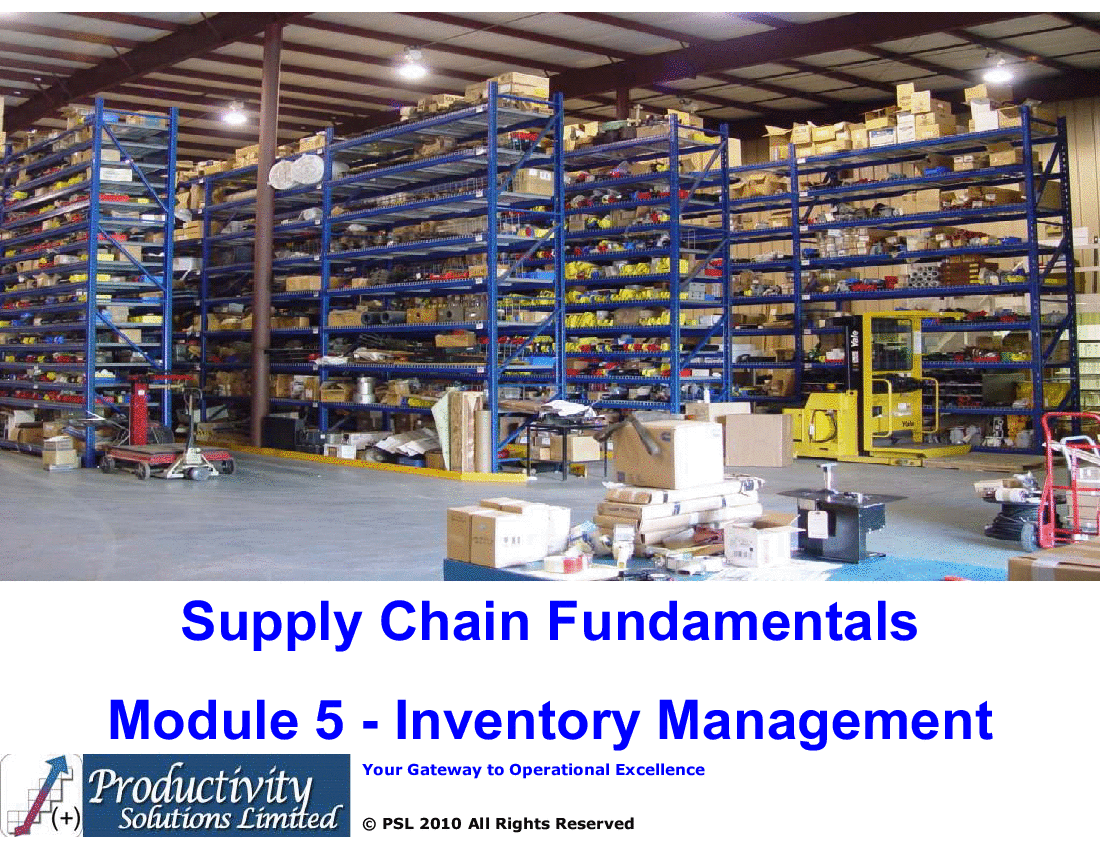

Supply Chain Fundamentals Module 5 - Inventory Management   69-slide PPT PowerPoint presentation slide deck (PPTX)
$39.00

Supply Chain Fundamentals Module 5 - Inventory Management (69-slide PPT PowerPoint presentation slide deck (PPTX)) Preview Image
Log in to unlock full preview.
Supply Chain Fundamentals Module 5 - Inventory Management (69-slide PPT PowerPoint presentation slide deck (PPTX)) Preview Image
Arrow   Click main image to view in full screen.

Supply Chain Fundamentals Module 5 - Inventory Management (PowerPoint PPTX Slide Deck)

PowerPoint (PPTX) 69 Slides

Top 1,000 Best Practice $39.00
This presentation is developed by a pioneer in Lean and certified LSS Master Black Belt who has trained over 5,000+ students globally, from Directors, CEOs, GMs, to shop floor staff. He's endorsed by CMI Consortium, NZTE, HERA, NZPICS, CBAFF.
Add to Cart


Immediate download
Fully editable PowerPoint
Free lifetime updates

BENEFITS OF THIS POWERPOINT DOCUMENT

  1. Understand all aspects of Inventory Control and Management

INVENTORY MANAGEMENT PPT DESCRIPTION

Planning and managing inventories in a supply chain PPT: Learn inventory management fundamentals, techniques, control systems, and reduction plans. Download the PPT now. Supply Chain Fundamentals Module 5 - Inventory Management is a 69-slide PPT PowerPoint presentation slide deck (PPTX) available for immediate download upon purchase.

The Supply Chain Fundamentals Series has 5 modules in all as below:
Module 1 – Forecasting – 73 Slides
Module 2 – Aggregate Planning – 28 Slides
Module 3 – Materials Requirement Planning – 36 Slides
Module 4 – Scheduling – 43 Slides
Module 5 – Inventory Management – 69 Slides

The 5th Module on Inventory Management covers the following topics:
Independent versus Dependent Demand
Costs associated with Inventory
Order Quantity Strategies
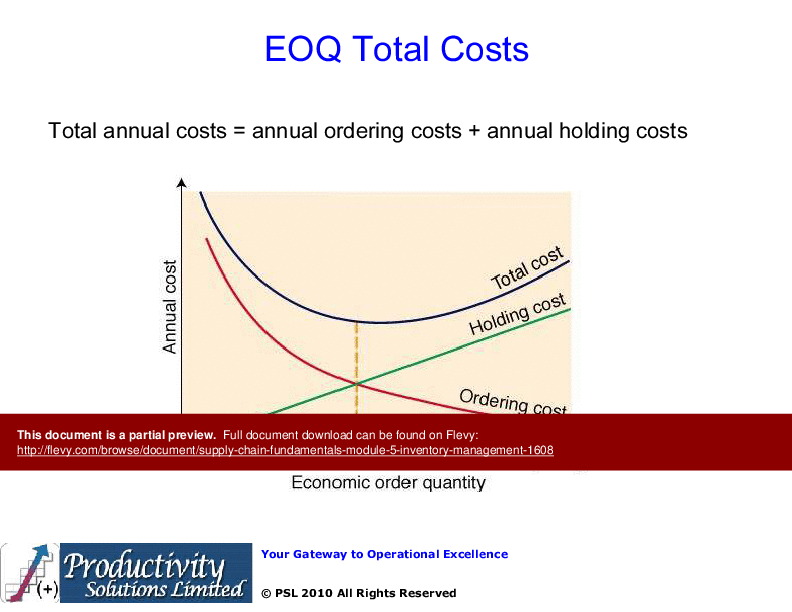
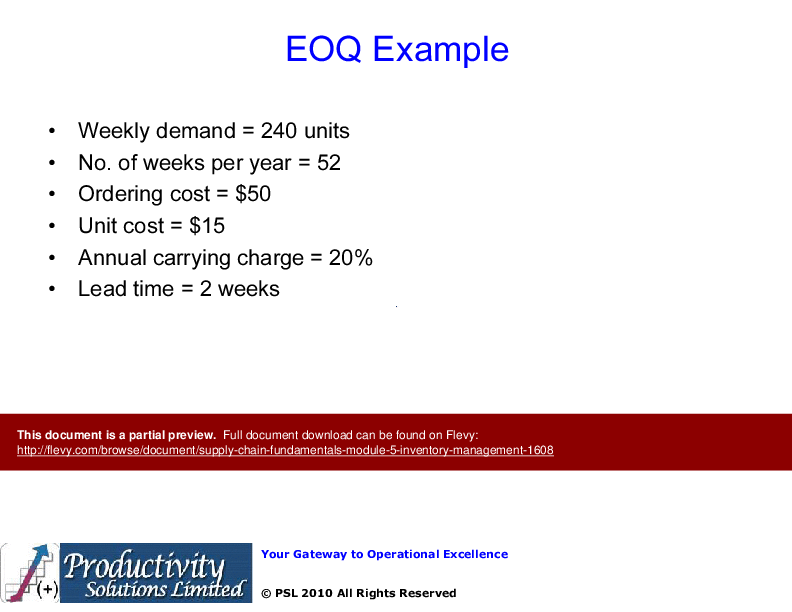
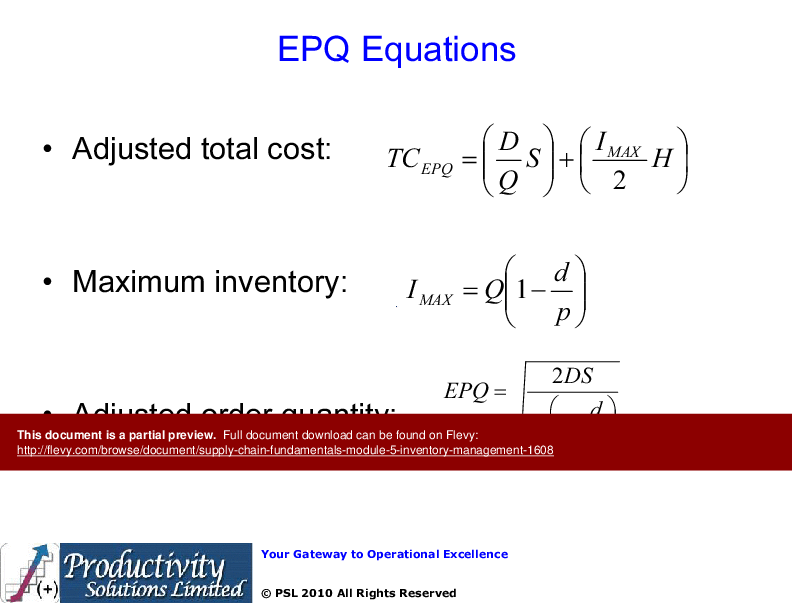
Determining Order Quantity (EOQ, EPQ and QD)
Inventory Parameters
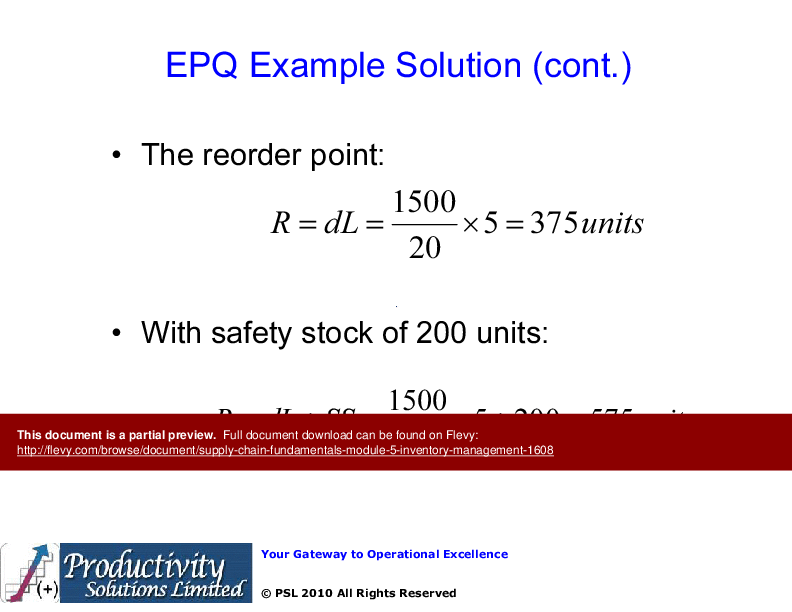
Order Point
Safety Stock
Lead Time
ABC Analysis
Inventory Management Policies
Cycle Counting
Inventory Record Accuracy
Periodic versus Perpetual Inventory

Buy all the 5 modules as a bundle and receive 25% discount!

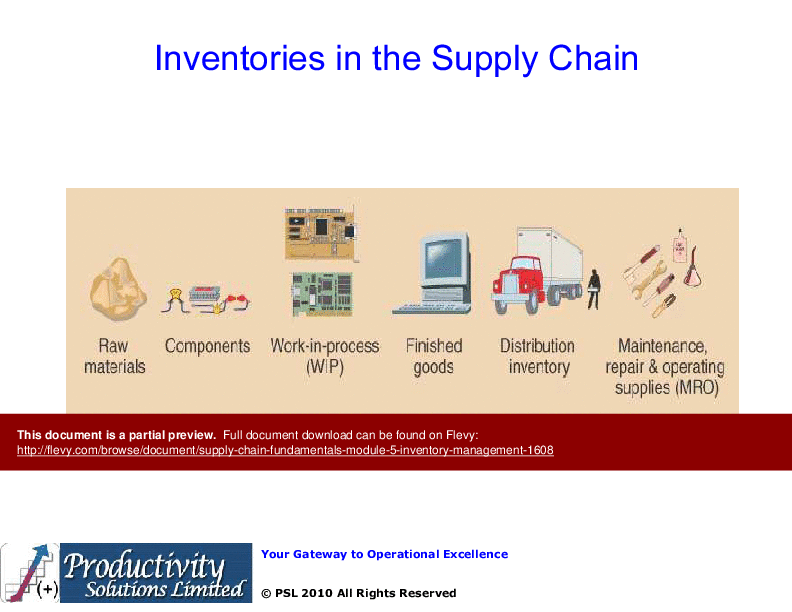
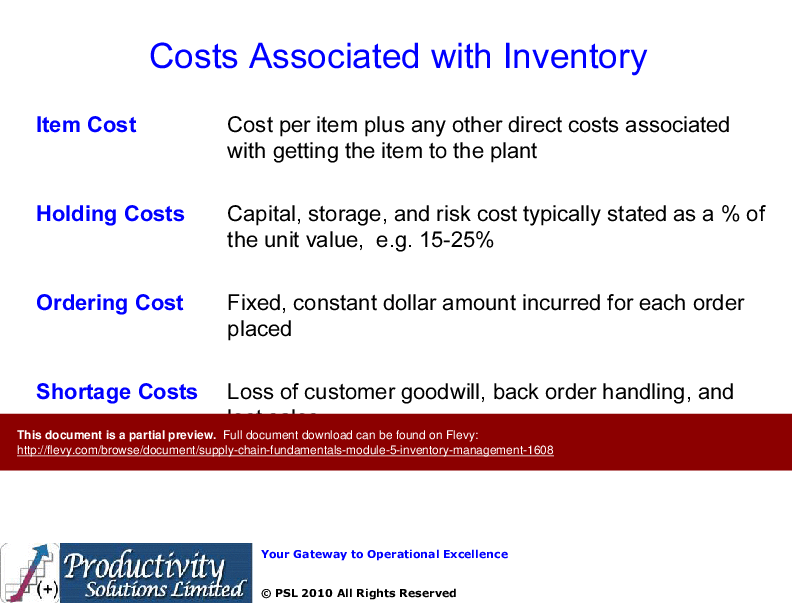
This module delves into the intricacies of inventory management, providing a comprehensive overview of the various types of inventories within the supply chain, including raw materials, components, work-in-process, finished goods, distribution inventory, and MRO supplies. It meticulously breaks down the costs associated with inventory, such as item cost, holding costs, ordering cost, and shortage costs, offering a clear understanding of the financial implications of inventory decisions.

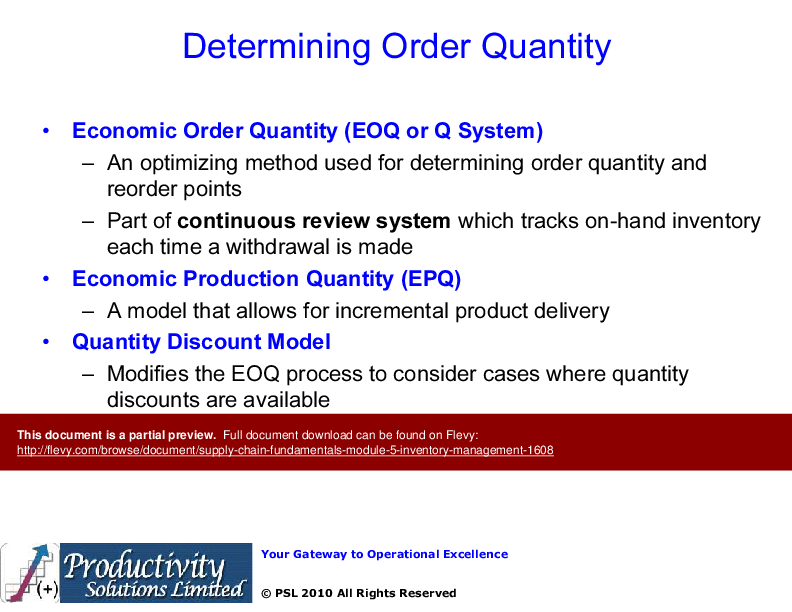
The PPT also explores sophisticated methods for determining order quantities, including the Economic Order Quantity (EOQ), Economic Production Quantity (EPQ), and Quantity Discount Model. These models are essential for optimizing order sizes and minimizing total costs, with detailed examples and equations to illustrate their application.

Additionally, the module covers ABC analysis, a critical tool for inventory categorization, helping managers prioritize their focus on the most valuable items. It also includes methods of validation such as FIFO, LIFO, and Weighted Average Cost, providing a robust framework for accurate inventory valuation. This module is a must-have for executives aiming to refine their inventory management strategies and drive operational excellence.

Got a question about the product? Email us at support@flevy.com or ask the author directly by using the "Ask the Author a Question" form. If you cannot view the preview above this document description, go here to view the large preview instead.

MARCUS OVERVIEW

This synopsis was written by Marcus [?] based on the analysis of the full 69-slide presentation.


Executive Summary
This presentation, "Supply Chain Fundamentals Module 5 - Inventory Management," is designed to equip professionals with essential inventory management strategies and techniques. Developed by a Lean pioneer and certified LSS Master Black Belt, this module provides a comprehensive understanding of inventory types, costs, and management policies. Users will learn to optimize inventory levels, enhance customer service, and minimize costs through effective order quantity strategies and inventory accuracy techniques. Download the PPT to transform your inventory management practices.

Who This Is For and When to Use
•  Supply Chain Managers overseeing inventory operations
•  Operations Executives responsible for cost efficiency
•  Inventory Analysts focused on stock accuracy
•  Procurement Professionals managing supplier relationships

Best-fit moments to use this deck:
•  During training sessions for new supply chain staff
•  In workshops aimed at improving inventory management practices
•  When assessing current inventory strategies for optimization

Learning Objectives
•  Define independent and dependent demand in inventory contexts
•  Analyze costs associated with inventory management
•  Implement order quantity strategies such as EOQ and EPQ
•  Establish effective inventory parameters including reorder points and safety stock
•  Conduct ABC analysis to prioritize inventory management efforts
•  Differentiate between periodic and perpetual inventory systems

Table of Contents
•  Independent versus Dependent Demand (page 3)
•  Costs Associated with Inventory (page 5)
•  Order Quantity Strategies (page 7)
•  Determining Order Quantity (EOQ, EPQ, and QD) (page 9)
•  Inventory Parameters (page 11)
•  ABC Analysis (page 15)
•  Inventory Management Policies (page 18)
•  Cycle Counting (page 20)
•  Inventory Record Accuracy (page 22)
•  Periodic versus Perpetual Inventory (page 25)

Primary Topics Covered
•  Independent Demand - Finished goods or items sold externally, crucial for understanding customer-facing inventory needs.
•  Dependent Demand - Materials or components used in production, essential for managing internal inventory flows.
•  Costs Associated with Inventory - Item, holding, ordering, and shortage costs that impact overall inventory management.
•  Order Quantity Strategies - Various methods like lot-for-lot, fixed-order quantity, and min-max systems to optimize ordering processes.
•  Economic Order Quantity (EOQ) - A formula to determine the most cost-effective quantity to order, minimizing total inventory costs.
•  ABC Analysis - A categorization method that prioritizes inventory items based on their consumption value, enabling focused management.

Deliverables, Templates, and Tools
•  Economic Order Quantity (EOQ) calculation template
•  ABC analysis framework for inventory categorization
•  Safety stock determination model
•  Order quantity strategy examples for practical application
•  Inventory management policy guidelines
•  Cycle counting schedule template

Slide Highlights
•  Visual representation of independent vs. dependent demand
•  Cost breakdown associated with inventory management
•  Graphical depiction of order quantity strategies
•  Step-by-step EOQ calculation example
•  ABC analysis classification chart

Potential Workshop Agenda
Introduction to Inventory Management (30 minutes)
•  Overview of inventory management concepts
•  Discussion on the importance of effective inventory control

Order Quantity Strategies (60 minutes)
•  Detailed explanation of EOQ, EPQ, and QD
•  Group exercises on calculating order quantities

ABC Analysis and Inventory Policies (45 minutes)
•  Interactive session on categorizing inventory using ABC analysis
•  Review of inventory management policies

Cycle Counting and Record Accuracy (30 minutes)
•  Methods for ensuring inventory accuracy
•  Best practices for cycle counting

Customization Guidance
•  Adjust the order quantity examples to reflect your specific inventory needs and demand patterns.
•  Tailor the ABC analysis framework to fit your organization’s inventory categorization criteria.
•  Modify safety stock calculations based on your service level requirements and lead time variability.

Secondary Topics Covered
•  Types of inventory and their specific uses
•  Inventory management policies tailored to item classification
•  Procurement implications of ABC analysis
•  Cycle counting frequency based on item classification
•  Methods of inventory valuation (FIFO, LIFO, Weighted Average)

FAQ
What is the difference between independent and dependent demand?
Independent demand refers to finished goods sold externally, while dependent demand pertains to components used in production.

How can I calculate the Economic Order Quantity (EOQ)?
EOQ can be calculated using the formula: EOQ = √(2DS/H), where D is annual demand, S is ordering cost, and H is holding cost.

What is ABC analysis and why is it important?
ABC analysis categorizes inventory into 3 classes (A, B, C) based on consumption value, allowing managers to focus on the most critical items.

How often should cycle counting be performed?
Cycle counting frequency should be based on item classification: A-items quarterly, B-items biannually, and C-items annually.

What are the costs associated with holding inventory?
Holding costs include capital, storage, and risk costs, typically expressed as a percentage of the unit value.

How do I determine safety stock levels?
Safety stock can be determined using the formula: Safety Stock = z * σdL, where z is the desired service level, σ is the standard deviation of demand, and L is lead time.

What are the benefits of using a perpetual inventory system?
A perpetual inventory system provides real-time tracking of inventory levels, improving accuracy and reducing the risk of stockouts.

What is the reorder point?
The reorder point is the inventory level at which a new order should be placed to replenish stock before it runs out.

What methods can be used to validate inventory?
Common methods include FIFO, LIFO, and Weighted Average Cost methods for inventory valuation.

Glossary
•  Independent Demand - Demand for finished goods sold externally.
•  Dependent Demand - Demand for components used in production.
•  Economic Order Quantity (EOQ) - The optimal order quantity that minimizes total inventory costs.
•  ABC Analysis - A method of categorizing inventory based on consumption value.
•  Safety Stock - Extra inventory held to prevent stockouts.
•  Reorder Point - The inventory level at which a new order should be placed.
•  Cycle Counting - A method of inventory auditing where a subset of inventory is counted on a specific day.
•  Periodic Inventory System - Inventory system that relies on physical counts at specific intervals.
•  Perpetual Inventory System - Inventory system that continuously updates inventory records.
•  FIFO (First In, First Out) - Inventory valuation method assuming the first items purchased are the first sold.
•  LIFO (Last In, First Out) - Inventory valuation method assuming the last items purchased are the first sold.
•  Weighted Average Cost - Inventory valuation method that averages the cost of all items in stock.
•  Holding Costs - Costs associated with storing unsold goods.
•  Ordering Costs - Costs incurred every time an order is placed.
•  Shortage Costs - Costs associated with running out of stock, including lost sales and customer dissatisfaction.
•  Lead Time - The time between placing an order and receiving it.
•  Service Level - The probability of not running out of stock during lead time.
•  Inventory Accuracy - The degree to which inventory records match actual physical inventory.
•  Lot Size - The quantity of inventory ordered or produced at one time.
•  Min-Max System - An inventory control system that sets minimum and maximum inventory levels.

Source: Best Practices in Inventory Management PowerPoint Slides: Supply Chain Fundamentals Module 5 - Inventory Management PowerPoint (PPTX) Presentation Slide Deck, OpEx Academy NZ


$39.00
This presentation is developed by a pioneer in Lean and certified LSS Master Black Belt who has trained over 5,000+ students globally, from Directors, CEOs, GMs, to shop floor staff. He's endorsed by CMI Consortium, NZTE, HERA, NZPICS, CBAFF.
Add to Cart
  

ABOUT THE AUTHOR

Author image
Additional documents from author: 88

Vishnu Rayapeddi is an experienced management consultant and trainer specializing in implementing continuous process improvements. Vishnu is a pioneer in Lean Management which combines the power of Lean Thinking, TOC, Six Sigma, TQM, TWI, Balanced Scorecard, cGMP and other best-class methodologies such as, DMAIC, Value Stream Mapping, Root Cause Analysis, 5S, Quick Changeovers, Quality and ... [read more]

Ask the Author a Question

You must be logged in to contact the author.

Click here to log in Click here register

Did you know?
The average daily rate of a McKinsey consultant is $6,625 (not including expenses). The average price of a Flevy document is $65.
Bundle and save! You can save up to % with bundles!

View bundle(s)


Trusted by over 10,000+ Client Organizations
Since 2012, we have provided business templates to over 10,000 businesses and organizations of all sizes, from startups and small businesses to the Fortune 100, in over 130 countries.
AT&T GE Cisco Intel IBM Coke Dell Toyota HP Nike Samsung Microsoft Astrazeneca JP Morgan KPMG Walgreens Walmart 3M Kaiser Oracle SAP Google E&Y Volvo Bosch Merck Fedex Shell Amgen Eli Lilly Roche AIG Abbott Amazon PwC T-Mobile Broadcom Bayer Pearson Titleist ConEd Pfizer NTT Data Schwab


Read Customer Testimonials

 
"[Flevy] produces some great work that has been/continues to be of immense help not only to myself, but as I seek to provide professional services to my clients, it gives me a large "tool box" of resources that are critical to provide them with the quality of service and outcomes they are expecting."

– Royston Knowles, Executive with 50+ Years of Board Level Experience
 
"FlevyPro has been a brilliant resource for me, as an independent growth consultant, to access a vast knowledge bank of presentations to support my work with clients. In terms of RoI, the value I received from the very first presentation I downloaded paid for my subscription many times over! The "

– Roderick Cameron, Founding Partner at SGFE Ltd
 
"Flevy is now a part of my business routine. I visit Flevy at least 3 times each month.

Flevy has become my preferred learning source, because what it provides is practical, current, and useful in this era where the business world is being rewritten.

In today's environment where there are so "

– Omar Hernán Montes Parra, CEO at Quantum SFE
 
"My FlevyPro subscription provides me with the most popular frameworks and decks in demand in today’s market. They not only augment my existing consulting and coaching offerings and delivery, but also keep me abreast of the latest trends, inspire new products and service offerings for my practice, and educate me "

– Bill Branson, Founder at Strategic Business Architects
 
"As a niche strategic consulting firm, Flevy and FlevyPro frameworks and documents are an on-going reference to help us structure our findings and recommendations to our clients as well as improve their clarity, strength, and visual power. For us, it is an invaluable resource to increase our impact and value."

– David Coloma, Consulting Area Manager at Cynertia Consulting
 
"If you are looking for great resources to save time with your business presentations, Flevy is truly a value-added resource. Flevy has done all the work for you and we will continue to utilize Flevy as a source to extract up-to-date information and data for our virtual and onsite presentations!"

– Debbi Saffo, President at The NiKhar Group
 
"As an Independent Management Consultant, I find Flevy to add great value as a source of best practices, templates and information on new trends. Flevy has matured and the quality and quantity of the library is excellent. Lastly the price charged is reasonable, creating a win-win value for "

– Jim Schoen, Principal at FRC Group
 
"I have found Flevy to be an amazing resource and library of useful presentations for lean sigma, change management and so many other topics. This has reduced the time I need to spend on preparing for my performance consultation. The library is easily accessible and updates are regularly provided. A wealth of great information."

– Cynthia Howard RN, PhD, Executive Coach at Ei Leadership


Save with Bundles

This document is available as part of the following discounted bundle(s):

Save %!
Supply Chain Fundamentals (5 Modules)

This bundle contains 5 total documents. See all the documents to the right.

$105.00


Add Bundle & Save


Customers Also Bought These Documents


Customers Also Like These Documents

Explore Related Management Topics


Your Recently Viewed Documents
Receive our FREE presentation on Operational Excellence

This 50-slide presentation provides a high-level introduction to the 4 Building Blocks of Operational Excellence. Achieving OpEx requires the implementation of a Business Execution System that integrates these 4 building blocks.