
This framework is developed by a team of former McKinsey and Big 4 consultants. The presentation follows the headline-body-bumper slide format used by global consulting firms.
Editor Summary
The Product Strategy: Smart Customization is a 23-slide PowerPoint framework by LearnPPT Consulting that outlines a smart customization approach for product strategy, cost optimization, and growth.
Read moreCovers 3 sources of improved performance: understanding value from customization, focusing on the right customization, and tailoring business streams. Includes templates and tools: smart customization framework, business stream segmentation template, order qualifiers/order winners analysis, cost-benefit analysis, performance-tracking metrics, and best-practices checklist. Target users: product managers, strategy teams, operations leaders, executives. Sold as a digital download on Flevy.
Use this deck when an organization must reconcile customer demand for personalization with operational cost and complexity—common during strategic planning, operational efficiency reviews, or product offering workshops.
Product managers mapping which features to modularize and assessing value sources from customization for specific customer segments.
Strategy teams segmenting offerings and differentiating order qualifiers from order winners to prioritize investments.
Operations leaders designing tailored business streams to share resources and reduce overhead while preserving value.
Executives setting metrics and governance for cross-functional customization programs.
The three-source approach—value, focus, and tailored streams—follows standard consulting emphasis on segmentation, cost‑value trade-offs, and measurable metrics.
The advantages of Smart Customization are a bit more discernible in the manufacturing industry—owing to fairly speedy cash recoveries when factory costs are aligned to customer value. However, services sector can also benefit from Smart Customization, but requires relatively closer interactions with customers and more flexible systems for providing offerings. Service sector is more complexity ridden, yet offers more opportunities.
However, success lies in balancing the cost of complexity against the value of variety, comparing the benefits of sales growth against the buildup of overhead and indirect costs.
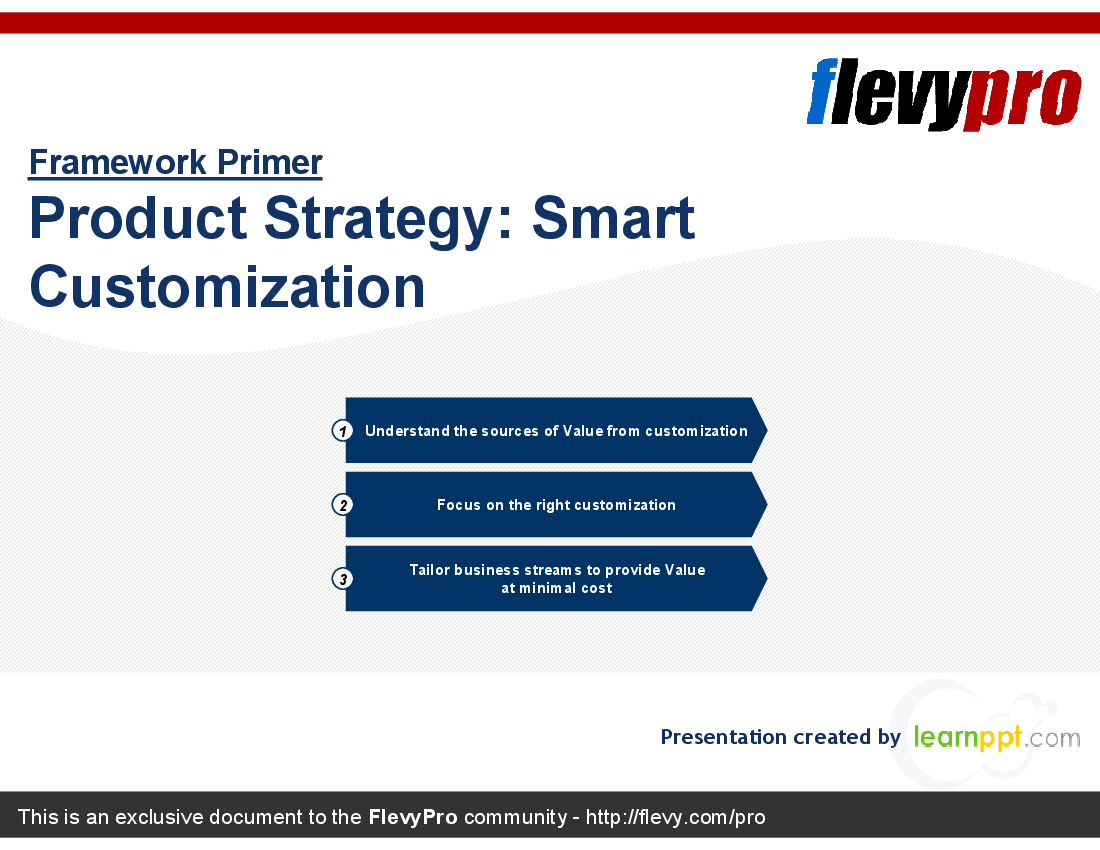
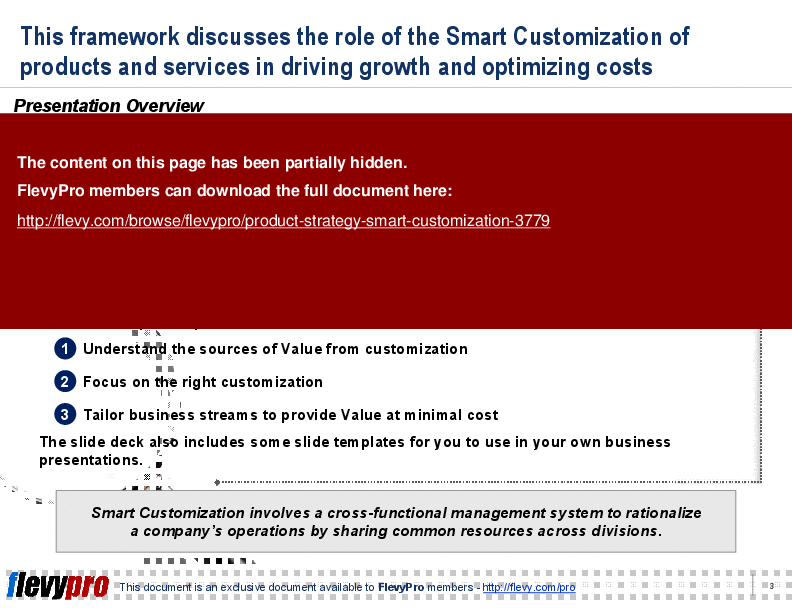
This presentation talks about the benefits of enabling Smart Customization to survive and knock competition. To take full advantage of Smart Customization, organizations must focus on 3 sources of improved performance:
1. Understand the sources of Value from customization
2. Focus on the right customization
3. Tailor business streams to provide Value at minimal cost
Smart Customization involves a cross-functional management system to rationalize a company's operations by sharing common resources across divisions.
The slide deck also includes some slide templates for you to use in your own business presentations.
Smart Customization is pivotal for firms aiming to stay ahead in today's competitive landscape. This framework provides a comprehensive analysis of how companies can leverage customization to drive growth and optimize costs. It delves into the critical aspects of understanding customer value, focusing on the right customization strategies, and tailoring business streams to deliver maximum value at minimal cost. Executives will find actionable insights into balancing complexity costs with the benefits of variety, ensuring that their customization efforts lead to sustainable competitive advantages.
The presentation also highlights the importance of harmonizing multiple points of focus to meet the diverse needs of modern customers. With detailed templates and practical examples, this PPT serves as a valuable resource for organizations looking to refine their product strategies. By adopting the principles of Smart Customization, companies can enhance their market share, improve customer satisfaction, and achieve higher profit margins. This slide deck is an essential tool for any business leader committed to driving innovation and efficiency in their operations.
This synopsis was written by Marcus [?] based on the analysis of the full 23-slide presentation.
Executive Summary
The "Product Strategy: Smart Customization" presentation provides a framework for leveraging smart customization to enhance product strategies, optimize costs, and drive growth. Developed by experienced consultants, this presentation outlines how organizations can align their operations with customer demands for personalized offerings. By focusing on 3 key performance sources—understanding value from customization, targeting the right customization, and tailoring business streams—executives can foster competitive advantages and improve profitability.
Who This Is For and When to Use
• Product managers seeking to enhance product offerings through customization
• Strategy teams focused on aligning business models with customer needs
• Operations leaders aiming to optimize costs while delivering personalized services
• Executives looking to drive growth through innovative product strategies
Best-fit moments to use this deck:
• During strategic planning sessions to align product offerings with customer expectations
• When assessing operational efficiencies in product customization
• In workshops aimed at developing tailored business strategies
Learning Objectives
• Define the concept of smart customization and its relevance to product strategy
• Identify sources of value from customization to enhance customer satisfaction
• Analyze the distinction between order qualifiers and order winners in product offerings
• Develop strategies for tailoring business streams to minimize costs while maximizing value
• Implement best practices for managing complexity in product customization
• Establish metrics for tracking the success of customization initiatives
Table of Contents
• Overview (page 3)
• Types of Customization (page 5)
• Sources of Improved Performance (page 9)
• Templates (page 15)
Primary Topics Covered
• Overview of Smart Customization - This section introduces the concept of smart customization and its significance in driving growth and optimizing costs.
• Types of Customization - Differentiates between simple customizers and smart customizers, highlighting the performance advantages of the latter.
• Sources of Improved Performance - Discusses 3 critical areas for organizations to focus on: understanding value from customization, focusing on the right customization, and tailoring business streams.
• Order Qualifiers vs. Order Winners - Explains the importance of distinguishing between basic offerings and those that meet critical customer needs.
• Tailored Business Streams - Describes how to segment business operations to deliver differentiated services effectively.
• Best Practices for Smart Customization - Outlines strategies for managing complexity while maximizing customer value.
Deliverables, Templates, and Tools
• Smart customization framework template for assessing product strategies
• Business stream segmentation template for tailoring offerings
• Performance tracking metrics for customization initiatives
• Order qualifiers and order winners analysis tool
• Cost-benefit analysis template for customization efforts
• Best practices checklist for implementing smart customization
Slide Highlights
• Overview slide that succinctly defines smart customization and its benefits
• Comparison chart illustrating the performance differences between simple and smart customizers
• Visual representation of the sources of improved performance in customization
• Framework for distinguishing between order qualifiers and order winners
• Tailored business streams model showcasing how to segment operations effectively
Potential Workshop Agenda
Introduction to Smart Customization (30 minutes)
• Overview of smart customization principles
• Discussion on the importance of aligning with customer needs
Identifying Value Sources (60 minutes)
• Workshop activity to assess current product offerings
• Group analysis of customer feedback and market trends
Developing Tailored Strategies (90 minutes)
• Breakout sessions to create tailored business stream plans
• Presentation of group findings and strategies
Customization Guidance
• Adjust the framework to reflect specific customer segments and their unique needs
• Incorporate relevant metrics to track the effectiveness of customization efforts
• Modify templates to align with organizational terminology and operational processes
Secondary Topics Covered
• The role of technology in enabling smart customization
• Challenges and risks associated with implementing customization strategies
• Case studies of successful smart customization initiatives
Topic FAQ
What is smart customization and how does it differ from simple customization?
Smart customization is tailoring products or services to specific customer needs while optimizing operational costs. It differs from simple customization by structuring offerings to align factory or service processes to customer value, enabling better cost recovery; manufacturing often sees faster cash recoveries when costs align to customer value.
What are the primary sources of improved performance from customization?
The framework identifies 3 sources: understanding the value generated by customization, focusing on the right types of customization that matter to customers, and tailoring business streams to deliver value at minimal cost. These are described as the 3 sources of improved performance.
What metrics should I track to evaluate customization initiatives?
Track customer satisfaction, cost savings (or cost-to-serve), revenue growth attributable to customized offerings, and market share changes to evaluate impact. The presentation explicitly lists customer satisfaction, cost savings, revenue growth, and market share as key performance metrics.
What should I look for when selecting a smart customization toolkit or template?
Seek tools that support cross-functional alignment, allow business stream segmentation, quantify order qualifiers versus order winners, and include cost-benefit and performance-tracking templates. Flevy's Product Strategy: Smart Customization includes a smart customization framework template and a cost-benefit analysis template.
How much time should I plan for a workshop to begin a smart customization program?
A starter workshop can run a few hours using a suggested agenda: 30 minutes for an overview, 60 minutes for identifying value sources, and 90 minutes for developing tailored business stream strategies, as outlined in the slide deck.
How should a services business approach reducing costs while offering personalization?
Services should emphasize closer customer interactions, flexible delivery systems, and segmentation of operations to limit complexity. Success requires balancing the cost of complexity against the value of variety and designing tailored business streams to share common resources across divisions.
How can I determine which features are order qualifiers versus order winners?
Assess customer expectations to identify basic requirements (order qualifiers) versus differentiating features that drive purchase decisions (order winners). Use structured analysis and the order qualifiers/order winners analysis tool provided in Flevy's Product Strategy: Smart Customization to document distinctions.
Can both manufacturing and services firms benefit from smart customization?
Yes. Manufacturing often captures advantages through faster cash recovery when factory costs align to customer value, while services can benefit, but need closer customer interaction and more flexible systems; services are typically more complex, but offer additional opportunities.
Document FAQ
These are questions addressed within this presentation.
What is smart customization?
Smart customization refers to the strategic approach of tailoring products and services to meet specific customer needs while optimizing operational costs.
How can organizations benefit from smart customization?
Organizations can enhance customer satisfaction, improve market share, and achieve higher profit margins by effectively implementing smart customization strategies.
What are order qualifiers and order winners?
Order qualifiers are the basic requirements needed to compete, while order winners are the features that differentiate a product and meet critical customer needs.
How can I implement smart customization in my organization?
Begin by assessing your current product offerings, understanding customer needs, and developing tailored strategies that align with those needs while managing costs.
What metrics should I track for customization initiatives?
Track customer satisfaction, cost savings, revenue growth, and market share improvements to evaluate the success of your customization efforts.
What challenges might I face with customization?
Common challenges include managing complexity, balancing costs, and ensuring alignment across different business streams.
How do I tailor business streams effectively?
Segment your operations based on customer needs, ensuring that each stream is designed to deliver maximum value at minimal cost.
What tools can assist in implementing smart customization?
Utilize templates for performance tracking, customer analysis, and business stream segmentation to facilitate effective implementation.
Glossary
• Smart Customization - Tailoring products and services to meet specific customer needs while optimizing costs.
• Order Qualifiers - Basic requirements needed to compete in the market.
• Order Winners - Features that differentiate a product and meet critical customer needs.
• Tailored Business Streams - Segmented operations designed to deliver differentiated services effectively.
• Performance Metrics - Measurements used to evaluate the success of customization initiatives.
• Customer Segmentation - The process of dividing customers into groups based on shared characteristics.
• Complexity Management - Strategies for handling the challenges associated with product customization.
• Cost Optimization - Efforts to reduce expenses while maintaining quality and value.
• Value Proposition - The unique value a product or service offers to customers.
• Market Share - The portion of a market controlled by a particular company or product.
• Customer Satisfaction - A measure of how products and services meet or exceed customer expectations.
• Revenue Growth - The increase in a company's sales over a specified period.
This PPT slide introduces 2 critical categories in customer segmentation: Order Qualifiers and Order Winners. Order Qualifiers are essential offerings that enable firms to remain competitive, but do not differentiate them in the market; these must be standardized to minimize costs. In contrast, Order Winners directly address the pressing needs of customers and can vary significantly across segments, allowing for customized solutions that enhance market share. Effective customization strategies align offerings with customer expectations, driving performance and revenue growth. Businesses that offer similar services to all customers risk unnecessary costs, highlighting the importance of tailoring products and services to distinct customer needs.
Tailored Business Streams (TBS) enable businesses to segment operations effectively to meet diverse customer needs while minimizing costs. Streamlining complexities in a competitive economy allows for agile responses to market dynamics. Managing multiple flows facilitates differentiated services and products, reducing management overhead and improving resource allocation. Keeping these streams separate further decreases costs, enabling tailored offerings without the burden of complex operational infrastructures. TBS are influenced by internal and external factors, such as market conditions and cost fluctuations, necessitating robust policies and controls for consistent value creation across different streams. This approach enhances operational efficiency and customer satisfaction by focusing on segmentation and cost management.
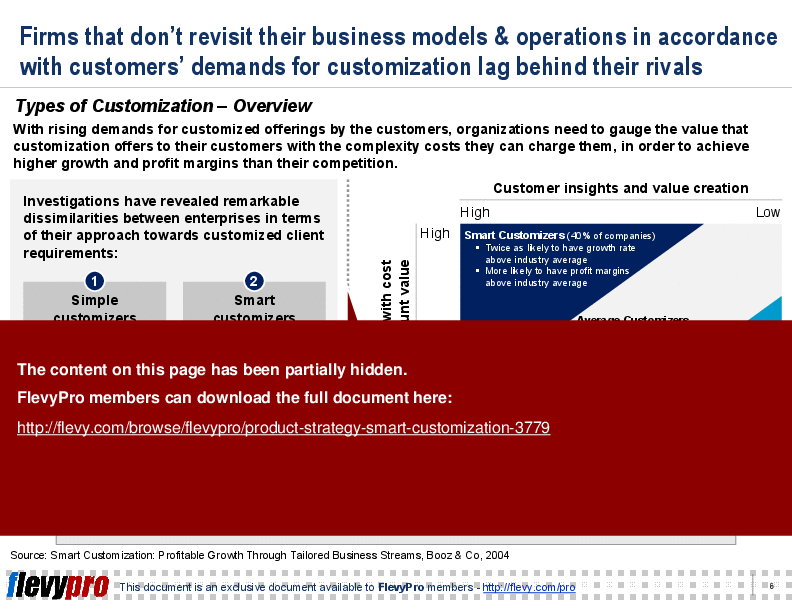
This PPT slide categorizes customization strategies into 3 types: Simple Customizers, Average Customizers, and Smart Customizers. Simple Customizers offer transient solutions that fail to meet evolving customer expectations, resulting in a performance gap; they are 5 times more likely to experience growth below industry averages and struggle with profit margins. Average Customizers show moderate alignment with customer needs, but still underperform compared to industry standards. Smart Customizers, representing 40% of companies, proactively transform customer strategies, achieving growth rates above the industry average and enjoying superior profit margins. Organizations must refine their business models to meet customer demands effectively to avoid lagging behind competitors.
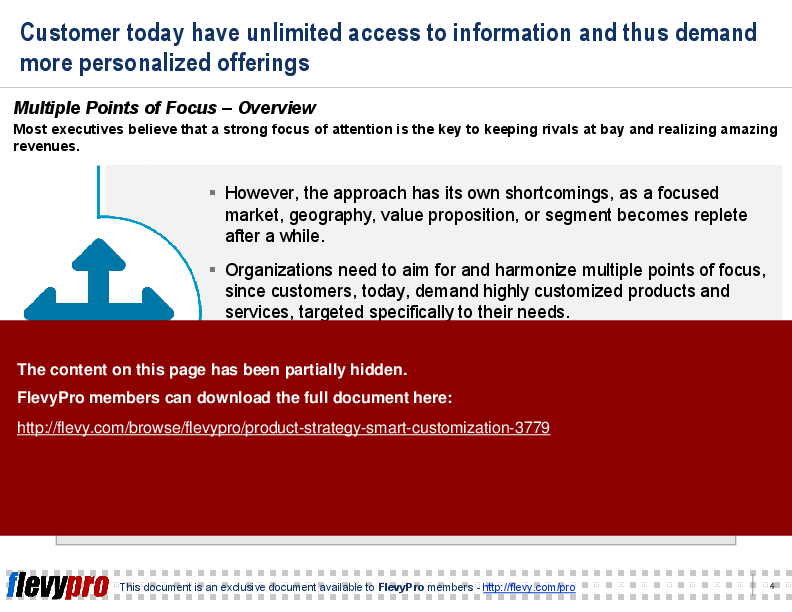
Smart Customization enhances organizational performance across sectors. In manufacturing, benefits arise from aligning factory costs with customer value, while the service sector faces challenges due to complexity and the need for closer customer interactions. Key sources of improved performance include understanding value from customization to meet specific customer needs, prioritizing effective customization aligned with strategic goals, and tailoring business streams for efficiency while delivering high-quality solutions. Organizations must balance complexity with the value of variety to avoid unnecessary overhead and costs. A comprehensive review of business streams is essential for effective and efficient customization efforts, guiding organizations to leverage Smart Customization for improved performance and customer satisfaction.
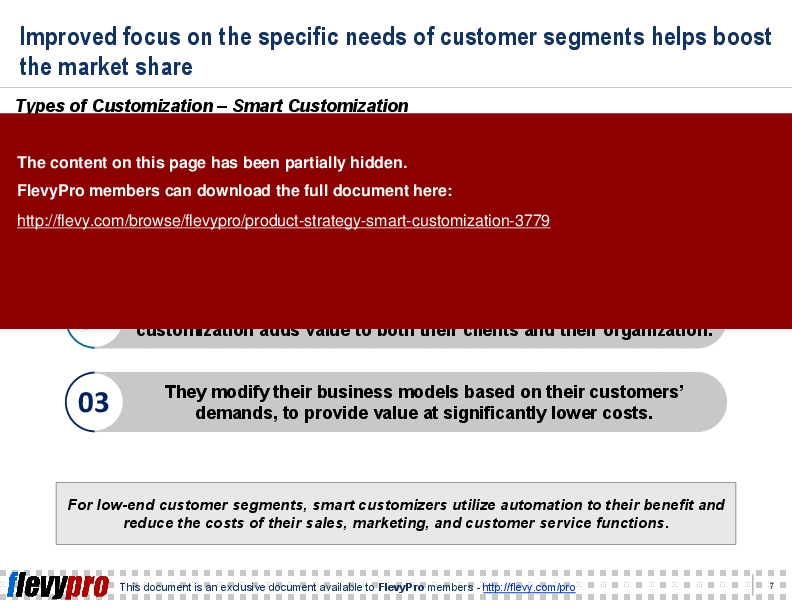
Smart customizers are high-performing companies that effectively tailor offerings to meet specific customer needs. They understand the value of customization, driving their strategy to deliver relevant solutions. Committed to continuous transformation, they enhance customization to benefit both clients and operations, reflecting a holistic approach. These companies adapt their business models to align with customer demands, providing value at lower costs in a competitive marketplace. By responding to customer feedback and market trends, they maintain relevance and efficiency. For lower-end customer segments, smart customizers leverage automation to optimize sales, marketing, and customer service, reducing operational costs while enhancing service delivery.
This framework is developed by a team of former McKinsey and Big 4 consultants. The presentation follows the headline-body-bumper slide format used by global consulting firms.
For $10.00 more, you can download this document plus 2 more FlevyPro documents. That's just $13 each.
ABOUT FLEVYPRO
This document is part of the FlevyPro Library, a curated knowledge base of documents for our FlevyPro subscribers.
FlevyPro is a subscription service for on-demand business frameworks and analysis tools. FlevyPro subscribers receive access to an exclusive library of curated business documents—business framework primers, presentation templates, Lean Six Sigma tools, and more—among other exclusive benefits.
The average daily rate of a McKinsey consultant is $6,625 (not including expenses). The average price of a Flevy document is $65.
Trusted by over 10,000+ Client Organizations
Since 2012, we have provided business templates to over 10,000 businesses and organizations of all sizes, from startups and small businesses to the Fortune 100, in over 130 countries.
"As a small business owner, the resource material available from FlevyPro has proven to be invaluable. The ability to search for material on demand based our project events and client requirements was great for me and proved very beneficial to my clients. Importantly, being able to easily edit and tailor
the material for specific purposes helped us to make presentations, knowledge sharing, and toolkit development, which formed part of the overall program collateral. While FlevyPro contains resource material that any consultancy, project or delivery firm must have, it is an essential part of a small firm or independent consultant's toolbox.
"
– Michael Duff, Managing Director at Change Strategy (UK)
"Flevy.com has proven to be an invaluable resource library to our Independent Management Consultancy, supporting and enabling us to better serve our enterprise clients.
The value derived from our [FlevyPro] subscription in terms of the business it has helped to gain far exceeds the investment made, making a subscription a no-brainer for any growing consultancy – or in-house strategy team."
– Dean Carlton, Chief Transformation Officer, Global Village Transformations Pty Ltd.
"As a consulting firm, we had been creating subject matter training materials for our people and found the excellent materials on Flevy, which saved us 100's of hours of re-creating what already exists on the Flevy materials we purchased."
– Michael Evans, Managing Director at Newport LLC
"As a consultant requiring up to date and professional material that will be of value and use to my clients, I find Flevy a very reliable resource.
The variety and quality of material available through Flevy offers a very useful and commanding source for information. Using Flevy saves me time, enhances my expertise and ends up being a good decision."
– Dennis Gershowitz, Principal at DG Associates
"My FlevyPro subscription provides me with the most popular frameworks and decks in demand in today’s market. They not only augment my existing consulting and coaching offerings and delivery, but also keep me abreast of the latest trends, inspire new products and service offerings for my practice, and educate me
in a fraction of the time and money of other solutions. I strongly recommend FlevyPro to any consultant serious about success.
"
– Bill Branson, Founder at Strategic Business Architects
"Flevy is now a part of my business routine. I visit Flevy at least 3 times each month.
Flevy has become my preferred learning source, because what it provides is practical, current, and useful in this era where the business world is being rewritten.

many challenges and there is the need to make the right decisions in a short time, with so much scattered information, we are fortunate to have Flevy. Flevy investigates, selects, and puts at our disposal the best of the best to help us be successful in our work.
"
– Omar Hernán Montes Parra, CEO at Quantum SFE
"As an Independent Management Consultant, I find Flevy to add great value as a source of best practices, templates and information on new trends. Flevy has matured and the quality and quantity of the library is excellent. Lastly the price charged is reasonable, creating a win-win value for
the customer, Flevy and the various authors. This is truly a service that benefits the consulting industry and associated clients. Thanks for providing this service.
"
– Jim Schoen, Principal at FRC Group
"One of the great discoveries that I have made for my business is the Flevy library of training materials.
As a Lean Transformation Expert, I am always making presentations to clients on a variety of topics: Training, Transformation, Total Productive Maintenance, Culture, Coaching, Tools, Leadership Behavior, etc. Flevy
It is well worth the money to purchase these presentations. Sure, I have the knowledge and information to make my point. It is another thing to create a presentation that captures what I want to say. Flevy has saved me countless hours of preparation time that is much better spent with implementation that will actually save money for my clients.
"
– Ed Kemmerling, Senior Lean Transformation Expert at PMG
Download our free compilation of 50+ Strategy & Transformation slides and templates. Frameworks include McKinsey 7-S, Balanced Scorecard, Disruptive Innovation, BCG Curve, and many more.