
This framework is developed by a team of former McKinsey and Big 4 consultants. The presentation follows the headline-body-bumper slide format used by global consulting firms.
Editor Summary
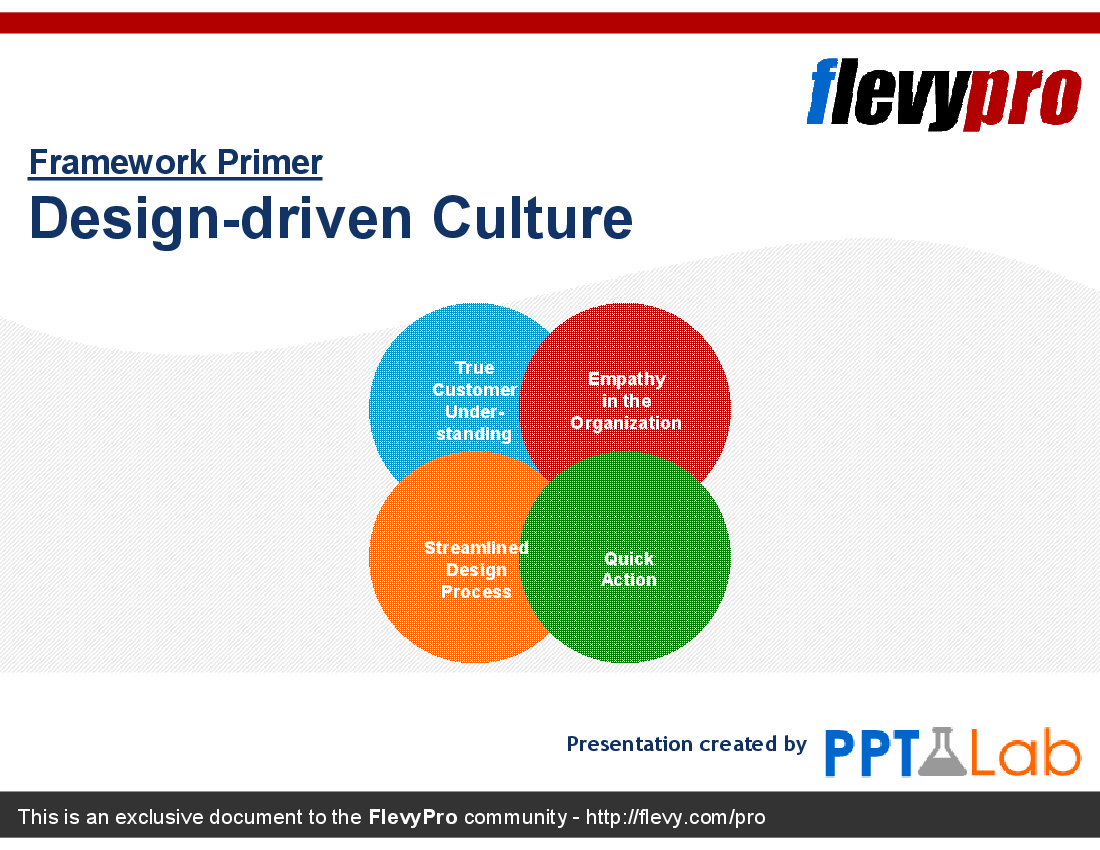
Design-driven Culture is a 24-slide PowerPoint (PPT) presentation by PPT Lab that outlines how organizations can adopt a design-driven culture, presenting 4 core elements: True Customer Understanding, Empathy in Organization, Streamlined Design Process, and Acting Quickly.
Read moreCovers models and topics such as the Braided Design Model, Four Wall Approach, Customer Decision Journey, Minimum Viable Product, and Competitive Advantage; includes editable templates for business presentations. Sold as a digital download on Flevy.
Use this presentation when customer experience is becoming a strategic differentiator and leadership needs a structured way to shift culture, processes, and governance toward customer-centric design.
Chief Design Lead candidates building a business case and governance model to champion customer advocacy across functions.
Product managers running rapid prototyping and MVP experiments to shorten feedback cycles and time-to-market.
CX leaders mapping the customer decision journey and embedding empathy across departments.
Transformation leads applying cross-functional models to reduce handoffs between design, strategy, and technology.
The focus on customer empathy, iterative prototyping, and cross-functional integration mirrors design-thinking and agile consulting practices.
Over time, we are seeing the growing importance of Customer Experience. As it becomes more and more difficult to separate the experience of buying and using the product, we are seeing many cases where customers prioritize the buying experience to the performance of the product itself.
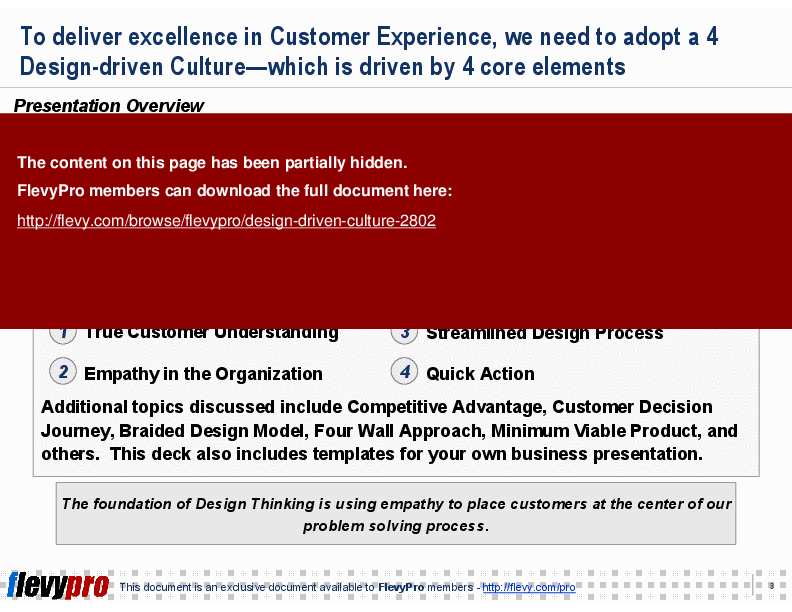
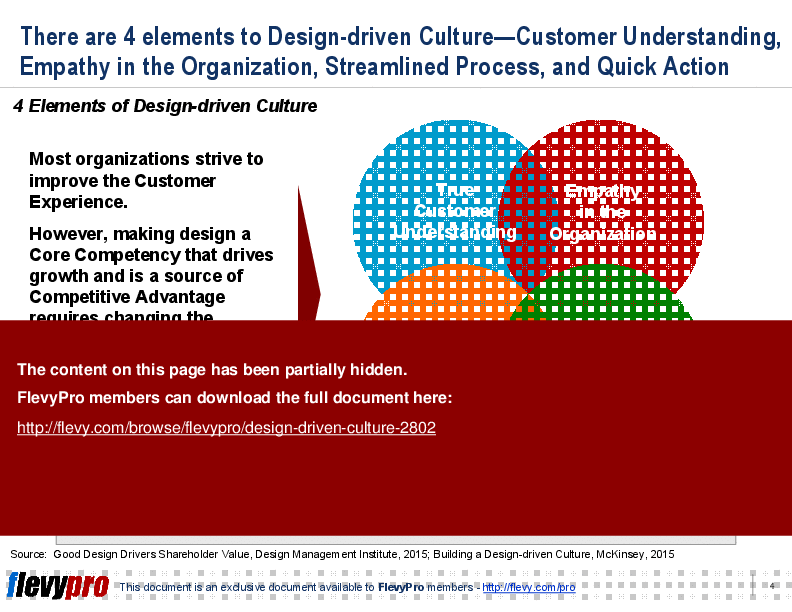
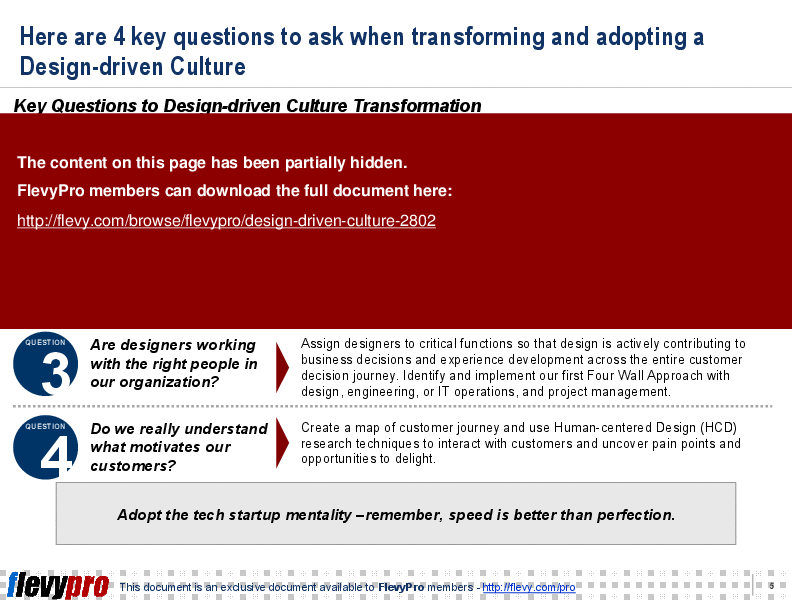
To truly prioritize and deliver excellence in Customer Experience, our organization needs to adopt a Design-driven Culture. In this presentation, we discuss the 4 core elements to a Design-driven Culture:
1. True Customer Understanding
2. Empathy in Organization
3. Streamlined Design Process
4. Acting Quickly
Additional topics discussed include Competitive Advantage, Customer Decision Journey, Braided Design Model, Four Wall Approach, Minimum Viable Product, and others.
This deck also includes templates for your own business presentation.
This presentation provides a comprehensive framework for transforming your organization into a design-driven powerhouse. It delves into the critical role of empathy in fostering a customer-centric mindset across all departments. The deck emphasizes the significance of appointing a Chief Design Lead to champion customer advocacy and align business strategies with customer needs.
The PPT also explores the Braided Design Model and Four Wall Approach to streamline the design process. These methodologies ensure seamless collaboration between design, strategy, and technology teams, driving efficiency and innovation. The Braided Design Model integrates diverse functions to co-create optimal experiences, while the Four Wall Approach mitigates process inefficiencies by fostering cross-functional teamwork.
To accelerate product development, the presentation highlights the importance of rapid prototyping and frequent iteration. By adopting agile practices and focusing on Minimum Viable Products (MVPs), organizations can quickly bring products to market and refine them based on real-time customer feedback. This approach not only speeds up the development cycle, but also ensures that the final product resonates with customer expectations.
What are the core elements of a design-driven culture I should focus on first?
A design-driven culture emphasizes 4 core elements: True Customer Understanding, Empathy in Organization, Streamlined Design Process, and Acting Quickly. Starting initiatives that build customer insight and organizational empathy creates the foundational behaviors described in the deck's 4 core elements.
How does appointing a Chief Design Lead help embed customer focus across the company?
A Chief Design Lead serves as a customer advocate and aligns business strategy, design, and technology teams to ensure decisions reflect customer needs. The presentation highlights this role to centralize accountability for customer advocacy and cross-functional alignment, recommending appointment of a Chief Design Lead.
What is the Braided Design Model and why would I consider it?
The Braided Design Model integrates diverse functions—design, strategy, and technology—to co-create customer experiences and improve collaboration. The model is presented as a way to combine perspectives and reduce siloed work through integrated team practices such as the Braided Design Model.
How do rapid prototyping and Minimum Viable Products (MVPs) support faster product development?
Rapid prototyping and frequent iteration let teams test assumptions with real users, gather feedback, and refine solutions quickly. The deck links these practices to agile approaches that accelerate time-to-market and iterative improvement using Minimum Viable Products (MVP).
What should I look for when choosing a design-culture toolkit or slide deck for executives?
Seek a resource that covers customer understanding, empathy-building, process models for cross-functional work, and rapid iteration guidance, plus editable presentation templates. Flevy's Design-driven Culture includes these topics—Braided Design Model, Four Wall Approach, MVP—and provides editable templates in a 24-slide PPT.
How can I explain the value of empathy-driven change to senior leaders worried about time and cost?
Explain that embedding empathy aligns product and strategy decisions with customer needs, reducing rework and improving adoption; governance via a Chief Design Lead helps sustain focus across projects. The presentation connects empathy to organizational mindset and governance around a Chief Design Lead.
Our teams experience slow handoffs between design, strategy, and tech—what approaches address that?
Frameworks that emphasize cross-functional integration and shared workflows reduce handoffs; the presentation describes the Braided Design Model for integrated co-creation and the Four Wall Approach to mitigate process inefficiencies through cross-functional teamwork and collaboration.
Are PowerPoint templates useful for launching a design-driven culture program and what do they typically include?
Templates help communicate strategy, models, and governance to stakeholders and standardize workshops or roadmaps; decks often include models (customer journey, process), role descriptions, and presentation-ready slides. Flevy's Design-driven Culture provides editable templates within a 24-slide PPT.
The "Streamlined Design Process" within the Braided Design Model integrates Design, Strategy, and Technology to drive innovation and enhance user experience. The "Frame" phase focuses on mapping business opportunities, identifying user needs, and understanding market dynamics while considering technology trends. The "Cocreate" phase emphasizes customer feedback for refining problem statements and defining the value proposition through workshops. The "Prototype" section highlights rapid prototyping and iterative design for real-time feedback, supporting agile technology development. The "Validate" component involves usability testing to ensure alignment of technology and processes with business strategy. Finally, the "Govern" section establishes best practices tied to business strategy, ensuring ongoing investment and adaptation in the innovation process. This comprehensive approach provides a roadmap for organizations to enhance innovation capabilities.
The McKinsey Customer Decision Journey framework outlines 4 key stages in the purchasing process. The "Initial Consideration Set" is when customers first identify brands they might purchase. In the "Active Evaluation" stage, customers seek information, compare features, and gather insights about their options. The "Moment of Purchase" is the actual transaction, where customer satisfaction and loyalty can be influenced. Finally, the "Post-purchase Experience" stage reflects on the buying experience, impacting future purchase decisions and potentially cycling back to the initial consideration phase. Understanding these stages helps organizations tailor strategies to meet customer needs effectively.
Source: Best Practices in Customer Experience, Corporate Culture, Customer Decision Journey, Service Design PowerPoint Slides: Design-driven Culture PowerPoint (PPT) Presentation Slide Deck, PPT Lab
This framework is developed by a team of former McKinsey and Big 4 consultants. The presentation follows the headline-body-bumper slide format used by global consulting firms.
For $10.00 more, you can download this document plus 2 more FlevyPro documents. That's just $13 each.
ABOUT FLEVYPRO
This document is part of the FlevyPro Library, a curated knowledge base of documents for our FlevyPro subscribers.

FlevyPro is a subscription service for on-demand business frameworks and analysis tools. FlevyPro subscribers receive access to an exclusive library of curated business documents—business framework primers, presentation templates, Lean Six Sigma tools, and more—among other exclusive benefits.
The average daily rate of a McKinsey consultant is $6,625 (not including expenses). The average price of a Flevy document is $65.
Trusted by over 10,000+ Client Organizations
Since 2012, we have provided business templates to over 10,000 businesses and organizations of all sizes, from startups and small businesses to the Fortune 100, in over 130 countries.
"One of the great discoveries that I have made for my business is the Flevy library of training materials.
As a Lean Transformation Expert, I am always making presentations to clients on a variety of topics: Training, Transformation, Total Productive Maintenance, Culture, Coaching, Tools, Leadership Behavior, etc. Flevy
It is well worth the money to purchase these presentations. Sure, I have the knowledge and information to make my point. It is another thing to create a presentation that captures what I want to say. Flevy has saved me countless hours of preparation time that is much better spent with implementation that will actually save money for my clients.
"
– Ed Kemmerling, Senior Lean Transformation Expert at PMG
"Flevy.com has proven to be an invaluable resource library to our Independent Management Consultancy, supporting and enabling us to better serve our enterprise clients.
The value derived from our [FlevyPro] subscription in terms of the business it has helped to gain far exceeds the investment made, making a subscription a no-brainer for any growing consultancy – or in-house strategy team."
– Dean Carlton, Chief Transformation Officer, Global Village Transformations Pty Ltd.
"As a small business owner, the resource material available from FlevyPro has proven to be invaluable. The ability to search for material on demand based our project events and client requirements was great for me and proved very beneficial to my clients. Importantly, being able to easily edit and tailor
the material for specific purposes helped us to make presentations, knowledge sharing, and toolkit development, which formed part of the overall program collateral. While FlevyPro contains resource material that any consultancy, project or delivery firm must have, it is an essential part of a small firm or independent consultant's toolbox.
"
– Michael Duff, Managing Director at Change Strategy (UK)
"If you are looking for great resources to save time with your business presentations, Flevy is truly a value-added resource. Flevy has done all the work for you and we will continue to utilize Flevy as a source to extract up-to-date information and data for our virtual and onsite presentations!"
– Debbi Saffo, President at The NiKhar Group
"My FlevyPro subscription provides me with the most popular frameworks and decks in demand in today’s market. They not only augment my existing consulting and coaching offerings and delivery, but also keep me abreast of the latest trends, inspire new products and service offerings for my practice, and educate me
in a fraction of the time and money of other solutions. I strongly recommend FlevyPro to any consultant serious about success.
"
– Bill Branson, Founder at Strategic Business Architects
"The wide selection of frameworks is very useful to me as an independent consultant. In fact, it rivals what I had at my disposal at Big 4 Consulting firms in terms of efficacy and organization."
– Julia T., Consulting Firm Owner (Former Manager at Deloitte and Capgemini)
"I have used FlevyPro for several business applications. It is a great complement to working with expensive consultants. The quality and effectiveness of the tools are of the highest standards."
– Moritz Bernhoerster, Global Sourcing Director at Fortune 500
"As a niche strategic consulting firm, Flevy and FlevyPro frameworks and documents are an on-going reference to help us structure our findings and recommendations to our clients as well as improve their clarity, strength, and visual power. For us, it is an invaluable resource to increase our impact and value."
– David Coloma, Consulting Area Manager at Cynertia Consulting
Download our FREE Digital Transformation Templates
Download our free compilation of 50+ Digital Transformation slides and templates. DX concepts covered include Digital Leadership, Digital Maturity, Digital Value Chain, Customer Experience, Customer Journey, RPA, etc.









