 Click main image to view in full screen.
Design Thinking Poster – PDF
PDF document + PowerPoint (PPTX) 3 Pages


BENEFITS OF THIS DOWNLOADABLE PDF DOCUMENT
- Provides a summary of the five phases of Design Thinking based on the Stanford University's model.
- Serves as a complementary tool for your Design Thinking workshop session.
- Print the poster in A3/A4 size right out from your office copier machine.
DESIGN THINKING PDF DESCRIPTION
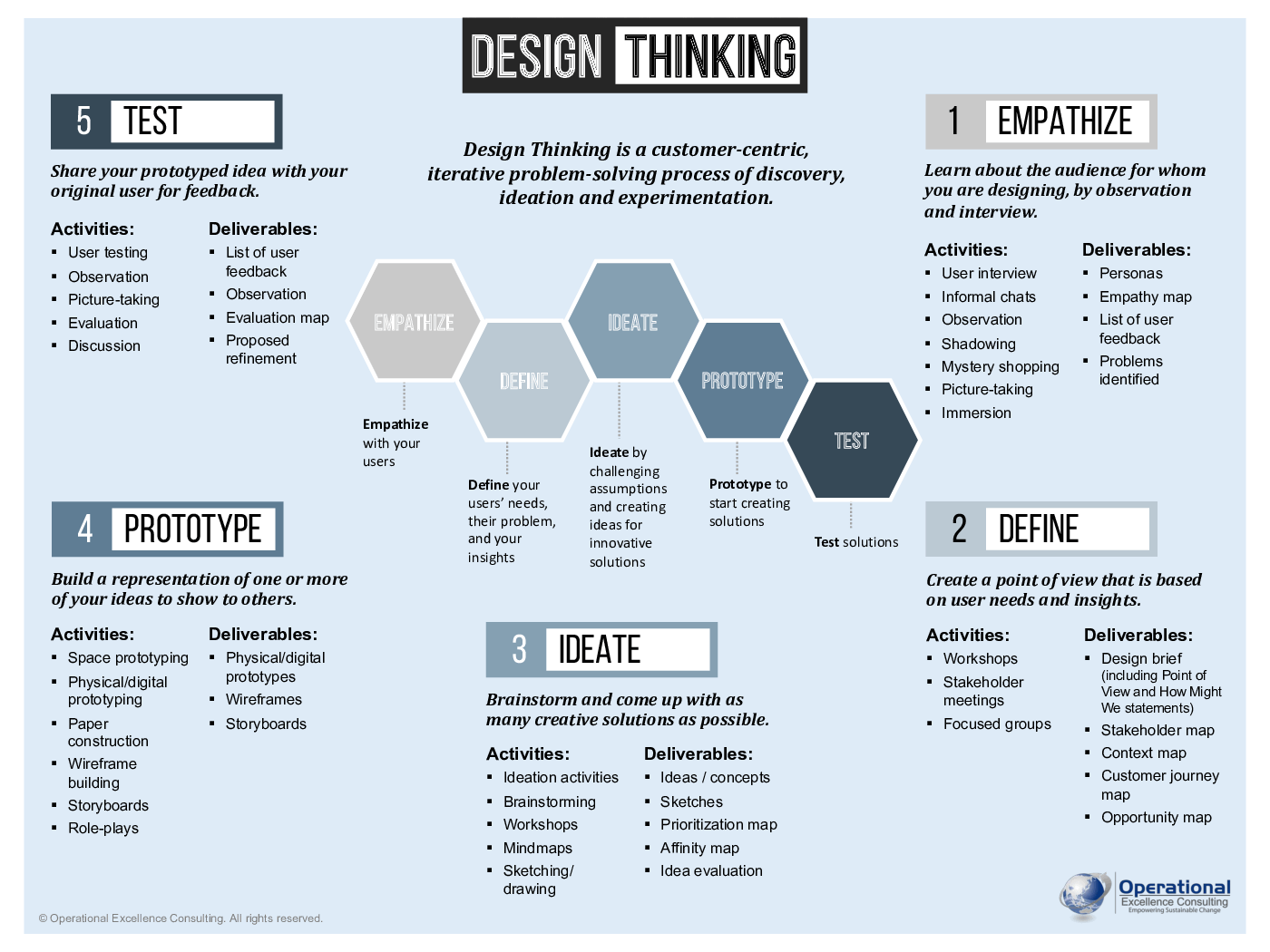
The Design Thinking Poster describes the five phases of creative problem-solving and innovation based on the Hasso Plattner Institute of Design (Stanford University) model.
The poster focuses on three key groups of information that are essential to Design Thinking practitioners:
• Phase objectives
• Phase activities
• Phase deliverables
Overall, the Design Thinking Poster is a useful tool for design thinking users who are looking for an easy-to-use reference guide to help them navigate through the five phases of the creative problem-solving and innovation process.
The Design Thinking Poster is available in two distinct themes: a vibrant color scheme and a professional monochrome version. In both formats, the poster comes in a convenient PDF as well as an editable PPTX format, enabling effortless printing on A3/A4-sized paper from standard office copier machines. This versatile resource can be prominently displayed on employee workstations or distributed alongside Design Thinking training materials.
Furthermore, the Design Thinking Poster is an ideal supplement to design-related training presentations. It serves as a valuable takeaway, summarizing the core principles of Design Thinking and reinforcing the key takeaways from your training.
Description of the Design Thinking Poster:
1. EMPATHIZE
Phase Objective: Learn about the audience for whom you are designing, by observation and interview.
Phase Activities:
• User interview
• Informal chats
• Observation
• Shadowing
• Mystery shopping
• Picture-taking
• Immersion
Phase Deliverables:
• Personas
• Empathy map
• List of user feedback
• Problems identified
2. DEFINE
Phase Objective: Create a point of view that is based on user needs and insights.
Phase Activities:
• Workshops
• Stakeholder meetings
• Focused groups
Phase Deliverables:
• Design brief (including Point of View and How Might We statements)
• Stakeholder map
• Context map
• Customer journey map
• Opportunity map
3. IDEATE
Phase Objective: Brainstorm and come up with as many creative solutions as possible.
Phase Activities:
• Ideation activities
• Brainstorming
• Workshops
• Mindmaps
• Sketching/drawing
Phase Deliverables:
• Ideas / concepts
• Sketches
• Prioritization map
• Affinity map
• Idea evaluation
4. PROTOTYPE
Phase Objective: Build a representation of one or more of your ideas to show to others.
Phase Activities:
• Space prototyping
• Physical/digital prototyping
• Paper construction
• Wireframe building
• Storyboards
• Role-plays
Phase Deliverables:
• Physical/digital prototypes
• Wireframes
• Storyboards
5. TEST
Phase Objective: Share your prototyped idea with your original user for feedback.
Phase Activities:
• User testing
• Observation
• Picture-taking
• Evaluation
• Discussion
Phase Deliverables:
• List of user feedback
• Observation
• Evaluation map
• Proposed refinement
The poster includes detailed visual aids that break down each phase into actionable steps, making it an indispensable tool for quick reference during workshops or brainstorming sessions. Designed with the busy executive in mind, it ensures that critical information is easily accessible, facilitating seamless integration into your strategic planning processes.
Got a question about the product? Email us at support@flevy.com or ask the author directly by using the "Ask the Author a Question" form. If you cannot view the preview above this document description, go here to view the large preview instead.
TOPIC FAQ
What are the 5 phases of Design Thinking and what does each phase focus on?
Design Thinking commonly follows Empathize, Define, Ideate, Prototype, and Test. Empathize focuses on user research; Define creates a point of view from insights; Ideate generates concepts; Prototype builds representations of ideas; Test gathers user feedback — covering 5 phases.What activities and deliverables are typical in the Empathize phase?
Empathize activities include user interviews, observation, shadowing, mystery shopping, picture-taking, and immersion. Typical deliverables are personas, an empathy map, lists of user feedback, and identified problems; these outputs anchor subsequent Define and Ideate work and include an empathy map.How should prototypes be used during design thinking workshops?
Prototypes should represent ideas for rapid validation with users. Activities include space prototyping, physical/digital builds, paper construction, wireframing, storyboards, and role-plays. Deliverables are physical or digital prototypes, wireframes, and storyboards to demonstrate concepts to users and stakeholders, such as wireframes.What should I look for when buying a design thinking reference poster for workshops?
Look for clear mapping of phase objectives, sample activities, and concrete deliverables; editable formats for customization and printing; and layout suited to workshop use. The Design Thinking Poster provides phase breakdowns and comes as a PDF plus editable PPTX for A3/A4 printing, including visual aids and phase details like a design brief.Are standalone posters and templates worth purchasing for design thinking training?
Posters serve as concise visual takeaways that summarize core principles and reinforce training content. As an example, Flevy's Design Thinking Poster is offered in PDF and editable PPTX formats and is sized for straightforward A3/A4 printing to distribute at workshops and training sessions.I need a quick checklist for running user tests — what should it include?
A user testing checklist should include defined test objectives, recruited users from the original research cohort, observation and picture-taking protocols, scripted evaluation tasks, discussion prompts, and a system to capture feedback and observations. Typical test outputs include a list of user feedback and an evaluation map.How can product teams use Design Thinking artifacts to prioritize features?
During Ideate and early product planning, teams can gather ideas, sketches, and affinity maps, then apply a prioritization map and idea evaluation criteria to rank concepts. Using these artifacts helps translate user insights into a prioritized backlog, anchored by a prioritization map.What file formats and visual styles are most useful for a workshop poster?
Useful workshop posters are available in both vibrant and monochrome themes and in editable formats that print cleanly on office copiers. The Design Thinking Poster is supplied as a PDF plus an editable PPTX and sized for A3/A4 printing in 2 themes.Source: Best Practices in Design Thinking PDF: Design Thinking Poster PDF (PDF) Document, Operational Excellence Consulting
ABOUT THE AUTHOR

Operational Excellence Consulting, founded in 2009 by Allan Ung, draws from extensive experience at Microsoft, IBM, and Underwriters Laboratories (UL). We specialize in strategy deployment, customer experience design, and operational excellence, applying Design Thinking, Lean, and Systems Thinking to maximize customer value and minimize waste.
Our
... [read more]
Ask the Author a Question
You must be logged in to contact the author.