 Click main image to view in full screen.
TSA Exit Cost Comparison Model – Excel XLSX
Excel (XLSX) + Zip archive file (ZIP)


BENEFITS OF THIS DOWNLOADABLE EXCEL DOCUMENT
- Compares baseline, early-exit and extension scenarios to show how TSA timing changes total cash requirements.
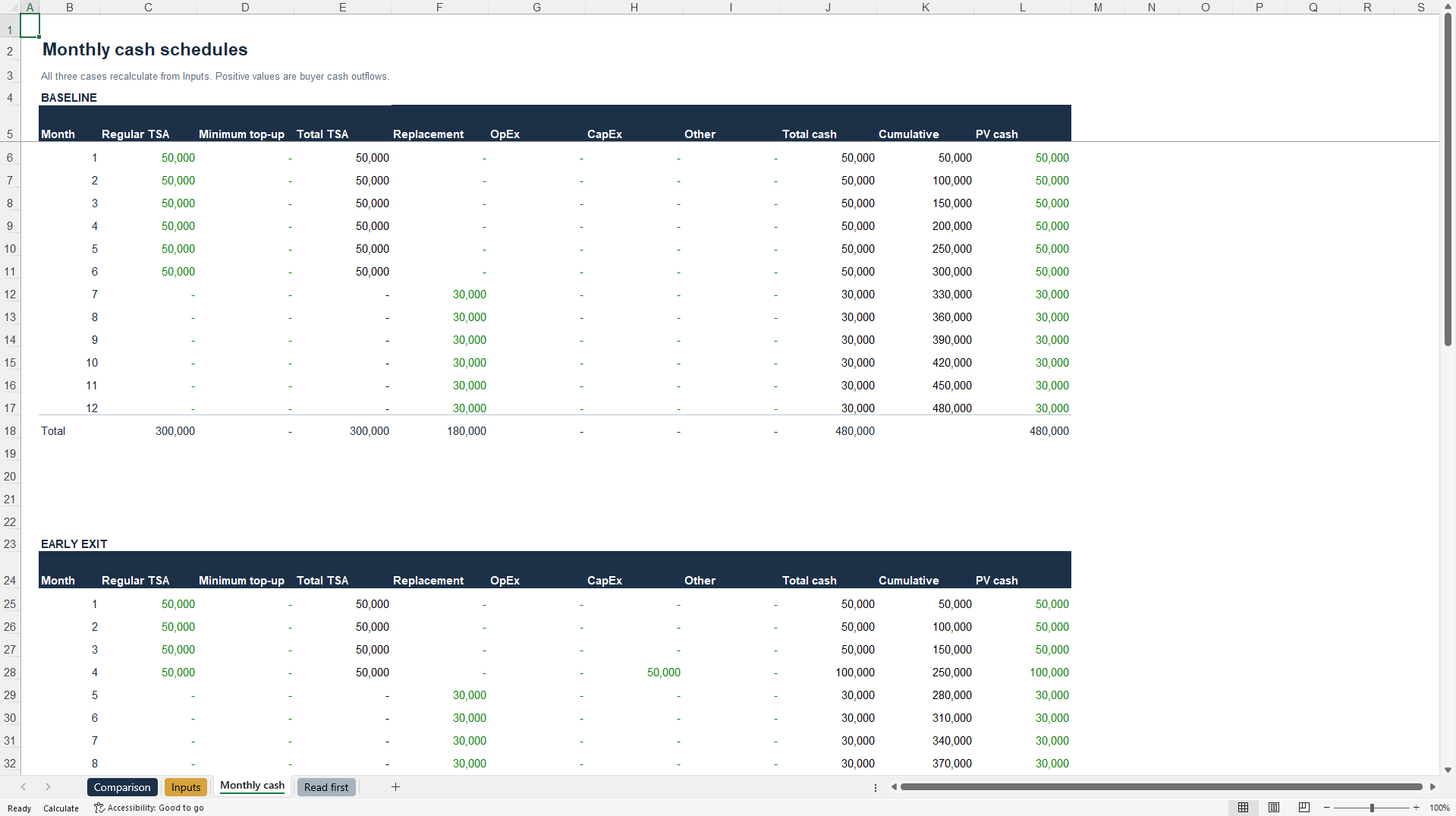
- Separates TSA fees, replacement costs and transition spending so users can trace the drivers of each scenario.
- Provides monthly cash schedules and present-value comparisons to support a more informed exit-cost discussion.
M&A (MERGERS & ACQUISITIONS) EXCEL DESCRIPTION
Does an earlier TSA exit actually reduce cash costs once replacement services and transition spending are included?
The TSA Exit Cost Comparison Model helps buyer-side finance and integration teams answer that question with a transparent, side-by-side comparison of baseline, early-exit and extension scenarios. It is designed for a focused review of one independent Transition Services Agreement service over a 12-month planning period.
An earlier exit can reduce TSA fees while bringing forward replacement costs and one-time transition spending. An extension can defer the transition while adding premium service charges. This model brings those cash effects into one consistent view so teams can discuss the trade-offs using the same assumptions and time horizon.
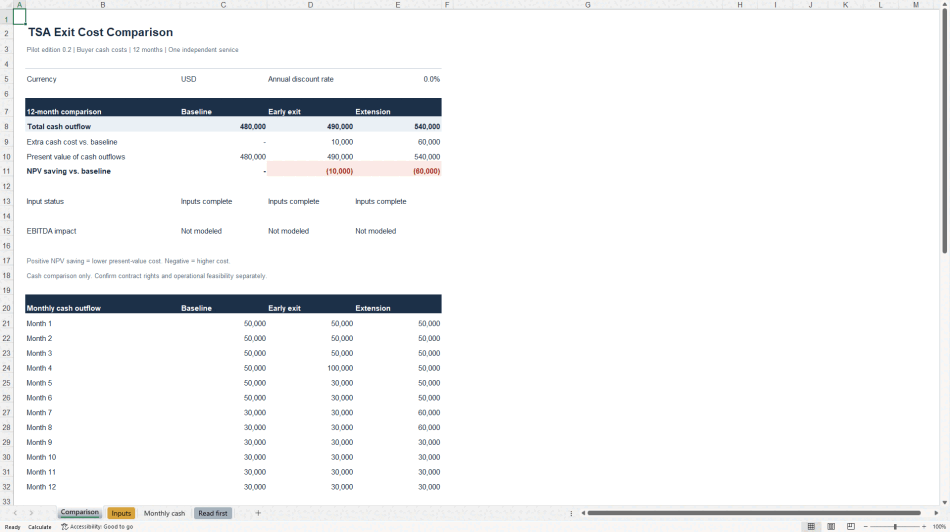
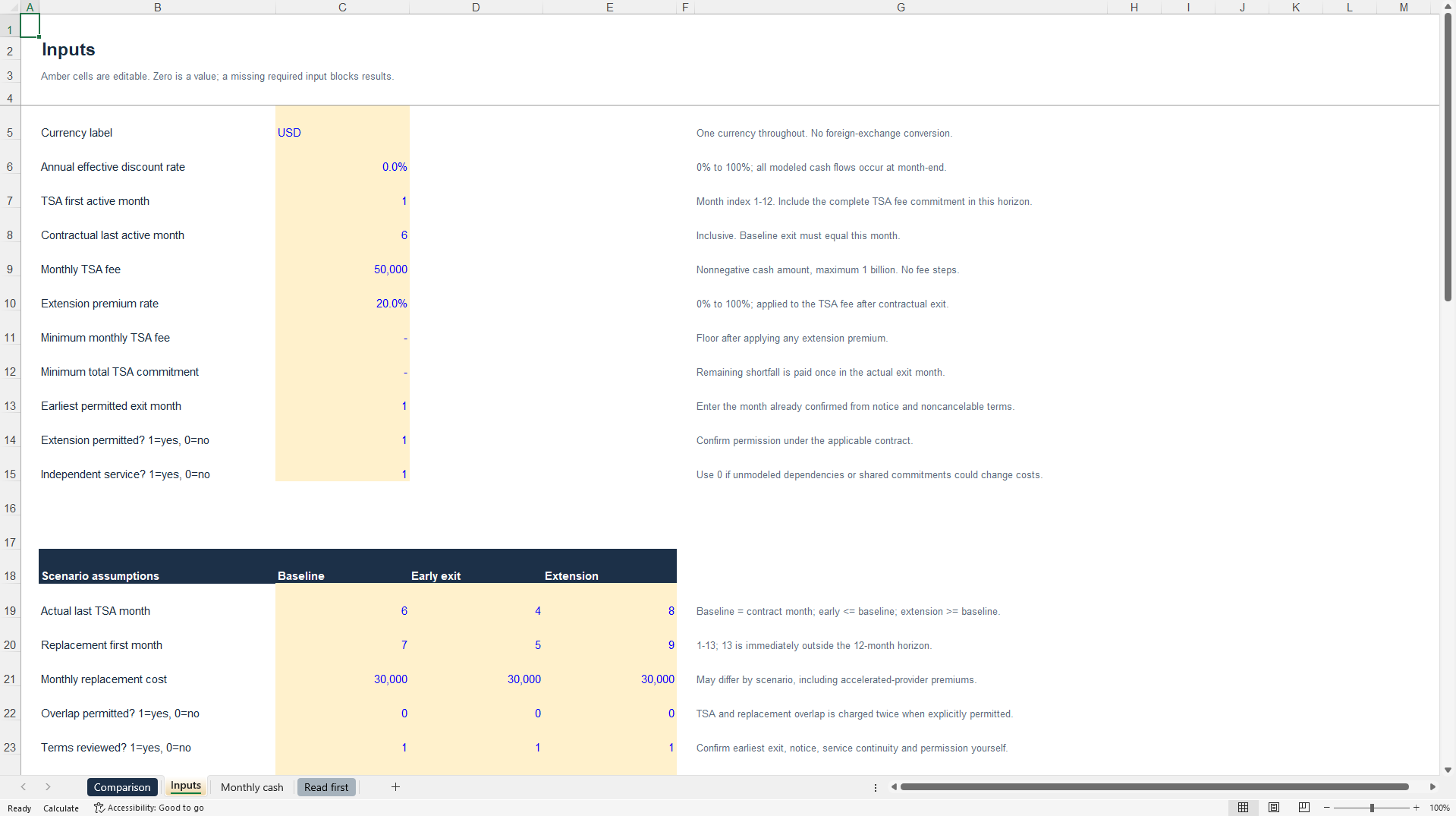
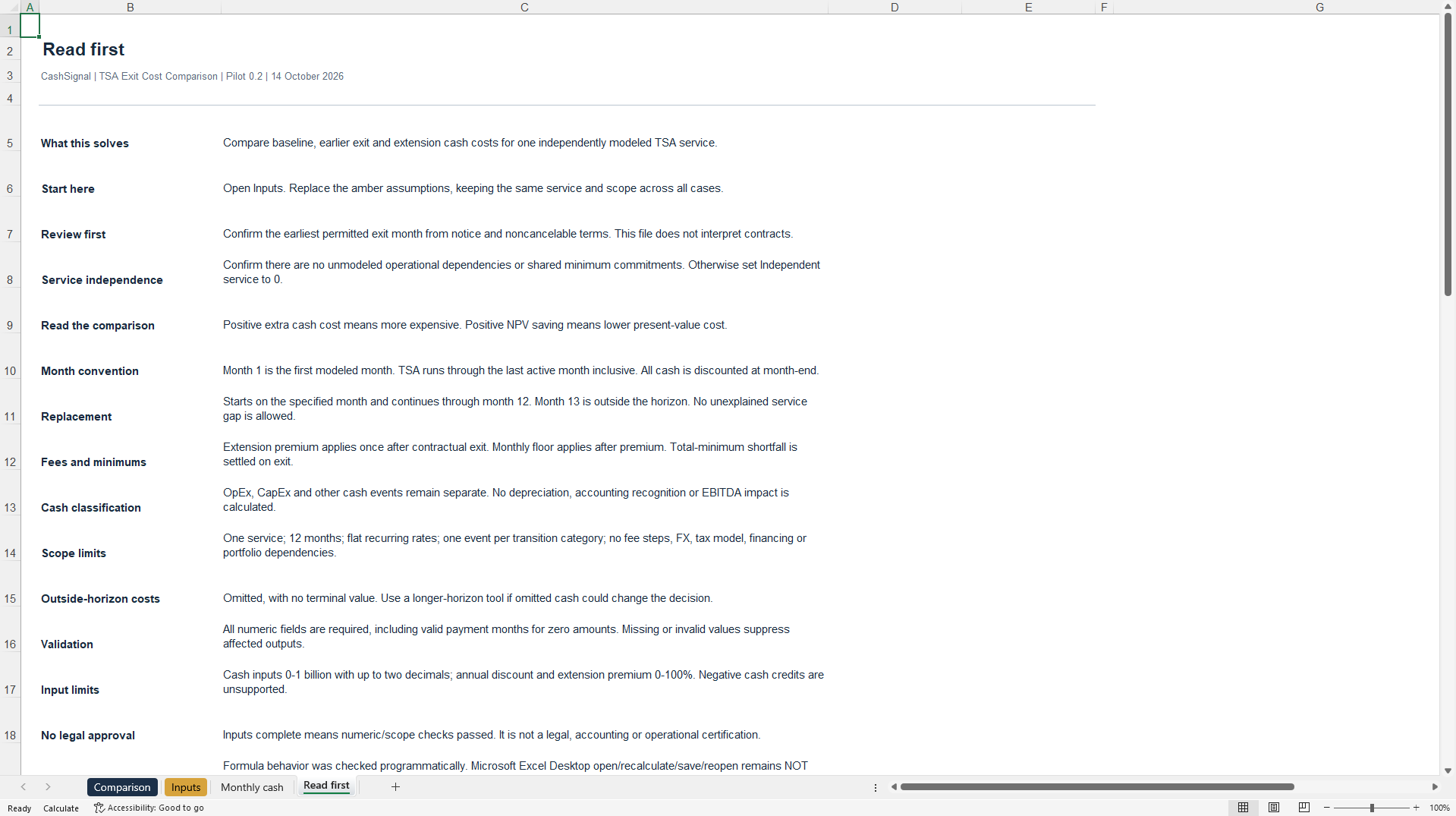
The Comparison worksheet presents total cash cost, present value, additional cash cost versus baseline and NPV savings versus baseline. The Inputs worksheet separates shared contractual assumptions from scenario-specific choices. The Monthly cash worksheet shows all three scenarios in detail, making it possible to trace a headline difference back to its monthly components. The Read first worksheet explains the conventions and boundaries of the model.
Users can vary exit timing, replacement-service timing and replacement cost by scenario. The model also incorporates an extension premium, a monthly TSA fee floor and a total minimum commitment. Separate fields capture a transition operating-cost payment, a CapEx payment and another cash payment for each scenario. Explicitly approved overlap includes both TSA and replacement costs; input checks flag unsupported gaps and missing assumptions.
The included synthetic example illustrates why an earlier exit is not automatically cheaper: baseline cash costs total USD 480,000, early-exit costs total USD 490,000 and extension costs total USD 540,000. These figures demonstrate the calculation structure and are not customer outcomes or promised savings. Replace the example with your own assumptions and retain the source of each assumption with your analysis.
Use the workbook to prepare an internal exit-cost discussion, compare a proposed timetable with the baseline or explain the cash consequences of an extension. Start with the amber input cells, resolve input warnings and review the monthly schedules before using the comparison. The workbook uses formulas without macros or external data connections. Confirm that changed inputs recalculate in your spreadsheet environment before relying on an output.
The primary download is an editable Excel workbook with four worksheets. The accompanying ZIP contains a three-page quick-start PDF, a readme and the product license. The guide explains the calculations, input conventions and review steps.
The model covers one independent service, flat recurring costs and a fixed 12-month horizon. It does not calculate notice deadlines, service dependencies, EBITDA, tax, foreign exchange or costs beyond that horizon. Users supply the contract-confirmed earliest permitted exit month and confirm operational feasibility. It supports financial analysis rather than providing legal interpretation or an automatic exit recommendation.
One purchase permits internal reuse within one organization at one location for up to 10 users. Static analysis outputs may be shared with clients and stakeholders. Redistribution or resale of the editable workbook, its formulas or derivative reusable templates is not permitted. These product-specific usage terms are included in the license. Support through Flevy covers file-operation questions and reproducible defects; bespoke modeling, deal reviews and guaranteed future updates are not included. Platform refund procedures and applicable mandatory rights apply.
Got a question about the product? Email us at support@flevy.com or ask the author directly by using the "Ask the Author a Question" form. If you cannot view the preview above this document description, go here to view the large preview instead.
Source: Best Practices in M&A (Mergers & Acquisitions), Post-merger Integration Excel: TSA Exit Cost Comparison Model Excel (XLSX) Spreadsheet, CashSignal Tools




























