
This framework is developed by a team of former McKinsey and Big 4 consultants. The presentation follows the headline-body-bumper slide format used by global consulting firms.
Editor Summary
The Internet of Things (IoT) Decision Framework is a 21-slide PowerPoint by LearnPPT Consulting that provides a structured approach to developing and improving IoT products.
Read moreIt maps 30 decision-point pairings between the IoT Technology Stack (Device Hardware, Device Software, Communications, Cloud Platform, Cloud Applications) and 6 decision areas (User Experience, Data, Business, Technology, Security, Standards and Regulations). Includes reusable slide templates and is sold as a digital download on Flevy with immediate digital download. Used by product managers, CTOs, UX designers, and compliance leads to align IoT decisions with Product, Digital Transformation, and Corporate Strategy.
Use this framework when your organization is designing or iterating an IoT product and needs to coordinate technical choices, user experience, data practices, security, and regulatory compliance before heavy investment.
Product Managers weighing device hardware/software trade-offs against product strategy and market requirements.
Chief Technology Officers evaluating cloud platform and communications options against security and scalability constraints.
UX Designers translating device constraints into user flows and interaction models across hardware and cloud applications.
Compliance or regulatory leads validating standards decisions against device, communications, and cloud components.
The framework’s prescribed sequential evaluation across decision areas and its iterative cycle reflect structured consulting decision approaches that reduce misalignment across the 5 technology layers and 6 decision areas.
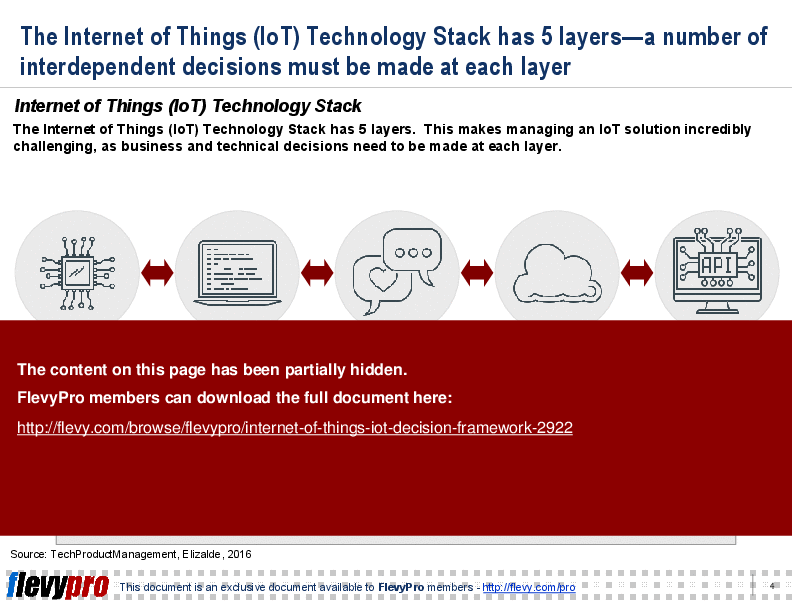
Internet of Things (IoT) products are more complex than typical products, since there a 5 layers of technology to consider, whereas other products may only have 2 or 3. With each additional layer, the complexity includes exponentially.
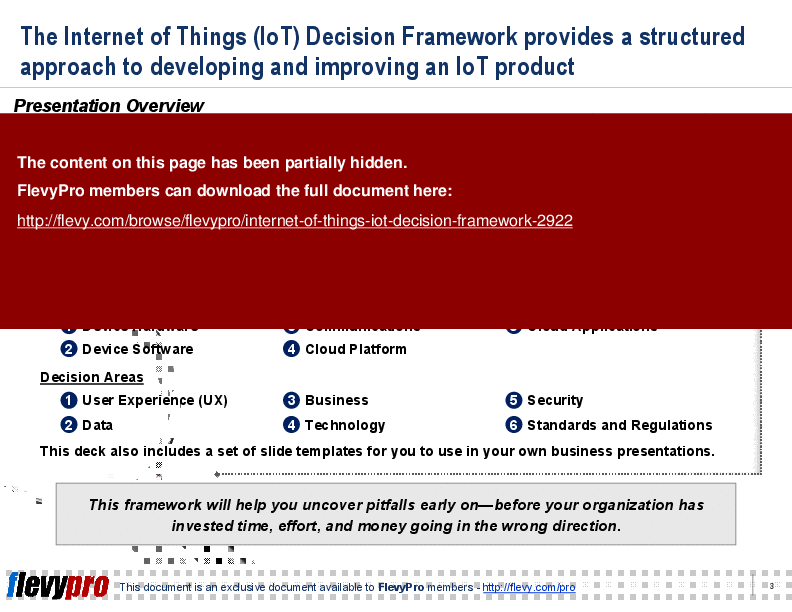
The IoT Decision Framework provides a structured approach to developing and improving an IoT product. It helps ensure all decisions are consistent and aligned with the Product Strategy, Digital Transformation Strategy, and overall Corporate Strategy.
Within the IoT Decision Framework, we 30 decision points pairings between the 5 layers of the IoT Technology Stack and 6 decision areas:
Decision Areas
1. User Experience (UX)
2. Data
3. Business
4. Technology
5. Security
6. Standards and Regulations
This framework will help you uncover pitfalls early on, before your organization has invested time, effort, and money going in the wrong direction.
This deck also includes a set of slide templates for you to use in your own business presentations.
The IoT Decision Framework also emphasizes the importance of evaluating each decision area in sequence, ensuring that decisions in one area inform and align with those in subsequent areas. This approach minimizes the risk of misalignment and ensures a cohesive strategy across the entire IoT Technology Stack. By leveraging this framework, your organization can systematically address all critical aspects of IoT product development, from user experience to compliance with standards and regulations.
The framework's iterative nature allows for continuous refinement and improvement. Once a complete evaluation cycle is finished, the process begins again, incorporating new insights and data. This iterative approach ensures that your IoT product remains adaptable and responsive to changing market conditions and technological advancements. The included slide templates facilitate clear communication of these complex processes in your business presentations.
What are the main technology layers teams must consider when building an IoT product?
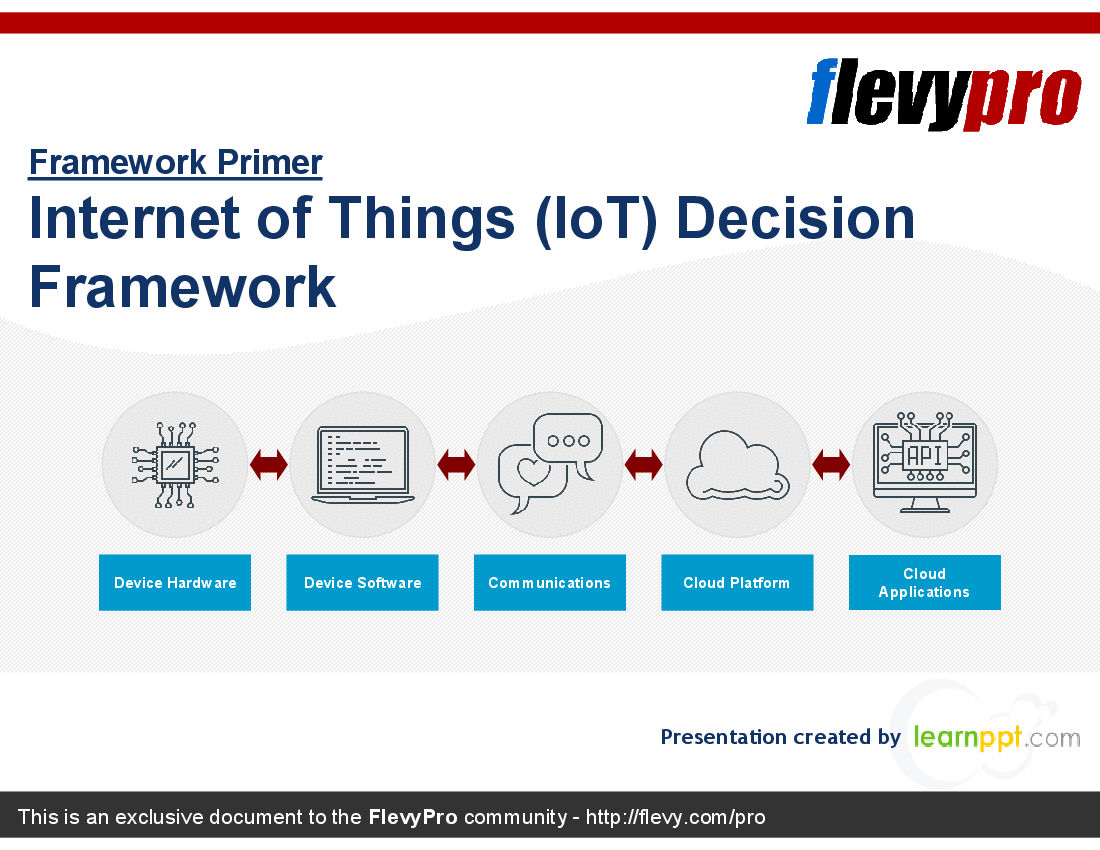
Designing an IoT product requires considering 5 technology layers: Device Hardware, Device Software, Communications, Cloud Platform, and Cloud Applications. Effective decisions should explicitly map requirements and trade-offs across these 5 layers to avoid downstream integration and alignment issues, covering the 5 layers.
Which decision areas typically affect IoT product choices?
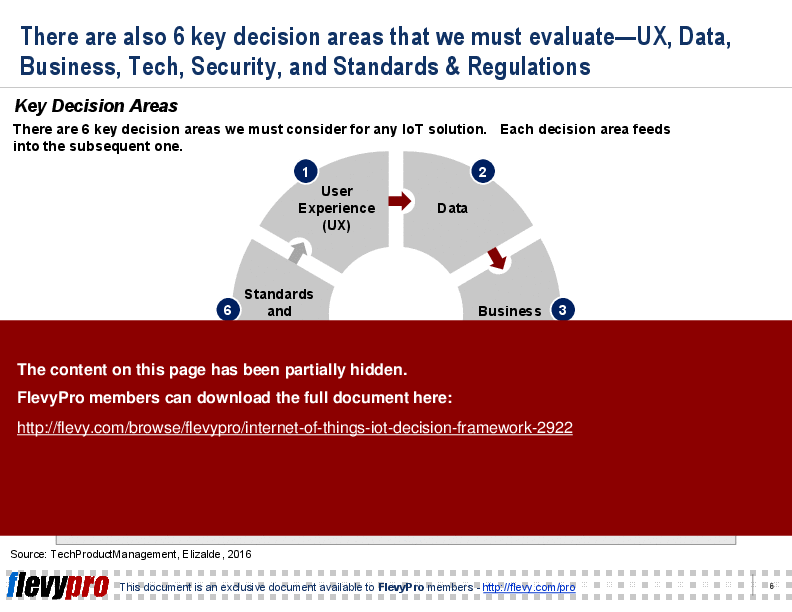
IoT decisions commonly span 6 areas: User Experience (UX), Data, Business, Technology, Security, and Standards & Regulations. Teams should assess each choice against these 6 areas to ensure consistency between technical design and market, legal, and operational constraints, covering the 6 decision areas.
How can teams identify and avoid early pitfalls in IoT development?
A structured decision framework that pairs technology layers with decision areas helps surface misalignments before major investment. Following a matrix of cross-layer decision points enables teams to uncover conflicting assumptions early; for example, using a 30 decision-point pairing approach between layers and areas.
How should decisions be sequenced when technical, business, and compliance needs conflict?
Sequence decisions so that outcomes in one decision area inform subsequent areas, minimizing misalignment. A recommended approach evaluates decision areas in order—such as UX, Data, Business, Technology, Security, Standards—to ensure coherence across the IoT stack and the 6 decision areas.
What should I look for in an IoT decision framework or toolkit before purchase?
Prioritize frameworks that explicitly link the IoT Technology Stack to decision areas, prescribe a sequential and iterative evaluation process, and include communication artifacts (like slide templates) to present findings. A toolkit that documents 5 technology layers and 6 decision areas plus templates addresses these needs.
How can I assess whether an IoT framework offers good value for a small product team?
Value derives from how well the framework reduces rework and misalignment: check for explicit cross-layer decision mappings, guidance on sequencing and iteration, and deliverables you can reuse in stakeholder communication. Practical coverage includes the 5 layers, 6 decision areas, and reusable slide templates.
I need to align IoT design decisions with our digital transformation goals—what process should we follow?
Use a structured evaluation that ties each technical decision to Product Strategy, Digital Transformation Strategy, and Corporate Strategy, ensuring sequential decisions across UX, Data, Business, Technology, Security, and Standards. Repeat the cycle iteratively to incorporate new insights, following the sequential and iterative approach.
What deliverables help communicate complex IoT decisions to executives and cross-functional teams?
Clear, templated presentation slides that map decisions across the IoT layers and decision areas help stakeholders understand trade-offs. Slide templates that illustrate the device-to-cloud stack paired with the 6 decision areas are useful for executive briefings and cross-functional alignment.
The IoT Decision Framework provides a structured approach for evaluating decision points across the IoT Technology Stack, encompassing 30 distinct decision points across 5 layers: Device Hardware, Device Software, Communications, Cloud Platform, and Cloud Applications. Key decision areas include User Experience (UX), Data, Business, Technology, Security, and Standards & Regulations, each sequentially numbered. This framework aids organizations in systematically addressing critical questions for effective IoT implementation, identifying gaps and opportunities. It allows for tailored decision-making methodologies based on organizational needs, promoting informed and strategic choices in IoT product development.
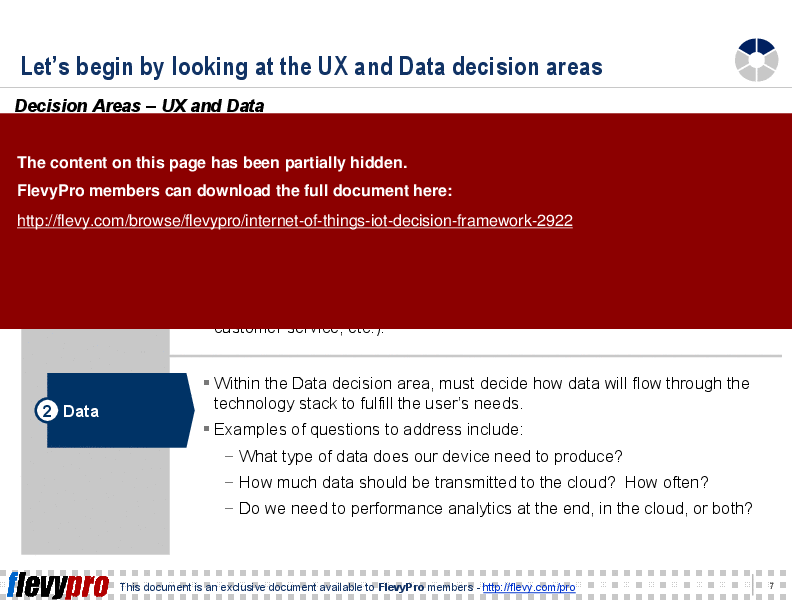
This PPT slide outlines 6 critical decision areas for evaluating Internet of Things (IoT) solutions: User Experience (UX), Data, Business, Technology, Security, and Standards and Regulations. UX focuses on end-user interaction, impacting adoption and satisfaction. Data encompasses collection, analysis, and ensuring relevance to business objectives. The Business area aligns the IoT solution with organizational goals for tangible benefits. Technology addresses implementation aspects, including infrastructure and integration. Security emphasizes protecting data and systems from threats, crucial amid rising data breach concerns. Standards and Regulations ensure compliance with legal requirements, mitigating risks. Each area must be evaluated across the IoT technology stack for a comprehensive strategy.
Source: Best Practices in Digital Transformation, Internet of Things PowerPoint Slides: Internet of Things (IoT) Decision Framework PowerPoint (PPT) Presentation Slide Deck, LearnPPT Consulting
This framework is developed by a team of former McKinsey and Big 4 consultants. The presentation follows the headline-body-bumper slide format used by global consulting firms.
For $10.00 more, you can download this document plus 2 more FlevyPro documents. That's just $13 each.
ABOUT FLEVYPRO
This document is part of the FlevyPro Library, a curated knowledge base of documents for our FlevyPro subscribers.
FlevyPro is a subscription service for on-demand business frameworks and analysis tools. FlevyPro subscribers receive access to an exclusive library of curated business documents—business framework primers, presentation templates, Lean Six Sigma tools, and more—among other exclusive benefits.
The average daily rate of a McKinsey consultant is $6,625 (not including expenses). The average price of a Flevy document is $65.
Trusted by over 10,000+ Client Organizations
Since 2012, we have provided business templates to over 10,000 businesses and organizations of all sizes, from startups and small businesses to the Fortune 100, in over 130 countries.
"[Flevy] produces some great work that has been/continues to be of immense help not only to myself, but as I seek to provide professional services to my clients, it gives me a large "tool box" of resources that are critical to provide them with the quality of service and outcomes they are expecting."
– Royston Knowles, Executive with 50+ Years of Board Level Experience
"As a small business owner, the resource material available from FlevyPro has proven to be invaluable. The ability to search for material on demand based our project events and client requirements was great for me and proved very beneficial to my clients. Importantly, being able to easily edit and tailor
the material for specific purposes helped us to make presentations, knowledge sharing, and toolkit development, which formed part of the overall program collateral. While FlevyPro contains resource material that any consultancy, project or delivery firm must have, it is an essential part of a small firm or independent consultant's toolbox.
"
– Michael Duff, Managing Director at Change Strategy (UK)
"Flevy is now a part of my business routine. I visit Flevy at least 3 times each month.
Flevy has become my preferred learning source, because what it provides is practical, current, and useful in this era where the business world is being rewritten.

many challenges and there is the need to make the right decisions in a short time, with so much scattered information, we are fortunate to have Flevy. Flevy investigates, selects, and puts at our disposal the best of the best to help us be successful in our work.
"
– Omar Hernán Montes Parra, CEO at Quantum SFE
"My FlevyPro subscription provides me with the most popular frameworks and decks in demand in today’s market. They not only augment my existing consulting and coaching offerings and delivery, but also keep me abreast of the latest trends, inspire new products and service offerings for my practice, and educate me
in a fraction of the time and money of other solutions. I strongly recommend FlevyPro to any consultant serious about success.
"
– Bill Branson, Founder at Strategic Business Architects
"As a niche strategic consulting firm, Flevy and FlevyPro frameworks and documents are an on-going reference to help us structure our findings and recommendations to our clients as well as improve their clarity, strength, and visual power. For us, it is an invaluable resource to increase our impact and value."
– David Coloma, Consulting Area Manager at Cynertia Consulting
"Flevy.com has proven to be an invaluable resource library to our Independent Management Consultancy, supporting and enabling us to better serve our enterprise clients.
The value derived from our [FlevyPro] subscription in terms of the business it has helped to gain far exceeds the investment made, making a subscription a no-brainer for any growing consultancy – or in-house strategy team."
– Dean Carlton, Chief Transformation Officer, Global Village Transformations Pty Ltd.
"I have used FlevyPro for several business applications. It is a great complement to working with expensive consultants. The quality and effectiveness of the tools are of the highest standards."
– Moritz Bernhoerster, Global Sourcing Director at Fortune 500
"As an Independent Management Consultant, I find Flevy to add great value as a source of best practices, templates and information on new trends. Flevy has matured and the quality and quantity of the library is excellent. Lastly the price charged is reasonable, creating a win-win value for
the customer, Flevy and the various authors. This is truly a service that benefits the consulting industry and associated clients. Thanks for providing this service.
Download our FREE Digital Transformation Templates
Download our free compilation of 50+ Digital Transformation slides and templates. DX concepts covered include Digital Leadership, Digital Maturity, Digital Value Chain, Customer Experience, Customer Journey, RPA, etc.