
Customer-centric Culture of Innovation   25-slide PPT PowerPoint presentation slide deck (PPT)
$29.00

Customer-centric Culture of Innovation (25-slide PPT PowerPoint presentation slide deck (PPT)) Preview Image
Log in to unlock full preview.
Customer-centric Culture of Innovation (25-slide PPT PowerPoint presentation slide deck (PPT)) Preview Image
Arrow   Click main image to view in full screen.

Customer-centric Culture of Innovation (PowerPoint PPT Slide Deck)

PowerPoint (PPT) 25 Slides FlevyPro Document

$29.00
FlevyPro price: FREE (included in subscription)
This framework is developed by a team of former McKinsey and Big 4 consultants. The presentation follows the headline-body-bumper slide format used by global consulting firms.
Add to Cart


Immediate download
Free lifetime updates

CUSTOMER-CENTRICITY PPT DESCRIPTION

Editor Summary Customer-centric Culture of Innovation is a 25-slide PowerPoint presentation developed by LearnPPT Consulting and former consultants from McKinsey and the Big 4, presenting a three-phase framework: Qualitative Insights, Quantitative Insights, and Implementation. Read more

A large majority of organizations rarely focus on gathering and utilizing customer-centric knowledge. So much so that they even introduce a product without having vital insights on the customer and their unmet needs, and they are often clueless about them. Consequently, many product development initiatives fall flat as managers struggle to filter and evaluate ideas.

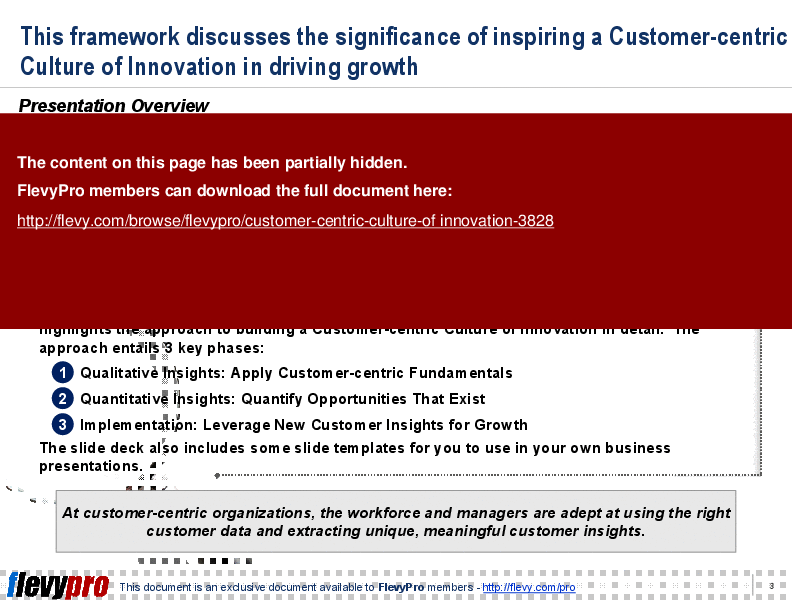
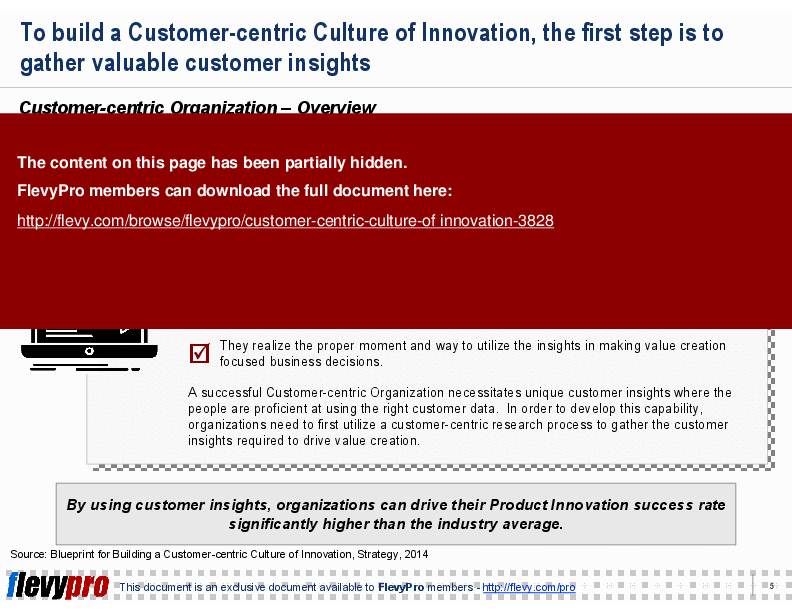
Customer-centric organizations are deeply focused towards value creation for their customers. They understand the unique customer insights needed to make customer-centric decisions, are able to gather those customer insights, and are aware of the way to utilize the insights in creating value for their customers. At customer-centric organizations, the workforce and managers are adept at using the right customer data and extracting unique, meaningful customer insights.

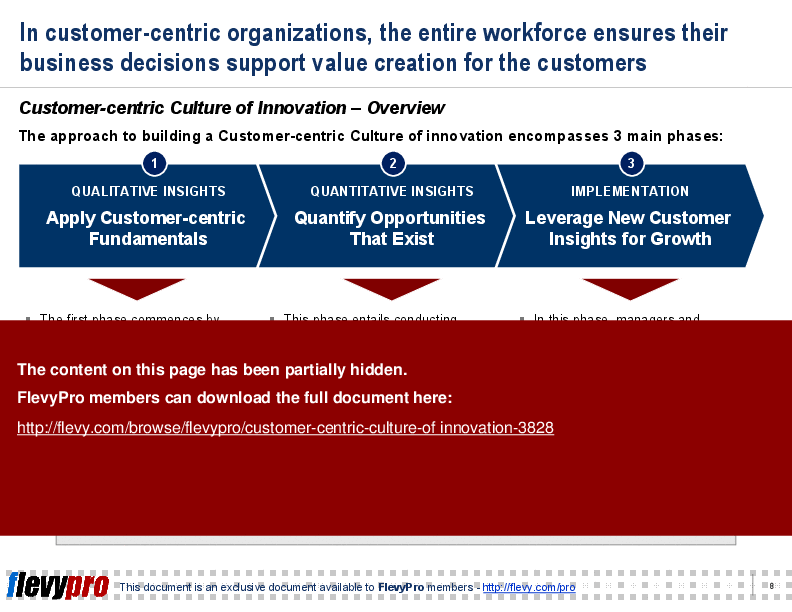
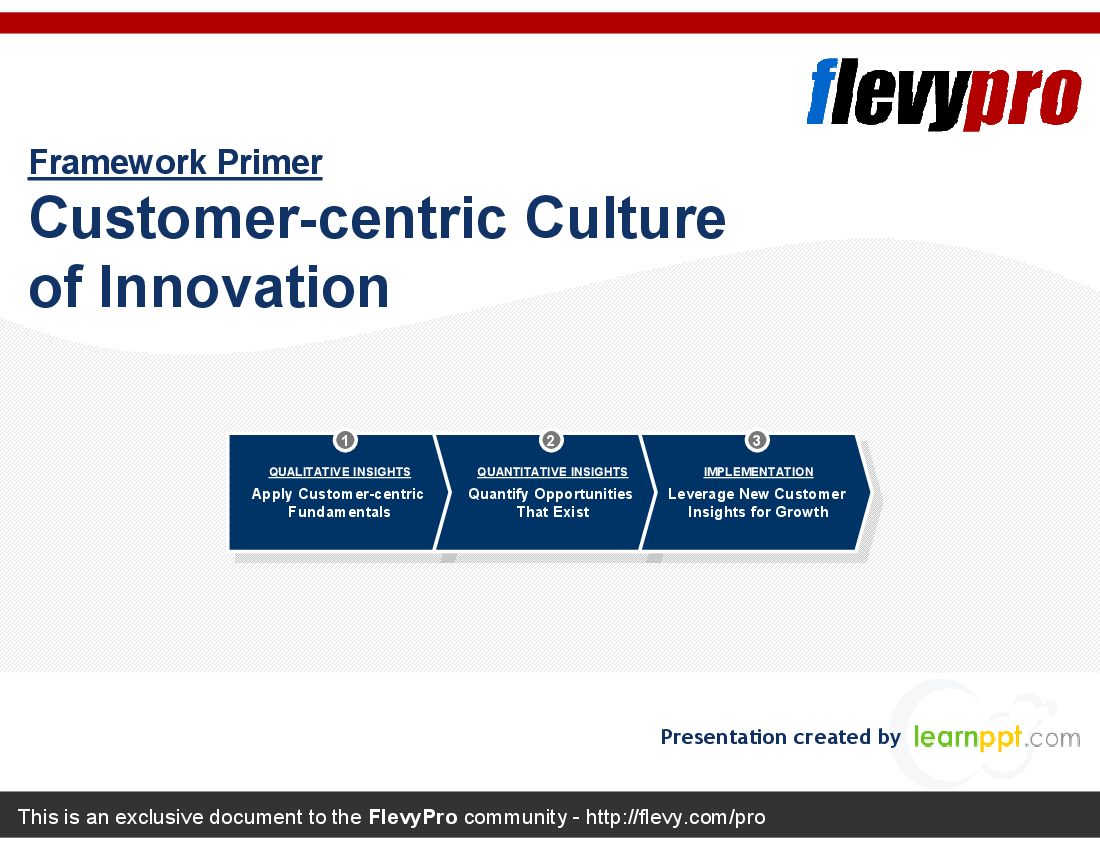
In order to develop this capability, organizations need to first utilize a customer-centric research process to gather the customer insights required to drive value creation. This presentation highlights the approach to building a Customer-centric Culture of Innovation in detail. The approach entails 3 key phases:

1. Qualitative Insights: Apply Customer-centric Fundamentals
2. Quantitative Insights: Quantify Opportunities That Exist
3. Implementation: Leverage New Customer Insights for Growth

The slide deck also includes some slide templates for you to use in your own business presentations.

This PPT provides a comprehensive framework for developing a customer-centric culture of innovation. It emphasizes the importance of gathering qualitative and quantitative insights to drive strategic decisions. The three-phase approach ensures that teams are equipped with the necessary tools and knowledge to leverage customer data effectively. The presentation also includes practical templates to aid in the implementation of these strategies, making it a valuable resource for any organization looking to enhance its innovation capabilities.

Got a question about this document? Email us at flevypro@flevy.com.

MARCUS OVERVIEW

This synopsis was written by Marcus [?] based on the analysis of the full 25-slide presentation.


Executive Summary
The "Customer-centric Culture of Innovation" presentation provides a structured approach for organizations aiming to enhance their innovation capabilities through a customer-focused lens. Developed by former consultants from McKinsey and the Big 4, this presentation outlines a three-phase framework that emphasizes the importance of gathering and utilizing customer insights to drive product innovation and business growth. By implementing this framework, organizations can significantly improve their product development success rates and foster a culture that prioritizes customer value.

Who This Is For and When to Use
•  Product Managers seeking to align product development with customer needs
•  Marketing Teams focused on enhancing customer engagement and satisfaction
•  Innovation Leaders tasked with driving organizational change towards customer-centricity
•  Executive Teams aiming to integrate customer insights into strategic decision-making

Best-fit moments to use this deck:
•  During strategic planning sessions to align innovation initiatives with customer insights
•  In workshops aimed at fostering a customer-centric mindset across teams
•  When launching new products or services that require deep customer understanding

Learning Objectives
•  Define the principles of a customer-centric culture and its impact on innovation
•  Apply qualitative insights to identify customer needs and preferences
•  Conduct quantitative research to validate customer insights and market opportunities
•  Implement strategies to leverage customer insights for product development and marketing
•  Foster a collaborative environment that encourages cross-functional teams to prioritize customer value
•  Develop actionable plans that integrate customer feedback into the innovation process

Table of Contents
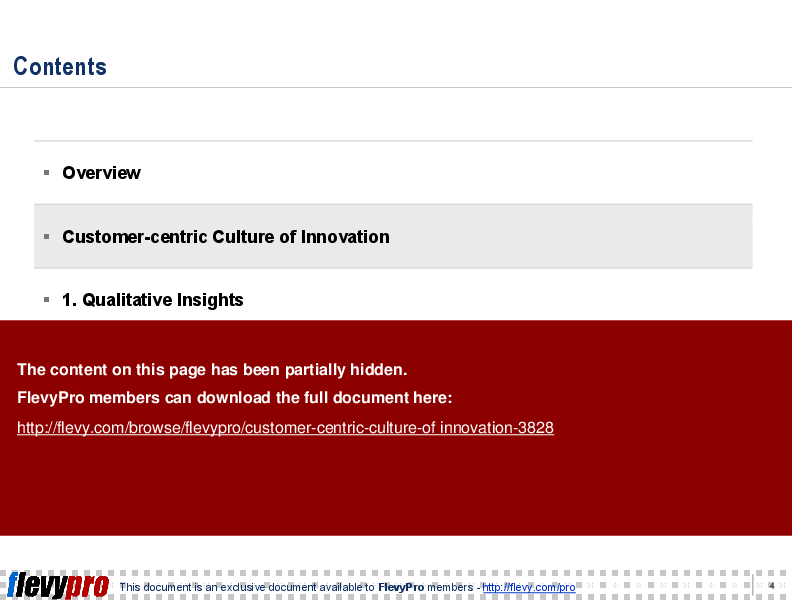
•  Overview (page 3)
•  Customer-centric Culture of Innovation (page 3)
•  1. Qualitative Insights (page 10)
•  2. Quantitative Insights (page 13)
•  3. Implementation (page 16)
•  Templates (page 19)

Primary Topics Covered
•  Qualitative Insights - This phase focuses on applying customer-centric fundamentals through workshops that engage cross-functional teams in identifying critical customer insights.
•  Quantitative Insights - In this phase, teams conduct research to quantify customer needs and market opportunities, enabling data-driven decision-making.
•  Implementation - This phase emphasizes leveraging gathered insights to develop strategies that enhance customer engagement and drive innovation.

Deliverables, Templates, and Tools
•  Workshop facilitation guide for conducting customer-centric training sessions
•  Customer journey mapping template to visualize customer experiences and needs
•  Survey questionnaire template for gathering quantitative customer data
•  Market analysis framework for evaluating product positioning and opportunities
•  Action plan template for integrating customer insights into product development
•  Communication strategy template for aligning marketing messages with customer needs

Slide Highlights
•  Overview of the Customer-centric Culture of Innovation framework
•  Visual representation of the 3 phases: Qualitative Insights, Quantitative Insights, and Implementation
•  Case studies showcasing successful customer-centric initiatives
•  Charts illustrating the impact of customer insights on product development success rates
•  Templates for workshop facilitation and customer journey mapping

Potential Workshop Agenda
Customer-Centric Workshop (4 hours)
•  Introduction to customer-centric principles and their importance
•  Group activities to identify customer needs using qualitative insights
•  Presentation of quantitative research methodologies and data analysis

Implementation Planning Session (2 hours)
•  Review of insights gathered from previous phases
•  Development of actionable strategies for product and marketing initiatives
•  Assignment of responsibilities and timelines for implementation

Customization Guidance
•  Tailor workshop content to reflect specific industry challenges and customer segments
•  Adjust survey questions to align with organizational goals and product offerings
•  Incorporate company-specific case studies to enhance relevance and engagement

Secondary Topics Covered
•  The role of cross-functional teams in fostering innovation
•  Techniques for effectively gathering and analyzing customer feedback
•  Strategies for maintaining a customer-centric culture over time
•  Best practices for integrating customer insights into strategic planning

Topic FAQ

What are the core phases of a customer-centric innovation process I should follow?

A common structured process starts with Qualitative Insights to surface customer needs, moves to Quantitative Insights to validate and size opportunities, and ends with Implementation to convert insights into product and go-to-market plans. The Customer-centric Culture of Innovation presentation uses these 3 phases: Qualitative Insights, Quantitative Insights, Implementation.

How do qualitative research methods inform product decisions?

Qualitative methods uncover unmet needs, behaviors, and preferences through interviews, workshops, and journey-mapping exercises, which help teams generate hypotheses and design features aligned with real customer problems. The deck emphasizes applying customer-centric fundamentals via workshops and a customer journey mapping template.

Which quantitative techniques are effective for validating customer insights?

Surveys and statistical data analysis are used to quantify customer preferences and market opportunity, providing statistically grounded evidence to prioritize features and segments. The presentation specifically includes a survey questionnaire template and a market analysis framework for quantitative validation.

How should cross-functional teams use workshops to embed customer focus?

Cross-functional workshops guided by a facilitation playbook help participants align on customer insights, map journeys, and translate needs into action items and responsibilities. The product lists a workshop facilitation guide and a customer journey mapping template to support these activities.

What should I look for when choosing a customer-centric innovation toolkit or deck?

Prioritize materials that cover discovery, validation, and implementation phases and include actionable templates for workshops, journey mapping, surveys, market analysis, and action planning. Flevy's Customer-centric Culture of Innovation provides those elements, including workshop and survey templates.

How much time should I budget for running the workshops and planning sessions described?

The sample agendas in the presentation suggest a 4-hour customer-centric workshop for qualitative activities and a 2-hour implementation planning session to review insights and assign actions, implying a short-series approach to initial capability building.

What practical value do ready-made templates deliver compared with building materials from scratch?

Ready-made templates provide structured formats for common activities—facilitating workshops, mapping journeys, drafting surveys, analyzing markets, and creating action plans—which teams can tailor to industry specifics. The deck supplies a workshop facilitation guide, journey map, survey questionnaire, market analysis framework, and action plan template.

I have little customer data and must launch a new product — what sequence of activities should I follow?

Begin with qualitative discovery via workshops and journey mapping to identify unmet needs, then field quantitative surveys and market analysis to validate and size opportunities, and conclude with implementation planning to assign owners and timelines. The presentation recommends this three-step sequence: Qualitative, Quantitative, Implementation.

Document FAQ
These are questions addressed within this presentation.

What is a customer-centric culture?
A customer-centric culture prioritizes understanding and addressing customer needs in all business decisions, driving innovation and value creation.

How can qualitative insights improve product development?
Qualitative insights help teams identify customer needs and preferences, leading to more relevant and successful product offerings.

What methods are used to gather quantitative insights?
Quantitative insights are typically gathered through surveys and data analysis, providing statistically valid information on customer preferences and market opportunities.

How can organizations implement customer insights effectively?
Organizations can implement customer insights by developing clear action plans, training teams on data utilization, and fostering a culture that values customer feedback.

What tools are included in the presentation?
The presentation includes templates for workshops, customer journey mapping, survey questionnaires, and action plans for integrating insights into product development.

How does this framework support innovation?
This framework supports innovation by ensuring that product development is aligned with actual customer needs, thereby increasing the likelihood of success.

Can this framework be customized for specific industries?
Yes, the framework can be tailored to address the unique challenges and customer segments of different industries.

What outcomes can organizations expect from adopting this framework?
Organizations can expect improved product success rates, enhanced customer satisfaction, and a more collaborative and innovative organizational culture.

Glossary
•  Customer-centric Culture - An organizational mindset that prioritizes customer needs in decision-making.
•  Qualitative Insights - Non-numerical data gathered through methods like interviews and focus groups to understand customer behaviors and preferences.
•  Quantitative Insights - Numerical data collected through surveys and statistical analysis to identify trends and patterns in customer behavior.
•  Customer Journey Mapping - A visual representation of the customer experience across various touchpoints.
•  Market Analysis - The process of assessing market conditions to inform business decisions.
•  Action Plan - A detailed strategy outlining steps to achieve specific goals based on customer insights.
•  Workshop Facilitation - The process of guiding a group through discussions and activities to achieve specific outcomes.
•  Survey Questionnaire - A structured set of questions designed to gather quantitative data from customers.
•  Cross-functional Teams - Groups composed of members from different departments working together towards a common goal.
•  Customer Feedback - Information provided by customers regarding their experiences and satisfaction with products or services.
•  Innovation Strategy - A plan that outlines how an organization will foster and implement new ideas and improvements.
•  Data Analysis - The process of inspecting, cleansing, and modeling data to discover useful information.

CUSTOMER-CENTRICITY PPT SLIDES

Phase 2: Customer Data Collection and Analysis

Framework for Building a Customer-Centric Culture

Core Elements and Phases of Innovation Management

Transformative Shift in Team Customer-Centric Thinking

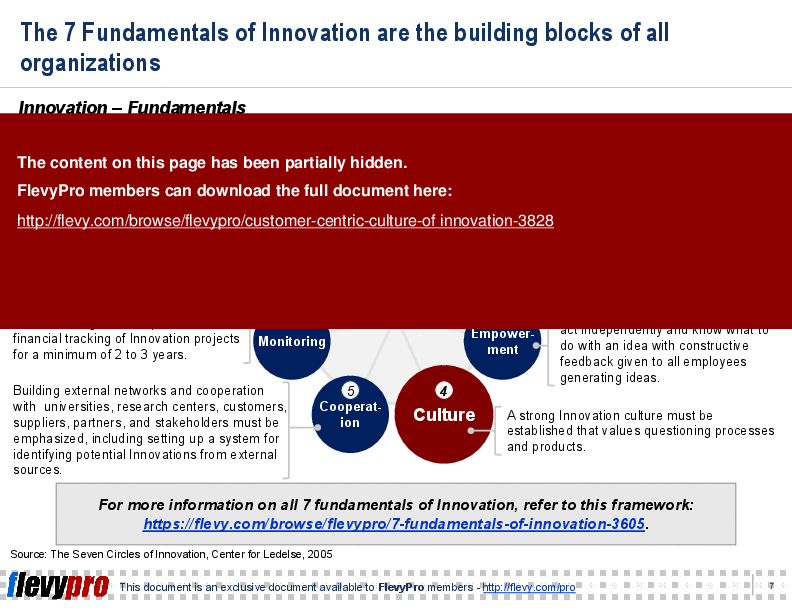
Essential Building Blocks for Organizational Innovation

Source: Best Practices in Corporate Culture, Innovation, Customer-centric Organization PowerPoint Slides: Customer-centric Culture of Innovation PowerPoint (PPT) Presentation Slide Deck, LearnPPT Consulting


$29.00
FlevyPro price: FREE (included in subscription)
This framework is developed by a team of former McKinsey and Big 4 consultants. The presentation follows the headline-body-bumper slide format used by global consulting firms.
Add to Cart
  

Did you need more documents?

Consider a FlevyPro subscription from $39/month. View plans here.

For $10.00 more, you can download this document plus 2 more FlevyPro documents. That's just $13 each.

ABOUT FLEVYPRO

This document is part of the FlevyPro Library, a curated knowledge base of documents for our FlevyPro subscribers.

FlevyPro is a subscription service for on-demand business frameworks and analysis tools. FlevyPro subscribers receive access to an exclusive library of curated business documents—business framework primers, presentation templates, Lean Six Sigma tools, and more—among other exclusive benefits.

Click here to learn more about FlevyPro and its benefits.

Did you know?
The average daily rate of a McKinsey consultant is $6,625 (not including expenses). The average price of a Flevy document is $65.


Trusted by over 10,000+ Client Organizations
Since 2012, we have provided business templates to over 10,000 businesses and organizations of all sizes, from startups and small businesses to the Fortune 100, in over 130 countries.
AT&T GE Cisco Intel IBM Coke Dell Toyota HP Nike Samsung Microsoft Astrazeneca JP Morgan KPMG Walgreens Walmart 3M Kaiser Oracle SAP Google E&Y Volvo Bosch Merck Fedex Shell Amgen Eli Lilly Roche AIG Abbott Amazon PwC T-Mobile Broadcom Bayer Pearson Titleist ConEd Pfizer NTT Data Schwab


Read Customer Testimonials

 
"As a consulting firm, we had been creating subject matter training materials for our people and found the excellent materials on Flevy, which saved us 100's of hours of re-creating what already exists on the Flevy materials we purchased."

– Michael Evans, Managing Director at Newport LLC
 
"My FlevyPro subscription provides me with the most popular frameworks and decks in demand in today’s market. They not only augment my existing consulting and coaching offerings and delivery, but also keep me abreast of the latest trends, inspire new products and service offerings for my practice, and educate me "

– Bill Branson, Founder at Strategic Business Architects
 
"I have found Flevy to be an amazing resource and library of useful presentations for lean sigma, change management and so many other topics. This has reduced the time I need to spend on preparing for my performance consultation. The library is easily accessible and updates are regularly provided. A wealth of great information."

– Cynthia Howard RN, PhD, Executive Coach at Ei Leadership
 
"I have used FlevyPro for several business applications. It is a great complement to working with expensive consultants. The quality and effectiveness of the tools are of the highest standards."

– Moritz Bernhoerster, Global Sourcing Director at Fortune 500
 
"[Flevy] produces some great work that has been/continues to be of immense help not only to myself, but as I seek to provide professional services to my clients, it gives me a large "tool box" of resources that are critical to provide them with the quality of service and outcomes they are expecting."

– Royston Knowles, Executive with 50+ Years of Board Level Experience
 
"As a consultant requiring up to date and professional material that will be of value and use to my clients, I find Flevy a very reliable resource.

The variety and quality of material available through Flevy offers a very useful and commanding source for information. Using Flevy saves me time, enhances my expertise and ends up being a good decision."

– Dennis Gershowitz, Principal at DG Associates
 
"I am extremely grateful for the proactiveness and eagerness to help and I would gladly recommend the Flevy team if you are looking for data and toolkits to help you work through business solutions."

– Trevor Booth, Partner, Fast Forward Consulting
 
"If you are looking for great resources to save time with your business presentations, Flevy is truly a value-added resource. Flevy has done all the work for you and we will continue to utilize Flevy as a source to extract up-to-date information and data for our virtual and onsite presentations!"

– Debbi Saffo, President at The NiKhar Group


Customers Also Bought These Documents


Customers Also Like These Documents

Explore Templates on Related Management Topics


Your Recently Viewed Documents
Download our FREE Digital Transformation Templates

Download our free compilation of 50+ Digital Transformation slides and templates. DX concepts covered include Digital Leadership, Digital Maturity, Digital Value Chain, Customer Experience, Customer Journey, RPA, etc.