Your AI assistant becomes a Flevy-powered consultant, with direct access to our full library of frameworks, templates, and case studies. Free to connect. No account, sign-in, or API key required.
STEP 1 · CHOOSE YOUR ASSISTANT
STEP 2 · CONNECT
1
Copy the Flevy MCP URL below.
2
Open the Claude connector settings and choose Add Custom Connector. Paste the URL and name it Flevy.
This framework is developed by a team of former McKinsey and Big 4 consultants. The presentation follows the headline-body-bumper slide format used by global consulting firms.
Editor Summary
4 Schools of Strategy is a 28-slide PowerPoint (PPTX) by LearnPPT Consulting that categorizes corporate and business strategy frameworks into 4 schools: Position (competitive strategy), Execution (operational excellence), Adaption (organizational learning), and Concentration (core competencies/strategic intent).
Read moreThe deck reviews established tools such as the BCG Experience Curve, Porter’s Five Forces, and Capabilities-Driven Strategy, and references Six Sigma, Lean, Mintzberg, Tom Peters, Gary Hamel, and C.K. Prahalad. Sold as a digital download on Flevy for executives and strategy practitioners to integrate multiple frameworks.
Use this deck when an organization needs to reconcile different strategic approaches—market positioning, operations, learning, and capability focus—into a coherent corporate or business strategy.
Corporate strategists mapping market attractiveness and competitive forces using Porter's Five Forces to select favorable markets.
Operations leaders designing process and people alignment programs using Six Sigma or Lean for Execution-focused initiatives.
Strategy consultants facilitating workshops to define core competencies and strategic intent referencing Hamel and Prahalad.
Transformation leads building organizational learning pilots informed by the Adaption School and Mintzberg/Peters insights.
The framework’s synthesis of positioning, operational alignment, adaptive learning, and capability focus mirrors standard strategic practice emphasizing market analysis, process excellence, and capability-led strategy.
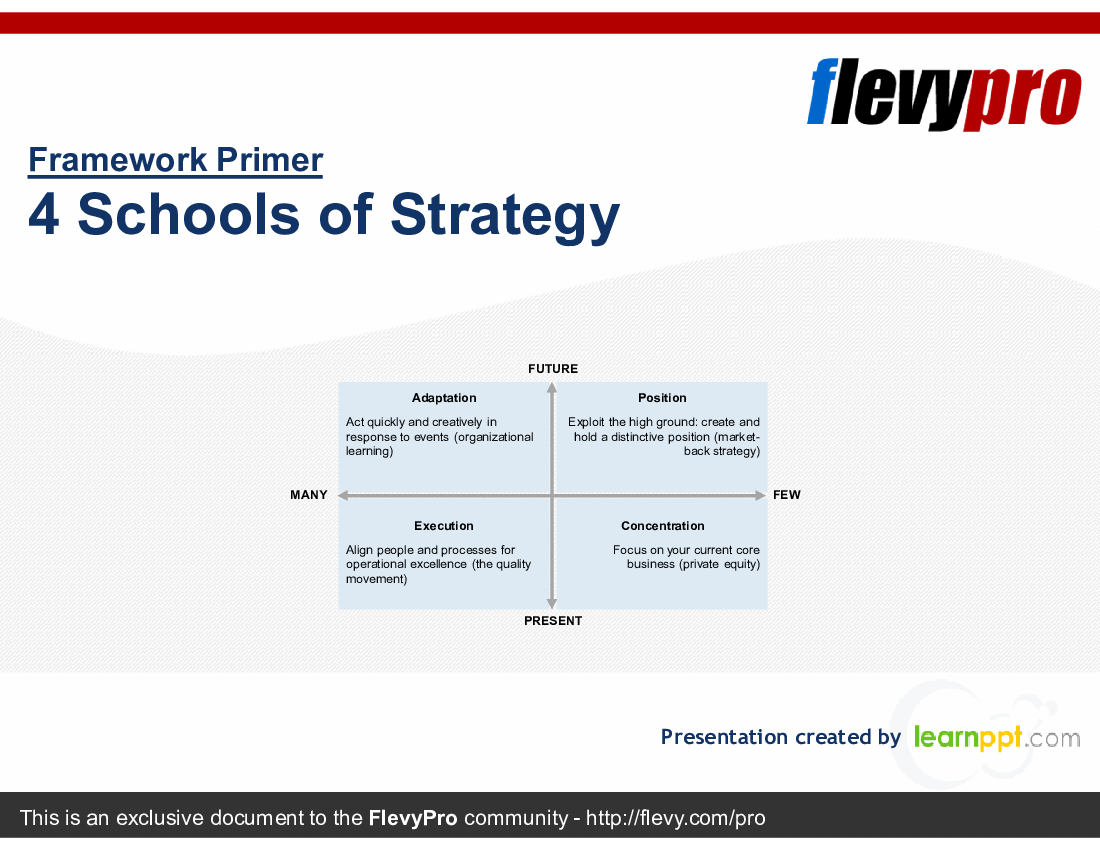
There are countless business frameworks on Corporate and Business Strategy that have developed over the years. The frameworks can be categorized into 4 schools of thought—i.e. 4 Schools of Strategy:
1. Position School, which focuses on Competitive Strategy
2. Execution School, which focuses on Operational Excellence
3. Adaption School, which focuses on Organizational Learning and Experimentation
4. Concentration School, which focuses on Core Competencies and Strategic Intent
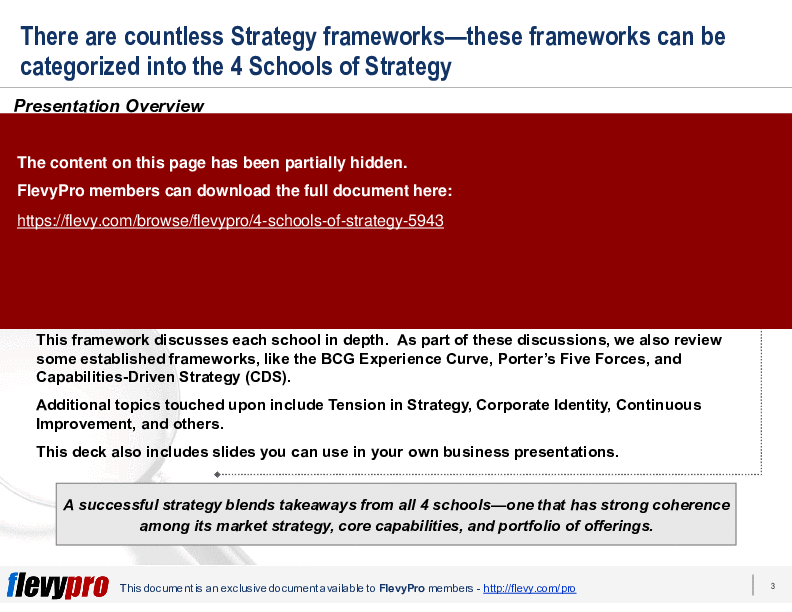
A successful strategy blends takeaways from all 4 schools—one that has strong coherence among its market strategy, core capabilities, and portfolio of offerings.
This framework discusses each school in depth. As part of these discussions, we also review some established frameworks, like the BCG Experience Curve, Porter's Five Forces, and Capabilities-Driven Strategy (CDS).
Additional topics touched upon include Tension in Strategy, Corporate Identity, Continuous Improvement, and others.
This deck also includes slides you can use in your own business presentations.
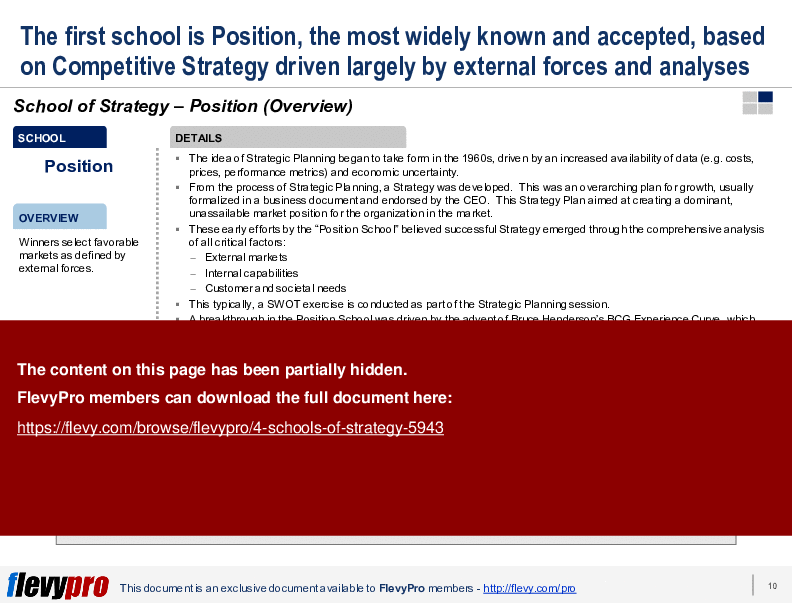
The PPT provides a comprehensive analysis of the Position School, emphasizing the importance of selecting favorable markets through external forces and analyses. It delves into the BCG Experience Curve, illustrating how experience can lead to cost reductions and competitive advantages. The Execution School is explored with a focus on aligning people and processes for operational excellence, leveraging methodologies like Six Sigma and Lean Management.
The Adaption School highlights the significance of organizational learning and the ability to respond quickly to changes. It references key strategic thinkers like Henry Mintzberg and Tom Peters. The Concentration School underscores the need to focus on core competencies and strategic intent, drawing on insights from Gary Hamel and C.K. Prahalad. This deck is an essential resource for executives seeking to integrate diverse strategic frameworks into a cohesive strategy.
What are the 4 schools of strategy and how do they differ?
Strategy frameworks in this classification fall into 4 schools: Position (focus on selecting favorable markets and competitive forces), Execution (aligning people and processes for operational excellence), Adaption (organizational learning and rapid response), and Concentration (focus on core competencies and strategic intent). The model groups them into 4 schools.
When should I use Porter's Five Forces versus a capabilities-driven approach?
Use Porter’s Five Forces when assessing external market attractiveness and competitive pressures to choose favorable markets; use a capabilities-driven approach when defining what the organization must be able to do internally to sustain advantage. The deck contrasts both approaches, including Porter's Five Forces and Capabilities-Driven Strategy.
How does the BCG Experience Curve affect strategic choices on pricing and scale?
The BCG Experience Curve illustrates how cumulative experience can drive cost reductions and create competitive advantage, informing decisions about pricing, scale, and investment to exploit learning effects. The slide deck explains the Experience Curve’s role in cost and advantage formation with the BCG Experience Curve.
How can Six Sigma and Lean be integrated into corporate strategy planning?
Six Sigma and Lean are presented within the Execution School as methods to align people, processes, and metrics for operational excellence; they support strategy by improving delivery reliability and cost efficiency that enable strategic positioning. The deck references Six Sigma and Lean.
What does the Adaption School recommend for organizations facing rapid change?
The Adaption School emphasizes organizational learning, experimentation, and the ability to respond quickly to change; it highlights practices for continuous improvement and cites thinkers such as Henry Mintzberg and Tom Peters to support adaptive approaches to strategy and organizational learning.
What should I look for when buying a strategy framework or slide deck for executive briefings?
Look for coverage that helps integrate market positioning, operational models, adaptive learning, and core capabilities, and for inclusion of established analytic tools (for example, Porter's Five Forces or the BCG Experience Curve). Flevy’s 4 Schools of Strategy is a 28-slide PPTX example that covers these topics.
How do I judge the practical value of a strategy slide deck for internal workshops?
Judge value by whether the deck helps stakeholders link market analysis to internal capabilities and portfolio choices, provides named frameworks to apply, and supplies slides usable in presentations; the 4 Schools approach explicitly aims for coherence among market strategy, core capabilities, and portfolio across 4 schools.
Which strategic thinkers or frameworks should I cite when presenting a blended strategy approach?
Relevant thinkers and frameworks cited in this literature include Henry Mintzberg and Tom Peters for adaption/learning, Gary Hamel and C.K. Prahalad for core competencies and strategic intent, plus tools like Porter’s Five Forces and the BCG Experience Curve.
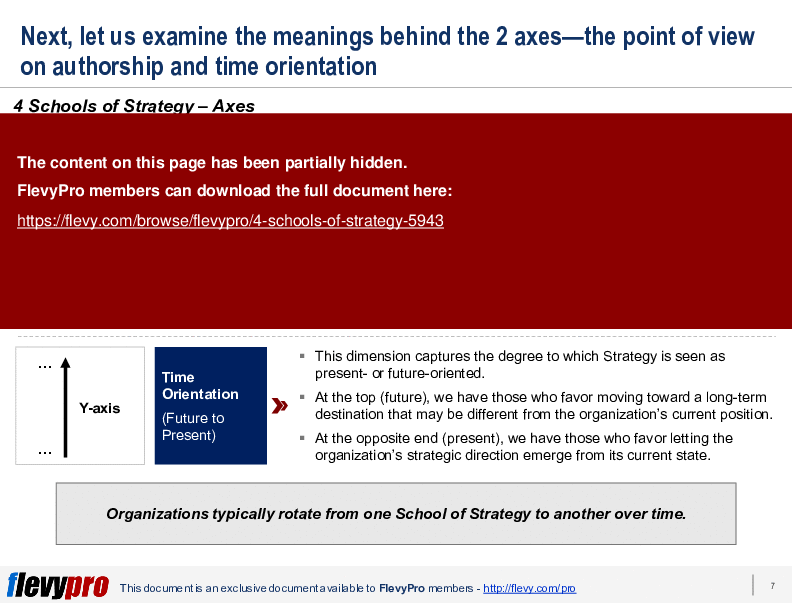
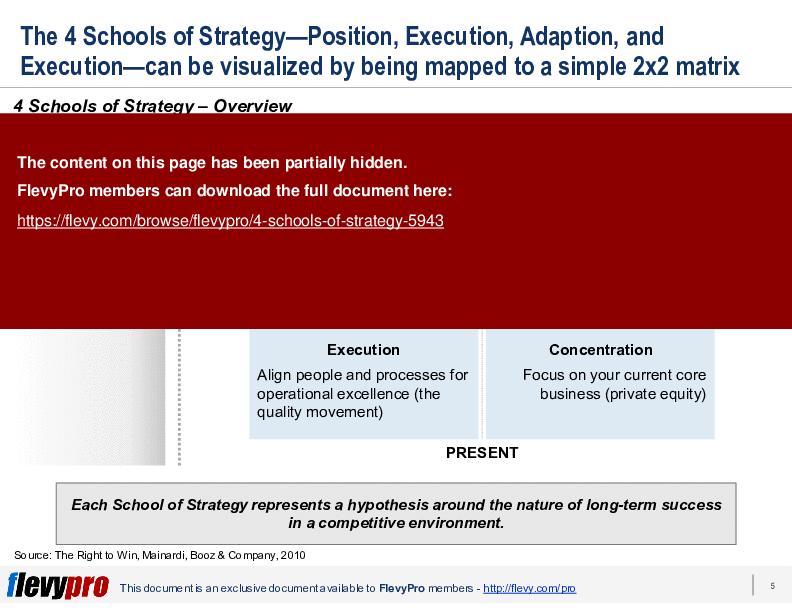
This PPT slide template presents a framework for strategic decision-making based on 2 axes: "Point of View on Authorship" and "Time Orientation." The x-axis ranges from collective input, emphasizing inclusivity and diverse perspectives, to top-down strategy development led by senior executives. The y-axis differentiates between future-oriented strategies, which focus on long-term goals and innovation, and present-oriented strategies, which evolve from existing conditions. Organizations often shift between these strategic approaches, highlighting the need for leaders to adapt their frameworks in response to changing environments. Understanding these axes enables a nuanced strategy that aligns with organizational culture and market demands.
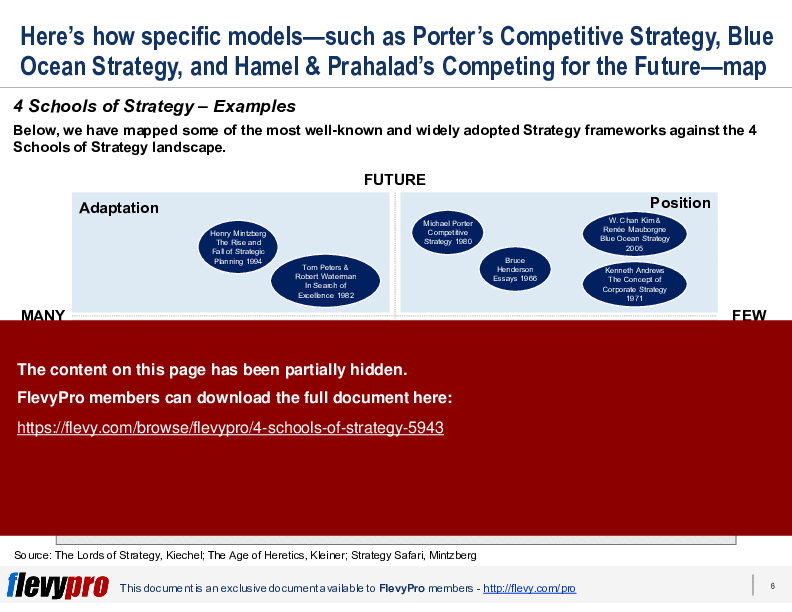
This PPT slide template categorizes strategic models into 4 schools of thought: Adaptation, Execution, Position, and Concentration. The Adaptation quadrant features Henry Mintzberg's "The Rise and Fall of Strategic Planning" and Tom Peters & Robert Waterman's "In Search of Excellence," emphasizing flexibility in strategy formulation. The Execution quadrant includes W. Edwards Deming's "Out of the Crisis" and Ram Charan & Larry Bossidy's "Execution," focusing on operational effectiveness. In the Position quadrant, Michael Porter’s "Competitive Strategy" and W. Chan Kim & Renée Mauborgne's "Blue Ocean Strategy" highlight market positioning and differentiation. The Concentration quadrant showcases Gary Hamel & C.K. Prahalad's "Competing for the Future" and Chris Zook's "Profit from the Core," advocating for a focused strategic approach. A balanced integration of these schools enhances strategic effectiveness and informs contemporary business applications.
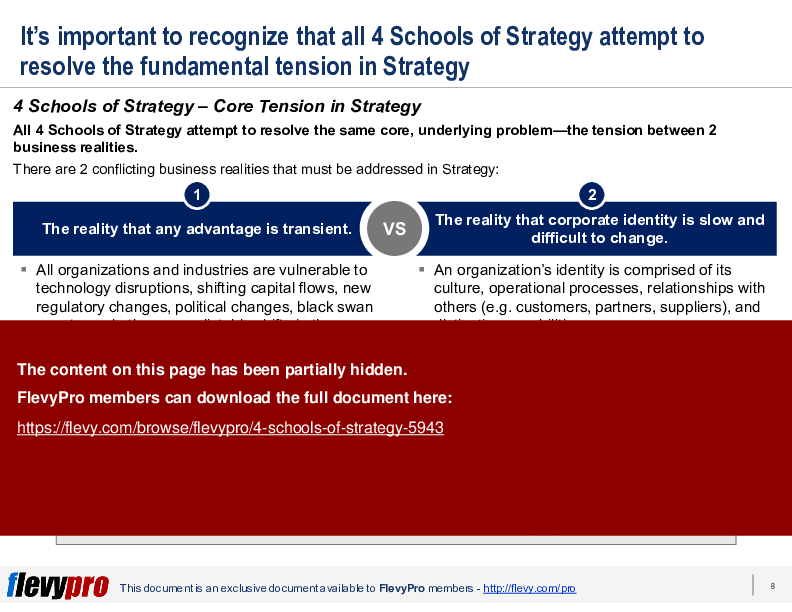
This PPT slide template presents a framework addressing the tension in strategy between 2 conflicting business realities. The first reality is that competitive advantages are transient, with organizations facing vulnerabilities from technological disruptions, capital flow shifts, and regulatory changes. This volatility can lead to the failure of established companies and rapid success for startups. The second reality highlights the slow and challenging nature of corporate identity change, defined as the composite of culture, operational processes, and stakeholder relationships. Changing this identity requires leadership recognition of the need for adaptation. Together, these realities illustrate the balance organizations must strike between leveraging transient advantages and evolving their core identity in response to external pressures.
This PPT slide template provides an overview of Porter’s Five Forces framework, a strategic tool for assessing competitive dynamics within an industry. The framework identifies 5 critical elements influencing a business's competitiveness: Threat of New Entrants, Supplier Power, Internal Rivalry, Buyer Power, and Threat of Substitution. Each force shapes the competitive landscape; for example, the Threat of New Entrants evaluates barriers to entry, while Supplier Power examines the influence of suppliers on pricing. Utilizing Porter’s Five Forces alongside a SWOT analysis offers a comprehensive view of a business's position, aiding in strategic decision-making by identifying strengths, weaknesses, opportunities, and threats.
This PPT slide template presents the Capabilities-Driven Strategy (CDS), which enhances core competencies by focusing on sustainable capabilities essential for attracting primary customers. CDS is outward-looking, centered on customer needs. Three core components drive this strategy: Value Creation, Product and Service Fit, and the Capabilities System. Value Creation requires understanding how the company generates value for customers, aligning organizational efforts with customer expectations. The Capabilities System, consisting of 3 to 6 distinctive capabilities, acts as the engine of Value Creation, enabling effective delivery of the value proposition. A cyclical relationship exists among Value Creation, Competitive Advantage, and Product and Service Fit, suggesting that coherence in capabilities strengthens market position and contributes to sustained competitive advantage.
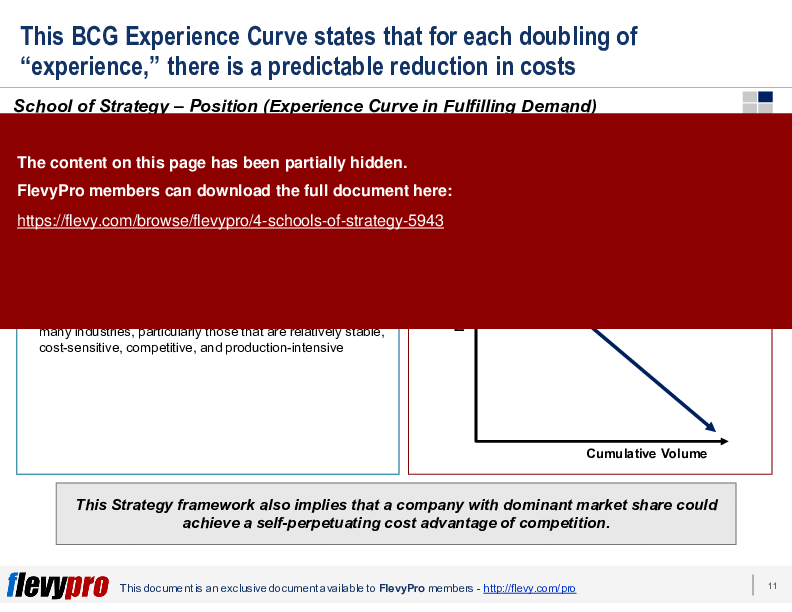
This PPT slide template presents the BCG Experience Curve, illustrating the relationship between accumulated production experience and unit production costs. For every doubling of experience, costs typically decrease by 20% to 30%. As production volume increases, organizations benefit from reduced costs due to efficiencies gained through experience, particularly in stable, competitive, and production-intensive industries. The graphical representation shows a downward slope where marginal costs decrease as cumulative volume increases, indicating that higher production volumes lead to lower costs per unit. Companies with significant market share can leverage this experience to maintain a cost advantage over competitors, impacting long-term growth and market positioning.
The Execution School within Operational Excellence emphasizes an internal focus, contrasting with the external orientation of the Position School. Profitability is driven by developing and deploying better practices, processes, technologies, human capital, and products. Key components for achieving Operational Excellence include Strategy Deployment, Performance Management, Process Excellence, and High Performance Work Teams, forming an integrated Business Execution System. This systematic approach aligns resources for continuous improvement. Operational Excellence is linked to management philosophies like Six Sigma and Lean Management, prioritizing Continuous Improvement by focusing on customer needs, empowering employees, and optimizing processes for efficiency and sustainable growth. Influential thought leaders, such as W. Edwards Deming and Ram Charan, support the Execution School's principles, reinforcing the credibility of these concepts.
The Adaption School emphasizes organizational learning for effective results through quick, creative responses to change. Rooted in Professor Henry Mintzberg's work, it advocates for a shift from traditional analysis to an experimental decision-making style. Mintzberg encourages executives to explore diverse strategic options, likening this to letting a thousand flowers bloom, which fosters innovation over rigid analytical techniques. However, this approach can be inefficient and costly, with the risk of resource depletion from pursuing too many initiatives. Continuous improvement is essential, requiring organizations to test new directions, discard ineffective strategies, and refine efforts. Key works in strategic thinking, such as Mintzberg's "The Rise and Fall of Strategic Planning" and "In Search of Excellence" by Tom Peters and Robert Waterman, provide context for the Adaption School's principles and applications.
Source: Best Practices in Strategic Planning, Operational Excellence, Strategy Development, Strategy Frameworks PowerPoint Slides: 4 Schools of Strategy PowerPoint (PPTX) Presentation Slide Deck, LearnPPT Consulting
This framework is developed by a team of former McKinsey and Big 4 consultants. The presentation follows the headline-body-bumper slide format used by global consulting firms.
For $10.00 more, you can download this document plus 2 more FlevyPro documents. That's just $13 each.
ABOUT FLEVYPRO
This document is part of the FlevyPro Library, a curated knowledge base of documents for our FlevyPro subscribers.
FlevyPro is a subscription service for on-demand business frameworks and analysis tools. FlevyPro subscribers receive access to an exclusive library of curated business documents—business framework primers, presentation templates, Lean Six Sigma tools, and more—among other exclusive benefits.
The average daily rate of a McKinsey consultant is $6,625 (not including expenses). The average price of a Flevy document is $65.
Trusted by over 10,000+ Client Organizations
Since 2012, we have provided business templates to over 10,000 businesses and organizations of all sizes, from startups and small businesses to the Fortune 100, in over 130 countries.
"I have used FlevyPro for several business applications. It is a great complement to working with expensive consultants. The quality and effectiveness of the tools are of the highest standards."
– Moritz Bernhoerster, Global Sourcing Director at Fortune 500
"Last Sunday morning, I was diligently working on an important presentation for a client and found myself in need of additional content and suitable templates for various types of graphics. Flevy.com proved to be a treasure trove for both content and design at a reasonable price, considering the time I
saved. I encountered a download issue during the ordering process. However, a quick email to Flevy's support team, even on a Sunday (!!!), resulted in assistance within less than an hour, allowing me to download the content I needed. Fantastic job, Flevy! I give 5 stars for both content/price and customer service. Thank you!
"
– M. E., Chief Commercial Officer, International Logistics Service Provider
"One of the great discoveries that I have made for my business is the Flevy library of training materials.
As a Lean Transformation Expert, I am always making presentations to clients on a variety of topics: Training, Transformation, Total Productive Maintenance, Culture, Coaching, Tools, Leadership Behavior, etc. Flevy
It is well worth the money to purchase these presentations. Sure, I have the knowledge and information to make my point. It is another thing to create a presentation that captures what I want to say. Flevy has saved me countless hours of preparation time that is much better spent with implementation that will actually save money for my clients.
"
– Ed Kemmerling, Senior Lean Transformation Expert at PMG
"I have used Flevy services for a number of years and have never, ever been disappointed. As a matter of fact, David and his team continue, time after time, to impress me with their willingness to assist and in the real sense of the word. I have concluded in fact
that it is not at all just a repository of documents/resources but, in the way that David and his team manage the firm, it is like dealing with consultants always ready to assist, advise and direct you to what you really need, and they always get it right.
I am an international hospitality accomplished senior executive who has worked and lived during the past 35 years in 23 countries in 5 continents and I can humbly say that I know what customer service is, trust me.
Aside from the great and professional service that Flevy's team provide, their wide variety of material is of utmost great quality, professionally put together and most current.
Well done Flevy, keep up the great work and I look forward to continue working with you in the future and to recommend you to a variety of colleagues around the world.
"
– Roberto Pelliccia, Senior Executive in International Hospitality
"The wide selection of frameworks is very useful to me as an independent consultant. In fact, it rivals what I had at my disposal at Big 4 Consulting firms in terms of efficacy and organization."
– Julia T., Consulting Firm Owner (Former Manager at Deloitte and Capgemini)
"FlevyPro provides business frameworks from many of the global giants in management consulting that allow you to provide best in class solutions for your clients."
– David Harris, Managing Director at Futures Strategy
"I have found Flevy to be an amazing resource and library of useful presentations for lean sigma, change management and so many other topics. This has reduced the time I need to spend on preparing for my performance consultation. The library is easily accessible and updates are regularly provided. A wealth of great information."
– Cynthia Howard RN, PhD, Executive Coach at Ei Leadership
"As a niche strategic consulting firm, Flevy and FlevyPro frameworks and documents are an on-going reference to help us structure our findings and recommendations to our clients as well as improve their clarity, strength, and visual power. For us, it is an invaluable resource to increase our impact and value."
– David Coloma, Consulting Area Manager at Cynertia Consulting
Download our free compilation of 50+ Strategy & Transformation slides and templates. Frameworks include McKinsey 7-S, Balanced Scorecard, Disruptive Innovation, BCG Curve, and many more.
Download our free compilation of 50+ Strategy & Transformation slides and templates. Frameworks include McKinsey 7-S, Balanced Scorecard, Disruptive Innovation, BCG Curve, and many more.

 Click main image to view in full screen. Unlock all 12 preview images: